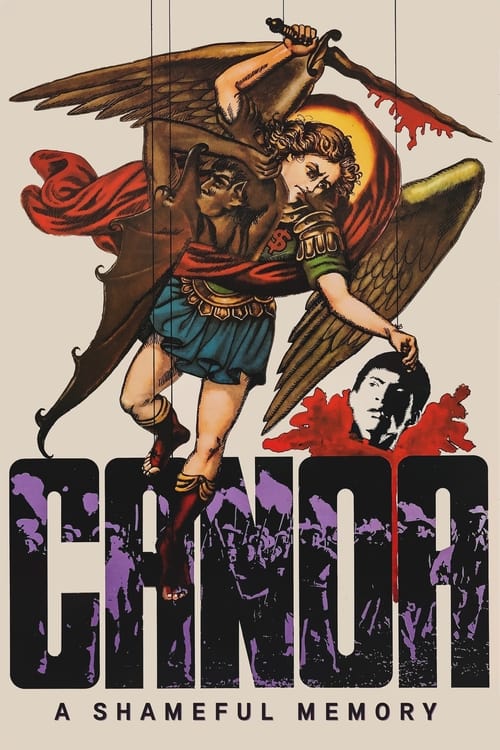
Canoa: A Shameful Memory
1976 · Felipe Cazals
For when you want a film that confronts you — a demanding, unforgettable watch for a night when you're ready to sit with something dark and true. Not comfort viewing, and it will stay with you for days.
What it's about
A group of young university employees sets out to climb a volcano and, caught by rain, stops for the night in the small town of San Miguel Canoa. The local priest has spent years preaching that communists and outside agitators are coming for the town — and he tells the villagers these strangers are exactly that. Based on a real atrocity from September 1968, the film reconstructs, hour by hour, how ordinary neighbors are turned into a mob.
The experience
Dread from the first frames — you know something terrible is coming, and the film makes you watch it assemble piece by piece. It's harrowing, angry, and clinical at once; the violence, when it arrives, is among the most upsetting in Mexican cinema.
The craft
Cazals structures it like an investigation: a documentary-style narrator and townspeople who address the camera directly, cut against the dramatized events, so the film indicts the machinery of rumor rather than just depicting it. That hybrid form — testimony plus reconstruction — gives it a chilling, forensic power.
Why it matters
Made only eight years after the real lynching and weeks-adjacent Tlatelolco massacre it implicitly indicts, it broke a silence in Mexican cinema about state-fostered violence and remains a touchstone of Latin American political filmmaking.
Snapshot
Canoa: A Shameful Memory (Canoa: Memoria de un hecho vergonzoso) is a reconstruction of the San Miguel Canoa lynching of 14 September 1968, in which a mob in a village on the slopes of the La Malinche volcano, near Puebla, attacked a group of young University of Puebla employees who had come to hike and were caught by rain. Whipped up by the local parish priest — who for years had preached that "communists" and outside agitators threatened the town — the villagers were told the visitors were student subversives who had come to raise a red flag over the church. The mob killed several of the men and gravely wounded others. The atrocity occurred less than three weeks before the Tlatelolco massacre of 2 October 1968, and Cazals's film reads the two events as expressions of the same machinery of state-abetted fear. Made inside Mexico's state film apparatus during the Echeverría "apertura," Canoa fused documentary address, dramatic reconstruction, and thriller mechanics into one of the most politically ferocious Mexican films of the 1970s. It won the Silver Bear (Special Jury Prize) at the 1976 Berlin International Film Festival and, after a 2010s World Cinema Project restoration, entered wider international circulation as a recognized landmark of Latin American political cinema.
Industry & production
Canoa is a product of the specific institutional moment of Mexican cinema under President Luis Echeverría (1970–76), when the state, seeking to co-opt and channel post-1968 dissent, poured resources into a nationalized film industry and permitted a cohort of directors to make unusually critical, socially engaged work. The film was produced through the state production arm (Conacine, the era's Corporación Nacional Cinematográfica), the same public-sector structure that enabled a wave of ambitious auteur projects in the mid-1970s. That backing is itself part of the film's meaning: a government-funded company financed a film about a massacre rooted in the same climate of anti-subversive panic that the Mexican state had exploited in 1968. Cazals belonged to a generation — alongside figures such as Arturo Ripstein, Jorge Fons, and Paul Leduc — who used the apertura to make confrontational cinema before the window narrowed under the succeeding administration. The precise budget and box-office figures are not something I can state reliably, and I won't invent them; what is well established is that the film was made economically, on location, with a largely ensemble cast rather than star vehicles.
Technology
The film was shot in 35mm color, standard for a state-produced Mexican feature of 1976. Its technical profile is defined less by any novel apparatus than by the decision to work on real locations — village exteriors, rain, mud, cramped interiors — rather than in the studios that still shaped much Mexican production. Location shooting in adverse weather and in confined domestic spaces places demands on lighting and camera mobility, and the film's grainy, weather-beaten texture is consistent with fast film stock pushed under difficult natural light. I'm not able to confirm specific camera or lens equipment from the reliable record, so I'll leave that unstated rather than guess. The more significant "technology" of the film is organizational: the coordination of large groups of non-professional or semi-professional performers as crowds, which the production stages with unusual density and control.
Technique
Cinematography
The cinematography is by Alex Phillips Jr., a leading Mexican cinematographer of the period (son of the veteran cameraman Alex Phillips). His work here is the film's central formal achievement. The palette is muted and earthen — grays, browns, the cold blue of rain — and the camera oscillates between two registers: an observational, quasi-documentary handling of the townsman-narrator and the village geography, and a tightening, increasingly claustrophobic coverage as the night of the attack arrives. The climactic siege, staged largely in darkness lit by torches and the frenzy of the crowd, converts the pastoral setting into something infernal. Phillips's camera favors the physical fact of bodies, mud, and thresholds — doorways and rooftops become the geography of the killing — and the restraint of the earlier passages makes the violence, when it comes, feel documentary rather than choreographed.
Editing
Structurally the film is built on an unusually aggressive montage logic for its national context: it braids a direct-address documentary strand, dramatized scenes of the victims and the townspeople, and a broader social panorama, cutting across time so that the outcome is announced before it is shown. This fragmentation is the film's signature — the audience is repeatedly told what will happen, so suspense is displaced from "what" to "how" and "why," and the cross-cutting between the priest's sermonizing, the young men's ordinary banter, and the gathering mob generates the tragic irony. I'm not able to confirm the editor's name from the reliable record, so I won't attribute it; but the editing scheme itself — the interleaving of testimony, reconstruction, and foreshadowing — is inseparable from Tomás Pérez Turrent's script and Cazals's direction and is the film's most-discussed formal device.
Mise-en-scène / staging
Cazals stages Canoa as an anatomy of a place. The film takes pains to map San Miguel Canoa's social order — the priest's economic and moral grip, the caciquismo (local bossism) that shadows him, the poverty and isolation of the villagers — before it lets the violence occur, so that the massacre reads as the product of a structure rather than an aberration of individuals. Crowd staging is the great set piece: the assembling of the mob, the church bells as summons, the surging of bodies against a besieged house. The interiors are cramped and threshold-bound; much of the terror is organized around doors, walls, and roofs that separate the hunted from the hunters. The staging is deliberately unglamorous, refusing spectacle in favor of a granular, almost ethnographic attention to how a community talks itself into an atrocity.
Sound
Sound is used to bind the community into a single instrument of violence: the church bell that calls the mob, the rising murmur and roar of the crowd, the sermons and rumor that circulate as the true contagion. Dialogue carries a strong vernacular and regional texture, and the film's alternation between the narrator's measured direct address and the din of the mob is a key part of its rhythm. On the question of the musical score and its composer I don't have a reliable attribution, so I won't name one; what is safe to say is that the film leans on diegetic and environmental sound — bells, weather, voices — more than on a conventional orchestral score to generate its dread.
Performance
Performance is ensemble-driven and pitched toward realism. Ernesto Gómez Cruz, one of the great Mexican character actors, plays the manipulative priest, giving the film its central study of provincial demagoguery — pious, self-interested, and lethal. The victims are played as ordinary, unheroic young men, which is essential to the film's ethics: they are not martyrs or ideologues but hikers, and their normality indicts the fantasy projected onto them. A townsman-narrator figure, speaking directly to camera, anchors the documentary register and functions as the film's conscience and guide. The casting favors faces that read as authentic to the milieu, and the crowd performances — the collective slide from suspicion to bloodlust — are as much the film's "lead performance" as any single actor.
Narrative & dramatic mode
The film's dramatic mode is docudrama built on tragic irony and inevitability. Because it announces the massacre in advance — through titles, the narrator, and its fractured chronology — it forecloses conventional suspense and replaces it with dread and analysis. The viewer watches ordinary events (a hike, rain, a search for shelter) knowing they lead to slaughter, so the drama becomes an investigation of causation: how rumor, clerical authority, isolation, and the national anti-communist panic of 1968 converge on one night. It is simultaneously a reconstruction (faithful to a documented event), a piece of testimony (the direct-address strand mimics the form of a witness account), and a thriller (the siege). This hybridity — the refusal to stay inside a single mode — is precisely what gave the film its force and its influence.
Genre & cycle
Nominally a history/crime/thriller, Canoa is best understood as political docudrama and as an entry in a distinctly Mexican mid-1970s cycle of state-critical films. Within Cazals's own work it belongs to a run of unflinching mid-decade features often grouped together — Canoa, El apando (adapted from José Revueltas), and Las Poquianchis — that dissect Mexican violence, institutions, and marginality. More broadly it participates in the New Latin American Cinema's tradition of reconstructing real atrocities as indictments of social structures, and in the international lineage of the political thriller and the "cinema of fact" that flourished across the late 1960s and 1970s. Its genre identity is inseparable from its politics: it uses the grammar of the thriller to make historical analysis viscerally legible.
Authorship & method
Felipe Cazals (1937–2021) trained partly in France and emerged as one of the most rigorous political filmmakers of the Echeverría generation. His method on Canoa is that of reconstruction disciplined by research: the film hews to a documented event and organizes it through a quasi-journalistic structure rather than melodrama. The authorship is genuinely collaborative in ways that matter to the result. The screenplay is by Tomás Pérez Turrent, a critic-screenwriter whose script supplies the film's braided documentary/dramatic architecture and its foreshadowing logic. The cinematography by Alex Phillips Jr. furnishes the film's tactile, weather-bound realism. The lead performance by Ernesto Gómez Cruz as the priest gives the abstraction of demagoguery a human face. On the editor and composer I decline to attribute names I cannot verify. The through-line of Cazals's authorship is a refusal of consolation: he presents the massacre as a social product and withholds catharsis, implicating the structures — clerical, economic, national — that made it possible.
Movement / national cinema
Canoa is a keystone of 1970s Mexican political cinema and, by extension, of the broader New Latin American Cinema. Domestically it exemplifies the paradoxical apertura moment: films of real dissent financed by the very state whose apparatus they critiqued. Internationally it sits alongside the continent's tradition of committed cinema that treated the reconstruction of historical violence as a political act. It is frequently cited in surveys and retrospectives as one of the essential Mexican films, and its later restoration under Martin Scorsese's World Cinema Project — a foundation dedicated to preserving neglected world cinema — confirmed its standing as a work of the national canon deserving global circulation.
Era / period
The film is doubly period-bound. It depicts 1968 — the Mexican student movement, the government's anti-subversive rhetoric, and the atmosphere of paranoia that culminated at Tlatelolco — and it was made in 1976, at the tail end of the Echeverría sexenio, when the political conditions for such a film briefly existed. That eight-year gap is load-bearing: making the film in 1976 meant re-opening a wound the state preferred closed, and reading the Canoa lynching as the rural rehearsal for the urban massacre that followed weeks later. The film belongs, then, to the post-1968 Mexican reckoning — the long cultural aftermath in which artists tried to name what had happened and who was responsible.
Themes
The film's governing theme is the manufacture of atrocity: how fear, rumor, and authority can turn an ordinary community into a lynch mob. Clerical power and its collusion with local bossism (caciquismo) form the central mechanism — the priest as economic overlord and moral demagogue who weaponizes anti-communism against outsiders. Around this radiate the film's other concerns: the poverty and isolation that make a village manipulable; the paranoid nationalism of the state in 1968; the scapegoating of youth and "subversives"; and the complicity — active or passive — of institutions (church, state, press) in violence. The subtitle, "a shameful memory," frames the whole as an act of national conscience: the film insists on remembering an episode the country would rather forget, and on treating shame as a civic obligation rather than a private feeling. Its refusal of heroes or easy villains — the mob are victims too, of ignorance and manipulation — is central to its moral seriousness.
Reception, canon & influence
Critically, Canoa was recognized immediately at the highest level: it took the Silver Bear (Special Jury Prize) at the 1976 Berlin International Film Festival, a rare international laurel for a Mexican political film of the period, and it has since been consistently ranked among the greatest Mexican films in national critics' surveys. Its later restoration by the World Cinema Project / Film Foundation and its circulation through the Criterion Collection in the 2010s introduced it to new international audiences and cemented its canonical status.
Influences on the film (backward): Canoa draws on the traditions of documentary reconstruction and the political "cinema of fact" that flourished internationally in the late 1960s, marrying them to the committed, structurally analytical impulse of New Latin American Cinema. Cazals's European training and the era's appetite for films that dissected social violence inform its refusal of melodrama in favor of investigation.
Legacy (forward): The film's braided form — direct-address testimony, dramatized reconstruction, and foreshadowed inevitability — became a touchstone for how Mexican and Latin American cinema could stage real historical atrocity without sensationalism. It stands as the essential cinematic account of the pre-Tlatelolco climate and is routinely invoked in discussions of 1968 on screen, most obviously as a companion to Jorge Fons's later Rojo amanecer (1989), which dramatized the Tlatelolco massacre itself. For Felipe Cazals it remains the defining work of a major career, and for Mexican cinema it endures as a model of politically committed filmmaking — proof that a state-funded industry could, for a brief window, produce an unsparing indictment of the society that funded it.
Reception
A hit in Mexico and a Silver Bear winner at Berlin in 1976, it then spent decades nearly invisible abroad — until a 2017 Criterion restoration, championed by Guillermo del Toro, turned it into a global cinephile discovery.
How Canoa: A Shameful Memory was received, from release to now →
How to watch Canoa: A Shameful Memory: what to notice on a first viewing
- Track how the film cuts between a narrator and the actors' story. A documentary-style, direct-address strand keeps interrupting the dramatized scenes of the visiting students and the townspeople, cross-cutting testimony against reconstruction rather than following one continuous story. The braided structure tells you early what will happen, so your attention shifts from what occurs to how and why it does.
- Notice the muted grays, browns, and rain-blue that color every scene. Cinematographer Alex Phillips Jr. keeps the palette earthen and overcast throughout, so the village never looks picturesque even in its ordinary daylight scenes. The color tells you this is not a scenic countryside story before a single ominous event occurs.
- Watch how the priest is framed against the church and the village. Early scenes carefully map the priest's economic hold and moral authority over the town, staging him among parishioners and property before any conflict with the visiting students begins. You are shown the structure of power in the village before you are shown what that power can do.
- Watch Ernesto Gómez Cruz's manner as he speaks to the villagers. Gómez Cruz plays the priest as warm, reasonable, and paternal in ordinary conversation, never raising his voice or looking like a villain. His calm makes the danger of his influence harder to see coming, and harder to dismiss as one bad man's doing.
The whole guide to watching Canoa: A Shameful Memory, with the keys for a rewatch →
Influences: the films it descends from and the films it influenced
- Culloden (1964) — Pioneered the exact device Canoa lives on — a documented massacre staged as newsreel while participants and a narrating investigator address the camera, braiding to-camera testimony into dramatized reconstruction.
- The Battle of Algiers (1966) — Model for reconstructing a real political atrocity with grainy pseudo-newsreel handling and a non-professional ensemble whose crowd behavior reads as documentary rather than staged drama.
- Z (1969) — Supplies the quasi-journalistic, investigative structure — organizing a documented killing as a dossier of who-did-what rather than as melodrama, the analytic spine Pérez Turrent's script adopts.
- Night and Fog (1955) — The foreshadowing-of-inevitability montage and the French essayistic mode of reckoning with atrocity that Cazals absorbed during his training in France.
- The Hour of the Furnaces (1968) — Founding text of the 'cinema of fact' and militant direct-address montage of New Latin American Cinema, the committed analytic impulse Canoa channels into a single event.
- Memories of Underdevelopment (1968) — Demonstrates the braiding of documentary/newsreel fragments into a fiction so the political frame and the dramatized life inform each other — Canoa's documentary/drama weave.
- Los olvidados (1950) — Established the Mexican mode of ethnographic anatomy of a poor milieu with a refusal of consolation, presenting cruelty as a social product rather than eliciting pity.
- Blood of the Condor (1969) — Treats an indigenous village as collective protagonist and reconstructs a real abuse inflicted on that community, the ensemble-as-community staging Canoa applies to San Miguel Canoa.
- Reed: Insurgent Mexico (1973) — Immediate Mexican precedent for handheld, desaturated documentary-realist reconstruction of history with an earthen, weather-bound period texture like Alex Phillips Jr.'s.
- Rojo amanecer (1989) — The explicit heir — dramatizes the Tlatelolco massacre Canoa foreshadowed, using a single claustrophobic siege interior and ensemble realism to stage historical atrocity without spectacle.
- The Act of Killing (2012) — Extends Canoa's central subject — the manufacture of atrocity — by using reconstruction to expose how ordinary people and local structures are mobilized into massacre, implicating the machinery rather than isolating villains.
- Post Mortem (2010) — Carries forward the anatomy of ordinary complicity feeding state violence, rendered in a muted earthen palette and withholding consolation as Canoa does around its priest-demagogue.
- Herod's Law (1999) — Cazals' sunbaked docudrama indicts institutional complicity in mob violence, modeling Mexican political cinema's move to arraign the whole apparatus rather than a single villain.
- Las Poquianchis (1976) — Cazals's own companion piece from the same year, reconstructing a real crime through the identical braided testimony-plus-dramatization architecture and foreshadowing logic.
- El apando (1976) — Same-author sibling built on claustrophobic siege staging and pressure-cooker ensemble realism within a single confined space, the spatial device Canoa uses in the besieged house.
- Letters from Marusia (1976) — Mexican-produced exile reconstruction of a documented massacre with a large realist ensemble in the New Latin American Cinema register, contemporaneous with and adjacent to Canoa.
- The Battle of Chile (1975) — Parallel 'cinema of fact' anatomy of the climate that produces state-sanctioned slaughter, dissecting the social structures preceding an atrocity rather than dramatizing catharsis.
Similar films
- Z (1969) — influence & lineage
- The Young and the Damned (1950) — influence & lineage
- Aguirre, the Wrath of God (1972) — shared sensibility
- Who Can Kill a Child? (1976) — shared sensibility
- Witchhammer (1970) — shared sensibility
- Our Land (2026) — shared sensibility
- Red Dawn (1990) — shared sensibility
- Mother Joan of the Angels (1961) — shared sensibility