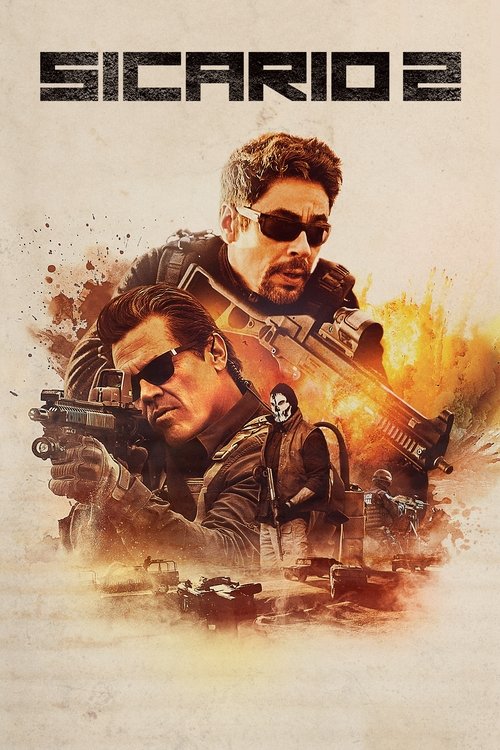
Sicario: Day of the Soldado
2018 · Stefano Sollima
For when you want something hard-edged and morally murky — a tense, violent geopolitical thriller with no heroes, best watched when you're up for darkness rather than escape. Challenge, not comfort.
What it's about
After cartels begin smuggling terrorists across the U.S.–Mexico border, a black-ops CIA officer is given license to start a war between the cartels — and recruits a lethal operative with his own history of cartel vengeance to do it. Their scheme centers on the kidnapping of a kingpin's teenage daughter, and when the operation slips its leash, loyalties and orders start pulling in opposite directions.
The experience
Grim, muscular, and relentless — a thriller stripped of any comforting point of view, where you're embedded with the people doing the dirty work. It's brutal and bleak, but grips like a vise.
Performances
Benicio del Toro deepens his quiet, wolflike hitman into something almost paternal without softening him, and Josh Brolin plays institutional ruthlessness with unnerving good humor.
The craft
Stefano Sollima directs the convoys, shootouts, and border crossings with punishing physicality, and the throbbing, dread-heavy score keeps the pressure on even in quiet scenes. It sounds enormous — worth good speakers.
Why it matters
A rare sequel that survived losing its original director, star, and moral compass, proving the border-war world Taylor Sheridan wrote could carry a franchise on atmosphere and menace alone.
Snapshot
Sicario: Day of the Soldado is a sequel built on a paradox: it extends a film whose power derived almost entirely from the elements it chooses to abandon. The 2015 Sicario, directed by Denis Villeneuve, was a procedural horror story organized around the bewildered moral consciousness of an FBI agent, Kate Macer (Emily Blunt), through whose eyes the audience watched extralegal U.S. operations on the Mexican border curdle into something unaccountable. Soldado keeps screenwriter Taylor Sheridan, keeps stars Josh Brolin and Benicio del Toro, and discards the audience surrogate entirely, plunging instead into the operational world of black-budget intelligence officer Matt Graver and the cartel-killing "sicario" Alejandro Gillick. The plot — the U.S. government attempting to provoke a war between cartels by staging the kidnapping of a kingpin's daughter — is set in motion by a politically fraught premise that drug cartels are smuggling terrorists across the border. Directed by the Italian filmmaker Stefano Sollima in his English-language debut, the film is leaner, pulpier, and more morally indifferent than its predecessor, a hard-edged genre exercise that trades Villeneuve's dread-soaked ambiguity for the propulsive amorality of a crime thriller. It is a competent, frequently gripping film whose chief critical problem is the very excellence of the one it follows.
Industry & production
Soldado is a study in franchise economics applied to material that was never conceived as a franchise. The original Sicario was a self-contained, awards-courting prestige thriller; its critical success and reasonable returns made a continuation attractive, even though the story had been told. Sheridan, who by 2018 had become one of Hollywood's most sought-after screenwriters on the strength of Sicario, Hell or High Water, and his directorial debut Wind River, conceived the sequel as the middle entry of a planned trilogy, reportedly originally titled Soldado before the studio appended the brand-name Sicario prefix to anchor it commercially.
The production came together through Black Label Media and Thunder Road, the financing-and-production entities behind the first film, with Basil Iwanyk and Edward McDonnell among the producing principals who carried over. Notably, Lionsgate distributed the original; for the sequel, Columbia Pictures (Sony) handled domestic release, a distributor shift that reflects the deal-by-deal nature of independently financed studio-adjacent productions. The budget was modest by tentpole standards — reported in the mid-tens-of-millions range — and the film's worldwide gross, while comfortably exceeding that figure, did not reach blockbuster territory. I would treat any single precise box-office number with caution; the consensus is that it performed solidly without becoming a breakout, enough to keep a third installment in development but not to guarantee it.
The most consequential production decision was the wholesale replacement of the original's authorial fingerprints below the writer level. Villeneuve, by 2018 committed to Blade Runner 2049 and ascending toward Dune, did not return. Cinematographer Roger Deakins, composer Jóhann Jóhannsson, and editor Joe Walker — three figures central to the first film's identity — were all gone. The film therefore functions as a real-world experiment in authorship: how much of Sicario's power lived in Sheridan's script versus in Villeneuve's directorial sensibility and his collaborators' craft.
Technology
Soldado was shot digitally by Dariusz Wolski, a significant aesthetic break from Deakins, who had used a combination of film and digital capture on the original with his characteristic precision. Wolski, a veteran of large-scale studio filmmaking (notably his long collaboration with Ridley Scott), brought a high-resolution digital clarity suited to the film's harsh desert light and its appetite for scale — convoy ambushes, helicopter movement, wide vistas of the borderlands. The film makes conspicuous use of aerial and surveillance-derived imagery: drone perspectives, thermal and night-vision optics, and the cool, data-rich visual vocabulary of contemporary intelligence operations. This is partly inherited from the first film's celebrated tunnel-assault sequence, which used night-vision and thermal imaging to disorienting effect, but Soldado generalizes that surveillance gaze across its whole texture, making the omniscient overhead view a recurring formal motif rather than a single set piece. Beyond these elements the technical record is unremarkable for a 2018 studio thriller, and I would not overstate any claim of technological innovation.
Technique
Cinematography
Wolski's photography is the most-discussed craft element precisely because it invites comparison to Deakins. Where Deakins composed with a painterly restraint that let silence and negative space generate dread, Wolski's work is more muscular and conventionally "epic" — strong sunlight, saturated desert palettes, sweeping movement. The borderland is rendered as a vast, indifferent arena. The film is handsomely shot and the action is legible, but most critics registered the loss of Deakins's particular alchemy, in which an image could feel beautiful and morally sickening at once. Wolski delivers tension; he less often delivers the original's uncanny unease.
Editing
Cut by Matthew Newman, a frequent Sollima collaborator, the editing favors momentum. The film moves with the efficiency of a hard genre thriller, its set pieces — a roadside ambush of an armed convoy, a chaotic extraction gone wrong — assembled for clarity and force. Compared to Walker's work on the first film, which used patient duration to build almost unbearable suspense (the cross-border traffic jam remains a textbook sequence), Newman's cutting is more propulsive and less interested in dread-by-stillness. The trade-off is characteristic of the whole sequel: gain in pace, loss in suffocating tension.
Mise-en-scène / staging
Sollima stages violence with documentary-inflected concreteness, a sensibility carried over from his Italian crime work. Action erupts abruptly and is rendered tactically — sightlines, cover, the geometry of an ambush — rather than balletically. The film's spaces are functional and unglamorous: convoy interiors, detention facilities, dusty crossings, anonymous safe houses. A recurring staging idea is the contrast between the antiseptic, screen-mediated control rooms where American officials authorize violence and the dust-and-blood ground level where it is executed, a spatial expression of the film's interest in bureaucratic distance from killing.
Sound
The sound design extends the first film's emphasis on the percussive shock of gunfire and the low-frequency menace of approaching force, though without quite the original's signature integration of score and ambience into a single oppressive drone. The mix is aggressive and immersive in the action sequences.
Performance
The performances are the film's most secure asset. Benicio del Toro deepens Alejandro from the spectral avenger of the first film into something closer to a tragic protagonist; the screenplay gives him an unexpected arc of reluctant paternal feeling toward the kidnapped girl, Isabela Reyes (Isabela Moner, in a notably composed performance), and del Toro plays the thaw with minimalist control. Josh Brolin's Graver is all swaggering, sandal-wearing amorality, a man who treats geopolitical catastrophe as a logistics problem; Brolin finds the dark comedy in the character without softening him. The absence of Blunt's moral foil means the actors carry the film's ethics entirely through behavior rather than reaction, and del Toro and Brolin are good enough to make that work even as the structure misses its missing center.
Narrative & dramatic mode
The screenplay's defining choice is to remove the witness. Sicario was a tragedy of complicity observed; Soldado is an operation depicted from inside, with no one positioned to be appalled. The dramatic mode shifts accordingly from moral horror to hard-boiled crime thriller, even procedural. Sheridan structures the film around a cynical false-flag scheme that goes wrong, a betrayal from above (Graver is ordered to "clean up" by eliminating Alejandro and the girl when the operation becomes a political liability), and a mid-film rupture of violence — Alejandro is shot point-blank by a teenage cartel recruit, Miguel, and improbably survives — that fractures the plot into parallel survival stories. A coda reuniting Alejandro and the now-radicalized Miguel sets up a sequel that, as of this writing, has not materialized. The narrative is gripping scene to scene but structurally looser than the first film's pitiless forward march, and its willingness to grant Alejandro a near-magical survival marks the shift from the original's bleak naturalism toward genre convention.
Genre & cycle
The film sits at the intersection of the post-2000s "narco" thriller and the American war-on-terror procedural. It belongs to a cycle of borderland crime cinema — works preoccupied with cartels, smuggling, and the militarized U.S.–Mexico frontier — while grafting on the counterterrorism imagery of the Zero Dark Thirty era. Its premise that cartels traffic terrorists across the border places it, uncomfortably, adjacent to the political rhetoric of its moment, and much of the film's contemporary controversy stemmed from how it deployed that premise. As a sequel, it participates in the broader 2010s trend of extending a self-contained prestige property into intended franchise territory.
Authorship & method
The film is best understood as an authorship transplant. Taylor Sheridan is the continuity — his career-long themes (the moral rot of institutions, violence at the edges of the American project, men who have surrendered their consciences) saturate the script. But the directorial intelligence is entirely new. Stefano Sollima, son of the spaghetti-Western and crime director Sergio Sollima, arrived from a distinguished body of Italian crime work — the films and television of Romanzo Criminale, Gomorrah, and Suburra — steeped in the procedural depiction of organized violence and institutional corruption. His sensibility is grittier and less metaphysical than Villeneuve's; he treats the material as crime cinema rather than existential horror. The key collaborators reflect this reset: cinematographer Dariusz Wolski for muscular digital scope, editor Matthew Newman for propulsion, and a score credited to Hildur Guðnadóttir. The scoring is its own poignant footnote: Jóhann Jóhannsson, who composed the haunting, Oscar-nominated music for the first film, died in February 2018; Guðnadóttir, his close collaborator who would go on to win an Academy Award for Joker, carried the sonic identity forward, preserving a thread of continuity through the franchise's only other irreplaceable craft voice. (Details of exactly how the scoring duties evolved around Jóhannsson's death should be stated cautiously, as the public record on the transition is limited.)
Movement / national cinema
Soldado is an American studio production, but its director's formation in Italian crime cinema gives it a quiet transnational dimension. Sollima belongs to a lineage of Italian genre filmmaking — from the poliziotteschi crime films of the 1970s through the contemporary Gomorrah school of unsentimental organized-crime realism — and that inheritance shapes the film's matter-of-fact brutality and its institutional cynicism. The film thus represents a familiar Hollywood maneuver: importing a European genre stylist to bring texture to an American property, much as the industry has long absorbed directors from other national traditions for exactly this kind of muscular, character-dark thriller.
Era / period
Released in mid-2018, the film is inseparable from its political moment. It arrived amid intense American controversy over border enforcement and family-separation policy, and its plot machinery — terrorists smuggled by cartels, a kidnapped child weaponized for geopolitical leverage, casual extrajudicial killing sanctioned from Washington — landed in a charged context. Some critics read the film as cynically opportunistic, others as a coldly amoral mirror that refuses to editorialize. That refusal, which in the first film read as devastating moral seriousness, in the sequel struck some viewers as evasive, because without Kate Macer the film provides no internal vantage from which its actions are judged. The film is very much a document of late-2010s American anxiety about the border, whatever its intentions.
Themes
The film's central themes are continuous with Sheridan's body of work: the erasure of moral lines under the logic of operational necessity; the United States' willingness to manufacture the violence it claims to be containing; and the recruitment of the young into cycles of killing — embodied in Miguel, the American teenager pulled into cartel work, whose arc mirrors and inverts Alejandro's. The unexpected thread is paternity and protection: Alejandro, who lost his own daughter (the wound that defined him in the first film), becomes a reluctant guardian to Isabela, and the film's most genuine emotional current runs through this surrogate-father dynamic. Around it sits the colder thesis that institutions treat human beings — a kidnapped girl, an expendable operative — as instruments, and discard them when the political calculus shifts.
Reception, canon & influence
Critical reception was mixed-to-favorable and shadowed throughout by comparison to the original. Reviewers widely praised del Toro and Brolin, the staging of the action, and the film's lean intensity, while lamenting the loss of Villeneuve's direction, Deakins's photography, and above all the moral perspective that Blunt's character provided. The recurring verdict was that Soldado is a well-made thriller that cannot escape the shadow of a far more distinctive predecessor, and that its more reactionary-seeming premise sat uneasily in 2018.
The lines of influence run mostly backward. The film draws on Villeneuve's Sicario as its immediate template; on the Zero Dark Thirty / war-on-terror procedural for its surveillance aesthetics and black-ops ethics; on Sheridan's own border-and-institution thematics; and on Sollima's Italian crime realism. Its forward influence is comparatively limited. It did not spawn a wave of imitators or redefine its cycle the way the original's tunnel and traffic-jam sequences entered the grammar of contemporary action filmmaking. Its principal legacy is as a case study — frequently cited in discussions of sequels and authorship — in how much a film's identity can depend on a director and crew rather than a script and cast, and as a continued showcase for del Toro's Alejandro, one of recent genre cinema's most magnetic morally-vacated figures. A planned third installment has been discussed but, as of this writing, remains unrealized, leaving Soldado as the uncertain middle chapter of an incomplete trilogy.
A Deleuzian reading
The image that organizes the whole film arrives from above: the borderland seen through a drone's optics, graded into thermal grays, human bodies reduced to heat-signatures sliding across sand.
The full Deleuzian reading of Sicario: Day of the Soldado →
Reception
Landed in summer 2018 to a shrug-and-a-wince — solid box office, but critics called it a grim retread missing Villeneuve, Deakins, and Emily Blunt. Since then it's picked up a steady genre-fan defense as a lean, nasty border thriller that's better than a 'nobody asked for this' sequel had any right to be.
How Sicario: Day of the Soldado was received, from release to now →
Influences: the films it descends from and the films it influenced
- Sicario (2015) — The direct template: Sheridan's same border-procedural screenplay architecture, the control-room-watches-the-convoy staging, and Wolski's brief inherits the aerial-surveillance grammar Deakins established.
- Zero Dark Thirty (2012) — Supplies the war-on-terror black-ops procedural: cross-cut between analysts in a control room and operators on the ground, with morally-vacated professionalism replacing heroics.
- The Hurt Locker (2008) — Model for documentary-inflected combat staging — handheld coverage, real-time tension build, percussive concussive sound design over score in firefights.
- Traffic (2000) — Originates the multi-strand US–Mexico drug-war mosaic and the institutionally-corrupt cross-border procedural that Sheridan's Alejandro (del Toro again as a cartel-adjacent operator) extends.
- Gomorrah (2008) — Sollima's formative milieu: the procedural, deglamorized depiction of organized crime as a system of labor and recruitment, including youths drawn into violence.
- Suburra (2015) — Sollima's own prior feature establishes his method — operatic crime cinema treating institutional corruption as kinetic genre rather than metaphysics, carried directly into Soldado.
- Violent City (1970) — The poliziotteschi inheritance from Sollima's father: terse, amoral professional-killer protagonists and hard cynical violence as the bedrock of Italian crime cinema.
- The Counselor (2013) — Wolski's muscular digital-scope cinematography of the Southwest borderlands cartel world, the visual register he reprises here for arid wide vistas and clinical violence.
- No Country for Old Men (2007) — Border-country thriller grammar of patient, dread-loaded violence and an implacable killer crossing the line — the tonal vocabulary Sheridan's Texas-Mexico work draws on (Brolin shared).
- Heat (1995) — The template for percussive, acoustically-realistic gunfire and procedural cross-cutting between professionals on opposite sides of the law as the engine of an action set-piece.
- Without Remorse (2021) — Sollima's next film carries forward his Soldado method — propulsive editing, control-room-versus-ground black-ops staging, and a minimalist vengeance-driven operator.
- Those Who Wish Me Dead (2021) — Extends Sheridan's surrogate-paternity engine — a hardened adult shepherding an endangered child through violence at the lawless American margins.
- Sicario: Day of the Soldado's score lineage — Joker (2019) — Hildur Guðnadóttir carried Jóhannsson's percussive-drone sonic identity from this franchise into her own Oscar-winning idiom of bowed-cello dread under institutional collapse.
- Hell or High Water (2016) — Sheridan screenplay sibling: same thesis of institutional rot at the edges of the American project and men who have surrendered their consciences, in a Texas borderland register.
- Wind River (2017) — Sheridan's directorial companion piece — the same surrogate-paternity motif and avenging-protector framework set against a lawless American periphery.
- Triple Frontier (2019) — Contemporary mercenary-procedural sibling: ex-military operators conducting a cross-border black operation, staged with the same tactical, documentary-inflected realism.
Similar films
- Sicario (2015) — influence & lineage · often watched together
- No Country for Old Men (2007) — influence & lineage
- Traffic (2000) — influence & lineage
- The Hurt Locker (2008) — influence & lineage
- Heat (1995) — influence & lineage · often watched together
- Blade Runner 2049 (2017) — often watched together
- Safe House (2012) — shared sensibility
- 13 Hours: The Secret Soldiers of Benghazi (2016) — shared sensibility