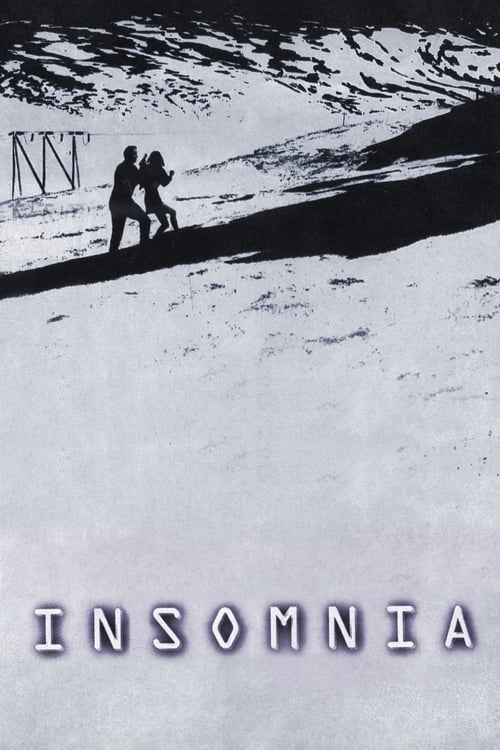
Insomnia
1997 · Erik Skjoldbjærg
For when you want a smart, chilly crime story that gets under your skin — a night for moral murk, not comfort viewing. Reach for it when you're in the mood to watch a man come undone in slow motion and think about how you'd hold up.
What it's about
A Swedish detective is sent north of the Arctic Circle to help solve the murder of a young woman, arriving in a small Norwegian town where the summer sun never sets. A stakeout in heavy fog goes wrong, and he accidentally shoots his own partner — then covers it up, pinning the death on the fugitive he's still hunting. What follows is a double chase: the detective pursuing a killer who may know his secret, while his own lie and the round-the-clock daylight slowly strip him of sleep.
The experience
Clammy, slow-burning, and quietly suffocating — a thriller that runs on dread rather than action. The perpetual daylight becomes its own kind of pressure, and you feel the hero's exhaustion seep into you as the film grinds forward with cool, unblinking patience. It leaves you uneasy more than thrilled, which is exactly the point.
Performances
Stellan Skarsgård carries the film almost single-handedly, playing the detective's unraveling with eerie restraint — sleeplessness, guilt, and calculation all flickering behind a nearly expressionless face.
The craft
The film's masterstroke is turning noir inside out: instead of shadows and night, everything happens in harsh, white, endless Arctic daylight, and the overexposed brightness feels more merciless than any darkness could. Fog, glare, and washed-out landscapes do the atmospheric work, and the muted sound and pacing reward watching it in a dark room where the screen's brightness can really needle you.
Why it matters
A landmark early entry in Nordic noir that helped put Scandinavian crime cinema on the international map, launched Erik Skjoldbjærg's career, and was influential enough to earn a high-profile Hollywood remake a few years later.
Snapshot
A Swedish detective is seconded north of the Arctic Circle in high summer, botches a stakeout in fog, kills his partner by accident, and then spends the rest of the film building a lie he cannot sleep through. Erik Skjoldbjærg's debut feature takes the oldest machinery in crime cinema — the outsider investigator, the drowned girl, the cat-and-mouse with a killer who knows too much — and runs it under conditions that make its usual expressive apparatus impossible. There is no night. There are no shadows to hide a guilty man, no darkness for the camera to withhold information in. The film's central formal wager is that noir's moral atmosphere survives the removal of its lighting scheme, and that perpetual daylight is in fact the crueller instrument: a sun that will not set is an interrogation lamp.
What makes Insomnia durable, twenty-odd years on, is not the gimmick but the refusal that follows it. Jonas Engström (Stellan Skarsgård) is not a decent man broken by circumstance. He arrives already compromised — trailing a disciplinary shadow from Sweden involving a witness — and his conduct in the north, including the coercion of a young hotel receptionist, establishes him as predatory before the misfire ever happens. The film declines to redeem him and declines to punish him. It is this flat, unconsoling ending that most sharply distinguishes the original from Christopher Nolan's 2002 remake, and it is the reason the Norwegian film remains the more disturbing object.
Industry & production
Insomnia was produced through Norsk Film AS, the state-backed production company that anchored Norwegian feature output for most of the postwar period and was wound down in the early 2000s as national film policy shifted toward decentralized funding. Norway in the mid-1990s was a small, subsidy-dependent industry producing a handful of features a year, with almost no domestic genre tradition and a chronic export problem: Norwegian films rarely traveled, and Norwegian directors rarely got second chances abroad.
1997 broke that pattern. Insomnia and Pål Sletaune's Junk Mail (Budbringeren) both went to Cannes — Insomnia to Critics' Week — and both were read internationally as evidence of a generational turn. Skjoldbjærg, then in his early thirties, had trained at the National Film and Television School in England and came to the feature with short-film credits and an outsider's relation to Norwegian screen convention. The choice of Skarsgård was strategically shrewd and thematically load-bearing at once: he was, in 1997, becoming internationally visible off Breaking the Waves and Good Will Hunting, and he had already done arctic-male-collapse work in Hans Petter Moland's Zero Kelvin (1995). Casting a Swede as the interloper also gave the film a linguistic fault line that costs nothing to stage and pays continuously — Swedish and Norwegian are mutually intelligible, so Jonas is understood everywhere and belongs nowhere, marked as foreign in every exchange without a single line of exposition.
Production took place on location in northern Norway during the midnight-sun period, which inverted the normal economics of a shoot: no night work was possible, no darkness was available, and the crew's principal technical problem was subtraction rather than addition of light. Specific budget and box-office figures for the film are not reliably documented in accessible sources and are omitted here rather than guessed; what is clear from the trade record is that the film performed strongly for a Norwegian production at home, secured a modest arthouse release in the United States in 1998, and accumulated its real influence on video and in critical memory rather than at the box office.
Technology
Insomnia was made on 35mm at the last moment before the digital intermediate changed how a film's color could be decided. The DI pipeline that would let a director desaturate, cool, or crush an image globally in post arrives at the end of the decade; in 1997, a look like this had to be built on the set and in the lab. That constraint is legible in the film. The bleached, chalky palette — whites blown toward paper, flesh drained to gray-green, blues thinned out — is the product of exposure decisions, stock and filtration choices, and print timing rather than a grading suite, and it therefore has the slightly unpredictable, granular quality of a photochemical result rather than the sealed uniformity of a graded one. The precise laboratory process is not well documented in the available record, and this dossier will not invent one.
The genuinely novel technical proposition was the light source itself. The midnight sun is not a lighting effect that can be simulated cheaply; it is also not a controllable one. It moves, it never dies, and it delivers low-angle, long-shadow illumination at hours when a crew's body clock says otherwise. The production's use of real conditions rather than day-for-night trickery or its inverse means the film's most important visual idea is documentary in origin. On the sound side, the score was realized in the synthesizer-and-sampler idiom of mid-1990s ambient electronica rather than through orchestral recording — a low-cost, high-control technology choice that turns out to be exactly right for a film about a nervous system failing.
Technique
Cinematography
Erling Thurmann-Andersen's photography is the film's argument. Interiors are lit as if by leakage: light comes through blinds, around cardboard, under doors, in blades and slabs that Jonas cannot tape out. The hotel room becomes a failed darkroom, and the running gag of the roller blind that will not stay down is also the film's thesis in miniature. Exteriors go the other way — flat, overexposed, spatially unhelpful. The Arctic landscape is photographed without romance: scrub, rock, water, drying racks, industrial fish infrastructure, a light that flattens depth cues instead of modeling them.
The camera is patient and frequently a half-step too close, holding on Skarsgård's face past the point of comfort, so that the film's information stream narrows to a single deteriorating instrument. Two set pieces carry the visual scheme: the fog on the shoreline, where the film achieves classical noir obscurity in broad daylight — visibility destroyed by weather rather than by night, which is precisely how the fatal shot becomes possible — and the sequence of Jonas's late-film hallucinatory drift, where framing and focus begin to behave like symptoms.
Editing
Håkon Øverås's cutting is the film's clock. The first act is procedurally brisk and legible. After the shooting, the grammar changes: shots are held slightly too long, transitions begin to elide connective tissue, and small perceptual intrusions — a flash of a face, a fly, a movement at the edge of frame — are cut in without warning or resolution. The technique is restrained rather than psychedelic. Nothing announces itself as a hallucination sequence; the film simply becomes less trustworthy, at roughly the rate its protagonist does. The structural decision to place the misfire early, around the end of the first act, converts the whole remainder from a whodunit into a sustained study of maintenance — the labor of keeping a lie standing while the mind that built it disintegrates.
Mise-en-scène / staging
The world is aggressively unglamorous: municipal offices, a chain-adjacent hotel, a fish plant, gravel roads, plastic chairs. The production design refuses the picturesque north, which matters, because the film needs the Arctic to read as workplace rather than wilderness. Staging repeatedly places Jonas at the edge of groups, physically included and socially adrift, and stages his encounters with the killer, Jon Holt (Bjørn Floberg), as banal meetings — a car, a room — between two men who have arrived at an understanding neither will name. Blocking in the police scenes is quietly procedural: Hilde Hagen (Gisken Armand) is almost always somewhere in the frame doing her job properly while Jonas does not.
Sound
Geir Jenssen — better known as the ambient producer Biosphere, and a northerner himself — supplies not a thriller score but a weather system. Sustained low drones, sub-bass, filtered noise and half-glimpsed tonal movement sit under the film as pressure rather than commentary. There are almost no stings, no cues that tell the audience how to feel about a revelation. The music instead does what the light does: it never stops. Around it, the sound design foregrounds the small, ineradicable irritants of the sleepless — a fan, a fly, a distant machine, footsteps in a corridor — so that silence is never available as relief. Jenssen's contribution is one of the strongest arguments for the film's status as a landmark: it imported the vocabulary of 1990s arctic ambient into narrative cinema at almost the exact moment that genre reached its peak.
Performance
Skarsgård gives a performance built almost entirely on subtraction. The early scenes have a professional's crispness; by the end, the face registers nothing and the body has begun to lag behind intention. He avoids the tremors and outbursts that usually signal breakdown, playing instead a man whose affect is thinning out, which makes the sexual coercion of the receptionist Ane (Maria Bonnevie) especially chilling — it is committed by a man too depleted to disguise what he is. Bjørn Floberg's Holt is the film's other great performance: mild, chatty, faintly ingratiating, a writer who treats the shared secret as a professional courtesy. He is not Jonas's opponent but his mirror, and Floberg plays him without a single villainous inflection. Sverre Anker Ousdal makes Erik warm in very little screen time, which is what makes the fog worth anything. Gisken Armand's Hilde is deliberately undramatic — competent, unhurried, unimpressed — and functions as the film's moral instrument precisely because she is never given a heroic register to play.
Narrative & dramatic mode
The film is an inverted detective story of a specific kind: not a howcatchem, in which the audience watches a known criminal be caught, but a suspense structure in which the detective and the criminal are the same person and the question is whether the machinery of investigation can be turned inside out to protect its operator. Jonas investigates a murder he did not commit while concealing a killing he did, and the two threads are braided so that every genuine act of detection also advances his cover-up.
The dramatic mode is closer to Dostoevsky and to Simenon's romans durs than to the thriller — guilt as a physiological condition, crime as an accelerant of self-knowledge that arrives too late to be useful. There is a persistent dry, deadpan black comedy at the edges: the bureaucratic tedium, the dog shot to manufacture ballistic evidence, the sheer administrative effort of villainy. And there is the structural refusal at the close. The film ends without arrest, confession, or catharsis. The evidence that could convict Jonas exists; the film simply stops before the institution does anything with it. Guilt is left as a private, permanent, sleepless condition rather than a plot problem that gets solved.
Genre & cycle
Insomnia belongs to the police procedural and takes its social-realist temperature from the Scandinavian crime tradition, but its formal contribution is the inversion of noir's defining apparatus. Noir is a lighting philosophy before it is a plot type: moral ambiguity rendered as chiaroscuro, the withheld corner of the frame, the city at night. Skjoldbjærg removes darkness entirely and demonstrates that the genre's real engine was never shadow but the impossibility of privacy. Total light is total exposure. The film thereby founds what has since become a recognizable cycle — sunlit or white noir, the arctic thriller, the "midnight sun" horror of visibility — and it sits at the head of the on-screen Nordic noir that would become Scandinavia's major cultural export a decade later, well before Forbrydelsen, the Wallander adaptations, or the Millennium films.
Authorship & method
Skjoldbjærg's method here is one of principled withholding: no explanatory flashback, no confessional scene, no score cue to license sympathy, no third-act reckoning. The screenplay, co-written with the novelist Nikolaj Frobenius — a serious literary figure in Norway, author of Latours katalog — is unusually disciplined about information, releasing Jonas's Swedish disgrace in fragments and never converting it into motive. The collaboration is legible in the film's novelistic patience and in its interest in a protagonist whose interiority is asserted and then denied to us.
Erling Thurmann-Andersen (cinematography) supplies the bleached, depth-flattening image; Håkon Øverås (editing) supplies the deteriorating clock; Geir Jenssen / Biosphere (music) supplies the pressure. What is notable is how completely these three departments agree. Each is doing the same thing — removing the audience's ability to rest — through different means.
Skjoldbjærg's subsequent career complicates the auteurist reading. His Hollywood follow-up, Prozac Nation (2001), was a troubled production held from release for years and poorly received. He returned to Norwegian work with An Enemy of the People (2005), the reconstruction-style heist film Nokas (2010), the North Sea diving thriller Pioneer (2013), and television including the Jo Nesbø-originated Occupied. The recurring interest across that body of work — institutions, cover-ups, professional men managing what cannot be admitted — reads back onto Insomnia consistently, even if none of the later films matched its impact.
Movement / national cinema
The film is a central document of the Norwegian revival of the 1990s, a moment when a state-supported industry with a thin genre history began producing internationally legible work: Marius Holst's Cross My Heart and Hope to Die (1994), Bent Hamer's Eggs (1995), Moland's Zero Kelvin (1995), Sletaune's Junk Mail (1997). Read regionally, it belongs to a broader Nordic surge — Denmark's Dogme 95 manifesto had been issued in 1995 with its first films arriving in 1998; Sweden was about to produce Moodysson — in which small national cinemas found international attention by making formally severe, unpolished work rather than by imitating Anglo-American production values.
Its Norwegian specificity is worth naming. The literary inheritance of Knut Hamsun — Hunger's first-person degradation, Pan's northern light as an erotic and unbalancing force — sits behind the film more audibly than any cinematic model. So does the internal geography of Nordic countries: the north as a place the south sends people, and the additional joke that the person Norway's south sends is Swedish. Peripherality is doubled, and nobody in the film mentions it.
Era / period
1997 is the hinge. The Cold War frame that had organized the Nordic thriller was gone; the digital tools that would standardize the look of world cinema had not arrived; and Scandinavian crime fiction was in the middle of the transition from the socially critical procedural of Sjöwall and Wahlöö's Martin Beck novels toward the globally marketed brand it became with Mankell, Nesbø and Larsson. Insomnia arrives with the older tradition's institutional pessimism intact and the newer one's atmospheric, landscape-driven appeal already fully formed. It also arrives at the end of photochemical authorship, which is part of why it looks the way it does and why that look has not dated into a style signature.
Themes
Light as exposure. The sun is not a setting but an antagonist and a moral condition: a state of permanent visibility in which concealment requires continuous physical labor — tape, cardboard, blinds — and always fails.
Sleep deprivation as epistemic collapse. The film treats insomnia clinically rather than poetically. Judgment degrades, then perception, then the film's own reliability. Guilt is dramatized as a nervous-system event.
The double. Jonas and Holt are not opponents but versions. Both are men who did something to a young woman and then managed the consequences; the film's most quietly savage move is to make the detective's predation and the killer's continuous rather than opposed.
Institutional license. Jonas's cover-up is possible only because the apparatus of policing — evidence handling, ballistics, the authority to direct an investigation — is in his hands. The film is at least as interested in what a badge permits as in what a man feels.
The outsider and the periphery. Nationality, language, the north, the hotel room: Jonas is provisional everywhere, and the film suggests this is less a source of his corruption than a condition that removes the friction that might have restrained it.
Guilt without absolution. There is no confession, no priest, no partner's forgiveness, no arrest. The film's secular ending insists that consequence and punishment are different things.
Reception, canon & influence
Critical reception. The film was well received at Cannes Critics' Week and domestically, took Norwegian awards recognition, and earned strong notices in its 1998 American arthouse release, with critics converging almost immediately on the light-instead-of-shadow inversion as its signature idea and on Skarsgård's performance as its anchor. It became one of the most internationally visible Norwegian films of the decade and did much of its cultural work afterward, on video and in critical retrospect.
Influences on the film (backward). Classical film noir and its moral apparatus, held at arm's length and stripped of its lighting; Hitchcock's studies of guilt and obsession; Polanski's chamber portraits of psychological disintegration in Repulsion and The Tenant; Simenon and Dostoevsky for the mode of crime-as-symptom; the Sjöwall–Wahlöö procedural tradition for the compromised, unheroic, institutionally embedded policeman; and, closer to home, Hamsun's northern light and starving consciousness. Skjoldbjærg has not, so far as the accessible record shows, issued a definitive list of models, and these are offered as demonstrable affinities rather than as claimed citations.
Legacy (forward). The most concrete line of descent is Christopher Nolan's Insomnia (2002), produced by Steven Soderbergh and George Clooney's Section Eight for Warner Bros. from a screenplay by Hillary Seitz, with Al Pacino, Robin Williams, Hilary Swank and Martin Donovan, shot by Wally Pfister and cut by Dody Dorn. It was Nolan's first studio film, his first with major stars, and his first from someone else's script — a career pivot enabled by this Norwegian original. The remake preserves the premise, the fog, the shared secret and the light, and reverses the ethics: its detective is a good man who cheated, he is granted a redemptive death, and the young officer is told to keep her integrity. The comparison has become a standard case study in adaptation and in the difference between a European art thriller's tolerance for unresolved guilt and a Hollywood production's need to settle accounts. Criterion's subsequent home-video release of the Nolan version has, somewhat ironically, kept the pairing in circulation.
The larger legacy is atmospheric. Insomnia established, earlier and more completely than any other film, the visual and moral grammar that Nordic noir would export globally — landscape as psychological state, the procedural conducted at a depressive tempo, the detective as institutional liability, the north as a place where light and dark are both pathological. Its specific innovation, horror and dread staged in unbroken daylight, has since become a recognizable strategy across contemporary genre film and television; the resemblance is often noted, and this dossier treats it as a lineage of shared grammar rather than a documented chain of direct citation. What remains singular is the ending. Most of the works downstream of Insomnia have taken its light. Very few have taken its refusal to let anyone sleep it off.
A Deleuzian reading
The blind will not stay down.
The full Deleuzian reading of Insomnia →
Reception
It arrived as a Cannes Critics' Week discovery and a Criterion pick while still practically brand new — then spent the 2000s reframed as 'the original' after Christopher Nolan remade it, and is now cited as a forerunner of the whole Nordic noir wave.
How Insomnia was received, from release to now →
How to watch Insomnia: what to notice on a first viewing
- Watch for a roller blind that will not stay down. Light keeps finding its way into Jonas's hotel room through blinds, cardboard, and doors no matter how he blocks it. There is no darkness left for him to hide in, only light he cannot fully block.
- Notice how flat and overexposed the outdoor scenes look. Thurmann-Andersen shoots scrub, rock, and water under a sun that flattens depth instead of giving it shape or shadow. The landscape offers no cover, no shadow, and no relief from being seen.
- Watch Skarsgård's face for what stops registering as the film goes on. His performance is built on subtraction: no tremors, no outbursts, just an affect that thins out scene by scene. The stillness is the breakdown. You are watching exhaustion instead of hysteria.
- Listen for the fan, the fly, sounds that never stop. Biosphere's score never resolves into a cue, and the sound design keeps small irritants running under every scene so silence is never available. The sound refuses to rest, matching a man who cannot sleep through his own lie.
- Watch where Jonas stands relative to the other officers in group scenes. He is staged at the edge of groups, included but adrift, while Hilde Hagen is almost always visible doing her job properly. The blocking quietly measures the distance between him and everyone still doing honest work.
The whole guide to watching Insomnia, with the keys for a rewatch →
Influences: the films it descends from and the films it influenced
- Vertigo (1958) — Builds a detective film out of a policeman's culpable failure in the field and then renders his guilt as an optical condition — POV pursuit, vertiginous perceptual distortion — rather than explaining it in dialogue, the same substitution of perception for confession Skjoldbjærg uses for Jonas.
- Touch of Evil (1958) — Quinlan planting evidence and then supervising the inquiry into his own act is the structural template for the inverted detective: the investigation's antagonist is its investigator, and the film's suspense comes from procedure closing on the man running it.
- Repulsion (1965) — Chamber-scale sensory attrition — dripping taps, a ticking clock, light bleeding through blinds and shutters — carries a mind's collapse with no flashback or diagnosis, exactly the withheld-interiority method of Insomnia's light-leakage interiors and irritant sound design.
- Hunger (Sult) (1966) — The Hamsun line: a starving, unslept consciousness in a northern city, shot in flat unmodelled Scandinavian light with unannounced perceptual slippages that the film never marks as hallucination.
- Hour of the Wolf (1968) — Sleeplessness staged on a Baltic island under near-perpetual summer light, with Sven Nykvist's naturalistic exteriors turned hostile precisely because there is no shadow available to hide the dread in.
- Chinatown (1974) — John A. Alonzo's sun-flooded, shadowless anamorphic exteriors relocate noir fatalism into glare, and the detective is undone by re-enacting an earlier failure — sunlit noir with the moral apparatus intact and the lighting scheme inverted.
- The Conversation (1974) — Walter Murch makes sound the site of guilt — one fragment replayed until it deforms and intrudes on the present — the model for Insomnia's perceptual intrusions arriving as auditory rather than narrative events.
- The Passenger (1975) — Luciano Tovoli's overexposed, depth-flattened exteriors dissolve a man's identity in excess light, and the film asserts his interiority only to deny us access to it, ending without reckoning.
- The Man on the Roof (1976) — The Sjöwall–Wahlöö procedural as municipal labor: fluorescent offices, paperwork tempo, cops as fallible civil servants — the unglamorous Nordic workplace staging Insomnia inherits wholesale for its Tromsø station.
- The Vanishing (Spoorloos) (1988) — Stages abduction and burial in banal midday daylight at a motorway service station and closes on an ending that grants neither punishment nor consolation — the daylight-dread plus refused-catharsis combination Insomnia radicalizes.
- Insomnia (2002) — Direct remake: Wally Pfister whitens the fog and blows out the interiors, and Dody Dorn converts the perceptual intrusions into subliminal flash-frames of the shooting — while the ethics are reversed into a redemptive death the original refuses.
- Memories of Murder (2003) — Detectives who contaminate their own evidence, an investigation conducted in open rural daylight and drab station rooms, and a final refusal of solution that leaves the guilt distributed rather than discharged.
- Jar City (2006) — Exports the grammar to Iceland: desaturated, near-monochrome sub-Arctic exteriors, a procedural conducted at depressive tempo, and a detective embedded in an institution that is itself part of the pathology.
- Zodiac (2007) — The deteriorating clock as structure — timestamped dissolves and years of attrition — with the investigation eroding the investigators and closing on identification without conviction, catharsis withheld at the level of editing.
- Sicario (2015) — Jóhann Jóhannsson's sub-bass drone works as physiological pressure rather than emotional cue, exactly as Biosphere's ambient score does, over Deakins's hard, shadowless daylight in which the threat is fully visible and unavoidable.
- Midsommar (2019) — Takes the light and the latitude literally: Pawel Pogorzelski shoots an entire horror film under a Scandinavian sun that never sets, using sleep deprivation and the impossibility of nightfall as the mechanism of disorientation.
- Headhunters (2011) — The Norwegian-language genre film that first proved international commercial viability for Nordic crime: a morally compromised protagonist, social texture embedded in location, bleak procedural escalation — the formal template and market precedent that makes Headhunters legible to international distributors.
- The Girl with the Dragon Tattoo (2009) — The founding Nordic-noir look — cold overexposed northern light and a guilt-corroded investigator — supplies the desaturated visual atmosphere and morally compromised protagonist this film adopts.
- Nightwatch (1994) — The Nordic genre wave's other sleep-deprivation engine: a nightshift protagonist in a clinical institutional workplace (the morgue) whose exhaustion becomes both the film's editing rhythm and its unreliability.
- Fargo (1996) — Roger Deakins's whiteout snowscapes remove the horizon and flatten depth so that crime plays out with nowhere to conceal it, paired with a procedural conducted at deadpan workplace tempo — the same bleached-noir grammar arrived at independently.
Similar films
- Insomnia (2002) — influence & lineage
- Hour of the Wolf (1968) — influence & lineage
- Midsommar (2019) — influence & lineage
- Vertigo (1958) — influence & lineage
- The Guilty (2018) — shared sensibility
- Nosferatu (2024) — shared sensibility
- The Girl with the Dragon Tattoo (2009) — shared sensibility
- Following (1999) — shared sensibility