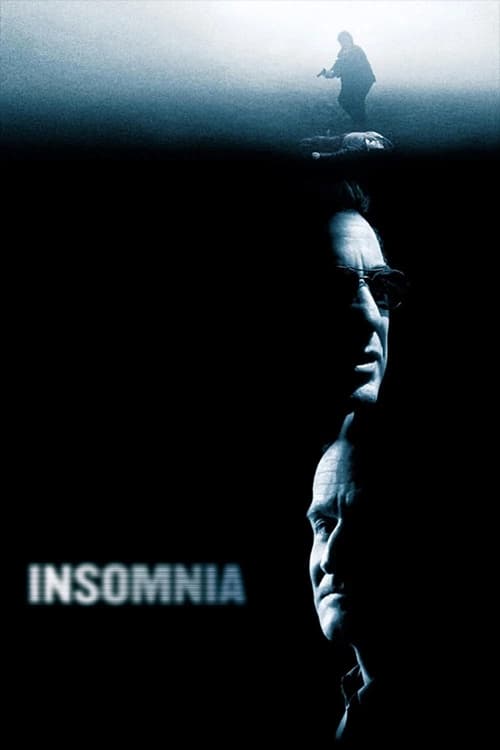
Insomnia
2002 · Christopher Nolan
The director whose every release is treated as a referendum on theatrical cinema itself: Oppenheimer's IMAX-70mm pilgrimage culture, the Barbenheimer phenomenon, and now The Odyssey selling out screenings a full year in advance. Naming him signals you believe in the big screen; arguing about him (cold characters, muddy sound mixing) is its own cottage industry.
For when you want a smart, grown-up crime story that trades explosions for moral pressure — a slow-burn you sink into on a quiet night. More absorbing than comforting; it leaves you a little haunted.
What it's about
A veteran Los Angeles homicide detective flies to a remote Alaskan town to help solve the murder of a local teenager — in the season when the sun never sets. A pursuit through fog goes terribly wrong, and the only witness to his mistake is the killer he's hunting, who starts calling him not with threats but with an offer. What begins as a manhunt becomes a slow-motion negotiation between two men who each know too much about the other.
The experience
Tense in a grinding, sleepless way rather than a jumpy one — the constant daylight wears you down along with the hero, and the film gets under your skin the way exhaustion does. It's a thriller that moves like a guilty conscience: deliberate, queasy, never letting you fully relax.
Performances
Al Pacino plays fatigue like a physical illness — you can see the man eroding scene by scene — while Robin Williams, cast chillingly against type, is soft-spoken, reasonable, and all the more disturbing for it.
The craft
The setting does half the work: endless white daylight turns the usual noir shadows inside out, so the film feels exposed and pitiless instead of murky. Nolan builds dread through editing — intrusive flashes of memory that mimic a mind that can't shut off — and a fog-bound chase sequence that's pure disorientation. It rewards a dark room, ironically, since the film's brightness is its weapon.
Why it matters
This was Christopher Nolan's proving ground — the film that convinced Hollywood the indie puzzle-maker could handle stars and studio scale, opening the door to everything he made after.
Snapshot
A Los Angeles homicide detective travels to a remote Alaskan town during the season of perpetual daylight to investigate a teenager's murder, only to accidentally shoot his own partner in a fog-shrouded pursuit — and find himself blackmailed by the killer who witnessed it. Christopher Nolan's adaptation of Erik Skjoldbjærg's 1997 Norwegian film is a moral thriller built on a single, unrelenting premise: that the inability to sleep is indistinguishable from the inability to stop thinking. Starring Al Pacino, Robin Williams, and Hilary Swank, the film is Nolan's pivot from independent formal experiment to studio craft, and it demonstrates that his preoccupations — guilt, self-deception, the collapse of a reliable narrator — survive transplantation into mainstream genre.
Industry & Production
Insomnia marks the formal opening of Nolan's career as a Hollywood director-for-hire, a step that surprised observers who had followed the labyrinthine micro-budget Following (1998) and the genre-scrambling Memento (2000). Warner Bros., recognizing Memento's word-of-mouth momentum and the critical consensus that Nolan was a filmmaker of unusual intelligence, offered him an existing property rather than an original script. The film was produced under Section Eight, the production banner run by Steven Soderbergh and George Clooney, both of whom served as executive producers. Their involvement connected Insomnia to a strand of prestige genre filmmaking associated with adult, writer-driven crime pictures that had been reinvigorated in the late 1990s by Out of Sight and Traffic.
The screenplay, adapted by Hillary Seitz from the original written by Nikolaj Frobenius and Skjoldbjærg, transplanted the story from northern Norway to Nightmute, Alaska, and converted the protagonist from a Swedish detective working abroad (with all the attendant institutional ambiguity of the Scandinavian original) into an LAPD investigator on loan — a change that reframed the central guilt around a domestic Internal Affairs investigation rather than a foreign jurisdiction. The production shot primarily in and around Stewart, British Columbia, and the Whistler corridor, locations chosen to approximate arctic summer lighting conditions. The choice of Canada as a practical double for Alaska was logistically unremarkable but photographically decisive: the near-continuous daylight of a northern summer became the film's most consistent dramatic element.
The budget was modest by the standards of the studio star vehicles that surrounded it, and Warner Bros. positioned Insomnia as a serious adult thriller — a category the studio had largely abandoned through the blockbuster years — rather than an action film. The casting of Pacino and Williams, both Oscar-winning presences with enormous commercial recognition, gave the film a marquee credibility that studio distribution required while also suggesting the tonal register Nolan intended: lived-in, performance-driven, psychologically weighted.
Technology
The film was shot on 35mm using anamorphic lenses, establishing the widescreen visual grammar that would characterize Nolan and Wally Pfister's subsequent collaborations. Pfister calibrated his exposure to render the Alaskan light as a physical assault rather than an ambient quality — deliberate overexposure in outdoor sequences bleaches the image toward white, communicating Will Dormer's sleep-deprived perceptual breakdown through photographic means rather than purely editorial ones. The decision not to use a day-for-night filter, or to artificially darken the Alaskan sequences into conventional thriller murk, was both a fidelity to the story's premise and a formal commitment: the sun is the antagonist, and it must look like one.
No unusual proprietary technology distinguishes Insomnia from its contemporaries. Its technical achievements are those of classical craft pushed to expressive extremes: controlled overexposure, careful location sound, and the disciplined use of handheld camera to locate the audience inside Dormer's deteriorating perception without tipping into incoherence.
Technique
Cinematography
Pfister's work here operates on a restricted palette — the whites and grays of perpetual daylight, the brown interiors of a small-town police department, the blue-black of the film's few nocturnal sequences (a riverside log chase, a foggy shoreline). The overlit outdoor world functions expressionistically: what should be beautiful is exhausting, what should offer clarity is blinding. The composition is largely classical — medium shots and two-shots dominate, with Pacino's face as a recurring landscape — but Pfister introduces handheld instability at moments calibrated to Dormer's internal state rather than to conventional action grammar. The opening aerial shots over glacial terrain, which establish the white, textureless world Dormer is entering, echo the visual language of European art cinema and distinguish the film's opening movement from conventional thriller establishing shots.
Editing
Dody Dorn, who edited Memento, continues her collaboration with Nolan here under radically different formal constraints. Where Memento made the edit itself the subject, Insomnia uses editing in the service of a more conventional dramatic structure while embedding Dormer's sleep deprivation into the rhythm of sequences. Flash-cuts of Dormer's recurring waking dreams — fragmented images of the crime, of his partner, of his own compromised acts — are inserted at the threshold moments of near-sleep, calibrated to feel like intrusions rather than flashbacks. The effect is less formally audacious than Memento but precisely aimed: the edit enacts the experience of consciousness that cannot shut down.
Mise-en-scène / Staging
Nolan's staging consistently organizes the world around Dormer's diminishing perception. The fog sequence in which Hap is shot is choreographed so that the spatial relationships between figures are genuinely unclear — the audience cannot confidently determine from the staging alone whether the shooting was accidental or deliberate, a formal choice that embeds the film's moral ambiguity into the spatial organization of the scene rather than reserving it for dialogue. The log-strewn river chase, conducted across shifting, unstable surfaces, literalizes Dormer's psychological precariousness. Interiors, particularly Finch's apartment and the police station, are rendered with a flatness that emphasizes function over atmosphere, the mundane procedural world that Dormer's collapsing conscience cannot escape into.
Sound
David Julyan's score is textural rather than melodic — sustained tones and ambient frequencies that accumulate dread without announcing it. Julyan had scored Following and Memento, and his work on Insomnia is similarly reluctant to impose conventional thriller affect. The sound design integrates the intrusive presence of Alaskan wildlife — birds, wind, the creak of the hotel's structure against light — into the fabric of Dormer's insomnia as a form of environmental torment. The use of diagetic sound in the hotel room sequences, where every ordinary noise is amplified into a small aggression, is among the film's most effective techniques.
Performance
Pacino delivers one of his most restrained performances of the period, working against the operatic register he had developed in films like Scarface and Any Given Sunday. Dormer's exhaustion is rendered physically — slowed movement, reddened eyes achieved through the practical conditions of location shooting — and Pacino grounds the moral deterioration in incremental hesitations rather than dramatic declarations. The performance is calibrated to a slow leak rather than a rupture.
Robin Williams's casting as Walter Finch was widely noted as a departure: a beloved comic performer playing a quietly dangerous antagonist. Williams underplays throughout, locating Finch's menace in careful politeness and an almost reasonable tone. The telephone scenes between Finch and Dormer, which drive the film's middle section, are structured as a sustained dialogue between mirror images, and Williams holds his register steadily against Pacino's decay. Hilary Swank as Ellie Burr provides the film's moral center with equal restraint: a junior detective of principled intelligence who comes to understand what Dormer has done and must decide what to do about it.
Narrative & Dramatic Mode
Insomnia operates as an inversion thriller in the tradition of Hitchcock's Rope and Vertigo: the audience knows more than the secondary characters, watches the protagonist attempt to sustain a false version of events, and is implicated in the cover-up through identification. The key structural move — Finch witnessing Dormer's shooting of Hap and using it as leverage — creates a situation in which the detective and the killer are mutually entangled, each holding evidence that could destroy the other. The film is not a whodunit; the killer is identified early. Its dramatic motor is the question of whether Dormer will allow an innocent man to be convicted for Finch's crime in order to protect himself, and whether the Hap shooting was accidental or an act of murder rationalized as accident. The perpetual daylight operates as a narrative device for guilt as a literally inescapable condition: Dormer cannot sleep because he cannot stop reviewing what he did.
Genre & Cycle
The film belongs to the neo-noir psychological thriller cycle that had gathered momentum through the 1990s, tracing a line from Sea of Love (1989) and Basic Instinct (1992) through Se7en (1995) and L.A. Confidential (1997). These films rehabilitated the morally compromised detective as a viable Hollywood protagonist and borrowed from European crime cinema — particularly French polar and Scandinavian crime fiction — a willingness to suspend the resolution of guilt and innocence. Insomnia fits this cycle but arrives at its endpoint, after the critical and commercial success of the 1990s thriller had somewhat subsided. Its closest formal relatives are the films of the polar tradition and the existential crime films of early 1970s American cinema in which institutional corruption is as much a subject as individual evil.
Authorship & Method
Nolan, working from someone else's story for the first time, nonetheless saturated the material with his recurring concerns. The unreliable consciousness at the center of Following, the fractured memory of Memento, the self-deceiving protagonist whose version of events cannot be trusted — all reappear in Dormer. The film confirmed that Nolan's signature was not a formal device (reverse chronology, nested temporalities) but a thematic structure: the intelligent protagonist whose intelligence is deployed in the service of self-protection, and who constructs a narrative of himself that the film methodically dismantles.
Hillary Seitz's adaptation preserved the original's core moral geometry while Americanizing its institutional context. Wally Pfister's cinematography established the visual relationship — controlled, classically framed, technically immaculate, expressive through exposure and lens choice rather than movement — that would define the Nolan-Pfister films through The Dark Knight Rises (2012). Pfister would receive Academy Award nominations for subsequent collaborations before winning for Inception (2010). David Julyan's score represents the final film of his collaboration with Nolan; the composer was not retained for Batman Begins, where Hans Zimmer and James Newton Howard took over, marking a shift in Nolan's sonic palette toward the larger orchestral and textural registers of his subsequent work. Dody Dorn similarly did not continue with Nolan past Insomnia; Lee Smith became his regular editor from Batman Begins onward.
Movement / National Cinema
Insomnia is a Hollywood studio production that carries a European inheritance. The source material was a Norwegian-Danish co-production embedded in the tradition of Scandinavian crime writing that would, in the following decade, achieve global commercial and critical prominence through Stieg Larsson, Jo Nesbø, and the television exports of The Killing and Wallander. Skjoldbjærg's original drew on that tradition's characteristic concerns: institutional corruption, the psychological cost of investigative work, the moral equivalence of investigator and criminal. Nolan's film translates these into an American genre idiom without fully domesticating them; the film retains an European flatness of affect and moral irresolution that distinguishes it from the redemptive arc most Hollywood crime thrillers require.
Era / Period
The film was released in May 2002, approximately eight months after 11 September 2001, into a cultural moment in which questions of ends and means — when it is permissible to compromise procedure in pursuit of guilty men — had acquired an uncomfortable political dimension. Whether the film's moral ambiguities were received in this light is difficult to establish with precision. What is clear is that Insomnia arrived at a transitional moment in mainstream Hollywood filmmaking: before the total consolidation of the superhero franchise model, when studios still regularly produced mid-budget adult thrillers for wide release. Within five years, the conditions that made Insomnia a viable studio product had substantially contracted.
Themes
The film's central theme is the instability of the good conscience. Dormer has spent a career planting evidence against men he believed guilty, a pragmatic corruption that he has sustained through the conviction that the right outcome was achieved even by impermissible means. The Hap shooting — whether accidental or not — strips that conviction away: if he killed his partner, even in the fog of a genuine pursuit, the gap between himself and the criminals he has framed closes to nothing. Sleep deprivation makes this reckoning inescapable. The midnight sun is not a metaphor appended to the story; it is the story's mechanism, making unconsciousness — the daily erasure of guilt that ordinary rest provides — unavailable. The film also engages the theme of the mirror antagonist: Finch and Dormer are not opposites but variants, each having done something they have rationalized, each dependent on the other's silence. Finch's argument — that Dormer's guilty act makes them equivalent — is both the film's most dangerous idea and its most insidiously accurate one.
Reception, Canon & Influence
Insomnia received strong reviews on release, with particular attention paid to Williams's performance as a reversal of his established persona and to Pacino's unusual restraint. Critics positioned the film within Nolan's emerging body of work while noting that its formal ambitions were more modest than Memento's; some read this modesty as evidence of commercial accommodation, others as maturity. The film performed solidly at the box office, confirming Nolan's viability as a studio director without establishing him as a blockbuster filmmaker.
Its backward influences include Skjoldbjærg's original, the classical Hollywood noir tradition (particularly the compromised-detective cycle from Double Indemnity onward), and the European art crime film. The Alaskan location photography belongs to a lineage of landscape-as-psychology that runs from Werner Herzog's arctic and jungle films through Terrence Malick's use of extreme light, though the connection is one of general sensibility rather than documented influence.
Its forward influence operates primarily through its role in Nolan's career trajectory. Insomnia is the film that demonstrated to Warner Bros. that Nolan could manage studio resources, prestige talent, and genre expectations while producing a film of identifiable authorial character. It was the direct antecedent to Batman Begins (2005) — the commission that reshaped contemporary Hollywood. In this sense, Insomnia's canonical significance is partly institutional: it is the film that made Nolan's subsequent career possible. Within the crime thriller genre, its influence is harder to trace with precision; it contributed to a critical rehabilitation of the morally ambiguous cop film and demonstrated the viability of the Scandinavian crime tradition as source material for American adaptation, a demonstration that would be followed by subsequent Stieg Larsson and Nesbø adaptations in the following decade.
A Deleuzian reading
The towel jammed under the curtain.
The full Deleuzian reading of Insomnia →
Reception
Warmly reviewed and a solid hit in 2002, it gradually became 'the forgotten Nolan' — routinely ranked last in Nolan filmographies before a steady wave of 'actually, it's underrated' reappraisals.
How Insomnia was received, from release to now →
Influences: the films it descends from and the films it influenced
- Insomnia (1997) — Nolan inherits the foundational formal device — perpetual Arctic daylight deployed as externalization of irresolvable guilt — and the morally inverted detective structure in which the investigator's cover-up becomes indistinguishable from the killer's crime; Pfister's deliberate overexposure literalizes what Skjoldbjærg's coastal Norwegian light accomplished through restraint.
- Vertigo (1958) — Nolan explicitly inverts Hitchcock's guilt mechanism: where Scottie projects culpability outward onto Madeleine/Judy, Dormer's guilt collapses inward — the film substitutes waking insomnia for Hitchcock's obsessive spiral as the formal shape of self-persecution, turning the detective's reliable gaze against himself rather than against an object of desire.
- Chinatown (1974) — Polanski's neo-noir establishes the sun-bleached daylit landscape as an environment hostile to concealment — where shadow fails as metaphor, overexposure takes its place — and the structure of an investigation that implicates the detective in the crime he pursues, both of which Nolan and Pfister transpose to Arctic Alaska.
- Touch of Evil (1958) — Welles stages a corrupt detective investigation in a disorienting borderland environment; specifically, Quinlan's physical grotesquerie — the deteriorating body as legible sign of moral disorder, made visible through low-angle staging and shadow-expressionism — is the template for Pfister's construction of Pacino's Dormer as a body increasingly at odds with its surroundings.
- The Conversation (1974) — Coppola's formal use of ambient sound as the texture of guilty consciousness — Harry Caul's paranoid aural world, where every recorded sound is simultaneously factual and psychological — is the ancestor of Dormer's amplified diegetic soundscape, in which mundane sounds intrude as accusatory presences at the threshold of sleep.
- Manhunter (1986) — Mann's anamorphic neo-noir investigation establishes the formal device of rendering a detective's absorption into criminal consciousness through compositional sterility and ambient electronic score — Dante Spinotti's geometric coldness and the Tangerine Dream textures — that Pfister's widescreen grammar and David Julyan's score directly extend.
- Bad Lieutenant (1992) — Ferrara's against-type deployment of Harvey Keitel — a recognizable star of moral authority playing physical deterioration and spiritual corruption — is the performance template for Pacino's Dormer; specifically, Ferrara's technique of making guilt visible in the body (sweat, trembling, collapse) rather than through dialogue or confession.
- Fargo (1996) — Roger Deakins's snow-overlit Minnesota establishes the formal grammar of an extreme white landscape as an environment in which moral transgression cannot hide in shadow — the indifferent brightness of the exterior world functioning expressionistically — which Pfister's decision to let Arctic summer operate as an accusatory light source directly inherits.
- Heat (1995) — Pacino's Vincent Hanna — a law enforcement figure whose psychological intensity mirrors his quarry's in a mirror structure that collapses moral distance between cop and criminal — is the direct performance lineage Nolan conscripts for Dormer; Spinotti's overlit, geometrically cold anamorphic Los Angeles is the visual idiom Pfister's Arctic overexposure inherits.
- Memento (2000) — Editor Dody Dorn's system for representing disrupted consciousness — specifically the flash-cut intrusion technique that renders involuntary memory as violent insertion rather than smooth recollection — was developed here and carried directly forward as the formal mechanism for Dormer's sleep-deprived waking hallucinations.
- Batman Begins (2005) — The first franchise-scale deployment of the Nolan-Pfister anamorphic 35mm grammar developed in Insomnia: Pfister carries forward controlled-exposure approach, widescreen compositional coldness, and location-as-psychological-pressure, proving that the visual system built for an intimate character study scales to blockbuster production.
- The Prestige (2006) — Nolan and Pfister carry the inversion-thriller structure — in which the protagonist's investigation of an antagonist reveals his own culpability — into a period magic-act setting; the flash-cut intrusion editing and the morally compromised unreliable narrator are both direct extensions of the Insomnia template.
- The Dark Knight (2008) — The fullest statement of the Nolan-Pfister anamorphic grammar initiated in Insomnia: textural ambient score (Zimmer/Howard), spatial-ambiguity staging in interrogation sequences, and the structuring of a crime investigation around a morally compromised investigator (Harvey Dent as Dormer's tragic inheritor) are all carried forward at maximum industrial scale.
- Prisoners (2013) — Villeneuve and Deakins inherit the moral-inversion investigation thriller set in a winter landscape of spatial ambiguity: Deakins's overlit snow world directly extends Pfister's hostile ambient light, while Jake Gyllenhaal's Loki — a detective whose perceptual failures compromise the investigation — is the formal descendant of Dormer's guilt-shaped consciousness.
- Wind River (2017) — Sheridan transposes the perpetual-daylight-as-guilt device into a snowbound register: the white, featureless winter terrain functions as moral exposure — a world in which wrongdoing cannot hide in shadow — extending the visual grammar Pfister established in Insomnia's Arctic summer sequences to a contemporary crime procedural.
- Zodiac (2007) — Fincher deploys the same strategy of making time's physical cost visible in performance — Gyllenhaal and Ruffalo deteriorating across decades of obsessive investigation — and Harris Savides's overlit, color-drained cinematography operates in the same expressionistic register as Pfister's Arctic overexposure: both use natural light made hostile as an index of psychological damage.
- No Country for Old Men (2007) — The Coens extend neo-noir moral inversion into a film in which the detective literally cannot solve the crime; Deakins's flat, overlit Texas desert refuses concealment in the same expressionistic mode as Pfister's Alaska, and Tommy Lee Jones's physical deterioration across the film maps structurally onto Dormer's insomnia-as-accumulated-guilt.
Similar films
- Heat (1995) — influence & lineage · often watched together
- Insomnia (1997) — influence & lineage
- Memento (2000) — influence & lineage
- Batman Begins (2005) — influence & lineage
- Fargo (1996) — influence & lineage · often watched together
- Vertigo (1958) — influence & lineage · often watched together
- Zodiac (2007) — influence & lineage · often watched together
- No Country for Old Men (2007) — influence & lineage · often watched together
All the films related to Insomnia →