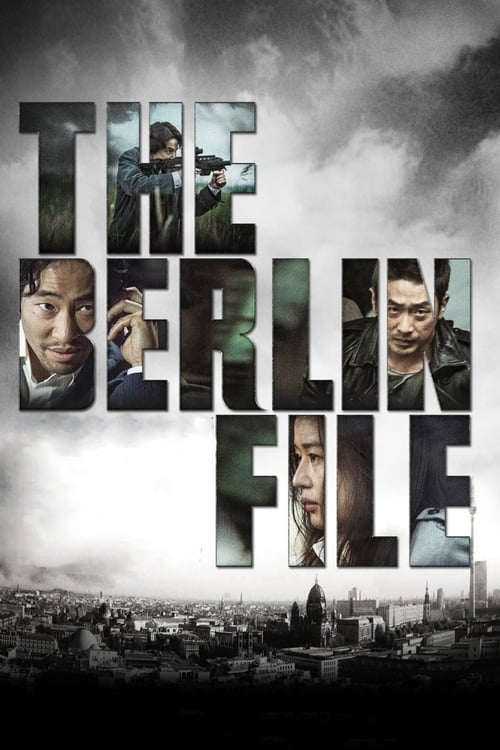
The Berlin File
2013 · Ryoo Seung-wan
When you're craving a serious, hard-hitting spy thriller — the kind for a locked-in evening where you want tension, action, and a hint of tragedy rather than popcorn escapism.
What it's about
A North Korean 'ghost' agent in Berlin sees an illicit arms deal collapse and suddenly finds himself hunted from every side — by South Korean intelligence, by foreign services, and most dangerously by his own government, which sends a ruthless investigator to sniff out a traitor. His wife, a translator at the embassy, becomes the question he can't answer: is she loyal, and can he protect her either way?
The experience
Fast, dense, and physical — a paranoid chess game that keeps erupting into bruising, close-quarters fights and rooftop chases. It asks you to keep up with the double-crosses, then rewards you with real emotional stakes under all the tradecraft.
Performances
Ha Jung-woo brings weary, watchful gravity to the hunted agent, while Ryoo Seung-bum is chillingly live-wire as the investigator sent from Pyongyang — the two make ideology feel like a family feud.
The craft
Ryoo Seung-wan stages action with brutal clarity — hand-to-hand combat you can actually follow, built on impact rather than gloss — and uses wintry Berlin as a chessboard of embassies, safe houses, and rooftops. The set pieces hit hard with good sound.
Why it matters
A major South Korean box-office hit that fused the country's long tradition of inter-Korean spy drama with the globe-trotting style of modern Western espionage cinema, cementing Ryoo Seung-wan's standing as one of Korea's top action directors.
Snapshot
The Berlin File (Korean: 베를린, Bereullin) is Ryoo Seung-wan's attempt to fold the inter-Korean spy thriller — a durable strain of South Korean commercial cinema since Shiri (1999) — into the grammar of the post-millennial, globe-trotting espionage picture epitomized by the Bourne films. The story strands a North Korean "ghost" operative, Pyo Jong-seong (Ha Jung-woo), in Berlin after an arms deal collapses, leaving him hunted simultaneously by South Korea's National Intelligence Service, by foreign agencies, and — most dangerously — by his own state, which dispatches a ruthless investigator, Dong Myung-soo (Ryoo Seung-bum), to root out a leak. Around Pyo orbits his wife, Ryun Jung-hee (Jeon Ji-hyun / Gianna Jun), a translator at the North Korean embassy whose loyalty becomes the film's central, fatal uncertainty, and the dogged NIS agent Jung Jin-soo (Han Suk-kyu). The film married Ryoo's reputation as Korean cinema's foremost action stylist to a comparatively somber, betrayal-driven spy plot, and it became one of the major Korean releases of 2013. It marks a pivot in Ryoo's career toward larger budgets and international scale that would culminate in Veteran (2015) and Escape from Mogadishu (2021).
Industry & production
The Berlin File was produced and distributed under the CJ Entertainment (CJ E&M) banner, the dominant force in Korean commercial film at the time, and it belongs to the category of the Korean daejak — the large-budget tentpole that Korean studios increasingly mounted in the late 2000s and early 2010s as the domestic industry consolidated and reached for transnational ambition. The production was conspicuously international in its footprint: it shot on location in Berlin and used Riga, Latvia, as a stand-in for additional European settings, a logistical and budgetary undertaking well beyond the scale of Ryoo's earlier, scrappier work. The precise budget and final admissions figures are best treated as approximate in a synthesized account, but the film was understood as a substantial investment and performed strongly, drawing a domestic audience in the millions and ranking among the year's top Korean releases. Its commercial success consolidated CJ's confidence in Ryoo as a director capable of delivering scale, and it functioned as a bridge between the mid-budget genre work of his earlier career and the outright blockbusters that followed. Talk of a sequel circulated after release, but no continuation materialized.
Technology
The film was made within the digital-capture norms that had become standard for Korean tentpole production by the early 2010s, when large-sensor digital cinema cameras had largely displaced film for action-heavy commercial work; the precise camera package is not something I can attribute with confidence and is better left unstated than guessed. What matters technologically is less the specific hardware than the way the production exploited contemporary tools for a kinetic, "realist" surveillance aesthetic — long-lens coverage, mobile rigs, and digital workflows that supported the rapid, fragmented cutting the genre demanded. The European locations were integrated through practical shooting rather than relying conspicuously on synthetic environments, and the film's set pieces — apartment infiltrations, rooftop pursuits, close-quarters gunfights — favor physically staged, choreographed action over digitally generated spectacle, consistent with Ryoo's grounding in stunt and martial-arts practice.
Technique
Cinematography
The visual scheme is deliberately cool and desaturated — a palette of grays, steel blues, and concrete that renders Berlin as an anonymous, post-Cold War transit zone rather than a tourist's city. The camera is mobile and often handheld, pushing in on faces and tracking bodies through corridors and stairwells in the manner the Bourne cycle had made the lingua franca of the modern spy film. Surveillance is built into the visual logic: long lenses, partially obscured sightlines, reflections, and framings that imply watchers just out of view. The film leans on the textures of European interiors — embassies, hotels, safe houses — to convey a sense of cramped, contingent operational space, and reserves its more expansive compositions for the climactic confrontation in an open field, where the visual openness becomes thematically loaded.
Editing
Cutting is the film's defining technical register. The action sequences are assembled in the fast, impactful style that defines contemporary espionage cinema, fragmenting hand-to-hand combat and gun battles into rapid, percussive beats while attempting to preserve spatial legibility — a balance Ryoo, with his action background, is more attentive to than many imitators of the Greengrass model. The espionage plot, by contrast, is cut more deliberately, withholding and parceling out information to sustain the central ambiguity about who has betrayed whom. The juxtaposition of these two rhythms — propulsive in the set pieces, withholding in the intrigue — is the structural engine of the film.
Mise-en-scène / staging
Ryoo's signature is most visible in the staging of physical conflict. The film foregrounds close-quarters, hand-to-hand combat and tactically grounded gunplay rather than glamorized superheroics; bodies collide, weapons jam, and fights have a bruising, attritional quality. The production design renders the institutional spaces of espionage — the bureaucratic interiors of intelligence work — with a drab functionalism that underscores the film's disenchanted view of the trade. The climactic battle, staged in an open grass field, deliberately strips away the urban cover and surveillance apparatus of the earlier sequences, isolating the antagonists in a primal, almost Western-like confrontation.
Sound
The sound design supports the realist register, emphasizing the concussive report of gunfire and the impact of blows over orchestral grandiosity. The musical score (whose composer I won't attribute without certainty) works largely in a tense, propulsive idiom appropriate to the genre, surging in the set pieces and receding into ambient unease during the espionage scenes. The film's multilingual texture — Korean, German, English, and the languages of its foreign agents — is itself a sonic theme, dramatizing the stateless, translated condition of its characters, with Jeon Ji-hyun's character literally employed as a translator.
Performance
The performances are central to the film's seriousness of tone. Ha Jung-woo, one of the most versatile Korean leads of his generation, plays Pyo as a contained, physically capable professional whose emotional life is suppressed beneath operational discipline, so that the cracks — his growing fear for and doubt about his wife — register as small fractures rather than outbursts. Han Suk-kyu, a veteran whose career stretches back to the foundational Shiri, brings weathered authority to the NIS agent. Ryoo Seung-bum — the director's brother and a recurring presence across his filmography — plays the Pyongyang enforcer Dong Myung-soo with a cold, almost gleeful menace that makes him the film's most vivid figure. Jeon Ji-hyun, a major star, is given a role that several observers found underwritten relative to her billing, its emotional stakes more gestured at than fully developed — a not-uncommon limitation of the genre's treatment of its few female figures.
Narrative & dramatic mode
The film operates in the mode of the betrayal thriller: its forward motion is generated less by the question of what will happen than by who can be trusted. The arms-deal-gone-wrong functions as an inciting accident that exposes a leak, and the narrative becomes a paranoid spiral in which Pyo must determine whether his own wife has informed on him, whether his handlers have abandoned him, and whether the South Korean agent pursuing him is foe or improbable ally. This is the structure of the le Carré-descended spy story — institutional betrayal, the agent as expendable instrument, loyalty as a commodity — grafted onto a high-velocity action chassis. The dramatic arc bends toward tragedy: the personal relationship at the film's center is consumed by the machinery of the states the characters serve, and the resolution is one of loss and revenge rather than triumph.
Genre & cycle
The Berlin File sits at the intersection of two cycles. The first is the indigenous Korean inter-Korean thriller, inaugurated commercially by Kang Je-gyu's Shiri (1999), deepened by Park Chan-wook's JSA: Joint Security Area (2000), and continued in films such as Secret Reunion (2010) and The Suspect (2013) — a body of work that uses the North–South division as an engine for melodrama, suspense, and national allegory. The second is the global post-Bourne espionage thriller, with its realist surveillance aesthetic, handheld kineticism, and morally exhausted protagonists. Ryoo's film is notable precisely for transposing the Korean division narrative out of the peninsula and the DMZ and into a European theater, treating Berlin — a city whose own history of division resonates pointedly — as neutral ground on which the two Koreas' agents collide alongside foreign intelligence services. That relocation is the film's signal generic move.
Authorship & method
Ryoo Seung-wan came up as a self-taught "action kid," a cinephile whose early features (Die Bad, 2000; No Blood No Tears, 2002; Crying Fist, 2005; The City of Violence, 2006) established him as Korea's premier action craftsman, deeply versed in stunt choreography and martial-arts staging, with a recurring satirical streak (Dachimawa Lee). The Berlin File arrived after The Unjust (2010) had demonstrated his facility with morally murky institutional thrillers, and it represents his decisive scaling-up. His method foregrounds physically grounded, choreographed action over digital spectacle and tends to invest genre forms with social and political weight — a tendency that would become explicit in the corruption satire of Veteran and the historical scale of The Battleship Island (2017) and Escape from Mogadishu. Among his collaborators, the most consistent is his brother, the actor Ryoo Seung-bum, a fixture of his films. Beyond that, I'll refrain from attributing the specific cinematographer, editor, composer, and screenwriter credits with false confidence; the record of who occupied each technical role on this particular production is something I cannot verify here, and it is better to flag that gap than to risk misattribution. (Ryoo is credited with the screenplay in the broad understanding of the film as his authored work.)
Movement / national cinema
The film is a product of the mature phase of the Korean commercial renaissance — the industry that emerged from the late-1990s "Korean New Wave" and Shiri-era blockbuster boom into a globally competitive, vertically integrated studio system dominated by conglomerates like CJ. By 2013, Korean cinema was both a robust domestic industry, regularly out-drawing Hollywood imports at home, and an increasingly outward-facing one, with the Hallyu (Korean Wave) carrying its stars and styles abroad. The Berlin File's European shoot and its deployment of a globally legible espionage idiom exemplify this transnational reach: it is a Korean national-division story told with international production values and an eye to a wider audience, a strategy of scale that the industry would pursue throughout the 2010s.
Era / period
The film is inseparable from its precise historical moment. It was made and released in the immediate aftermath of Kim Jong-il's death in December 2011 and the accession of Kim Jong-un, a period marked by reported factional turbulence and purges within the North Korean leadership. The film's plot — in which an enforcer is sent from Pyongyang to investigate disloyalty and the protagonist becomes collateral in an internal power struggle — directly echoes this atmosphere of succession-era instability and intramural suspicion. More broadly, it belongs to a post-Cold War sensibility in which espionage has detached from clear ideological stakes and become entangled with arms dealing, money, and survival; the North Korean characters are figures of ideological exhaustion as much as conviction, their state apparatus depicted as paranoid and self-cannibalizing.
Themes
The film's controlling theme is the individual crushed between states. Pyo is a man whose entire identity is instrumental — a "ghost" without legible nationhood, loyal to a system that treats him as disposable — and the drama strips away his professional armor to expose the human attachment (his marriage) that the apparatus cannot tolerate. Loyalty and betrayal are examined not as moral absolutes but as conditions manufactured by institutions: the question of whether Pyo's wife betrayed him is ultimately less important than the way both states make trust impossible. Statelessness and translation recur as motifs — the multilingual setting, the wife's literal job as translator, the city of Berlin as a divided-then-reunified palimpsest. And beneath the action runs a disenchanted political vision: ideology has curdled into bureaucratic survivalism, and the agents of both Koreas are revealed as fellow victims of larger machines.
Reception, canon & influence
The Berlin File was received as a commercial success and a significant entry in Ryoo's filmography, drawing a large domestic audience and figuring among the major Korean releases of 2013; it attracted attention at the year's Korean film awards for its craft and performances, with Ryoo Seung-bum's villain frequently singled out. Critical response was largely positive on the film's technical accomplishment — its action staging, its cool visual control, its successful scaling-up of Ryoo's craft to blockbuster dimensions — while a recurring reservation concerned the density and occasional opacity of its plotting and the underdevelopment of Jeon Ji-hyun's role.
Looking backward, the film's influences are legible: the post-Bourne realist espionage aesthetic of Paul Greengrass and Doug Liman; the le Carré tradition of institutional betrayal and the expendable agent; and the indigenous lineage of the Korean inter-Korean thriller running from Shiri and JSA forward. Looking forward, The Berlin File functioned chiefly as a hinge within Ryoo Seung-wan's own career — the proof of concept that he could command international scale and serious tone, directly enabling the ambitions of Veteran, The Battleship Island, and especially Escape from Mogadishu (2021), which similarly strands Korean agents abroad amid foreign chaos and can be read as a thematic descendant. Within the broader Korean industry, it stands as a notable instance of the early-2010s push to globalize the national-division narrative, relocating the peninsula's defining political wound to a foreign stage. A planned sequel did not materialize, leaving the film as a self-contained achievement rather than the start of a franchise — and, on the available record, that is where its direct legacy rests.
A Deleuzian reading
Start with a sightline.
The full Deleuzian reading of The Berlin File →
Reception
A monster hit in Korea in early 2013 — 7 million-plus admissions and instant 'Korean Bourne' headlines — though even fans then admitted the plot was knottier than the action deserved. Today it reads as the connective tissue in Ryoo Seung-wan's run from The Unjust to Veteran: respected, rewatched by genre heads, but overshadowed by what came next.
How The Berlin File was received, from release to now →
Influences: the films it descends from and the films it influenced
- Shiri (1999) — Codified the Korean inter-Korean blockbuster template in which a North Korean operative's mission disintegrates into divided-loyalty tragedy — the sleeper-agent-with-a-wife structure Berlin File rebuilds around Jong-seong and Jung-hee.
- Joint Security Area (2000) — Established the DMZ-thriller's grammar of institutional betrayal and doomed cross-border trust, supplying the 'individual crushed between states' architecture in which the agents are more humane than the services that expend them.
- The Bourne Supremacy (2004) — The direct template for the film's fragmented action cutting and handheld documentary-realist coverage — close, jittery, sub-second-cut hand-to-hand combat shot like reportage rather than spectacle.
- The Bourne Ultimatum (2007) — Modeled the surveillance aesthetic of CCTV feeds, comms intercepts and overhead tracking woven into the action geography, so pursuit is staged through the apparatus of watching.
- The Bourne Identity (2002) — Pioneered the grounded close-quarters fight built from improvised domestic weapons and economical takedowns, the realist hand-to-hand idiom Ryoo adopts over wushu flourish.
- The Spy Who Came in from the Cold (1965) — The le Carré source for the expendable agent burned by his own side amid a divided Berlin — the cold institutional fatalism and moral exhaustion Berlin File transplants to a post-Cold-War stage.
- Munich (2005) — Furnished the model of stateless operatives working foreign cities through safe-houses and dead drops, with tense apartment-bound combat and a paranoia that the handlers are the real enemy.
- The Unjust (2010) — Ryoo's own proof that genre could carry institutional moral murk; its withholding, deliberately opaque plotting rhythm and rotten-system fatalism are scaled up directly into Berlin File.
- The City of Violence (2006) — Ryoo's earlier showcase of practically-staged, physically grounded close-quarters brawling — the choreographed-over-digital ethos that distinguishes Berlin File's fights from CG-driven blockbuster action.
- Crying Fist (2005) — Established Ryoo's insistence on the bodily cost of violence — exhaustion, accumulated damage, weight of impact — carried into Berlin File's grueling, un-glamorous combat.
- The Yellow Sea (2010) — Ryoo inherits The Yellow Sea's extended-duration action staging and stateless-Korean-diaspora premise, transplanting the peninsula's political geography onto a foreign city with the same ethnographic-location grammar Na established.
- The Battleship Island (2017) — The international-scale historical production Berlin File served as proof-of-concept for — Ryoo commanding large foreign-set spectacle while retaining hand-to-hand realism.
- Escape from Mogadishu (2021) — Most direct descendant: strands North and South Korean diplomats amid foreign chaos abroad, reprising the open-field escape climax and the wound of national division relocated to a foreign stage.
- Steel Rain (2017) — Continues the early-2010s push to globalize the division narrative, pairing North and South agents in a betrayal thriller where individuals are ground between state machinery.
- Veteran (2015) — Extends the same method of investing commercial action choreography with social-political weight, the next step in Ryoo's project of genre-as-critique that Berlin File's serious tone enabled.
- The Suspect (2013) — Released the same year with a North Korean defector hero, deploying the identical Bourne-derived handheld vehicular and close-quarters action grammar applied to the inter-Korean premise.
- Confidential Assignment (2017) — Builds the cross-border cooperation thriller from the same template of a North Korean operative pursuing his own service's traitors on foreign-adjacent ground, with grounded fight staging.
Similar films
- Steel Rain (2017) — influence & lineage
- Escape from Mogadishu (2021) — influence & lineage
- Joint Security Area (2000) — influence & lineage
- The Bourne Supremacy (2004) — influence & lineage
- New World (2013) — shared sensibility
- The Man Standing Next (2020) — shared sensibility
- The Handmaiden (2016) — shared sensibility
- 12.12: The Day (2023) — shared sensibility