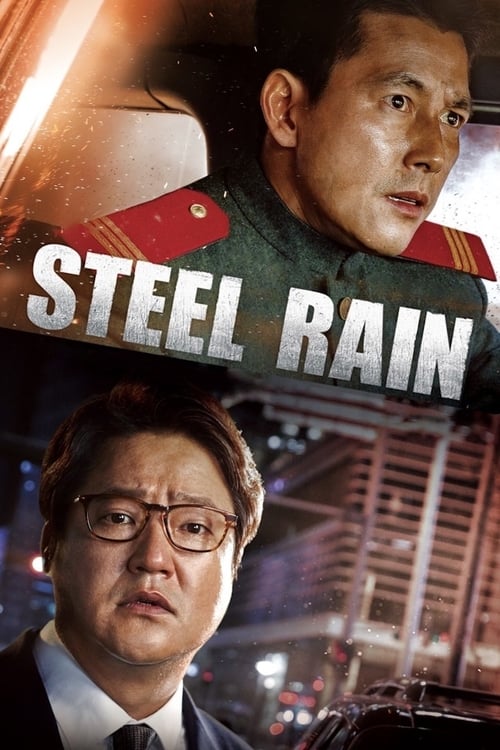
Steel Rain
2017 · Yang Woo-seok
For when you want a smart, meaty action night — bigger ideas than the average blockbuster, but still fully delivering car chases, gunfights, and countdown tension. Comfort-food thrills with a lump in the throat.
What it's about
A coup erupts in Pyongyang, and a North Korean special-forces agent flees across the DMZ with an unlikely passenger: his country's critically wounded supreme leader. Keeping the man alive may be the only thing standing between the peninsula and all-out nuclear war. In the South, he's forced into a wary partnership with a government security official, two men from opposite sides of the world's most fortified border racing the clock together.
The experience
A propulsive, high-stakes thriller that keeps the geopolitical doomsday clock ticking while sneaking in real warmth — the odd-couple bond at its center gives the explosions something to matter for. Tense, occasionally brutal, and more moving than you expect.
Performances
Jung Woo-sung brings wounded stoicism to the North Korean operative and Kwak Do-won a rumpled, funny humanity to his Southern counterpart — the film runs on the chemistry between them.
The craft
Mounted with real scale — missile strikes, urban shootouts, and a plausibly detailed vision of how a peninsula crisis could spiral — while the script keeps grounding the spectacle in the everyday things the two leads share, like a bowl of noodles. It's slick, confident mainstream filmmaking that plays great with good speakers.
Why it matters
Landing at the height of real-world nuclear tension between Washington and Pyongyang in 2017, it hit a nerve and became one of the defining entries in South Korea's wave of division thrillers.
Snapshot
Released in South Korea on 14 December 2017, Steel Rain (강철비, Gangjeobi) arrived at an unusually charged moment: the Korean peninsula was in the grip of escalating rhetoric between Washington and Pyongyang, and inter-Korean thrillers had become a reliable genre vehicle for South Korean audiences to process the anxieties of division. Yang Woo-seok's film takes a high-concept premise — a North Korean special-forces operative smuggles his country's critically wounded Supreme Leader across the DMZ into the South — and uses it less as a geopolitical procedural than as a humanist thought experiment about what shared identity persists beneath fifty years of enforced estrangement. Anchored by two star performances and mounted with above-average production ambition, Steel Rain became one of the more commercially and critically substantive Korean releases of its year, securing Yang's status as a filmmaker of political seriousness following the enormous popular success of his debut, The Attorney (2013).
Industry & production
Yang Woo-seok adapted the film from his own Naver Webtoon series of the same name, which he had written and drawn prior to production. The webtoon origins matter for understanding the film's structure: the narrative is storyboarded in a panel-by-panel spatial logic before it becomes cinematic, which may account for the film's unusually clean scene-to-scene geography and its habit of clarifying geopolitical exposition through dialogue that reads like caption text made audible. Adapting one's own source material gave Yang complete authorial continuity over the project — a relative rarity in mainstream Korean commercial cinema, where directors frequently work with scripts developed by independent writers or studios.
The film was produced and distributed by NEW (Next Entertainment World), one of the major South Korean production and distribution conglomerates that rose to prominence in the 2010s. NEW had previously handled The Attorney, so the Yang–NEW collaboration carried institutional confidence on both sides. The budget was substantial enough to sustain military hardware, period-adjacent production design for North Korean interiors, and competent action sequences, though the film does not aspire to the scale of a Hollywood or even a Avengers-adjacent Korean blockbuster. Its resources are concentrated in craft and performance rather than spectacle, a choice that proves strategically sound given the material's demands.
The production required plausible North Korean set design and costuming at a time when authentic reference material was — by definition — difficult to verify. The film's North Korean sequences rely on conventional South Korean assumptions about the Northern visual culture: Juche-inflected interiors, military regalia, cold-lit bureaucratic spaces. Whether these achieve documentary accuracy is impossible to adjudicate from outside the DPRK, but they function as legible genre shorthand within the Korean film market.
Technology
Steel Rain was shot digitally, consistent with mainstream Korean production practice by the mid-2010s. The action sequences involving the opening North Korean commando operation make use of controlled pyrotechnics and practical stunt work blended with digital visual-effects compositing — a hybrid approach standard to Korean genre production of the period, in which Dexter Studios and similar domestic VFX houses had achieved considerable sophistication. The specific VFX vendor credits are not in the record available here, but Korean commercial action films of this budget tier routinely relied on two or three domestic effects houses in tandem.
The film does not distinguish itself technologically in the manner of a stylistically ambitious production like The Handmaiden (2016); its technical choices are in service of transparency rather than spectacle or formal experimentation. Digital acquisition allows the low-light North Korean interiors to read with a modicum of naturalism, and the editing pipeline appears to have been entirely contemporary digital, with no analog processes invoked for texture or period affect.
Technique
Cinematography
The visual approach of Steel Rain is functional and efficient without being anonymous. Wide shots establish spatial relationships between characters who are nominally enemies occupying the same domestic space in the South Korean safe house — the cramped geography of their cohabitation is used to generate moral proximity before the dialogue confirms it. The film favors medium coverage in dialogue-heavy scenes, keeping faces readable and emotional registers legible, with shallow depth of field isolating characters from backgrounds that carry the visual signature of bourgeois Seoul domesticity. The cinematography does not call attention to itself, which is itself a tonal argument: this is a film about the ordinariness of the human beings caught inside geopolitical structures.
The North Korean prologue sequences are shot with slightly harder light and a cooler temperature, while the South Korean scenes gradually warm as the two protagonists develop rapport. This kind of chromatic emotional coding is a convention of the Korean mainstream, and Steel Rain deploys it without subversion but also without clumsiness. The specific cinematographer's contribution is not foregrounded in available English-language criticism, and the credit information in this record is insufficient to make attributions with confidence.
Editing
The editing rhythm is measured rather than hyperkinetic. Steel Rain is, at its core, a two-hander with procedural elements, and its cutting respects that — extended dialogue exchanges are allowed to breathe, with coverage patterns that follow classical continuity grammar. The action sequences in the first act are edited with more urgency but not with the disorienting compression that characterizes some Korean genre work; Yang wants audiences to understand spatial relationships even in the midst of violence. The structure moves between ticking-clock pressure (the Supreme Leader's deteriorating medical condition; the coup faction's advancing political consolidation; American and Chinese military mobilization) and scenes of uneasy stillness in the safe house, and the editing's pacing modulates between these registers with reasonable control.
Mise-en-scène / staging
The most striking staging choice in the film is the sustained domestic cohabitation sequence in which the North Korean agent (Eom Cheol-woo, played by Jung Woo-sung) nurses the wounded Supreme Leader while cautiously negotiating with the South Korean security official (Kwak Cheol-woo, played by Kwak Do-won). Yang stages these scenes against the deliberately un-cinematic backdrop of a middle-class Seoul apartment, emphasizing the absurdist surreality of a North Korean elite soldier and a South Korean bureaucrat performing mundane acts of care and negotiation in a setting designed for neither of them. The choice to place geopolitics inside domestic space is a consistent Korean genre strategy — visible in Park Chan-wook's JSA (2000) and Kim Jee-woon's The Good, the Bad, the Weird (2008) in different registers — but here it carries specific resonance because domesticity is precisely what division denies.
Sound
The sound design operates at a genre-appropriate level: action sequences are muscular and detailed, the DMZ crossing is built around wind, machinery, and controlled silence that heightens tension, and the political conference scenes use ambient room tone to suggest institutional weight. No unusually distinctive sound design choices are documented in available criticism, and the musical score — which underscores the film's more emotionally direct moments with orchestral warmth — functions conventionally as emotional reinforcement rather than counterpoint or commentary. The composer's identity is not confidently establishable from available records and is omitted here rather than attributed speculatively.
Performance
Jung Woo-sung's performance as Eom Cheol-woo is the film's center of gravity. One of South Korea's most durable leading men — active since the mid-1990s, associated with prestige films including A Moment to Remember (2004) and The Good, the Bad, the Weird — Jung brings to Eom a particular quality of compressed violence and ethical seriousness. The character is a product of the North Korean state's most ruthless training, and Jung plays him as a man whose ruthlessness is real but whose moral imagination has never been entirely extinguished. The physical performance is precise: Eom moves through space with special-forces economy, but Jung allows moments of unmistakable bewilderment when confronted with the comparative material abundance of the South.
Kwak Do-won, who had drawn international attention with his performance in Na Hong-jin's The Wailing (2016), plays Kwak Cheol-woo as a harried, intellectually modest civil servant whose decency is tested by the scale of what he has stumbled into. The pairing of these two actors — Jung's contained charisma against Kwak's more anxious naturalism — generates the film's central dynamic. The deliberate naming conceit (both characters are named Cheol-woo, a pointed gesture at shared Korean identity across the divide) gives their scenes a low-key symbolic resonance that the performances support without overplaying.
Narrative & dramatic mode
Steel Rain operates in a mode that might be called "humanist thriller" — a genre hybrid in which geopolitical stakes and genre mechanics function primarily as pressure apparatus to test the hypothesis that individual human connection can persist despite structural enmity. The narrative is built around a classic odd-couple structure: two men from opposing systems, each representing the institutional logic of his half of the peninsula, forced by circumstance into mutual dependency. The thriller elements (the coup, the ticking medical crisis, the approaching military escalation) create urgency, but the film's real drama is psychological and ethical.
The screenplay is unusually attentive to the geopolitics of the crisis from multiple vantage points — the American ambassador, the Chinese military, the South Korean presidential structure — and while this multi-perspectivalism can feel schematic, it reflects Yang's evident interest in depicting the Korean situation as a prisoner of great-power competition rather than purely as a domestic tragedy.
Genre & cycle
Steel Rain belongs to the well-established South Korean "inter-Korean encounter" cycle, a genre formation that has organized a substantial portion of Korean mainstream cinema since at least Park Chan-wook's JSA (2000). This cycle is defined by narratives in which North and South Korean characters are forced into proximity, and in which the conventions of genre (thriller, action, melodrama, comedy) create enough narrative pressure to make visible the human cost of a political situation usually discussed in abstract policy terms. Key texts in the cycle include Silmido (2003), Taegukgi (2004), Welcome to Dongmakgol (2005), The Front Line (2011), and Secretly, Greatly (2013). Steel Rain operates closer to the serious end of the spectrum, more in the lineage of JSA and The Front Line than of the more comedic iterations.
The film also participates in the Korean political thriller, a genre energized in the 2010s by films including Yang's own The Attorney, The Berlin File (2013), and Assassination (2015). In this broader frame, Steel Rain's interest in institutional dysfunction, inter-agency conflict within the South Korean government, and the limits of individual agency against structural momentum connects it to a cycle of Korean films processing the political traumas of the preceding decade.
Authorship & method
Yang Woo-seok's career suggests a filmmaker whose primary orientation is civic and political rather than formally experimental. The Attorney — his debut feature, drawn from the real legal career of former President Roh Moo-hyun — was a phenomenon in South Korea, drawing well over ten million admissions and functioning as a piece of cultural processing for a generation's political self-understanding. That film established Yang's core authorial interest: the conscientious individual confronting an unjust state structure, and the ethical costs of engagement or disengagement.
Steel Rain extends this interest onto a different terrain — the division of the peninsula rather than the internal politics of the South — but the underlying moral structure is consistent. Yang is not a director of formal radicalism; his camera and editing choices are in service of legibility and emotional transparency. What distinguishes his authorship is the seriousness with which he treats political subject matter and his refusal to resolve complexity into simple ideological affirmation. The North Korean state is not whitewashed in Steel Rain, but neither is the South Korean or American political apparatus.
Yang would return to this terrain with Steel Rain 2: Summit (2020), in which he reconceived the franchise entirely with new actors and a scenario built around an inter-Korean summit held aboard a submarine — evidence that his engagement with the division is a sustained project rather than a one-time genre exercise.
Movement / national cinema
Steel Rain sits within the tradition of post-Shiri (1999) Korean commercial cinema that found in the division a reliable source of genre energy and national-emotional resonance. South Korean cinema's capacity to mount technically credible, emotionally serious, commercially viable films on explicitly political subjects — without the intervention of state direction — reflects the particular character of the Korean industry in the decade following Oldboy and the new wave's consolidation.
The film is also part of a broader tendency within Korean genre cinema toward what scholars have described as "divided nation melodrama": narratives in which the formal conventions of genre encode the affective experience of a people for whom separation from family, community, and territorial self is a living rather than historical reality. The genre's persistence through varying political climates in North-South relations attests to its psychological utility for South Korean audiences.
Era / period
Steel Rain was produced and released during a period of acute anxiety about North Korean nuclear and ballistic missile development: 2017 saw a series of DPRK missile tests and a hydrogen bomb test, and the rhetorical exchange between Kim Jong-un and Donald Trump had reached a pitch that was openly discussed in the Korean and international press as potential prelude to conflict. The film's plot — in which a North Korean coup puts nuclear command authority in unstable hands, and in which American military intervention is presented as a threat rather than a guarantee — was read by Korean audiences against this immediate context. Films responding to specific geopolitical moments often date quickly, but Steel Rain's concern with the structural dynamics of peninsular division gives it resonances that extend beyond the immediate conjuncture.
Themes
The film's central thematic concern is the persistence of shared identity beneath enforced political division. The naming symmetry — two Cheol-woos, one from each Korea — makes this explicit: what the state has separated, a common language, a common history of suffering under occupation and war, and now a common name, endures. Yang is careful not to sentimentalize this: the two men are genuinely strangers to each other's daily lives, and the film does not pretend that goodwill dissolves structural difference.
Connected themes include: the captivity of small nations within great-power competition (the film is more critical of American and Chinese gamesmanship than a Hollywood production would be); the moral compromises demanded by loyalty to institutional structures; the question of what individual actors can accomplish against the momentum of military and political systems; and the specific tragedy of a generation of Korean men whose lives have been organized around a conflict whose causes predate their births.
Reception, canon & influence
Steel Rain performed strongly with South Korean audiences, drawing substantial admissions in a competitive December marketplace and receiving broadly positive critical attention in the domestic press for its ambition and the quality of its lead performances. International critical engagement was limited, as is common for Korean commercial genre films that are not associated with the international auteur profiles of Park Chan-wook, Bong Joon-ho, or Hong Sang-soo — the film circulated at some festivals and received streaming distribution, but did not catalyze international critical discourse at the level of, say, A Taxi Driver (2017), with which it shared the political-cinema portion of that year's Korean release calendar.
Looking backward, the film's most evident influences are JSA (2000) for its humanization of the North Korean figure within a genre framework; the Korean political thriller cycle of the 2010s for its treatment of institutional betrayal and individual conscience; and Yang's own The Attorney for its structural commitment to the conscientious individual caught inside a state apparatus. The source webtoon locates the project in a longer tradition of Korean popular narrative's engagement with the division.
Looking forward, Steel Rain functions primarily as the first installment of a Yang Woo-seok franchise, with Steel Rain 2: Summit (2020) recasting the formula with Jung Woo-sung and Kwak Do-won now playing different characters entirely — the South Korean president and the North Korean Supreme Leader, respectively — in a scenario that takes the inter-Korean encounter to its most extreme logical point. Whether the films constitute a durable contribution to the Korean canon will depend partly on whether the political situation they dramatize eventually resolves, and on whether future audiences read them as artifacts of a particular anxiety or as enduring narrative treatments of a structural condition. Within the inter-Korean genre cycle, Steel Rain holds a place of respectable craft and genuine political seriousness, if not the paradigm-defining status of JSA or the raw emotional force of Taegukgi.
A Deleuzian reading
There's a beat the dossier singles out, and it tells you what kind of film this is.
The full Deleuzian reading of Steel Rain →
Reception
A solid box-office hit in Korea in late 2017, it found a much bigger second life when Netflix picked it up globally — and it read as eerily well-timed, landing just weeks before the real-world 2018 inter-Korean thaw made its diplomatic anxieties front-page news.
How Steel Rain was received, from release to now →
Influences: the films it descends from and the films it influenced
- Shiri (1999) — Established the production grammar for Korean blockbuster inter-Korean cinema — large-scale action staging, hybrid practical-VFX, and the North Korean operative rendered as a figure of tragic interiority rather than ideological cipher — which Steel Rain directly inherits as both genre template and commercial ambition.
- JSA: Joint Security Area (2000) — Pioneered the humanization of the North Korean soldier within a genre framework through intimate two-hander staging across the DMZ; Steel Rain's Eom/Kwak pairing — North operative and South official forced into cohabitation and mutual trust — directly extends this odd-couple cross-border friendship structure.
- Welcome to Dongmakgol (2005) — Established the confined domestic interior as the primary stage for inter-Korean geopolitical encounter, with figures from opposing ideological systems forced into cohabitation — the structural premise Steel Rain reconfigures as a ticking-clock thriller, translating the village clearing into a Seoul safehouse.
- The Front Line (2011) — Applied equivalent emotional weight and visual attention to soldiers on both sides of the Korean division, developing a staging grammar — cross-cut interiors, physical proximity across ideological lines, exhaustion as shared condition — that Steel Rain absorbs for its inter-Korean encounter sequences.
- Secretly, Greatly (2013) — Adapted from a manhwa serial, it established the commercial viability of the embedded North Korean operative in South Korean domestic space as a webtoon-sourced genre premise — the direct industrial precedent for Yang's own webtoon-to-screen pipeline and for staging compressed Northern physicality inside civilian Southern interiors.
- The Attorney (2013) — Yang's own debut established his core authorial template — the conscientious individual confronting an unjust state apparatus through classical continuity editing that privileges emotional legibility over formal experimentation — which Steel Rain transposes wholesale onto the inter-Korean division scenario.
- The Berlin File (2013) — Established the inter-Korean espionage thriller with a North Korean special operative as the film's moral center rather than its antagonist, using an alienated internationalist setting and a cool, desaturated chromatic register for Northern sequences — the protagonist alignment and color-temperature grammar Steel Rain directly inherits.
- Inside Men (2015) — Established the Korean political thriller's architecture of multi-institutional betrayal — political, media, and corporate power revealed as equally compromised through a single conscience figure — providing Steel Rain the narrative template for its parallel indictment of the South Korean Blue House, the DPRK apparatus, and the American political class.
- The Spy Gone North (2018) — Extends Steel Rain's formal approach of using character-centered classical continuity to make intelligence operations legible to popular audiences, while doubling down on Steel Rain's great-power competition facet — the triangulation of Seoul, Washington, and Beijing in managing Pyongyang — by grounding it in documented KCIA operational history.
- Ashfall (2019) — Extends Steel Rain's template of forced North-South operative cooperation against a shared catastrophic threat — here volcanic rather than political — with a South Korean soldier and North Korean special forces agent forming a cross-ideological alliance; the use of large-scale disaster spectacle as the affective backdrop for humanizing inter-Korean encounter is directly inherited.
- Steel Rain 2: Summit (2020) — Yang reconceives the franchise by replacing the operative two-hander with a leaders two-hander — South Korean president and North Korean Supreme Leader confined together in a submarine — escalating the odd-couple confinement structure to its logical political extreme while retaining identical staging logic: enclosed interior, ticking clock, cross-ideological trust arc.
- Escape from Mogadishu (2021) — Transposes Steel Rain's forced North-South alliance structure to an international crisis — the 1991 Somali coup — with diplomatic staffs from both embassies compelled to cooperate for survival; the cross-ideological trust arc becomes the film's entire dramatic engine, demonstrating the portability of the inter-Korean cooperation formula to any geography where the two states share a geopolitical predicament.
- Confidential Assignment (2017) — Released in the same calendar year and shares the North/South two-hander structure, but deploys the contrast between the North Korean operative's compressed, military-trained physicality and the South Korean detective's expressive vernacular body as the engine of genre comedy rather than political drama — the same performance opposition in an entirely different register.
- A Taxi Driver (2017) — Co-occupies the 2017 Korean humanist political thriller cycle; both films stage individual moral awakening against state violence through a two-character central relationship, anchoring political urgency in personal emotional stakes via classical Hollywood continuity editing that refuses formal complexity in favor of populist legibility.
Similar films
- The Berlin File (2013) — influence & lineage
- Escape from Mogadishu (2021) — influence & lineage
- A Taxi Driver (2017) — influence & lineage
- 12.12: The Day (2023) — shared sensibility
- The Man Standing Next (2020) — shared sensibility
- Train to Busan (2016) — shared sensibility
- The Gangster, the Cop, the Devil (2019) — shared sensibility
- Forgotten (2017) — shared sensibility