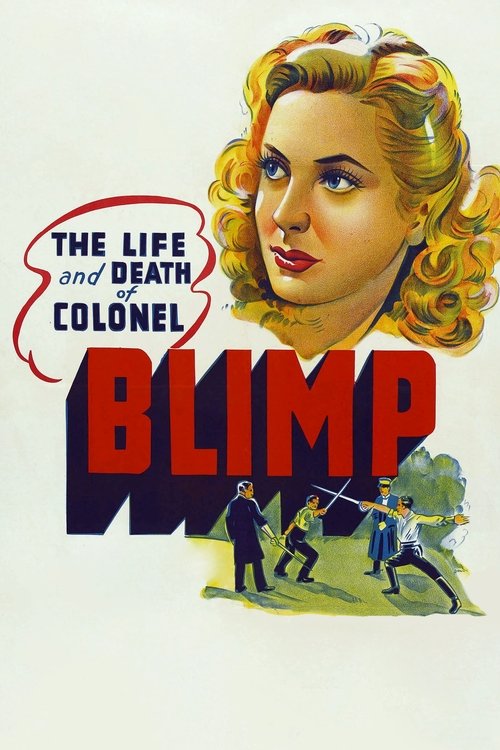
The Life and Death of Colonel Blimp
1943 · Michael Powell
For a long, immersive evening when you want a proper epic with a beating heart — the kind of film that starts as a comedy of manners and sneaks up on you until you're mourning a whole vanished world. Rich comfort viewing that repays your full attention.
What it's about
A blustery old British general — the very image of the out-of-touch military walrus — is humiliated in a 1943 Home Guard exercise by a young officer who refuses to fight by gentlemen's rules. Then the film rewinds forty years to show who he really is: a dashing young soldier of the Boer War, his lifelong friendship with a German officer he first met in a duel, and the three women — all played by Deborah Kerr — who shaped his life. It's the whole arc of a man, and of an England, from swagger to obsolescence.
The experience
Sweeping, funny, and unexpectedly moving — a wartime epic that keeps startling you with its generosity, especially toward its German character. Three decades glide by with wit and visual flourish, and by the end the pompous old fool of the opening has become someone you love.
Performances
Roger Livesey ages forty years on screen with total conviction, turning a national joke into a tragic hero. Anton Walbrook, as his German friend, delivers a late monologue about exile that is one of the most quietly shattering speeches in film, and Deborah Kerr is luminous in three distinct roles.
The craft
The Archers' first Technicolor feature is full of daring shortcuts — a duel whose camera drifts away before the blades cross, decades passing as trophies accumulate on a wall — and its glowing color and 163-minute canvas feel novelistic. The triple casting of Kerr is a structural masterstroke: one ideal of a woman, pursued across a lifetime.
Why it matters
Churchill tried to suppress it for daring to satirize the army and humanize a German in wartime, and it was cut and buried for decades before restoration revealed it as perhaps the greatest British film of its era. Its portrait of honor outliving its usefulness has influenced filmmakers ever since.
Snapshot
The Life and Death of Colonel Blimp is the first Technicolor feature produced by The Archers — the partnership of Michael Powell and Emeric Pressburger — and remains among the most ambitious British films of the war years: a 163-minute, three-decade portrait of a soldier who ages from dashing young hero into the very figure of the pompous, walrus-moustached reactionary that the cartoonist David Low had made a national byword. Structured as an extended flashback bookended by a 1943 Home Guard exercise, the film follows General Clive Wynne-Candy (Roger Livesey) from the Boer War through the First World War to the Blitz, tracing his lifelong friendship with a German officer, Theo Kretschmar-Schuldorff (Anton Walbrook), and his attachment to three women all played by Deborah Kerr. Made under wartime conditions and against the active displeasure of Winston Churchill's government, it is at once a romance, a comedy of manners, an elegy for a vanishing gentlemanly code, and a pointed wartime argument about how — and whether — decency can survive total war. Long circulated in mutilated prints, it was restored decades later into the form now regarded as one of the summits of British cinema.
Industry & production
The film was produced by The Archers, the production banner Powell and Pressburger had established the previous year, and released through General Film Distributors, tied to J. Arthur Rank's expanding British production empire. It was conceived and shot during 1942, at the height of the war, and its independence from direct state commission is central to its story. The most consequential production fact is documented and not legend: the Churchill government regarded the project with hostility. Powell had wanted Laurence Olivier for the lead, and the War Office declined to release Olivier from military service to play it — a refusal generally read as expressing official disapproval rather than mere manpower logic. Surviving government correspondence shows Churchill pressing his Minister of Information, Brendan Bracken, to stop the film, viewing a satirical treatment of a British officer as damaging to morale and to Britain's image abroad; when it could not be suppressed, efforts were reportedly made to hinder its export. The precise mechanics of these interventions are well attested in the archival record, though some of the more colorful anecdotes around them should be treated cautiously.
Casting resolved into the trio that now seems inevitable. Roger Livesey, rather than Olivier, played Candy across roughly forty years of screen age. Deborah Kerr, then very early in her career, was cast in three roles — Edith Hunter, Barbara Wynne, and Angela "Johnny" Cannon — a stroke that became her breakthrough and lifted her toward Hollywood. Anton Walbrook, an Austrian émigré, played the German Theo. The film was among the more costly and logistically demanding British productions of its moment, executed in full three-strip Technicolor at a time when color remained rare and expensive in Britain.
Technology
Colonel Blimp is a landmark of British Technicolor. It used the three-strip Technicolor process, which required the bulky Technicolor camera and the supervision of the company's color consultants — a technically exacting regime that constrained lighting levels and camera mobility. For The Archers it was a first: the film inaugurated the run of saturated, expressive color work that would culminate in Black Narcissus and The Red Shoes. The choice of color for a wartime picture was itself a statement of scale and confidence, given the material shortages of the period. The production also drew on the resources of Denham and the established British studio apparatus, marrying large interior sets to the period reconstruction the sprawling timeline demanded.
Technique
Cinematography
Georges Périnal, the French-born cinematographer who had shot for René Clair and for Alexander Korda's London Films, photographed Blimp, and the film is a showcase for early expressive Technicolor. Périnal renders the period settings — Edwardian drawing rooms, a Berlin nursing home, the wartime present — with a controlled, painterly palette rather than the garish primaries color was often accused of. The camera is used for set-pieces of visual wit as much as for beauty: the film's transitions across decades are frequently managed through elegant camera movement and framing rather than blunt cutting.
Editing
The film was edited by John Seabourne. Its most celebrated formal gesture is structural and elliptical: the passage of years is compressed through inventive elisions — most famously a montage of hunting trophies mounted on Candy's wall standing in for the years and campaigns between episodes, each animal head a date and a place. The long flashback architecture, framed by the 1943 present, requires the cutting to carry decades of ellipsis without losing the thread of character, and it does so with confidence. The opening — a young officer launching a mock-war "before midnight," ambushing the general in a Turkish bath — establishes the framing device that the entire retrospective then explains.
Mise-en-scène / staging
Alfred Junge's production design is fundamental to the film's meaning. The recurring motif of Candy's home, its walls filling with trophies as the years pass, materializes the theme of a life turned into ossified tradition. Junge and the Archers stage each era with period specificity while keeping a stylized, almost storybook clarity. The famous duel sequence in Berlin is a triumph of staging-through-withholding: the camera cranes up and away from the gymnasium just as the saber duel between Candy and Theo is about to begin, refusing the violence and dwelling instead on the ceremony and the snow outside — a decision that tells us the film's true subject is not combat but the relationship it forges.
Sound
Allan Gray composed the score. The sound design supports the film's tonal shifts between comedy, romance, and elegy, and the film's dialogue is unusually literate for its genre — Pressburger's script carries long, shaped speeches that the sound recording foregrounds. Walbrook's great monologue depends entirely on being allowed to run at length in near-stillness.
Performance
The performances are the film's living center. Roger Livesey ages Candy convincingly across forty years, and — crucially — makes the older Blimp figure not a target of ridicule but a man whose rigidities we have watched form; the film's sympathy is his achievement as much as the script's. Deborah Kerr, in three roles, supplies the through-line of idealized womanhood that Candy pursues across a lifetime, differentiating the parts while suggesting why they rhyme in his mind. Anton Walbrook's Theo is the film's moral gravity; his quiet monologue explaining, to a tribunal and to the audience, why he — a German — has come to England, is one of the most affecting passages in British cinema, and it is delivered with a restraint that makes its emotion overwhelming.
Narrative & dramatic mode
The dominant mode is the retrospective life-story: a framing present (1943) that seems to indict its protagonist, followed by a long flashback that reverses our judgment by showing how he became what he is. This structure — begin at the end, then earn the ending — is the film's masterstroke, turning a satirical cartoon premise into a humane biography. Within it the film moves fluidly between registers: romantic comedy in the Edwardian episodes, tragedy in the losses that accumulate, and a debate-drama in the exchanges between Candy and Theo about the ethics of war. The tone is elegiac more than satirical; the "death" of the title is less literal than the death of a worldview.
Genre & cycle
Blimp sits athwart several genres. It is a war film made during a war that contains almost no combat; a romance built on repetition and loss; a comedy that curdles into elegy. As a wartime British production it belongs, awkwardly, to the cycle of morale films — yet it stands against that cycle's grain by refusing simple propaganda, humanizing a German, and questioning whether the old chivalric code is adequate to the new kind of enemy. It is best understood not as a genre exercise but as a deliberate hybrid, characteristic of The Archers' habit of bending established forms to unorthodox ends.
Authorship & method
The film is the product of Powell and Pressburger's shared authorship — the credit "Written, Produced and Directed by Michael Powell and Emeric Pressburger" that The Archers made their signature. Pressburger, a Hungarian émigré, supplied the screenplay's structure and its European moral intelligence, including the sympathetic German and the great immigration speech; Powell supplied the visual command and the taste for spectacle and stylization. The key collaborators recur across their greatest work: cinematographer Georges Périnal; production designer Alfred Junge; composer Allan Gray; editor John Seabourne. The source material was David Low's Evening Standard cartoon figure Colonel Blimp — a byword for reactionary complacency — which the film takes as a provocation and then inverts, asking the audience to love the man behind the caricature. The method is characteristically Archers: take a familiar, even jingoistic-seeming premise, and complicate it into something generous, ambiguous, and formally daring.
Movement / national cinema
The film is a central document of British national cinema and specifically of the Powell–Pressburger strand within it — a body of work that resisted both Hollywood gloss and the sober documentary-realist tradition then dominant in wartime Britain (the Crown Film Unit, the Ealing manner). Where much British wartime cinema pursued restraint and understatement, The Archers pursued color, romanticism, European sophistication, and formal risk. Blimp is also, tellingly, a work shaped by émigré sensibilities — Pressburger, Walbrook, and others — which gave it a continental breadth of feeling unusual in the national output of the period.
Era / period
Colonel Blimp is both set across and made within a sweep of British history. Its narrative spans from the Boer War (c. 1902) through the First World War to the Blitz and the Home Guard of 1943, using one man's biography to chart the passage from Edwardian chivalry to total war. It was produced at the war's midpoint, when its argument — that the gentleman's rules would not defeat Nazism, and that something in the old England had to change — was urgent and, to some in government, dangerous. The film's period detail is meticulous, but its true subject is transition: the sense of a world and an ethic dying while another, harder one is born.
Themes
Its governing theme is the collision between honor and survival — dramatized in Theo's warning that decency and fair play cannot defeat an enemy who respects neither. Around this cluster its other concerns: friendship across enmity (the lifelong bond between an Englishman and a German who fight on opposite sides of two wars); the seductions and dangers of nostalgia; the persistence of an idealized love across a lifetime, figured in Kerr's three roles; and the pathos of obsolescence, as a good man hardens into a relic. Walbrook's monologue about why he fled Germany gives the anti-Nazi theme a moral weight rare in the period. Crucially, the film insists on sympathy for its Blimp: its argument that England must abandon the old rules is inseparable from its tenderness toward the man who embodies them.
Reception, canon & influence
The most famous fact of the film's reception is political: the wartime government's opposition, Churchill's documented attempts to prevent and later hinder it, and the refusal to release Olivier for the lead. Public reception was more favourable than officialdom's, and the film performed respectably, though specific contemporary box-office figures should not be asserted with false precision. What is certain is its subsequent fate: for years Blimp circulated in severely cut versions, its running time and its flashback structure compromised, and its full reputation was recovered only later.
Influences on the film run backward to David Low's cartoon and to the tradition of the British life-and-times novel and drama; to the émigré European culture that Pressburger and Walbrook carried; and to the theatrical, literate screenwriting that distinguished The Archers from their realist contemporaries. Its legacy forward is substantial. The film's restoration — championed by Martin Scorsese and carried out with the involvement of his editor Thelma Schoonmaker (widow of Michael Powell) and archival bodies including the BFI and UCLA — returned it to circulation and to the canon, where it now ranks among the greatest British films in critical polls. Scorsese and other filmmakers have repeatedly cited Powell and Pressburger as formative, and Blimp's humane treatment of a wartime enemy, its confidence in long dialogue, and its retrospective structure have been widely admired. Perhaps its deepest influence is exemplary: it demonstrated that a national cinema could produce, in the middle of a war, a work of ambiguity, generosity, and formal daring — a film that argues for its country's survival without flattering it.
A Deleuzian reading
Look at the wall first.
The full Deleuzian reading of The Life and Death of Colonel Blimp →
Reception
In 1943 Churchill's government tried to strangle it at birth and it was later hacked down for export, circulating for decades in mangled cuts. Since its 1983 restoration it's been steadily canonized as one of the greatest British films ever made, with Scorsese leading the cheerleading.
How The Life and Death of Colonel Blimp was received, from release to now →
How to watch The Life and Death of Colonel Blimp: what to notice on a first viewing
- Notice the mounted animal heads filling Candy's walls. Alfred Junge fills the house with trophies from Candy's campaigns, one head at a time, until the walls hold his whole life instead of a home. The wall turns a man's life into furniture: decades of war reduced to decor on his own drawing room wall.
- Watch the camera crane away just as the duel starts. Powell lifts the camera up and out of the gymnasium the moment the sabers are about to meet, leaving you with falling snow instead of blood. The film cares about the code two enemies share, not about who wins the fight.
- Watch how controlled and painterly the Technicolor stays throughout. Georges Perinal photographs Edwardian rooms and wartime London in a muted, careful palette instead of the garish primaries color film was accused of in this era. The restraint keeps Technicolor a tool for feeling, not spectacle, in one of the first films to use it this way.
- Notice the film opens in 1943 before flashing back decades. A framing present indicts Candy as a pompous relic, then the long flashback that follows spends three hours explaining, and complicating, that first impression. The structure asks you to judge a man first, then spends the rest of the film making that judgment harder.
The whole guide to watching The Life and Death of Colonel Blimp, with the keys for a rewatch →
Influences: the films it descends from and the films it influenced
- La Grande Illusion (1937) — Establishes the humane treatment of the wartime enemy through cross-line officer friendship and the elegiac obsolescence of an aristocratic warrior code — the exact register Pressburger gives Theo the sympathetic German.
- Cavalcade (1933) — The decades-spanning national chronicle told episodically through private lives, running Boer War forward through successive conflicts — the life-and-times structure Blimp inherits and compresses into one man.
- Citizen Kane (1941) — Reconstructs a whole public life in framed flashback from vigor to reactionary isolation, using aging makeup and accreted possessions to mark elapsed time — the retrospective-biography scaffolding Blimp adopts a year later.
- Becky Sharp (1935) — The first three-strip Technicolor feature, staging blocks of dramatic color (the red cloaks at Waterloo) as emotional charge rather than mere realism — the expressive-Technicolor grammar Périnal deploys in Blimp.
- Piccadilly (1929) — Showcases Alfred Junge's UFA-trained monumental studio design and layered depth staging — the same production-design hand and scale Junge brings to Blimp's clubs and Turkish baths.
- The Thief of Bagdad (1940) — Powell's immediate Technicolor apprenticeship with cinematographer Georges Périnal and designer Vincent Korda, learning to control saturated color on constructed sets — the craft team and palette carried directly into Blimp.
- 49th Parallel (1941) — Pressburger's articulate, morally complex German characters and long ideological monologues (Anton Walbrook's Hutterite speech) rehearse Blimp's confidence in sustained spoken argument and its sympathetic émigré voice.
- A Matter of Life and Death (1946) — Reuses Roger Livesey as the reasonable Englishman and stages a literal debate on national character, switching Technicolor and monochrome as an expressive device — the same dialectical, color-conscious method.
- Black Narcissus (1947) — Alfred Junge's wholly studio-built world plus Jack Cardiff's expressive Technicolor push Blimp's color-as-psychology further, with violence and desire withheld and displaced rather than shown.
- The Red Shoes (1948) — Extends Technicolor into pure emotional expressionism on Junge-designed sets, treating color and design as the primary narrative instrument in the Archers manner Blimp pioneered.
- Barry Lyndon (1975) — An ironic, narrated biography charting a man's rise and decline across an era, structured around duels with the violence formally elided — the same retrospective, honor-obsessed shape with withheld combat.
- The Age of Innocence (1993) — By the director who championed Blimp's restoration with Thelma Schoonmaker: lush expressive palette, elliptical dissolves and iris transitions, and passion withheld beneath decorum — Archers craft consciously revived.
- The English Patient (1996) — A life recalled in framed wartime flashback, with romance and loyalty crossing enemy lines and the film's moral sympathy granted to the 'wrong' side — Blimp's flashback frame and enemy-humanising ethic.
- Amadeus (1984) — An entire life narrated retrospectively by an aged rival, using aging-across-decades makeup and a confessional framing device — the same one-life-in-flashback architecture Blimp built around the Turkish-bath frame.
- Cloud Atlas (2012) — Systematises Blimp's one-actor-across-time device (Deborah Kerr as three women; Livesey aging decades) by recasting the same performers through successive eras as its central formal engine.
- Kind Hearts and Coronets (1949) — The one-actor-many-roles conceit (Guinness as eight D'Ascoynes) and the affectionate skewering of English-establishment complacency parallel Blimp's caricature-humanised colonel and Deborah Kerr's three women.
- Reds (1981) — Charts a committed man's life across turbulent decades of history, framing the personal against national-political upheaval with an epic retrospective structure akin to Blimp's era-spanning chronicle.
Similar films
- A Matter of Life and Death (1946) — influence & lineage
- 49th Parallel (1941) — influence & lineage
- Barry Lyndon (1975) — influence & lineage
- The Red Shoes (1948) — influence & lineage
- Kind Hearts and Coronets (1949) — influence & lineage
- Citizen Kane (1941) — influence & lineage
- Grand Illusion (1937) — influence & lineage
- A Canterbury Tale (1944) — shared sensibility
All the films related to The Life and Death of Colonel Blimp →