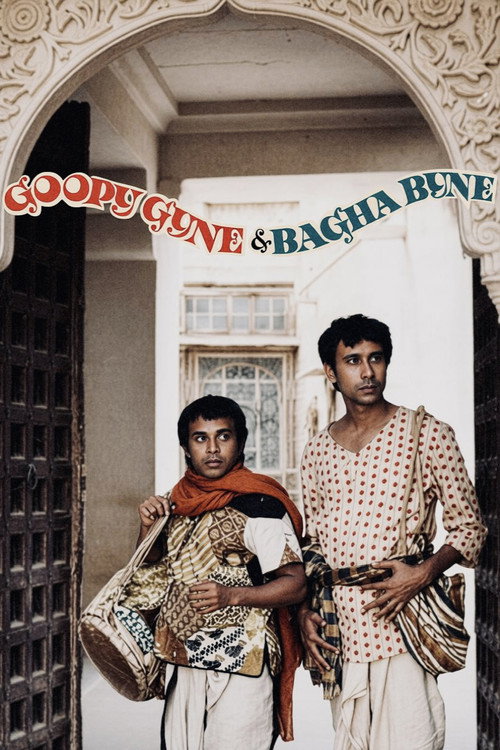
Goopy Gyne Bagha Byne
1969 · Satyajit Ray
For a family night or whenever you need to be charmed — comfort viewing with a conscience. Reach for it when you want songs, magic, and a story where kindness and music beat armies.
What it's about
Goopy can't sing and Bagha can't drum, and both are exiled from their villages for inflicting their music on others. Deep in a forest they charm the King of Ghosts, who grants them three boons — endless food and clothes, instant travel anywhere, and music that holds any listener spellbound. The two amble into neighboring kingdoms where a scheming minister is pushing two realms toward war, and only their songs stand in the way.
The experience
Pure delight — funny, musical, and gently wise, with an eerie ghost sequence that tips into genuine wonder. It has the shape of a bedtime story and the sneaky intelligence of a fable about power and war.
Performances
Tapen Chatterjee and Rabi Ghosh are an irresistible double act as Goopy and Bagha — wide-eyed innocence and earthy comic timing bouncing off each other like a great vaudeville pair.
The craft
Ray adapted a story by his own grandfather and wrote the songs himself, folding folk music into the storytelling so the numbers drive the plot rather than pause it. The black-and-white ghost king's dance is a marvel of inventive, handmade effects — a sequence unlike anything else in his work.
Why it matters
It became one of the biggest hits in Bengali film history, a generational touchstone whose songs and characters entered everyday speech — and it revealed a playful, fantastical side of Ray the world's art-house audiences rarely saw.
Snapshot
Goopy Gyne Bagha Byne is Satyajit Ray's exuberant musical fantasy about two hapless village musicians — Goopy the tuneless singer and Bagha the graceless drummer — who are exiled for their noise, stumble into a forest kingdom of ghosts, and are rewarded by the King of Ghosts with three magical boons: they will never want for food or clothing, they can travel anywhere they wish, and their music will hold any listener spellbound. Armed with these gifts, the pair drift into the neighboring realms of Shundi and Halla, where a scheming minister is engineering a needless war, and they avert the conflict with song rather than swords. Made in black-and-white and adapted from a story by Ray's own grandfather, the film is at once a children's adventure, a folk musical, and a gently pointed anti-war fable. It became one of the most beloved and commercially successful Bengali films of its generation, and stands apart from Ray's better-known realist dramas as proof of his range into pure enchantment.
Industry & production
The film was produced within the Bengali film industry centered on Kolkata (then Calcutta), a regional cinema distinct from the Hindi-language Bombay mainstream and one in which Ray, by 1969, was the towering figure. Ray adapted the story from Goopy Gyne Bagha Byne, a tale written and illustrated by his grandfather Upendrakishore Ray Chowdhury, which had appeared in the children's literary tradition associated with the family's magazine Sandesh (which Ray himself later helped revive). The project carried a personal, almost dynastic weight: Ray was bringing his grandfather's fantasy to the screen, and the film is frequently discussed as one he wished to make in part for younger audiences, including his own son Sandip.
The production was mounted on modest means relative to its ambitions — a fantasy with kingdoms, courts, a ghost ballet, and elaborate musical numbers demanded scale that Bengali budgets rarely afforded. Ray has been widely quoted over the years describing the practical strain of financing the film; the honest position for a dossier is that precise budget figures are not reliably documented in a form worth citing here, and the commonly repeated anecdotes about last-minute funding should be treated as part of the film's lore rather than as established accounting. What is firmly established is the outcome: upon release the film was an enormous popular success in Bengal, enjoying an exceptionally long theatrical run and becoming, by broad critical consensus, one of the biggest Bengali box-office hits of its time. Exact grosses and run-lengths circulate in varying forms across sources, so specific numbers are best avoided; the qualitative fact of a landmark commercial triumph is not in dispute.
Technology
The film was shot on 35mm black-and-white stock at a moment when Ray had not yet moved decisively into color (his first color feature, Kanchenjungha, predated it, but monochrome remained his default). The fantastical premise nonetheless pushed Ray and his crew toward optical and in-camera experimentation unusual in his filmography. The celebrated dance of the ghosts is the clearest instance: Ray used tonal reversal, superimposition, silhouette, and rhythmic editing to conjure a supernatural realm out of purely photographic means, working within the technical limits of a monochrome production rather than against them. The magical elements — teleportation by clapping the enchanted footwear, food and finery appearing on command — were realized through cuts, simple in-camera effects, and staging rather than elaborate optical wizardry, in keeping with the resources available. The result demonstrates how much fantasy Ray could extract from disciplined, economical technique.
Technique
Cinematography
The cinematography is by Soumendu Roy, Ray's regular camera collaborator in this period. Roy's work moves fluidly between two registers: the grounded, folk-realist texture of the villages and the open landscape through which Goopy and Bagha wander, and the stylized, high-contrast unreality of the ghost sequence. The forest encounter with the ghosts is the visual set-piece — built on stark silhouettes, negative-image inversions, and layered figures that transform the screen into a graphic field rather than a naturalistic space. Elsewhere the film's photography favours clarity and legibility appropriate to a story aimed partly at children, with clean compositions of the two kingdoms' courts and broad framings that let the physical comedy of the leads play out.
Editing
Editing is by Dulal Dutta, Ray's long-standing editor. The cutting is most conspicuous in the musical and fantasy passages, where rhythm is bound tightly to Ray's score — the ghost dance in particular depends on editorial timing to sustain its hypnotic, percussive momentum. Across the narrative the film balances leisurely, comic observation of its two protagonists against the compression required to keep a fantasy-adventure moving, and Dutta's work supports Ray's characteristic control of pace: unhurried where character and humor need room, decisive where spectacle demands it.
Mise-en-scène / staging
Ray's staging leans into a storybook theatricality suited to the material's origins in illustrated children's literature. The two kingdoms are conceived as contrasting worlds — Shundi peaceful (and, in a memorable conceit, struck mute by an epidemic) and Halla militarized and misgoverned — and their courts, costumes, and processions are composed with a designer's eye. Ray, who did much of his own production design and drew extensively in his working notebooks, gives the film a coherent visual grammar in which the comic, the courtly, and the uncanny each have a distinct look. The doubling of the two kings, both played by the same actor, is a staging idea as much as a casting one, underscoring the fable's point that the warring realms are essentially kin.
Sound
Sound is central rather than decorative, since the film's entire premise turns on music and its power over listeners. The songs are integrated into the action as narrative agents — Goopy and Bagha's performances literally freeze armies and win over kings — so the sound design must sell music as magic. The boons themselves are sonically coded: the clap that summons food and transport makes gesture and sound inseparable. Ray's approach treats the soundtrack as a dramatic instrument, with the musical numbers functioning as plot mechanism, comic engine, and thematic statement at once.
Performance
The film rests on the pairing of Tapen Chatterjee as Goopy and Rabi Ghosh as Bagha, and their chemistry is its foundation. Ghosh, an accomplished comic actor, brings expert physical timing to Bagha; Chatterjee gives Goopy a wide-eyed, guileless warmth. Together they sustain a double-act that is affectionate rather than merely buffoonish, and the film's emotional generosity flows largely from them. Santosh Dutta takes the dual role of the twin kings of Shundi and Halla, a performance that leans into the fable's symmetry. The supporting court figures — the scheming minister and the sinister magician who keep Halla's king in thrall — are played in a broad, near-pantomime register appropriate to the genre. Across the cast Ray directs toward a heightened but controlled comic style that never tips into shapelessness.
Narrative & dramatic mode
The dramatic mode is fable-comedy: a picaresque quest structure in which two innocents, granted extraordinary powers, wander from misadventure toward a benevolent resolution. The narrative follows a clean folk-tale arc — exile, magical intervention, the acquisition of gifts, a series of trials, and the aversion of catastrophe — and its logic is that of the fairy story rather than psychological realism. Yet Ray threads a serious spine through the whimsy: the looming war between Shundi and Halla is engineered by a corrupt minister and sustained by the drugging or bewitching of Halla's king, so the plot's engine is misrule and manipulation, and its resolution is the triumph of art and appetite over aggression. The film's tone modulates deftly between slapstick, wonder, suspense, and a final, almost utopian sweetness, holding these in a single coherent register.
Genre & cycle
The film is a musical fantasy-adventure with strong comic and family-film dimensions — a combination rare in Ray's output and rare in Bengali cinema of the period at this level of ambition. It draws on the deep well of Bengali children's literature and folk-tale, and it belongs to a small, distinguished cycle of Ray films addressed to younger audiences and to the fantastic, alongside his later detective and adventure works. Most significantly, it initiated its own cycle: the Goopy-Bagha characters returned in Hirak Rajar Deshe (1980), Ray's more overtly political sequel set in a tyrant's diamond kingdom, and again in Goopy Bagha Phire Elo (1992), directed by Ray's son Sandip Ray. The 1969 film is thus both a standalone classic and the origin point of a franchise unique in Ray's career.
Authorship & method
The film is a near-total expression of Ray as a multiply-gifted author. Beyond writing the screenplay and directing, Ray composed the music himself — a decisive step in his development as a film composer, since for much of his early career he had worked with established classical musicians before assuming full musical authorship of his films. Here he wrote the songs and score, drawing on classical, folk, and popular Bengali idioms, and the results became genuinely popular music, sung and remembered far beyond the film. Ray also drew heavily on his skills as illustrator and designer, and the project's roots in his grandfather Upendrakishore's story make the film an act of familial and cultural transmission. His key screen collaborators are the recurring nucleus of his unit: cinematographer Soumendu Roy and editor Dulal Dutta, both long associated with Ray's method of careful pre-visualisation and controlled execution. The authorship story here is unusually concentrated — writer, director, composer, and designer converging in one figure — which is part of why the film feels so personal despite its genre trappings.
Movement / national cinema
Ray is the central figure of the parallel or "art" tradition of Indian cinema and, more locally, of a serious Bengali film culture that positioned itself against the commercial mainstream. Internationally he is a cornerstone of the mid-century wave of humanist auteur cinema that made Indian film visible on the world stage, above all through the Apu Trilogy. Goopy Gyne Bagha Byne complicates the received image of that movement: it shows the leading realist of Indian art cinema working in fantasy, music, and comedy for a mass and juvenile audience, and finding his largest domestic popular success in doing so. The film thus sits at an instructive intersection — auteurist in authorship and craft, popular and folkloric in address — and demonstrates that the Bengali art tradition was never sealed off from entertainment.
Era / period
Released in 1969, the film arrives in the middle of Ray's career and at a turbulent moment in West Bengal, a region entering years of political unrest and economic strain. It is tempting, and defensible, to read the film's anti-war, anti-tyranny fable against that backdrop, though the story's ultimate source predates the period by decades. In the arc of Ray's own work, the late 1960s find him broadening his range — moving between intimate contemporary dramas and, here, large-scale fantasy — and consolidating his authorship of the musical dimension of his films. The picture belongs to the black-and-white maturity of his style, just before and around his fuller embrace of color.
Themes
The film's governing theme is the power of art — specifically music — as an alternative to violence: Goopy and Bagha disarm conflict not by force but by enchantment, and the climactic aversion of war is achieved through song and the satisfaction of hunger rather than through battle. Related is a pointed critique of misrule and manipulation, embodied in the corrupt minister and the magician who bewitch a king and manufacture a war for their own ends; the fable insists that ordinary people, even foolish ones, can undo the schemes of the powerful. The doubling of the two kings as brothers dramatizes the futility and near-fratricidal absurdity of war. Running beneath these is a warm populism — an affection for the humble, the appetite for food and comfort treated as legitimate and even redemptive, and a faith in innocence. The ghost dance carries a further layer of social observation: the ghosts are organized into distinct groups often read as representing the strata of society — the corpulent and well-fed, the common laboring people, kings and warriors, and holy men — so that even the film's most purely magical set-piece encodes a comment on class and power. (This reading is well established in the critical literature; the precise categorization is sometimes described in varying terms.)
Reception, canon & influence
Critically and popularly, the film was a triumph. It won major national honors, including recognition as Best Feature Film and for Ray's direction at India's National Film Awards for 1969, and it achieved a scale of popular affection in Bengal that few "art-cinema" directors' works ever reach, becoming a perennial favorite across generations and a fixture of Bengali cultural memory. Its songs entered the popular repertoire, and the characters became folk figures in their own right.
Looking backward, the film's influences are primarily literary and cultural rather than cinematic: it descends directly from Upendrakishore Ray Chowdhury's story and from the broader tradition of Bengali children's literature, folk-tale, and nonsense-and-fantasy writing associated with the Ray family (a lineage that also includes Sukumar Ray). Ray's own developing command of film music and design, honed across the preceding decade, is the other decisive input.
Looking forward, its legacy is substantial and multi-layered. It founded a beloved franchise, directly generating Hirak Rajar Deshe (1980) and, after Ray's death, Goopy Bagha Phire Elo (1992) under Sandip Ray, and it cemented Goopy and Bagha as enduring icons of Bengali popular culture. Within Ray's oeuvre it demonstrated, and licensed, his continued work in fantasy and children's storytelling. More broadly it stands as a landmark example of an auteur bridging art and mass entertainment without condescension — a model of how a serious filmmaker could make a genuinely popular, genuinely humane fantasy. Its combination of whimsy, musical invention, and quiet moral seriousness continues to make it one of the most cherished works in all of Indian cinema.
A Deleuzian reading
Two hands come together, and there is food on the plate.
The full Deleuzian reading of Goopy Gyne Bagha Byne →
Reception
An instant, colossal hit in Bengal — one of the longest theatrical runs in Bengali cinema history — while the West long filed it away as 'Ray's children's film,' a footnote to the Apu Trilogy. It's since been reappraised as one of his very best: a pacifist fantasy-musical that plays to all ages.
How Goopy Gyne Bagha Byne was received, from release to now →
How to watch Goopy Gyne Bagha Byne: what to notice on a first viewing
- Watch what happens to the image the instant they clap. Ray marks every use of the magic boots with a clap and a straight cut, no dissolve or effect, so the two men simply are somewhere else the next frame. The magic lives entirely in the edit; the join between two shots is doing the trick, not anything inside either shot.
- Watch the ghosts appear as stark, inverted silhouettes. The forest sequence uses negative-image inversion and layered figures to turn the screen into a graphic pattern rather than a naturalistic space. The technique alone tells you that you have left the ordinary world, before anything in the story says so.
- Watch Goopy's wide-eyed openness against Bagha's careful comic timing. Chatterjee plays Goopy guileless and eager while Ghosh gives Bagha a slower, more deliberate physical comedy, and the two rhythms play off each other constantly. Their double act works because they never rush to match each other, which is where most of the film's warmth comes from.
- Listen for how the score locks tightly to the ghost dance's rhythm. Dutta's editing depends on Ray's own percussive score to sustain the sequence's hypnotic momentum, image and beat cut to match exactly. The music is not accompaniment here; it is setting the pace the picture itself has to follow.
- Notice how differently the two kingdoms' courts are designed. Shundi is staged as peaceful and struck mute by illness while Halla is militarized and misgoverned, and the same actor plays both kings. Casting one man as both rulers tells you the two warring sides are basically kin, without a single line of dialogue saying so.
The whole guide to watching Goopy Gyne Bagha Byne, with the keys for a rewatch →
Influences: the films it descends from and the films it influenced
- Pather Panchali (1955) — Established the Ray production unit and his early reliance on a hired classical master (Ravi Shankar) for scoring — the exact dependency GGBB overturns by having Ray compose every song and cue himself.
- Jalsaghar (The Music Room) (1958) — Pioneered Ray's use of embedded live musical performance as a dramatic engine rather than decoration, the seed of GGBB's music-as-plot-mechanism where songs literally cast spells and end wars.
- Parash Pathar (The Philosopher's Stone) (1958) — Ray's earlier comic-fantasy register in which a single magic object drives a picaresque of social satire — the structural template for the three magical boons granting food, travel, and song.
- Le Voyage dans la Lune (1902) — Codified in-camera stop-substitution trickery and painted storybook theatricality — the same conjuring grammar behind the ghost king's appearances and the genie-granted boons staged as frontal spectacle.
- Nosferatu (1922) — Used photographic tonal reversal (printing sequences in negative) to render the uncanny, the exact technical device Soumendu Roy deploys in the ghost-dance to make the spirits read as inverted light.
- Das Cabinet des Dr. Caligari (1920) — Modeled high-contrast silhouette and stylized, overtly theatrical set-staging of the supernatural that GGBB channels in its shadow-play compositions of ghosts and kings against flat backdrops.
- Bronenosets Potyomkin (Battleship Potemkin) (1925) — Demonstrated the self-contained rhythmic montage set-piece Ray admired; Dulal Dutta cuts the wordless ghost-dance as percussive Eisensteinian montage timed to drumbeats rather than dialogue.
- Fantasia (1940) — Established image choreographed beat-for-beat to a score with no dialogue — the direct precedent for GGBB's four-tiered ghost ballet built entirely on music-and-movement synchronization.
- The Gold Rush (1925) — The pantomime tramp-duo blending slapstick with pathos underwrites the Goopy–Bagha comic double-act, whose physical clowning and outsider tenderness follow Chaplin's mime-comedy method.
- Hirak Rajar Deshe (1980) — Direct sequel that extends the songs-as-plot mechanism and Ray's self-composed score into pointed political allegory, with rhyming dialogue as a new formal escalation of the musical device.
- Goopy Bagha Phire Elo (1992) — Franchise continuation preserving the comic double-act casting logic and Ray's classical-folk musical idiom as an inherited house style after Satyajit Ray's death.
- Sonar Kella (The Golden Fortress) (1974) — Extends Ray's picaresque-quest structure for a young audience with Ray again as sole composer, carrying forward the travel-across-landscape scoring practiced in GGBB.
- The Darjeeling Limited (2007) — Openly Ray-indebted: Anderson lifts actual cues from Ray's films for his soundtrack and adopts the flat, frontal storybook staging that GGBB's fable theatricality helped codify.
- The Kingdom of Diamonds (1980) — The direct predecessor: it establishes the two-vagabond-musician heroes, the three boons, the in-camera match-cut magic (a clap dissolving them from place to place), and Ray's own composed songs as narrative engine — Hirak inherits this entire folk-musical-fantasy apparatus wholesale.
- Bhuvan Shome (1969) — Released the same year within Indian parallel cinema, it pursues gentle picaresque satire of authority through a wandering-bureaucrat structure paralleling GGBB's art-over-power fable.
- Meghe Dhaka Tara (1960) — Bengali parallel-cinema counterpart that weaponizes expressionist sound and folk-classical music as an emotional-narrative mechanism, the non-comic sibling to GGBB's sound-as-plot approach.
Similar films
- Pather Panchali (1955) — influence & lineage · same viewing thread
- The Kingdom of Diamonds (1980) — same viewing thread
- The Music Room (1958) — same viewing thread
- The World of Apu (1959) — same viewing thread
- Aparajito (1956) — same viewing thread
- Charulata (1964) — same viewing thread
- The Cloud-Capped Star (1960) — same viewing thread
- The River (1951) — same viewing thread
All the films related to Goopy Gyne Bagha Byne →
Watch it with: curated runs of related films
- Satyajit Ray's Bengal — A run through Ray's Bengal — the mud-and-monsoon village of the Apu films, the decaying aristocracy of The Music Room and Devi, the hushed Calcutta drawing rooms of Charulata — where ordinary lives turn quietly monumental.