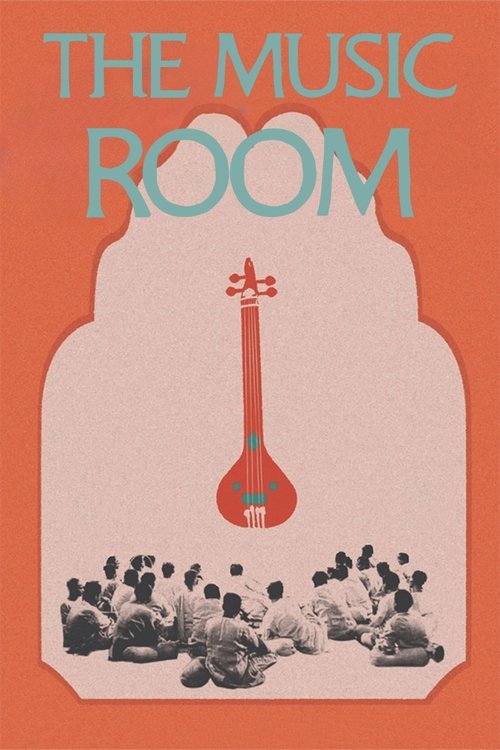
The Music Room
1958 · Satyajit Ray
For a contemplative evening when you want beauty and sadness together — patient, immersive cinema to sink into rather than something that grabs you; a challenge for the restless, a treasure for the attuned.
What it's about
In early twentieth-century Bengal, an aging zamindar — the last landlord of his line — sits in his crumbling riverside palace, his fortune nearly gone. The one extravagance he cannot give up is the jalsa: lavish private evenings of classical music and dance staged in his ornate music room. When a newly rich neighbor starts throwing his own opulent concerts, the old aristocrat stakes what remains of his wealth, and his legacy, on outdoing him.
The experience
Slow, stately, and quietly devastating — a film that moves at the pace of a dying way of life and lets full musical performances breathe on screen. It's melancholy rather than depressing, hypnotic if you give yourself over to its rhythm.
Performances
Chhabi Biswas is monumental as the zamindar Biswambhar Roy — imperious, vain, and heartbreaking, conveying an entire dying class in the way he lights a hookah or listens to a song.
The craft
Satyajit Ray builds the film almost entirely around one man and one decaying house, and the music room itself — its chandeliers, mirrors, and shadows — becomes a character. The Indian classical music and dance sequences are presented whole, with real reverence, and the film rewards good speakers as much as a big screen.
Why it matters
One of Ray's most celebrated films and a touchstone of world cinema's portraits of fading aristocracy, made between panels of the Apu Trilogy and long cherished for putting Indian classical performance on film with total integrity.
Snapshot
Jalsaghar (The Music Room) is Satyajit Ray's chamber tragedy of a Bengali feudal aristocracy expiring in the early twentieth century — a film built almost entirely around a single decaying figure and the crumbling great house he refuses to abandon. Biswambhar Roy, the last zamindar of his line, has ruined himself sustaining the one extravagance that still confers meaning on his existence: the jalsa, the private evening of classical music and dance staged in the ornate music room of his palace on the eroding banks of the Padma. Made in the interval between two panels of the Apu Trilogy, it is Ray's most concentrated study of a dying order, and one of the works in which his commitment to the integrity of Indian classical performance is most fully realized on film. The picture pairs a nearly static narrative with sustained musical sequences, producing an elegiac tempo that later became one of the signatures critics associate with Ray's mature style.
Industry & production
Jalsaghar was produced in 1958 within the Bengali-language film industry centered in Calcutta, and adapted from a short story by the celebrated Bengali novelist Tarasankar Bandyopadhyay. It arrived at a specific practical juncture in Ray's career: the international success of Pather Panchali (1955) and Aparajito (1956) had established him, but financing the third Apu film was not immediate, and Ray turned to a project he believed carried built-in commercial appeal. Because the story foregrounded classical music and dance — reliable draws for Bengali audiences — Ray anticipated that the film's musical sequences would give it a broader popular reach than his neorealist debut. The record on precise budgets and box-office figures is thin, and I will not invent numbers; what is reliably reported is that the film performed respectably in Bengal and helped consolidate Ray's domestic standing, even as some early Western viewers found its pace forbidding.
The production drew on the small, tightly knit collaborative unit Ray had assembled on the trilogy — the same cinematographer, editor, and art-direction sensibility — while adding, crucially, a roster of genuine classical musicians and dancers to perform the film's set-piece soirees. Location work centered on a real decaying palace, whose weathered grandeur Ray used rather than fabricating opulence in the studio, in keeping with his preference for authentic texture over set-bound artifice.
Technology
The film was shot on 35mm black-and-white stock, the standard for Indian art and commercial cinema of the period, in the Academy ratio. Ray and his cinematographer worked within the ordinary technical constraints of late-1950s Calcutta production — modest equipment, limited lighting resources, and the challenge of registering both the deep shadow of interiors and the flat glare of riverbank exteriors on the available emulsions. As was common in Indian filmmaking of the era, dialogue and music were handled through post-synchronized recording rather than live sync sound, which suited a film so dependent on capturing full-length musical performances at controllable fidelity. The most consequential "technology" of Jalsaghar is arguably musical rather than photographic: the decision to record and present classical performances at length, letting a raga or a dance unfold in something closer to its real duration than the abbreviated song sequences typical of popular cinema.
Technique
Cinematography
The photography is by Subrata Mitra, Ray's cinematographer from Pather Panchali onward and one of the major figures in the international history of black-and-white image-making. In Jalsaghar Mitra renders the music room as a pool of chiaroscuro — chandelier light catching gilt and mirror, faces emerging from surrounding darkness — while the exteriors present the opposite register: a blanched, depopulated landscape of sandbars and slow water, the great house reduced to a silhouette against an emptying sky. Mitra's control of tonal range lets the film move between these two visual worlds, the enclosed richness of memory and performance and the desolate openness of the present. Recurrent compositional motifs — the huge portrait of Roy's ancestors, the chandelier, the mirror in which the zamindar confronts his own aging face — organize the frame around images of vanity and lineage.
Editing
Dulal Dutta, Ray's regular editor, cut the film to a deliberately unhurried rhythm. The editing serves an essentially contemplative structure: a framing present in which the ruined Roy sits on his terrace, and extended flashbacks to the soirees of his prosperity. Within the musical sequences the cutting is restrained, holding on performers and listeners so that the music dictates the pace rather than being carved up to service plot. The result is a montage logic closer to duration and reverie than to conventional dramatic acceleration — a patience that reads as elegy.
Mise-en-scène / staging
The staging is dominated by the music room itself, a space that functions as the film's psychological and thematic center. Ray choreographs the jalsas as ritual: the arrangement of musicians, the seating of guests, the passing of the hookah, the play of light on the chandelier, all establish a hierarchy of patronage in which Roy presides as connoisseur and lord. Objects carry the film's meaning — the ancestral portraits watch over the room, an insect struggling in a glass and a spider crossing a portrait supply images of decay without a word of commentary. Against this interior, the exterior staging insists on erosion: the encroaching river, the idle elephant and horse, the sandy waste where cultivated land once stood.
Sound
Sound is inseparable from the film's subject. The musical performances are given room to breathe, and the contrast between the vibrancy of music inside the room and the wind, water, and silence outside becomes a structuring device. A storm on the river — carrying the tragedy that destroys Roy's family — is realized through sound as much as image. Ray's attentiveness to the soundscape, the way ambient quiet presses against the remembered music, contributes heavily to the film's mood of aftermath.
Performance
The film rests almost entirely on Chhabi Biswas as Biswambhar Roy, one of the leading actors of the Bengali stage and screen. Biswas gives the zamindar a compound of hauteur, tenderness, self-pity, and destructive pride, aging visibly across the flashback structure from imperious patron to spectral survivor. There is a well-documented irony, which Ray himself recorded in his writings, in the casting: Biswas was famously not a musical man, so the role of a character defined by his connoisseurship of classical music had to be built through performance rather than any personal affinity for the art. The surrounding performances — the servants who remain, the parvenu neighbor — are pitched to frame Biswas, whose face, especially in the mirror and terrace scenes, becomes the film's essential landscape.
Narrative & dramatic mode
The dramatic mode is tragic and retrospective rather than propulsive. The narrative is organized as a memory play: a ruined man in the present, and the recovered past that explains his ruin. The engine of the plot is a rivalry — between the old aristocrat Roy and his upstart, newly moneyed neighbor Mahim Ganguli — but Ray refuses to treat this as conventional conflict. Roy's competitive spending on ever more lavish soirees is at once his assertion of superiority and the mechanism of his self-destruction, and the film's central catastrophe (the death of his wife and son crossing the river) arrives as consequence rather than as melodramatic incident. The mode is closer to classical tragedy — pride confronting a changed world — than to social realism, and its climax is less a plot resolution than a final, doomed gesture of aristocratic self-assertion.
Genre & cycle
Jalsaghar sits at the intersection of drama and the "music film," but it belongs to neither in the conventional Indian sense. It is not a popular musical with interpolated song-and-dance numbers; rather it absorbs full classical performances into a serious dramatic frame. Within Ray's own output it inaugurates a recurring preoccupation with the decline of the Bengali gentry and the passing of feudal and colonial-era orders — a thematic cycle to which he would return in later works examining aristocracy, patronage, and historical change. It can be read alongside a broader mid-century world-cinema interest in the twilight of aristocracies, though Ray's treatment is grounded specifically in the Bengali zamindari system.
Authorship & method
Ray directs, wrote the screenplay adaptation of Bandyopadhyay's story, and shaped the film's overall design in keeping with his hands-on, total-authorship method. His approach here reflects the influences that formed him — the humanism and location realism absorbed from Italian neorealism, and the lessons in composition and mise-en-scène he took from assisting Jean Renoir during the shooting of The River in Bengal — but Jalsaghar is a more enclosed, formally stylized work than the trilogy, a deliberate turn toward interior, ritualized space.
The key collaborators form the core Ray unit. Cinematographer Subrata Mitra supplies the tonal architecture. Editor Dulal Dutta builds the film's contemplative rhythm. The music is composed by the sitar master Ustad Vilayat Khan, and the film incorporates performances by classical artists — including a celebrated kathak dance sequence performed by Roshan Kumari — that Ray treated as documentary-grade records of the traditions his story mourns. (Accounts vary in the precise attribution of every vocal and instrumental performer in the soiree sequences; where the record is inconsistent I decline to assign specific credits I cannot verify.) The collaboration between a director staging the decline of musical patronage and living master musicians performing within the fiction gives the film an unusual authority.
Movement / national cinema
The film is a foundational work of what became known as the Indian art cinema, or "parallel cinema" — the strand of serious, auteur-driven filmmaking Ray effectively opened in the Indian context and distinct from the mainstream commercial industry. It is equally central to Bengali cinema specifically, drawing on Bengal's literary culture (Tarasankar Bandyopadhyay), its classical and semi-classical musical traditions, and its historical experience of the zamindari system. Internationally, Jalsaghar helped define the profile of the postcolonial art film reaching festival and repertory audiences in the late 1950s and 1960s.
Era / period
Produced in 1958, the film belongs to the first flowering of independent India's serious cinema, only a decade after Independence, and to the moment when Ray was establishing Indian film as a presence on the world festival circuit. Its diegetic setting reaches back earlier — to the early decades of the twentieth century, when the landed aristocracy of Bengal was being economically displaced by a rising commercial class and by the erosion, literal and figurative, of the old agrarian order. The film thus looks from the vantage of the new nation back at the class whose passing it both mourns and judges.
Themes
The governing theme is the decline of feudal aristocracy and the collapse of the patronage system that had sustained classical art. Roy embodies a culture in which the connoisseurship and support of music was a mark of nobility; his ruin dramatizes the disappearance of that role and, with it, an entire economy of art. Interlocking themes include pride and its self-destruction; the confrontation between inherited status and new money; nostalgia and the seductions of the past; and time and mortality, figured throughout in images of dust, decay, mirrors, and the encroaching river. Ray's stance is finely balanced — the film is neither a simple elegy for a vanished grandeur nor a straightforward indictment of parasitic feudalism, but holds both, honoring the beauty the old order patronized while registering the vanity and human cost of Roy's refusal to let it go.
Reception, canon & influence
Critical reception developed over time. Some early Western critics found the film slow and its idiom unfamiliar, and it did not travel as immediately as Pather Panchali; but its reputation grew steadily, and it is now widely regarded as one of Ray's finest achievements and a landmark of world cinema, sustained in the repertory canon through restoration and reissue. In Bengal it reached a broad audience in its own time, helped by exactly the musical appeal Ray had anticipated.
Looking backward, the influences on the film are legible: Ray's formation under Renoir's example and his absorption of neorealism, filtered through his own literary sensibility and his deep engagement with Bengali culture and Hindustani classical music. The source material in Bandyopadhyay's fiction rooted the film in a specifically Bengali literary tradition of writing about the declining gentry.
Looking forward, Jalsaghar shaped both Ray's own subsequent cinema — his continued return to themes of aristocratic and historical decline — and the wider development of Indian parallel cinema, offering a model of how classical performance and serious dramatic form could be integrated without dilution. It has been admired by filmmakers and critics internationally as a demonstration of the elegiac, patient, image-and-music-driven mode Ray commanded, and its imagery of the last patron in his crumbling music room has become one of the enduring emblems of his body of work. Where specific individual testimonies of influence are sometimes cited loosely, I note only what is securely established: the film's durable place in the Ray canon and in the history of Indian art cinema.
A Deleuzian reading
An insect is thrashing in a glass of liquor.
The full Deleuzian reading of The Music Room →
Reception
Ray made it hoping for a commercial hit after Aparajito underperformed in Bengal, and Indian audiences initially gave it a lukewarm shrug — but Western critics slowly fell hard for it, and a 1981 Paris re-release turned it into an arthouse sensation. Today many cinephiles quietly rank it above the Apu Trilogy as Ray's masterpiece.
How The Music Room was received, from release to now →
How to watch The Music Room: what to notice on a first viewing
- Watch how the guests and musicians are seated in the music room. Ray choreographs each soiree as a ritual of hierarchy: where people sit, who passes the hookah, all mark Roy's place as patron and lord. The seating plan is the whole social order, laid out for you to read before anyone explains it.
- Watch chandelier light catch gilt and mirror inside the music room. Mitra lights the interior in rich chiaroscuro, faces emerging from dark, while the riverbank outside stays flat and blanched under an empty sky. The two kinds of light split the film into a lit memory and a drained present.
- Notice the insect struggling in a glass of liquor. Ray holds on small, unremarked details like this, and a spider crossing an ancestral portrait, without a word of commentary. The house is quietly full of small, doomed things, and nobody in it is minding.
- Watch Roy's face in the mirror when he looks at himself. Biswas ages visibly across the flashback structure, his hauteur and self-pity both legible in the same unhurried close-up. His face becomes the film's real landscape, more telling than anything the plot does.
- Listen for a full raga or dance allowed to run at length. Ray lets the classical performances play out close to their real duration rather than cutting them down to serve the plot. The film hands its own time over to the music, so you feel duration the way the listeners do.
The whole guide to watching The Music Room, with the keys for a rewatch →
Influences: the films it descends from and the films it influenced
- The River (1951) — Ray apprenticed on this Bengal shoot, absorbing Renoir's patient deep-focus mise-en-scène and the framing of ritual and landscape in long, composed takes — the direct schooling behind Jalsaghar's staged interior space.
- Devi (1960) — Ray again stages a Bengali feudal household's ruin in Mitra chiaroscuro with objects and rooms carrying symbolic weight — the immediate continuation of Jalsaghar's enclosed-interior method.
- Goopy Gyne Bagha Byne (1969) — Pioneered Ray's use of embedded live musical performance as a dramatic engine rather than decoration, the seed of GGBB's music-as-plot-mechanism where songs literally cast spells and end wars.
- The Rules of the Game (1939) — The great country house as a theater for a dying leisure class, choreographed in deep-focus ensemble movement through its salons — the model for treating an aristocratic dwelling as the stage-set of social obsolescence.
- Citizen Kane (1941) — Chiaroscuro deep-focus interiors of a decaying mansion (Xanadu) plus a flashback/memory structure that emblematizes a great man's isolation — the template for Jalsaghar's ruined room and its retrospective narration.
- The Magnificent Ambersons (1942) — The mansion itself as the embodiment of a superseded gentry, its decline charted through deep-focus staircase and hall compositions rather than dialogue — kin to Ray's use of the crumbling house as protagonist.
- Bicycle Thieves (1948) — The neorealist humanism and location realism Ray openly credited as formative, carried into Jalsaghar's grounding of a stylized fable in observed material texture and behavior.
- La Terra Trema (1948) — Long observational takes documenting a family's economic ruin within its actual locale — the neorealist method of filming a class's decline in situ that Ray inherited and stylized.
- Ugetsu (1953) — Long-take moving-camera duration fused with classical (Noh-derived) performance in an elegiac tale of ruined status — a precedent for treating diegetic classical music and slow temporal rhythm as the film's dramatic spine.
- Sunset Boulevard (1950) — The decaying grand mansion as mausoleum for an obsolete glory, inhabited by a self-destructively proud performer staging one final show — the same house-and-last-performance architecture as Biswas's zamindar.
- Pather Panchali (1955) — Established the Ray unit Jalsaghar reuses: Subrata Mitra's naturalistic bounce-lit interiors and Dulal Dutta's contemplative, duration-led cutting.
- Kaagaz Ke Phool (1959) — A music-driven tragedy of fading glory rendered in high-contrast expressionist chiaroscuro (V.K. Murthy), the artist-patron consumed by his own decline — a sibling elegy for a vanishing creative order.
- Meghe Dhaka Tara (1960) — Fellow Bengali parallel-cinema work using expressive, heightened diegetic sound and classical-derived music as dramatic architecture rather than accompaniment — a sibling in the same movement's sound practice.
- Sahib Bibi Aur Ghulam (1962) — The crumbling zamindar mansion and its doomed feudal household rendered in expressionist chiaroscuro — a direct descendant transposing Jalsaghar's decline-of-Bengali-gentry subject into studio-lit melodrama.
- The Leopard (1963) — An aristocrat presiding over his own class's extinction, with the great ballroom set-piece functioning as extended elegy and the score saturating the film — the definitive expansion of Jalsaghar's feudal-decline mode.
Similar films
- Charulata (1964) — influence & lineage · same viewing thread · often watched together
- Pather Panchali (1955) — influence & lineage · same viewing thread · often watched together
- Devi (1960) — influence & lineage · same viewing thread · often watched together
- The River (1951) — influence & lineage · same viewing thread
- The Leopard (1963) — influence & lineage · often watched together
- Aparajito (1956) — same viewing thread · often watched together
- The Hero (1966) — same viewing thread · often watched together
- The Cloud-Capped Star (1960) — same viewing thread · often watched together
All the films related to The Music Room →
Watch it with: curated runs of related films
- Satyajit Ray's Bengal — A run through Ray's Bengal — the mud-and-monsoon village of the Apu films, the decaying aristocracy of The Music Room and Devi, the hushed Calcutta drawing rooms of Charulata — where ordinary lives turn quietly monumental.