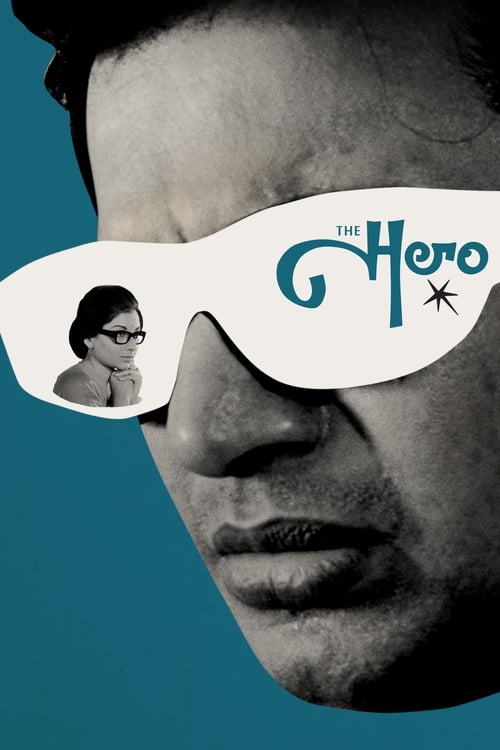
The Hero
1966 · Satyajit Ray
For a reflective evening when you want conversation over spectacle — a film about celebrity and regret that you'll chew on for days. Contemplative rather than comforting, but gentle in its way.
What it's about
Arindam, the biggest movie star of the Bengali screen, boards an overnight train from Calcutta to Delhi to collect a national award. In the next compartment is Aditi, a young magazine editor who reluctantly starts interviewing him — and, disarmed by her lack of awe, he begins to open up. Over twenty-four hours of corridors, dining cars, memories, and uneasy dreams, the polished public idol slowly comes apart, revealing the fears and compromises underneath the fame.
The experience
Intimate and conversational, with an undertow of melancholy — it feels like being seated close enough to a famous stranger to watch the mask slip. The pace is unhurried but never slack; two dream sequences give it a startling, uneasy charge.
Performances
Uttam Kumar, the actual reigning star of Bengali cinema, plays the matinee idol with astonishing candor — he lets vanity, charm, and self-loathing coexist in a single glance, and Sharmila Tagore matches him with cool, probing intelligence as the journalist.
The craft
Satyajit Ray wrote this original screenplay himself and stages nearly the whole film inside a moving train, turning compartments and corridors into a portable confessional. The flashbacks and nightmare imagery are cut with surgical precision, and the confined setting rewards close, patient viewing.
Why it matters
A landmark of Indian cinema's psychological turn, it cast Bengal's biggest star as a version of himself and became one of Ray's most quietly influential films — a template for stories that unmask fame from the inside.
Snapshot
Nayak (নায়ক, "The Hero") is Satyajit Ray's chamber study of celebrity and conscience, unfolding almost entirely over a twenty-four-hour train journey from Calcutta to Delhi. Arindam Mukherjee, the reigning matinee idol of the Bengali screen, is traveling to accept a national award when a chance encounter with Aditi, the young editor of a women's magazine, loosens his guard. Across the compartment corridors and the dining car, and through a series of flashbacks and two hallucinatory dreams, the poised public man is progressively unmasked — his fear of decline, his compromises, his guilt, his loneliness. It is one of only two wholly original screenplays Ray wrote (with Kanchenjungha, 1962), and it remains among his most psychologically interior films: a portrait of a star cast, pointedly, with the biggest star in Bengal.
Industry & production
Nayak was produced within the Bengali-language film industry centered on Calcutta ("Tollywood"), which by the mid-1960s ran on a parallel-track economy: a popular commercial cinema of romances and melodramas — the world Arindam inhabits within the fiction — and the smaller art cinema that Ray himself had defined internationally since Pather Panchali (1955). The film's decisive industrial gesture was Ray's casting of Uttam Kumar, the era's supreme Bengali romantic star and the living embodiment of exactly the mass stardom the film anatomizes. Building an original, self-reflexive screenplay around Uttam Kumar folded the star's real public aura into the character, a meta-textual charge audiences of the day would have felt immediately. It was Ray's first film with Uttam Kumar; they would reunite the following year on the detective picture Chiriyakhana (1967).
Ray worked here, as usual, with a settled repertory company of collaborators (Subrata Mitra, Bansi Chandragupta, Dulal Dutta), a continuity of craft that gave his productions their consistency of finish. Precise production budget and box-office figures are not something I can state reliably, and I won't invent them; the film is generally understood to have been a substantial critical and popular success at home, buoyed by Uttam Kumar's drawing power, but I'd flag the specific commercial record as thin in the sources available to me.
Technology
The film was shot on 35mm black-and-white stock in the Academy ratio, the standard format for Ray's 1960s work before his later, occasional moves toward larger frames. Its central technical problem was spatial and logistical: how to stage a feature almost entirely inside a moving train. The solution was studio-based — a railway carriage interior reconstructed as a set (the work of art director Bansi Chandragupta), allowing controlled lighting and camera placement, intercut with location and exterior material of the train in motion to sustain the illusion of a real journey. The confinement is a technological and design constraint turned into dramatic asset: the fixed geometry of berths, corridors, windows and dining car becomes the stage on which strangers are forced into proximity. Ray, characteristically, also served as his own music director and worked closely on the sound conception, so that the mechanical rhythm of the train itself functions as an organizing sonic bed.
Technique
Cinematography
Cinematographer Subrata Mitra, Ray's collaborator since Pather Panchali and a pioneering figure in Indian cinematography, faced the classic challenge of a cramped, high-contrast interior. Mitra was internationally known for developing bounce lighting — diffusing light off a reflective surface (famously, off stretched cloth to simulate an even Indian sky) to achieve soft, naturalistic illumination — and the enclosed train interior of Nayak rewards that sensibility with modeled, unglamorous light on faces held in sustained close conversation. The camera favors the two-shot and the reaction shot, the grammar of an interview and a confession, and reserves its most stylized image-making for the dream sequences, where the naturalism breaks. The découpage is disciplined rather than showy: the film's visual tension comes from how long Ray holds on a face as its composure slips.
Editing
Editor Dulal Dutta, Ray's lifelong cutter, carries the film's most demanding structural task — braiding three temporal registers (the present-tense train journey, Arindam's remembered past, and his dreams) into a legible whole. The flashbacks are triggered associatively, by a word from Aditi or a fellow passenger, so that the cutting dramatizes the mechanism of memory and self-justification rather than merely illustrating backstory. The transitions into the dream sequences are the film's boldest editorial gestures, where the ordinary continuity gives way to a more abrupt, disquieting montage.
Mise-en-scène / staging
The staging is a masterclass in confined blocking. Ray choreographs an ensemble of secondary passengers — an advertising man maneuvering to land an account, an elderly moralist scandalized by the actor, an anxious couple with an ailing child — into a moving social microcosm around the star, each subplot a small mirror of ambition, compromise and vanity that rhymes with Arindam's own. Within this bustle, the core of the film is the repeated, quiet two-person tableau of Arindam and Aditi, staged across the intimate distance of facing seats. The dream imagery supplies the film's most famous mise-en-scène: Arindam adrift in a nightmarish landscape of money — mounds of banknotes, ringing telephones, grasping hands — a surreal externalization of the wealth and celebrity that are drowning him.
Sound
Ray composed the score himself, as he had since the early 1960s, and his musical instinct here is restrained: the film leans heavily on ambient sound — the ceaseless clatter and sway of the train — as an emotional undertow, a rhythm of forward motion beneath a man reckoning with his past. Dialogue carries the picture, and the sound design sharpens the contrast between the noise of the public carriage and the pockets of hushed confession. The dream sequences deploy sound expressionistically, the insistent ringing of telephones lending the money-nightmare its anxiety.
Performance
Uttam Kumar's performance is the film's engine and its subject. Playing a matinee idol, he calibrates two registers: the burnished public charm of the star as the world sees him, and the fatigue, dread and self-disgust that leak through when the mask is down — much of it conveyed in small facial adjustments held in close-up. It is widely regarded as one of his finest performances, precisely because Ray asked the era's great glamour actor to interrogate glamour. Sharmila Tagore (already a Ray veteran from the Apu trilogy and Devi) plays Aditi with a watchful intelligence, a listener whose own moral position shifts over the journey — she arrives with a journalist's instinct to expose and departs having chosen discretion. The ensemble of character actors fills the carriage with sharply observed social types.
Narrative & dramatic mode
The dramatic mode is psychological realism organized as a confessional. Structurally the film is a huis clos on rails: a unity of place and near-unity of time (a single journey) into which memory and dream intrude. Its architecture is the intimate interview — a stranger's non-judgmental attention drawing out what could not be said to intimates — and its engine is gradual revelation rather than plot. Aditi functions as confessor and surrogate for the audience, and the drama's quiet ethical climax is her decision not to write the exposé her notes could have become: the film withholds the conventional payoff of scandal in favor of an act of grace. The dreams operate as a parallel confessional the waking man cannot control, telling us what he will not tell Aditi.
Genre & cycle
Nominally a drama, Nayak is more precisely a character study / psychological portrait and belongs to the small but distinct cycle of films about stardom and the film industry's own machinery. Within Ray's output it pairs with Kanchenjungha as his original-screenplay chamber dramas of the mid-1960s, marking his turn from literary adaptation and rural subjects toward contemporary, urban, bourgeois milieux. It sits within the broader international lineage of the "reckoning journey" film, and its self-reflexive interest in acting and celebrity connects it to the perennial cinema-on-cinema tradition, though Ray strips that tradition of glamour and treats the star as a case study in modern alienation.
Authorship & method
Nayak is a near-total authorial statement: Ray wrote the original screenplay, composed the music, and — as was his practice — was deeply involved in every design and technical decision, from storyboarding to sound. Writing an original rather than adapting a Bengali literary source (his more usual method, from Bibhutibhushan Bandyopadhyay to Tagore) freed him to build the material around a single contemporary idea and a single specific actor. His method here is one of compression and observation: an ordinary premise (a train ride) engineered to force interiority to the surface. His key collaborators are the constants of his cinema — cinematographer Subrata Mitra, art director Bansi Chandragupta, and editor Dulal Dutta — the team whose long-running partnership underwrites the technical assurance of the film. The decision to have Aditi ultimately protect her subject reflects Ray's habitual humanism: a refusal of cheap judgment even toward a flawed and privileged man.
Movement / national cinema
The film is a landmark of parallel cinema / the Bengali art film, the tradition Ray inaugurated and led, which pursued realism, social observation and psychological seriousness against the grain of mainstream Indian commercial cinema. Nayak is a particularly pointed intervention within that national-cinema context because it stages the very tension between art and commerce internally — casting a mass-market idol, in an art film, as a mass-market idol who once trained in the "serious" theater. Through Arindam's flashbacks (his dying stage mentor's contempt for the movies; a politically committed friend's demand for engagement) the film dramatizes the ethical arguments Bengali intellectual culture leveled at popular cinema, and lets its star embody the cost of that divide.
Era / period
Nayak is a document of mid-1960s urban Bengal and of a modernizing, anxious postcolonial middle class. Its texture is contemporary and metropolitan: advertising men and magazine editors, the aspirational world of "modern" womanhood that Aditi's publication addresses, the prestige economy of national awards. Made a decade after Pather Panchali, it marks Ray's full arrival in the present tense and in the city, part of the sequence of 1960s films in which he turned his realist attention on his own class. The train — a colonial-inherited technology carrying the new India between its old and new capitals — is an apt vessel for a story about a country and a man in transit between past selves and public roles.
Themes
The governing theme is the hollowness of fame and the alienation of the public self: the gap between the adored image and the frightened person inside it. Around this cluster: guilt and conscience (the compromises and betrayals Arindam has committed en route to the top — of mentors, friends, principles, and possibly a woman); the fear of decline, embodied in the memory of a faded older actor and haunting a star at his peak; art versus commerce, the reproach of the serious theater against the money of the movies, literalized in the drowning-in-cash dream; and modernity and moral choice, carried by Aditi, the emancipated professional woman who wields — and then relinquishes — the power to destroy him. Underneath runs a Ray constant: the possibility of grace between strangers, the idea that honesty and forgiveness may be more available to a passing acquaintance than to those we live among.
Reception, canon & influence
Nayak was well received critically on release and traveled internationally: it screened in competition at the Berlin International Film Festival in 1966, where it drew critical honors. I'd flag the precise citation of the Berlin awards as something I can't confirm exactly from memory — it is commonly reported to have taken a critics'/special jury recognition there — so I'll state the festival presence with confidence and leave the exact prize wording as uncertain rather than invent it. Over time the film has risen in estimation, frequently cited among Ray's major achievements and, together with Charulata (1964), as evidence of his mastery of the intimate, adult, contemporary drama; Uttam Kumar's performance is routinely singled out as a high point of both his career and Indian screen acting.
Influences on the film (backward): Critics have long read Nayak against *Ingmar Bergman's Wild Strawberries** (1957) — the shared architecture of a journey undertaken to receive an honor, punctuated by flashbacks and dreams, through which an eminent man confronts a compromised life. Ray admired Bergman, and the kinship is structural and thematic, though Ray's idiom is more socially observant and less overtly symbolic. The film's self-reflexive fascination with a great man reconstructed through interview and memory also invites comparison to the psychological-portrait tradition associated with Citizen Kane*, and its interior monologue and dream-logic reflect Ray's broad absorption of European modernist cinema. Any more specific line of borrowing beyond the well-attested Bergman affinity I'd treat as speculative.
Legacy (forward): Within Ray's own body of work, Nayak consolidated the mode of the contemporary psychological chamber drama and stands as a definitive fusion of star power and art-cinema seriousness — a template for using a popular icon self-reflexively. It endures as one of the essential films about film stardom from world cinema, and its central conceit (the celebrity unmasked over a confined journey by a sympathetic outsider) has proved a durable dramatic shape. Restored and re-circulated in later decades, it remains a touchstone in the study of Ray, of Uttam Kumar, and of Indian parallel cinema's engagement with its own commercial twin.
A Deleuzian reading
Somewhere between Calcutta and Delhi, a young woman stops taking notes.
The full Deleuzian reading of The Hero →
Reception
In 1966 it was an event in Bengal — art-house Ray directing Uttam Kumar, the biggest matinee idol in Bengali cinema — and it picked up a Special Jury prize at Berlin, yet for decades it sat in the shadow of the Apu Trilogy and Charulata as 'minor Ray.' The 2010s restoration changed that: it's now routinely called one of his very best.
How The Hero was received, from release to now →
Influences: the films it descends from and the films it influenced
- Wild Strawberries (1957) — The journey-to-collect-an-honor frame, interrupted by dream and flashback that force an eminent man to reckon with a compromised life, is the structural template Ray openly adapts.
- Citizen Kane (1941) — Reconstructs a celebrated public figure through a probing interlocutor and fragmented overlapping flashbacks — the psychological-portrait-by-inquiry method Nayak's train interview echoes.
- Aparajito (1956) — Subrata Mitra pioneered bounce lighting here (light thrown off a stretched cloth to mimic diffuse daylight), the soft interior modeling carried directly into Nayak's train compartments.
- Brief Encounter (1945) — Builds a full confessional chamber drama around a railway journey and candid disclosure to a stranger, pairing train rhythm with first-person interior narration.
- Rashomon (1950) — Establishes subjective flashback as self-serving, unreliable memory — the guilt-inflected recollection grammar Nayak's dream-flashbacks draw on.
- Seemabaddha (1971) — Extends Nayak's contemporary-urban-Calcutta portrait of a successful man's moral compromise as an original-screenplay study of ambition's cost.
- Jana Aranya (1976) — Continues the self-interrogating chamber study of Calcutta careerism and quiet ethical erosion that Nayak inaugurated in Ray's contemporary mode.
- Before Sunrise (1995) — Extends the train-bound two-hander in which strangers reach confessional intimacy across a single bounded journey, letting talk carry the whole structure.
- The Player (1992) — Carries forward the self-reflexive film-about-the-industry mode, exposing the commercial machinery behind the manufactured famous face.
- Birdman (2014) — A confined backstage unmasking of a screen celebrity's ego and self-loathing, extending the popular-icon-used-self-reflexively portrait.
- Locke (2013) — Compresses an entire confessional psychological portrait into one confined journey — the huis-clos-in-transit device Nayak built around a train ride.
- Charulata (1964) — Same Mitra/Chandragupta/Dutta team delivering intimate two-shot blocking and bounce-lit interiors in a compressed contemporary adult chamber drama.
- 8½ (1963) — Turns a celebrated artist's creative and moral crisis inward through interwoven dream, memory, and fantasy — the self-reflexive-star-interiority mode Nayak works in a realist key.
- Persona (1966) — A two-hander huis-clos in which a quiet listener gradually unmasks a performer, built on sustained close two-shots and confessional exchange.
- Kaagaz Ke Phool (1959) — Indian self-reflexive drama on the hollowness of screen stardom, staging a fallen-idol arc via expressive light shafts that parallels Uttam Kumar's unmasked star.
- La Dolce Vita (1960) — Anatomizes celebrity and the press's fabrication of the famous — the art-versus-fame tension Nayak dramatizes between star and interviewing journalist.
Similar films
- Charulata (1964) — influence & lineage · same viewing thread · often watched together
- Aparajito (1956) — influence & lineage · same viewing thread · often watched together
- Brief Encounter (1945) — influence & lineage
- Pather Panchali (1955) — same viewing thread · often watched together
- Devi (1960) — same viewing thread · often watched together
- The Music Room (1958) — same viewing thread · often watched together
- The Big City (1963) — same viewing thread · often watched together
- The World of Apu (1959) — same viewing thread
All the films related to The Hero →
Watch it with: curated runs of related films
- Satyajit Ray's Bengal — A run through Ray's Bengal — the mud-and-monsoon village of the Apu films, the decaying aristocracy of The Music Room and Devi, the hushed Calcutta drawing rooms of Charulata — where ordinary lives turn quietly monumental.