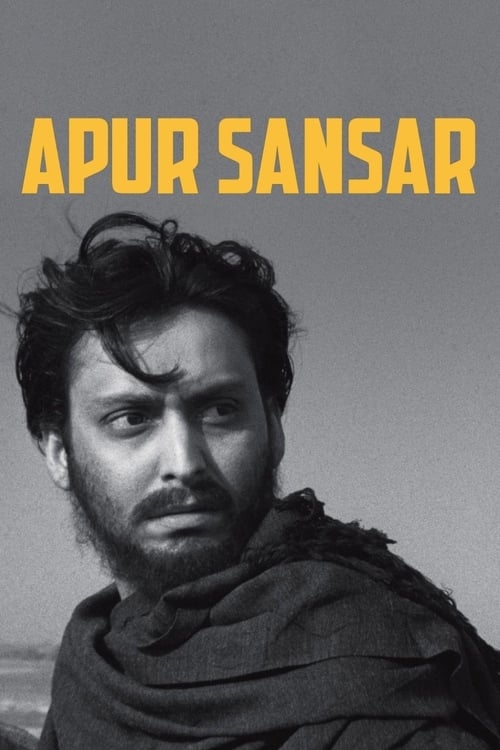
The World of Apu
1959 · Satyajit Ray
For when you need to feel something real — a film for a quiet, undistracted evening when you're ready to be moved. Bring your whole heart; it's a good-cry film that ends in grace rather than despair.
What it's about
Apu, the orphaned village boy now grown, lives in a rented Calcutta room above the railway line — a jobless ex-student half-heartedly writing a novel drawn from his own life. A friend's invitation to a village wedding upends everything, sweeping him by a strange turn of custom into an unplanned marriage that changes what his life is for.
The experience
Tender, intimate, and emotionally enormous — it moves from wry poverty-line comedy to one of cinema's most delicate portraits of young love, then into territory that will simply break your heart and mend it. Few films earn their emotions this completely.
Performances
Soumitra Chatterjee, in his first film role, gives Apu a dreamy, wounded openness that made him Ray's lifelong on-screen alter ego, and Sharmila Tagore — astonishingly young — makes Aparna luminous with almost no dialogue, mostly glances and small gestures.
The craft
Ray builds emotion from everyday textures: a hairpin, a curtain, the rattle of passing trains under the window. The black-and-white photography finds beauty in a shabby rooftop room, Ravi Shankar's score carries what words don't, and the storytelling trusts silence more than speeches.
Why it matters
It completes the Apu Trilogy, the work that put Indian cinema on the world map and made Ray an international master; its humanist, detail-driven style has shaped filmmakers across generations and continents.
Snapshot
Apur Sansar — The World of Apu — is the third and concluding film of Satyajit Ray's Apu Trilogy, following Pather Panchali (1955) and Aparajito (1956). It carries the orphaned village boy of the earlier films into adulthood in Calcutta, where Apu is an unemployed graduate living in a rented room above a railway line, half-heartedly writing a novel that mirrors his own life. A chance trip to a friend's family wedding delivers him, through a sudden turn of custom and superstition, into an unplanned marriage to Aparna; a brief, luminous domestic happiness is broken by her death in childbirth; and the film's final movement traces Apu's collapse into grief, his abandonment of his infant son, and an eventual, hard-won reconciliation. Adapted from Bibhutibhushan Bandyopadhyay's Bengali novel Aparajito, the film completes a coming-of-age cycle widely regarded as one of the summits of world cinema and as the work that carried Indian art film onto the international stage. It also marks the screen debuts of two performers who would become central to Ray's cinema and to Bengali culture more broadly: Soumitra Chatterjee as Apu and Sharmila Tagore as Aparna.
Industry & production
The film was produced within Ray's own production setup, an arrangement that had grown out of the precarious, near-improvised financing of Pather Panchali, which Ray had begun without a completed budget and which was ultimately completed with support from the Government of West Bengal. By 1959 Ray was no longer an untested advertising illustrator but an internationally recognized director whose first two features had won prizes at Cannes and Venice, and the third film could be mounted with comparatively more security, though still on the modest scale characteristic of Bengali "parallel" or art cinema rather than the commercial Bengali and Hindi industries of the day.
Production drew on the same core creative team Ray had assembled and largely trained on the earlier films: cinematographer Subrata Mitra, art director Bansi Chandragupta, editor Dulal Dutta, and composer Ravi Shankar. Shooting combined Calcutta locations — the crowded, water-stained cityscape, the rooftop and the railway that runs past Apu's window — with the riverine Bengal countryside for the wedding sequence and studio interiors for the newlyweds' room. Ray worked, as was his practice, from detailed pre-visualization: he sketched shots and worked out staging in advance, functioning as his own screenwriter and effectively as a hands-on collaborator in every department. The casting of unknowns — Chatterjee was a young radio announcer and stage aspirant, Tagore a schoolgirl of around fourteen — reflected both Ray's neorealist-influenced preference for faces without prior screen associations and the economics of a small production.
Technology
Apur Sansar was made in 35mm black-and-white, using the equipment and film stock available to a low-budget Bengali production of the late 1950s — resources markedly more limited than those of contemporaneous Hollywood or European studio filmmaking. This scarcity is central to the film's technical achievement rather than incidental to it: much of what is celebrated in the trilogy's image-making came from ingenuity worked against constraint. Subrata Mitra's most influential contribution, the technique of "bounce lighting," had been developed on Aparajito — famously to render the soft, ambient daylight of a Benares courtyard by bouncing studio light off a stretched white cloth to simulate an overcast sky — and by Apur Sansar it had become a mature part of his method, allowing interiors to be lit with a naturalistic, diffuse evenness rather than the hard modeled key-light of conventional studio practice. Location sound recording of the era was difficult, and post-synchronization and studio-built sound were part of the workflow. In every respect the film exemplifies how the Apu Trilogy turned technological modesty into an aesthetic signature.
Technique
Cinematography
Mitra's photography is the film's most immediately arresting technical dimension. His bounce-lit interiors give the newlyweds' shabby room a gentle, wraparound light that reads as tender rather than merely poor, and his handling of the Calcutta exteriors — smoke, monsoon skies, the passing trains whose recurring presence threads through the whole trilogy — sustains a documentary texture without sacrificing composition. Mitra favors patient framing and a sensitivity to reflected and filtered light; the camera observes more than it dramatizes, holding on faces and gestures. The train, a leitmotif from the boyhood field of Pather Panchali, returns here transformed into the sound and light of adult domestic life, and Mitra's images repeatedly bind Apu's inner states to the material world around him.
Editing
Dulal Dutta, Ray's regular editor across his career, cuts the film in the unhurried, observational rhythm that defines the trilogy. Scenes are allowed to breathe; emotional turns are given time to register on the actors' faces rather than being compressed for pace. The film's most discussed editorial and dramatic decision is its treatment of Aparna's death, which occurs offscreen and is conveyed obliquely — the narrative withholds the event and lets its meaning arrive through aftermath. This elliptical construction, refusing melodramatic display at the moment of maximum grief, is characteristic of Ray's restraint and depends on precise control of what the cut shows and withholds.
Mise-en-scène / staging
Bansi Chandragupta's art direction and Ray's staging make the cramped Calcutta room a fully expressive space: the domestic details of the young couple's life — a hairpin, a note, the small economies of poverty — carry the film's tenderness. Ray stages the marriage sequence around the mechanics of custom and the auspicious hour, using the rural setting and ritual framework to make Apu's improbable decision to marry Aparna feel both sudden and morally weighted. Throughout, staging privileges the ordinary: the drama emerges from everyday arrangement of bodies in modest rooms rather than from theatrical blocking.
Sound
Ravi Shankar's score, built on Indian classical idiom, is used sparingly and pointedly, marking transitions and emotional swells while leaving much of the film to ambient sound — above all the recurrent noise of the passing train, which functions almost as a second musical motif. Ray's attentiveness to the soundscape of place, evident from the earliest film, here fuses the industrial city with the interior life of its characters. (Ray would begin composing his own scores a few years later, but for the trilogy the music is Shankar's.)
Performance
The performances are the film's living center. Soumitra Chatterjee, in his screen debut, gives Apu an intelligence, humor, and vulnerability that carry the character from youthful drift through married contentment to devastation and near-dissolution; the role launched one of the great actor-director partnerships in film history, Chatterjee going on to appear in many later Ray films. Sharmila Tagore, also debuting and very young, makes Aparna's brief presence indelible, so that her absence governs the film's long final act. The performances are pitched in Ray's naturalistic register — small, precise, unforced — and the child actor playing Apu's son, Kajal, sustains the difficult closing reconciliation without sentimentality.
Narrative & dramatic mode
The film's mode is intimate realist drama organized as the culminating chapter of a bildungsroman. Its structure falls into three broad movements: Apu's aimless bachelor life and the accident of his marriage; the idyll of married poverty in Calcutta; and the long descent and recovery after Aparna's death. The dramaturgy is elliptical and restrained, trusting understatement over exposition — most conspicuously in withholding the death itself — and it resolves not in tragedy but in a tempered, humanist affirmation as Apu accepts his son. The narrative closes the trilogy's larger arc of loss (mother, father, sister, wife) with an image of continuity and forward movement, the child lifted onto the father's shoulders.
Genre & cycle
Apur Sansar belongs to the genre of literary-realist drama and, more specifically, to the coming-of-age film, but its defining generic identity is as the third panel of a trilogy — one of the most complete and influential film cycles ever made. The Apu Trilogy adapts material from two Bandyopadhyay novels (Pather Panchali and Aparajito) into a continuous three-film life story, and Apur Sansar must be understood as both a self-standing work and the resolution of a cumulative structure whose meaning depends on the two earlier films.
Authorship & method
The film is a definitive expression of Ray as an auteur in the fullest sense: he wrote the screenplay, designed the visual conception through his own sketches and storyboards, directed the actors, and exercised close control over every craft department. His method fused a European-influenced formal rigor with a deeply Bengali literary and cultural sensibility rooted in Bandyopadhyay's source novels and in Ray's own background as a graphic designer and illustrator. Crucially, Ray's authorship was collaborative in practice: the trilogy's achievement is inseparable from cinematographer Subrata Mitra, whose bounce-lighting and location photography shaped the films' visual language; composer Ravi Shankar, whose scores gave them their musical identity; art director Bansi Chandragupta; and editor Dulal Dutta. Ray had co-founded the Calcutta Film Society in 1947 and came to filmmaking through cinephilia and design rather than the commercial industry, and this formation is legible in the trilogy's disciplined, image-led construction.
Movement / national cinema
The film is the keystone work of the emergence of a serious Indian art cinema distinct from the commercial mainstream, and it is central to what would later be discussed as the roots of "parallel cinema" in India. Ray's practice was shaped by the international art-film currents of the postwar period — above all Italian neorealism and the humanism of Jean Renoir — but he transposed those influences into a specifically Bengali idiom grounded in regional literature, landscape, and social texture. Within world cinema, the Apu Trilogy became the work through which Indian filmmaking first entered the international critical canon as an art form.
Era / period
Made at the end of the 1950s, the film sits within a remarkable decade for international art cinema and within a formative period for postcolonial Indian culture, India having become independent in 1947. Its portrait of an educated but unemployed young man adrift in Calcutta, and of the persistence of custom and superstition alongside urban modernity, registers the textures of its moment. Ray's realism was itself part of a broader late-1950s global turn toward location shooting, non-professional or unknown performers, and everyday subject matter.
Themes
The film's governing themes are loss, grief, and endurance — the trilogy's Bengali title-word aparajito, "the unvanquished," names the animating idea of a life continually stripped of its attachments yet carried forward. It explores the tension between vocation and circumstance in Apu's abandoned literary ambitions; the collision of custom and contingency in his marriage; the transfiguration of poverty by love; and, in its final movement, fatherhood, responsibility, and the moral recovery of a man who has withdrawn from the world. Underlying all of these is Ray's characteristic humanism: a refusal of both sentimentality and despair, and an insistence on the dignity and continuity of ordinary life.
Reception, canon & influence
Critically, Apur Sansar was received as a worthy and moving conclusion to a trilogy that had already made Ray an internationally celebrated figure, and it has retained that standing; the Apu Trilogy as a whole is a fixture of international critics' and scholars' lists of the greatest films ever made, and the trilogy's restoration and rerelease in later decades renewed its canonical status for new audiences. The film received festival recognition in its time — it is generally credited with the Sutherland Trophy at the British Film Institute's London Film Festival — though scholars and viewers should confirm specific award particulars against authoritative records, as the exact roster of honors is the kind of detail sometimes misattributed.
The influences on the film (backward) are well documented in Ray's own account of his formation: Italian neorealism, and specifically the experience of seeing Vittorio De Sica's Bicycle Thieves in London in 1950, which crystallized his ambition to make films rooted in location, ordinary people, and real social texture; and Jean Renoir, whom Ray met and observed during the Bengal shooting of The River around 1949–50 and whose humanist example he repeatedly acknowledged. Beneath these cinematic models lies the primary source, Bandyopadhyay's Bengali fiction, and the visual sensibility Ray brought from graphic design and illustration.
The influence forward (legacy) is far-reaching. The trilogy established that a filmmaker working outside the commercial industry, in a regional Indian language and on a modest budget, could produce work of international artistic significance, and it is routinely cited as a foundational reference for later Indian art cinema and for humanist realism worldwide; the admiration of filmmakers such as Akira Kurosawa and Martin Scorsese for Ray is frequently noted, and Scorsese's association with the film-preservation effort that restored the trilogy is part of its ongoing afterlife. For Bengali and Indian cinema specifically, the film launched Soumitra Chatterjee and Sharmila Tagore, both of whom became major figures, and it consolidated the collaborative model — Ray with Mitra, Shankar, Chandragupta, and Dutta — that would define one of the most respected bodies of work in film history.
A Deleuzian reading
A train goes past Apu's window and the light from it swings across the wall of the rented room.
The full Deleuzian reading of The World of Apu →
Reception
Acclaimed from the start — it took India's President's Gold Medal and the Sutherland Trophy — though some Bengali critics sniped at it, prompting Ray to publish a written defense. Today it's routinely called the emotional peak of the Apu Trilogy, and the 2015 4K restoration brought a whole new generation to it.
How The World of Apu was received, from release to now →
How to watch The World of Apu: what to notice on a first viewing
- Listen for the train passing outside Apu's window. Its noise takes over the room for a few seconds each time, then leaves the space quieter than before, recurring across the whole film. Each return of the sound carries a little more weight than the last.
- Notice how evenly the light falls in the newlyweds' room. Mitra bounces studio light off white cloth rather than using a hard key light, so the shabby room glows evenly wall to wall. The poverty is never spotlit, which is why the room reads as tender rather than as evidence.
- Notice how long scenes run after the information has arrived. Ray and editor Dulal Dutta let ordinary moments, a hairpin, a note, small arithmetic, continue well past the point where the plot needs them. The story pauses to let a day simply be lived.
- Watch faces held still instead of reacting quickly. Chatterjee and Tagore are given long, quiet holds where a single feeling sits on the face without being pushed into a line of dialogue. A single feeling gets to sit on a face without being explained by dialogue.
- Notice the small objects that fill the cramped room. A hairpin, a note, the visible arithmetic of very little money, carry the tenderness of the couple's daily life. These small things are doing the work of showing you a marriage instead of describing one.
The whole guide to watching The World of Apu, with the keys for a rewatch →
Influences: the films it descends from and the films it influenced
- Bicycle Thieves (1948) — Ray credited seeing it in London in 1950 as the model for shooting on real locations with ordinary people and unforced social texture rather than studio artifice — the neorealist method Apu's Calcutta tenement scenes directly apply.
- The River (1951) — Ray observed Renoir composing humanist deep-focus tableaux of Bengal on location during the 1949–50 shoot, absorbing the patient, non-judgmental framing of everyday gesture that governs Apu's domestic staging.
- Rome, Open City (1945) — Established the neorealist genre innovation of building drama from actual streets and improvisatory faces, the formal permission Ray extended to a regional-language, non-industrial Indian cinema.
- Umberto D. (1952) — Its long, near-plotless attention to mundane routine (the maid waking, the dog) models the everyday-detail staging Ray uses to make Apu's poverty and marriage felt through small physical business rather than incident.
- La Terra Trema (1948) — Proved that a regional dialect and non-professional community could carry a feature of serious artistic ambition, the precedent for Ray casting Bengali literary realism with newcomers Chatterjee and Tagore.
- Pather Panchali (1955) — The trilogy's first film, where Subrata Mitra's location photography and Ravi Shankar's sitar-based scoring established the exact visual-musical grammar Apur Sansar concludes, including the recurring train motif as leitmotif of departure.
- Aparajito (1956) — Mitra invented his signature bounce-lighting here — reflecting studio light off cloth to mimic diffuse Benares skylight — the soft, sourceless interior illumination carried straight into Apu's garret in the sequel.
- Charulata (1964) — Ray and Mitra push the bounce-lit interior and Chatterjee's restrained naturalism further into a chamber study of a marriage, continuing the collaborative Ray–Mitra–Chandragupta–Dutta authorship consolidated by the trilogy.
- Bhuvan Shome (1969) — Widely marked as the launch of the Indian New Wave, it applies Ray's proof that low-budget, location-based art cinema outside the commercial industry was viable, extending the parallel-cinema model.
- Ankur (1974) — Builds a rural social-realist drama on non-star, first-time performers and location photography, directly inheriting the naturalistic-debut casting and image-led construction Ray institutionalized.
- Elippathayam (1981) — Extends Ray's disciplined, elliptical construction — meaning built through omission and precisely composed everyday detail rather than exposition — into Malayalam parallel cinema.
- Salaam Bombay! (1988) — Casts real street children as non-professional debuts and shoots on actual Bombay locations, carrying the neorealist-humanist lineage Ray transmitted from De Sica into a later Indian generation.
- Devi (1960) — Devi reunites its two leads, Soumitra Chatterjee and Sharmila Tagore, one film after their screen marriage here, importing the intimate, understated playing style Ray had just drawn from the pair.
- Do Bigha Zamin (1953) — An explicitly Bicycle Thieves–inspired Indian neorealism, shooting rural dispossession and Calcutta streets with the same location-and-ordinary-people ethic Ray was developing in parallel.
- The 400 Blows (1959) — A contemporaneous location-shot bildungsroman that draws its truth from a naturalistic child/youth debut (Léaud) observed without sentimentality — the same coming-of-age realism Apu embodies through Chatterjee's first performance.
- Meghe Dhaka Tara (1960) — The other pillar of Bengali parallel cinema, extending Ray's location-rooted postcolonial realism about the refugee family into a formally distinct (expressionist-sound) register within the same movement.
- The Music Room (1958) — Shot within the same trilogy period with the Ray–Mitra–Shankar–Dutta unit, it applies the identical bounce-lit interiors and a raga-based classical score, showing the craft ecosystem operating in a parallel register of loss and endurance.
Similar films
- Aparajito (1956) — influence & lineage · same viewing thread
- Pather Panchali (1955) — influence & lineage · same viewing thread
- Charulata (1964) — influence & lineage · same viewing thread
- The Music Room (1958) — influence & lineage · same viewing thread
- The River (1951) — influence & lineage · same viewing thread
- Devi (1960) — same viewing thread
- The Cloud-Capped Star (1960) — same viewing thread
- The Big City (1963) — same viewing thread
All the films related to The World of Apu →
Watch it with: curated runs of related films
- Satyajit Ray's Bengal — A run through Ray's Bengal — the mud-and-monsoon village of the Apu films, the decaying aristocracy of The Music Room and Devi, the hushed Calcutta drawing rooms of Charulata — where ordinary lives turn quietly monumental.