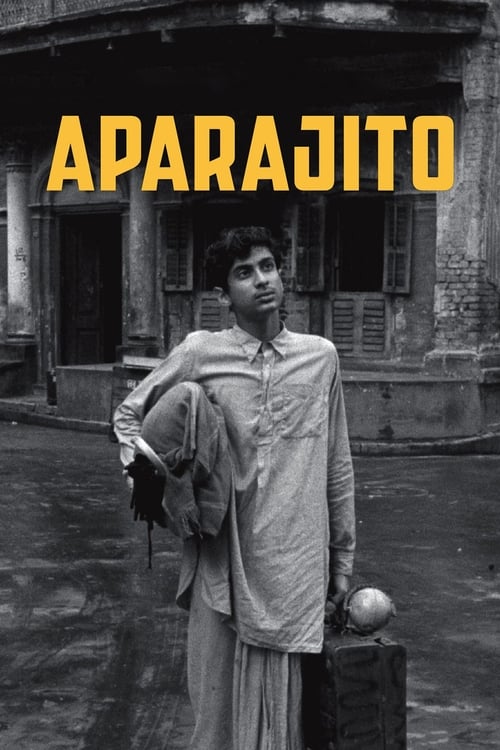
Aparajito
1956 · Satyajit Ray
For when you want to feel something true about family — the guilt of growing up and away from the people who raised you. A contemplative, quietly heartbreaking evening rather than an easy one; it rewards your full attention.
What it's about
The second chapter of Satyajit Ray's Apu Trilogy follows young Apu after his family leaves their village for the holy city of Benares, its ghats and alleys teeming with pilgrims. When hardship strikes, mother and son retreat to the countryside, where Apu discovers school — and an appetite for learning that eventually carries him, on a scholarship, to Calcutta. At its heart is the widening distance between an ambitious boy and the mother whose whole world he is.
The experience
Quiet, patient, and devastating in small increments — it moves at the rhythm of ordinary days, then catches you off guard with a glance, a departure, a letter. The ache builds so gradually you don't notice until it's unbearable, and it stays tender rather than sentimental.
Performances
Karuna Banerjee is extraordinary as Sarbajaya, the mother — a performance built almost entirely from silences, waiting, and the effort of not asking her son to stay. It's one of the great portraits of maternal love and loneliness on film.
The craft
Ray shoots in luminous black and white, finding whole emotional worlds in trains, doorways, and the riverside light of Benares. The storytelling trusts images over dialogue — a curl of smoke, fireflies at dusk — and Ravi Shankar's music threads grief and hope together. It's austere filmmaking where every cut carries feeling.
Why it matters
It won the Golden Lion at Venice, cementing Ray's international reputation and proving the Apu Trilogy was no one-off — it remains a cornerstone of Indian cinema and of humanist filmmaking everywhere.
Snapshot
Aparajito ("The Unvanquished") is the second panel of Satyajit Ray's Apu Trilogy, bridging the childhood elegy of Pather Panchali (1955) and the young-adulthood drama of Apur Sansar (1959). Adapted from Bibhutibhushan Bandyopadhyay's Bengali novels, it follows Apu from boyhood in the holy city of Benares, through the death of his father and a rural interlude, to his flowering as a scholarship student in Calcutta — and it centers, above all, on the slow, wrenching separation between Apu and his mother, Sarbajaya. Where Pather Panchali had been a portrait of a family bound to its village, Aparajito is a film about leaving: about how education, ambition, and the modern city draw a son away from the woman who raised him. It is quieter and more austere than its predecessor, and it took the trilogy in a direction some contemporary Bengali audiences resisted. Yet it won the Golden Lion at Venice in 1957 — the first Indian film to do so — and it remains a cornerstone of world cinema's humanist tradition and a landmark in the technical maturation of Indian filmmaking.
Industry & production
Aparajito emerged from a very particular, almost improbable production culture. Pather Panchali had been made outside the Bombay commercial system entirely, by a Calcutta amateur unit led by a graphic designer with no prior directing experience, and completed only after the Government of West Bengal effectively stepped in to finance it. Its unexpected domestic success and its 1956 Cannes recognition (the "Best Human Document" prize) gave Ray the standing to continue Bandyopadhyay's story. Aparajito was produced by Epic Films, with Ray again directing on a modest budget and again working largely with a hand-picked, loyal crew rather than a studio roster.
The film was shot partly on location — most famously the ghats and cramped riverside interiors of Benares (Varanasi) — and partly in and around Bengal, including a village standing in for Mansapota and Calcutta exteriors. Working on real locations, with available light and non-professional or minor performers alongside a few trained actors, kept the production tethered to the neorealist economics Ray admired: small, mobile, and dependent on ingenuity rather than infrastructure. Precise budget and box-office figures for the film are not reliably documented in the popular record, and this dossier does not invent them; what is well established is that Aparajito was made cheaply, that its initial commercial performance in Bengal was weaker than Pather Panchali's, and that its international festival success — the Venice Golden Lion above all — was decisive in securing Ray's global reputation and, with it, the eventual completion of the trilogy.
Technology
Aparajito was shot on 35mm black-and-white film. Its most significant technological contribution is not a camera or a stock but a lighting method: the "bounce lighting" technique refined by cinematographer Subrata Mitra. Faced with the problem of shooting interior scenes — particularly the Benares lodging — that needed to look as though they were lit by soft, ambient daylight rather than hard studio lamps, Mitra devised a setup in which light was bounced off a large white cloth or surface stretched overhead, recreating the diffuse, sourceless glow of an open courtyard sky. The result was a naturalistic illumination that flattered faces and textures without visible key-light modeling, and the approach became influential well beyond Indian cinema; bounce lighting is now standard practice, and Mitra is widely credited among its pioneers. Beyond this, the production relied on the modest, portable equipment characteristic of Ray's early unit; specific camera-body details are not consistently documented and are not embellished here.
Technique
Cinematography
Subrata Mitra's photography is the film's expressive engine. Its texture is soft, deep, and observational: long-held compositions, patient framing of thresholds, courtyards, staircases, and doorways, and a recurring attention to the play of natural light on skin, stone, and water. The Benares sequences exploit the vertical geometry of the ghats and the density of the old city, while the Calcutta and village passages open into flatter, more solitary spaces that mirror Apu's expanding but lonelier world. Mitra's bounce lighting gives interiors a luminous evenness that reads as truth rather than style. Throughout, the camera favors observation over emphasis — it watches Sarbajaya wait, watches Apu leave and return — trusting duration and composition to carry emotion.
Editing
Dulal Dutta, who would remain Ray's editor for decades, cut Aparajito. The editing is unhurried and elliptical, built to let scenes breathe and to register the passage of time — Apu ages from a small boy to an adolescent across the film — through calm juxtaposition rather than montage flourish. Transitions between the film's three geographic movements (Benares, the village, Calcutta) are handled as decisive narrative jumps, and the rhythm slows markedly in the mother's later scenes, where waiting itself becomes the subject. The famous motif of the train, carried across the trilogy, recurs here as an image of departure and of the modern world's pull.
Mise-en-scène / staging
Ray stages the film with documentary attentiveness to environment: the specific business of a Benares morning, the rituals of the ghats, the physical labor of a widow's household, the routines of a printing works and a Calcutta hostel. Objects and spaces do dramatic work — a globe, books, a lamp, a staircase — without being underlined as symbols. The staging repeatedly opposes enclosure and openness, tradition and modernity, and it isolates Sarbajaya within domestic frames as Apu's frame expands outward. Ray's own background as a graphic artist is visible in the precision of his compositions and the legibility of his spatial storytelling.
Sound
Ravi Shankar's score, following his work on Pather Panchali, again fuses classical Indian instrumentation with the emotional line of the drama, used sparingly to avoid sentimentality. Equally important is the film's naturalistic sound design: the ambient life of Benares, temple bells, river sounds, the noise of trains and the city. Ray, an acute listener, uses silence and environmental sound to carry scenes that a more conventional film would score, so that the mother's solitude in particular is felt in the quiet of her house.
Performance
The performances are grounded in restraint. Karuna Bannerjee returns as Sarbajaya and gives the film its emotional gravity; her portrait of a widowed mother — proud, self-effacing, slowly abandoned by circumstance and by her own son's success — is among the great maternal performances in cinema, precisely because it refuses melodrama. Kanu Bannerjee appears as the father, Harihar, whose death in Benares turns the story. Apu is played across ages by two young performers, Pinaki Sengupta as the child and Smaran Ghosal as the adolescent, whose growing self-absorption Ray presents without condemnation. The acting throughout is naturalistic, keyed to gesture and glance rather than declamation.
Narrative & dramatic mode
Aparajito is an episodic bildungsroman told in a realist, observational register. It has no conventional plot engine and no antagonist; its drama is the drift of a life and the erosion of a bond. The structure is tripartite — Benares and the father's death; the village and the mother's isolation; Calcutta and Apu's education — and it advances through the accumulation of everyday incident rather than through crisis and resolution. Its central dramatic irony is generational and universal: the very education and independence that fulfill the family's hopes for Apu are what carry him away from his mother, and the film's most devastating movement is the quiet, guilty gap between his ambition and her waiting. The mode is elegiac and unsentimental, achieving its power through understatement.
Genre & cycle
Formally, Aparajito is a humanist drama and coming-of-age story, and it is inseparable from its place in a cycle — the Apu Trilogy — one of world cinema's defining serial works. Within that arc, it is the transitional film, the panel of leaving and loss between the childhood of Pather Panchali and the marriage and fatherhood of Apur Sansar. It belongs to the international current of postwar realist cinema rather than to any commercial Indian genre; it deliberately stands apart from the song-and-spectacle conventions of mainstream Bombay production of its era, and it helped define what would later be recognized as India's parallel or art-cinema tradition.
Authorship & method
Aparajito is a paradigmatic auteur work, but one built on a small core of indispensable collaborators. Satyajit Ray wrote the screenplay (adapting Bandyopadhyay), directed, and shaped the film's design and music sensibility; his method combined meticulous preparation — he was known for detailed storyboards and sketches, a legacy of his commercial-art training — with an openness to real locations and non-professional presence. His formation was decidedly cosmopolitan: Ray had absorbed Italian neorealism (Vittorio De Sica's Bicycle Thieves was a famous catalyst), had assisted and observed Jean Renoir during the Bengal shooting of The River, and drew on classical Hollywood craftsmanship as well as Bengali literary and musical culture. Subrata Mitra, the cinematographer, was a genuine co-author of the trilogy's look and the originator, on this film, of the bounce-lighting method. Dulal Dutta edited. Ravi Shankar composed the score. This nucleus — Ray, Mitra, Dutta, Shankar — gave the early Ray films their extraordinary consistency of tone.
Movement / national cinema
The film sits at the head of what became India's art-cinema movement, often called Indian parallel cinema, and it is a central document of Bengali cinema's mid-century flowering. Ray, alongside figures such as Ritwik Ghatak and Mrinal Sen who were working in Bengal in the same period, established an alternative to the dominant commercial industry: literary in source, realist in method, regional in language and setting, and internationalist in ambition. Aparajito's Venice triumph gave that alternative global visibility and helped make "Indian cinema," in the eyes of the world's festivals and critics, mean something other than Bombay musicals. Its lineage runs directly to Italian neorealism in ethos and to the Bengali literary realism of Bandyopadhyay in substance.
Era / period
Aparajito was made in the mid-1950s, in the first decade of independent India, and it registers that moment's tensions: the pull between tradition and modernity, village and city, inherited vocation and secular education. The story it dramatizes is set earlier, in the world of Bandyopadhyay's novels, but the film's preoccupations — a young man's movement toward the modern, educated life of Calcutta, and the human cost of that movement — resonated with a nation in transition. Internationally, the film belongs to the great postwar wave of realist and modernist cinema, arriving between Italian neorealism's peak and the eruption of the various New Waves, and it stands as one of the works that carried humanist realism onto the world stage from outside Europe.
Themes
The film's governing theme is separation — the inevitable, grief-laced parting of parent and child that is also the parting of an old world from a new one. Around it cluster education and ambition as double-edged forces; the tension between duty to family and the summons of the wider world; the condition of widowhood and maternal sacrifice; urbanization and the lure of the modern city against the diminishing village; and the quiet operation of guilt in a young man who cannot yet feel the full weight of what he is leaving behind. Death and continuity thread through the film — the father's death, the mother's decline — set against Apu's stubborn forward motion, the "unvanquished" life implied by the title. Ray treats all of this without moralizing: Apu is neither hero nor betrayer, and the mother's suffering is presented as fact, not accusation.
Reception, canon & influence
Critically and historically, Aparajito's single most important early recognition was the Golden Lion at the 1957 Venice Film Festival, making it the first Indian film to win that top prize and cementing Ray's international standing; the film gathered further festival and critical honors abroad. Its reception at home was more divided: some Bengali viewers and critics reportedly found it colder than Pather Panchali and were unsettled by its unsparing treatment of the mother–son bond and its refusal of a conventionally devotional maternal figure, and its initial commercial run in Bengal was comparatively muted. That mixed domestic response is part of the historical record; the exact commercial figures are not reliably documented and are not invented here.
The influences on the film are well attested: Bibhutibhushan Bandyopadhyay's novels (chiefly Aparajito, with material carried from Pather Panchali) as narrative source; Italian neorealism, particularly De Sica, as an ethical and stylistic model; Jean Renoir's example and mentorship; and the broader humanist-realist tradition Ray had studied as a cinephile and society co-founder in Calcutta.
The film's forward legacy is large. As the middle panel of the Apu Trilogy, it helped make that trilogy a permanent fixture of world-cinema canons and film education, admired by filmmakers across generations and celebrated by international critics as a touchstone of humanist filmmaking. Subrata Mitra's bounce-lighting innovation, developed on this film, entered the global grammar of cinematography. And Ray's whole enterprise — literate, regional, realist, internationally legible — became the founding example for India's parallel cinema and an enduring reference point for filmmakers worldwide who sought to tell intimate stories with rigor and restraint. In the twenty-first century the trilogy's restoration and re-release renewed its visibility, confirming Aparajito's place not as a mere bridge between two more famous films but as an essential, self-standing work in the history of the medium.
A Deleuzian reading
Subrata Mitra had a problem in Benares.
The full Deleuzian reading of Aparajito →
Reception
Bengali audiences at home were cool on it in 1956 — a comedown after Pather Panchali's phenomenon — but the Golden Lion at Venice in 1957 flipped the script, and today plenty of critics quietly rank it as the best film in the Apu Trilogy.
How Aparajito was received, from release to now →
How to watch Aparajito: what to notice on a first viewing
- Watch how evenly lit interiors look, with no single light source visible. Mitra bounced light off a white cloth to recreate diffuse, sourceless daylight in the cramped Benares rooms, an evenness that reads as truth rather than style. The soft, even light never tells you where to look, which is the whole point of how this film asks you to watch.
- Watch how long the camera holds on a doorway or a staircase. Mitra favors deep, patient framing of thresholds and courtyards, watching Sarbajaya wait and watching Apu leave and return without emphasis. The camera trusts duration and composition to carry the feeling instead of pushing in to underline it.
- Listen for temple bells, river sounds, and trains instead of music. Ray uses the ambient life of Benares and long stretches of silence to carry scenes a more conventional film would score, keeping Ravi Shankar's music sparing. Letting the world's own noise carry a scene keeps the emotion from ever feeling manufactured.
- Watch for a globe, a lamp, and a staircase recurring across scenes. These objects do real dramatic work without ever being underlined as symbols, marking Apu's widening world against his mother's narrowing one. You have to notice the objects yourself. The film will never point at them for you.
- Watch how Sarbajaya is framed inside doorways and small rooms. The staging repeatedly isolates her within domestic frames as Apu's world opens outward into wider, more solitary spaces. The composition alone tells you whose world is expanding and whose is staying put.
The whole guide to watching Aparajito, with the keys for a rewatch →
Influences: the films it descends from and the films it influenced
- Bicycle Thieves (1948) — Supplied Ray's founding template of casting non-professionals and shooting real streets and interiors, treating dedramatized everyday incident as the load-bearing structure rather than plot.
- The River (1951) — Ray watched Renoir stage deep-focus, environment-first compositions on location in Bengal, learning to let landscape and household space frame and comment on the human figure.
- Rome, Open City (1945) — Modeled the neorealist documentary immediacy — grabbed light, imperfect location acoustics, faces over stars — that Ray adapted into his own observational grammar.
- Umberto D. (1952) — Its dilation of dead time and elliptical cutting around undramatic routine gave Ray the editing model for compressing years of a boy's life into gestural fragments.
- Pather Panchali (1955) — Built by the identical nucleus — Ray, Mitra, Dutta, Shankar — establishing the natural-light location realism and Shankar's sitar-driven scoring that Aparajito directly continues.
- Apur Sansar (1959) — Completes the trilogy using the same bounce-lit interiors and restrained non-professional-inflected performance pioneered in the middle panel.
- Charulata (1964) — Mitra's bounce-lighting method, invented on Aparajito, is refined here into the soft even-key interior look that became Ray's signature.
- Shakespeare Wallah (1965) — Shot by Subrata Mitra, it carries his Aparajito-born bounce-lighting technique directly into the Merchant-Ivory house style.
- Bhuvan Shome (1969) — Launched Indian New Wave/parallel cinema on the low-budget, location-shot, non-professional model Ray had legitimized internationally.
- Ankur (1974) — Extends the parallel-cinema realism with regional non-professional casting and available-light rural interiors descended from Ray's practice.
- Where Is the Friend's House? (1987) — Centers a non-professional child in natural light and elliptical, near-plotless observation, extending Ray's humanist realism into Iranian cinema.
- Salaam Bombay! (1988) — Casts real street children and shoots in actual locations with documentary staging, applying the neorealist-Ray ethic to contemporary urban India.
- The Darjeeling Limited (2007) — Explicitly homages Ray, scoring scenes with cues lifted from Ray's own films and quoting his framing of trains and Indian landscape.
- Moonlight (2016) — Structures a three-panel bildungsroman with restrained, interior performance and elliptical time-jumps, a form Jenkins traces to the Apu Trilogy.
- The World of Apu (1959) — Mitra invented his signature bounce-lighting here — reflecting studio light off cloth to mimic diffuse Benares skylight — the soft, sourceless interior illumination carried straight into Apu's garret in the sequel.
- The Big City (1963) — Subrata Mitra invented bounce lighting here (throwing light onto stretched cloth to simulate diffuse daylight), the soft naturalistic interior illumination that lights every cramped Calcutta room in The Big City.
- The Hero (1966) — Subrata Mitra pioneered bounce lighting here (light thrown off a stretched cloth to mimic diffuse daylight), the soft interior modeling carried directly into Nayak's train compartments.
- Meghe Dhaka Tara (1960) — A parallel Bengali strain of location realism and expressive naturalistic sound, sharing the postwar Calcutta film-society milieu Ray helped found.
- The 400 Blows (1959) — An independently arrived-at bildungsroman using an untrained child lead and elliptical location shooting, part of the same postwar realist coming-of-age lineage.
Similar films
- Pather Panchali (1955) — influence & lineage · same viewing thread · often watched together
- Charulata (1964) — influence & lineage · same viewing thread · often watched together
- The River (1951) — influence & lineage · same viewing thread
- Devi (1960) — same viewing thread · often watched together
- The Big City (1963) — same viewing thread · often watched together
- The Music Room (1958) — same viewing thread · often watched together
- The World of Apu (1959) — same viewing thread
- The Hero (1966) — same viewing thread · often watched together
All the films related to Aparajito →
Watch it with: curated runs of related films
- Satyajit Ray's Bengal — A run through Ray's Bengal — the mud-and-monsoon village of the Apu films, the decaying aristocracy of The Music Room and Devi, the hushed Calcutta drawing rooms of Charulata — where ordinary lives turn quietly monumental.