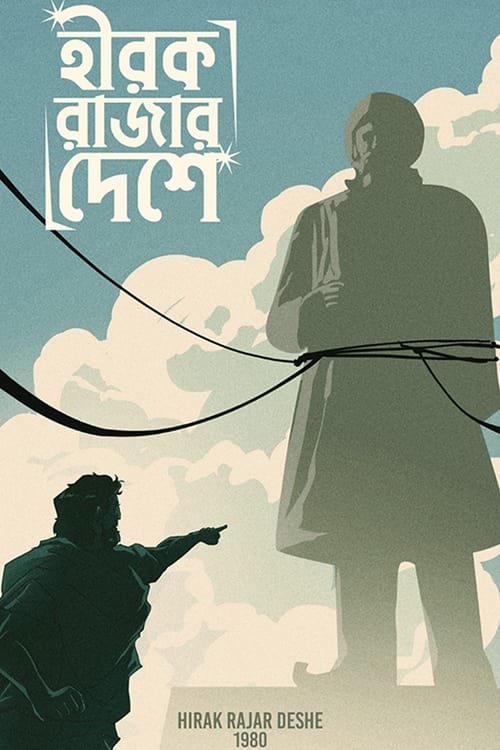
The Kingdom of Diamonds
1980 · Satyajit Ray
For family movie night when you want something that works for kids and adults on completely different frequencies — or when you want political anger delivered with a grin. Comforting in form, subversive in spirit.
What it's about
Goopy the singer and Bagha the drummer — two wandering musicians armed with magical gifts from the King of Ghosts — are summoned to the realm of the Diamond King, a mining tyrant whose court has built a machine that brainwashes dissenters into cheerful obedience. With a rebel schoolteacher as their ally, the pair set out to unstick the kingdom's minds and topple the throne, mostly through songs, tricks, and nerve.
The experience
On the surface it's a delight — musical numbers, wizardry, slapstick, villains who speak in rhyme. But the satire keeps glinting through the fairy-tale surface, and the brainwashing machine is genuinely eerie; adults will catch a sharpness the songs only half conceal.
The craft
Satyajit Ray wrote the screenplay, the songs, and the score himself, and the film's signature invention is verbal: the tyrant's courtiers speak entirely in rhymed couplets, so language itself becomes a mark of conformity. The fantasy staging is inventive on modest means, with the songs doing real narrative work rather than decorating it.
Why it matters
A beloved fixture of Bengali culture whose songs and rhymes are still quoted, and a rare case of a great art-film director making a children's musical that doubles as one of Indian cinema's most pointed political fables — widely read as a response to authoritarianism in 1970s India.
Snapshot
Hirak Rajar Deshe — literally "In the Land of the Diamond King" — is Satyajit Ray's 1980 Bengali-language musical fantasy, a sequel made eleven years after the enormously popular Goopy Gyne Bagha Byne (1969). It returns to the two wandering musicians Goopy the singer and Bagha the drummer, endowed since the first film with three magical boons from the King of Ghosts, and sends them into the realm of a diamond-mining tyrant, Hirak Raja, whose court has perfected a machine for brainwashing dissenting subjects into docile loyalty. Ostensibly a children's adventure — full of songs, wizardry, and slapstick — the film is simultaneously one of the most pointed political fables in Indian cinema, a fairy tale about propaganda, education, resource exploitation, and the toppling of despots. Ray directed it, wrote the screenplay and dialogue (much of the latter in rhymed verse), and composed the music and lyrics, making it among the most fully authored works in his filmography.
Industry & production
The film descends directly from characters invented by Ray's own grandfather, Upendrakishore Ray Chowdhury, the pioneering Bengali children's writer and printer, whose story furnished the 1969 original. By 1980 Ray had long since become the internationally pre-eminent figure of Indian cinema, and the Goopy–Bagha films occupied a distinctive place in his output: unlike the austere realism of the Apu Trilogy or his Calcutta films, they were unabashedly popular entertainments that nonetheless carried his intelligence and craft. The 1969 film had been a landmark commercial success in Bengal, and the sequel arrived with a built-in, multi-generational audience.
Hirak Rajar Deshe was produced with the backing of the Government of West Bengal — a detail that gives its satire of state power a particular piquancy, since a state apparatus financed a fable about the machinery of authoritarian control. Ray made the film through his established Calcutta-based unit of long-term collaborators. Precise budget and box-office figures are not something I can cite reliably, and I will not invent them; what is securely documented is that the film was a substantial popular hit in Bengal and has remained a perennial favorite, revived repeatedly for children and adults alike.
Technology
The film was shot on 35mm and, crucially, in color — a marked departure from the 1969 original, which was in black and white save for its celebrated final reel. Color is not incidental here: the diamond kingdom is a place of gaudy royal splendor, and the palette does dramatic work in contrasting courtly opulence with the drab misery of miners and displaced villagers.
Ray's films of this period continued to rely on relatively economical means by international standards, and the fantasy elements — the instantaneous appearance of food and clothing when Goopy and Bagha clap their hands, their teleportations, the eerie apparatus of the brainwashing chamber — were achieved through the same repertoire of in-camera tricks, optical effects, and staging that had served the first film. These effects are deliberately handmade and charming rather than seamless, a register appropriate to a fairy tale. The most technologically resonant object in the film is fictional: the magajdholai jantra, the brain-washing machine, a piece of pseudo-science whose whirring menace embodies the film's anxieties about mechanized thought control.
Technique
Cinematography
Photography was by Soumendu Roy, Ray's regular cinematographer from the mid-1960s onward (following Subrata Mitra). Roy handles the film's tonal range with assurance: the saturated, frontal spectacle of the throne room and the coronation-anniversary festivities on one hand; the shadowed, oppressive interior of the brainwashing chamber on the other; and the open, naturalistic exteriors where Udayan the schoolteacher hides in the hills. The camera generally serves clarity and legibility — this is a film meant to be read easily by children — but Ray and Roy modulate framing to underline power relations, placing the king high and central and his cowed courtiers in deferential arrangement below.
Editing
The editing was by Dulal Dutta, Ray's editor across virtually his entire career. The cutting balances two demands: the propulsive comic-adventure plotting, which moves briskly among the palace, the mines, the school, and the forest hideout; and the musical numbers, which require a more measured, performance-respecting rhythm. Dutta's work sustains the film's essential lightness while allowing the set-piece songs room to land.
Mise-en-scène / staging
Much of the film's meaning is carried by its staging of court ritual. The throne room is organized as a theater of obedience, with the king's rhyming pronouncements answered by the sycophantic couplets of his ministers. The brainwashing chamber, by contrast, is a chamber of un-making, where individuality is dissolved into slogan. The physical world is stratified: glittering palace above, exploited mine and threatened schoolhouse below. I am not certain of the art-director credit for this specific film and will not guess at it, but the production design consistently visualizes the film's central opposition between manufactured splendor and hidden suffering.
Sound
Sound is inseparable from the film's political argument. The brainwashing works through sound — through absurd, rhyming propaganda mantras that the machine implants: sayings to the effect that those who study starve, that the effort to learn is futile, that the poor are poor by natural law. These jingles are the film's most chilling invention precisely because they are catchy; Ray understands propaganda as an acoustic phenomenon, a tune that lodges in the mind. Against this, the film sets the honest sound of Goopy's song and Bagha's drum.
Performance
Tapen Chatterjee (Goopy) and Rabi Ghosh (Bagha) reprise their roles with the easy comic warmth that made the pair beloved — Chatterjee earnest and open-faced, Ghosh nimble and quick. But the performance that dominates the film is Utpal Dutt's Hirak Raja. Dutt, himself a towering figure of the Bengali radical stage, plays the tyrant with theatrical relish — grandiloquent, vain, and delivering nearly all his lines in rhyme — creating a villain who is at once genuinely menacing and gloriously absurd. There is a deep irony in a leftist man of the theater embodying the archetypal despot, and Dutt exploits it fully. Soumitra Chatterjee, Ray's most frequent leading man, plays Udayan Pandit, the schoolteacher who becomes the film's moral center and the organizer of resistance, bringing a quiet gravity that anchors the fantasy.
Narrative & dramatic mode
The film's mode is the fairy-tale fable, structured as a quest that becomes a liberation. Goopy and Bagha, now comfortably married into royalty after the events of the first film, are invited to Hirak's kingdom to perform for the anniversary of the king's reign. There they discover the truth beneath the pageantry: miners are ruthlessly worked for the king's diamonds, taxes crush the peasantry, and a schoolteacher's small academy is marked for destruction because education breeds the capacity to question. The king's solution to dissent is the brainwashing machine, into which subjects are fed and from which they emerge as obedient reciters of his slogans. The dramatic engine is the alliance between the musicians' magic and Udayan's principled resistance, building to the overthrow of the king — famously sealed when the tyrant is himself subjected to his own machine and the crowd topples his statue. The tone moves fluidly between comedy, song, suspense, and genuine moral seriousness, trusting children to feel the stakes without condescension.
Genre & cycle
Hirak Rajar Deshe is a musical fantasy-adventure and children's film that doubles as political satire. It belongs to a small, distinctive cycle within Ray's work — the Goopy–Bagha films — of which it is the second. The first, Goopy Gyne Bagha Byne (1969), established the characters and their magical boons; the third, Goopy Bagha Phire Elo (1992), was directed not by Ray but by his son Sandip Ray from Satyajit's story. As a genre object the film is a Bengali variant of the musical fairy tale, drawing on folk and fantastical traditions while bending them toward allegory. Within Indian cinema it is unusual in fusing the wholesome children's entertainment with sustained, legible political critique.
Authorship & method
This is among the most singularly authored films in world cinema of its era. Ray wrote the screenplay and dialogue, directed, composed the music, and wrote the song lyrics — and the verse dialogue is itself a compositional feat, sustaining rhymed couplets across the king's court to create a stylized, incantatory speech world. His key collaborators were the trusted members of his long-standing unit: cinematographer Soumendu Roy and editor Dulal Dutta, both of whom worked with Ray across many films. In music, Ray had by this point fully assumed the composer's role that in his earliest films had belonged to Indian classical masters; the Goopy–Bagha films are showcases of his own melodic gift and his ear for how a tune can carry ideology or joy. The performances of Utpal Dutt, Soumitra Chatterjee, Tapen Chatterjee, and Rabi Ghosh complete a picture of an auteur working with a repertory company he knew intimately.
Movement / national cinema
The film sits within Bengali cinema and within Ray's own oeuvre, but somewhat apart from the movement — the Indian New Wave or Parallel Cinema — with which Ray's name is most associated internationally. Where Parallel Cinema pursued realism and social critique in a modernist register, the Goopy–Bagha films are frankly popular, rooted in Bengali children's literature, folk performance, and the pleasures of song and spectacle. Yet Hirak Rajar Deshe demonstrates that popular form and political seriousness were not opposed for Ray: it smuggles a rigorous critique of authoritarianism inside a beloved entertainment, reaching an audience far broader than his art films did. In that sense it represents a distinctively Bengali synthesis of mass appeal and moral intelligence.
Era / period
Made in 1980, the film cannot be separated from the political atmosphere of India in the preceding decade — above all the Emergency of 1975–77, during which civil liberties were suspended, the press censored, and dissent suppressed under Indira Gandhi's government. The film's obsession with propaganda, with the silencing of teachers, and with a state machine that manufactures consent reads unmistakably against that recent memory, and audiences have long understood it as an allegory of authoritarian rule. Ray characteristically avoided reducing the film to a single topical key, and I want to be careful not to overstate any explicit statement of intent on his part; but the resonance with the Emergency and with authoritarianism more broadly is one of the most consistently noted features of the film's reception.
Themes
At its core the film is about the control of thought. The brainwashing machine literalizes what propaganda does; the absurd rhyming slogans it implants — that learning leads to starvation, that inquiry is futile, that hierarchy is natural — are a compact anatomy of how tyranny rationalizes itself. Set against this is education: the schoolteacher's academy is the tyrant's true enemy because literacy and reason threaten obedience. Other braided themes include the exploitation of labor and natural resources (the diamond miners bled for the king's wealth), the vanity and insecurity that drive despotism, and the perennial Ray motif of the artist and the innocent — here the wandering musicians — as bearers of truth against power. The film's optimism is unambiguous: tyranny is not natural or permanent, and collective action can bring the statue down.
Reception, canon & influence
The film's clearest ancestor is its own predecessor, Goopy Gyne Bagha Byne (1969), and behind that the storytelling world of Upendrakishore Ray Chowdhury; its immediate lineage is thus internal to the Ray family and to Bengali children's literature. Its most enduring legacy has been cultural and political rather than strictly cinematic. The film's climactic slogan — the rallying cry to pull the rope and smash the king to pieces — passed into Bengali public life as a genuine idiom of protest, invoked in later political demonstrations as shorthand for resisting authoritarian power. This migration of a line from a children's film into the language of dissent is a rare mark of a film's penetration into collective consciousness.
Critically and popularly, Hirak Rajar Deshe has remained one of Ray's most beloved works within Bengal, cherished across generations and continually revived — a film children encounter as adventure and later re-read as satire. Utpal Dutt's Hirak Raja is frequently cited as one of the great screen villains of Indian cinema. Detailed contemporaneous reviews and awards records are not something I can quote with confidence, and I will not fabricate them; but the film's status as a canonical Bengali classic, and as the rare political allegory that is also a genuine popular entertainment, is not in dispute. Its influence is best measured not in imitators but in its persistence — as a story parents pass to children, and as a set of images and slogans that Bengali audiences still reach for when they need to name the shape of tyranny and the possibility of bringing it down.
A Deleuzian reading
A man is walked into a cabinet.
The full Deleuzian reading of The Kingdom of Diamonds →
Reception
An instant hit in Bengal in 1980, it was long filed abroad as 'Ray's kids' sequel' next to his art-house canon — but it's since been reappraised as one of his sharpest works, its thinly-veiled Emergency-era satire of authoritarianism only growing in stature (and quotability) with every passing regime.
How The Kingdom of Diamonds was received, from release to now →
Influences: the films it descends from and the films it influenced
- Goopy Gyne Bagha Byne (1969) — The direct predecessor: it establishes the two-vagabond-musician heroes, the three boons, the in-camera match-cut magic (a clap dissolving them from place to place), and Ray's own composed songs as narrative engine — Hirak inherits this entire folk-musical-fantasy apparatus wholesale.
- Shatranj Ke Khilari (1977) — Ray's immediately prior study of rulers: it perfects his method of exposing sovereign power through court ceremony and game-playing detached from the ruled — the satirical framing of decadent authority that Hirak's throne-room rituals inherit.
- The Great Dictator (1940) — The tyrant as comic grotesque, undone by his own pompous verbal performance and preening self-aggrandizement — a direct template for Utpal Dutt's rhyming, strutting Hirak Raja who satirizes autocracy by voicing it.
- Duck Soup (1933) — The musical-comedy of state: patriotic anthems and jingles deployed satirically (the 'Freedonia' war number) to mock nationhood — ancestor of Hirak's propaganda-jingles that turn a catchy tune into instrument of ideology.
- Ivan the Terrible (1944) — Low-angle 'power framing' that monumentalizes the despot and stages the throne as chiaroscuro ritual — the monumentalizing court grammar (and cult of the king's statue) that Soumendu Roy's compositions echo.
- The Cabinet of Dr. Caligari (1920) — The somnambulist bent to a controller's hypnotic will is the expressionist forerunner of Hirak's magajdholai brain-washing machine that reprograms subjects into obedient reciters of the king's slogans.
- Metropolis (1927) — The mad-inventor's apparatus as engine of mass social control — the visual idea of a machine that manufactures compliant minds/bodies, literalized in Hirak's mind-cleansing device.
- The Wizard of Oz (1939) — The Technicolor fairy-tale quest to a fantastical kingdom whose all-powerful ruler is finally unmasked as humbug — ancestor of the color-fantasy-fable in which spectacle itself exposes the fraud behind the throne.
- Goopy Bagha Phire Elo (1992) — The trilogy's third film, directed by Ray's son from Ray's own story: a literal continuation of the repertory characters, boon-driven fantasy structure, and Ray-composed musical idiom.
- Kissa Kursi Ka (1977) — A contemporaneous Emergency allegory that, like Hirak, uses absurdist fable-satire to lampoon a ruler's authoritarian thought-control — and was suppressed for it, sharing the coded-critique strategy.
- Jaane Bhi Do Yaaro (1983) — Extends the Indian craft of absurdist political farce that exposes the corruption of the powerful through comic grotesque set-pieces rather than didactic address.
- The Hand (1965) — Uses the fairy-tale-fable form as coded critique of a state that coerces the artist's mind — the same maneuver by which Hirak smuggles anti-authoritarian allegory inside a children's fantasy under censorship.
- Brazil (1985) — Renders a state that engineers its citizens' minds as grotesque comic spectacle — the thought-control bureaucracy played for satirical fantasy rather than sober dystopia, as Hirak plays its brain-washing.
- The Death of Stalin (2017) — Satirizes the pomp and terror of an autocrat's inner court through comic verbal grotesque and choreographed ceremony — extending the court-ritual-as-farce staging that animates Hirak's throne room.
- Pan's Labyrinth (2006) — Fuses folk-fable form with anti-fascist political allegory, letting a fairy-tale grammar carry a critique of authoritarian cruelty — the same braid of fable and dissent Ray weaves for young and adult audiences alike.
Similar films
- Goopy Gyne Bagha Byne (1969) — influence & lineage · same viewing thread
- The Wizard of Oz (1939) — influence & lineage
- Pather Panchali (1955) — same viewing thread · often watched together
- The Music Room (1958) — same viewing thread · often watched together
- Aparajito (1956) — same viewing thread · often watched together
- Charulata (1964) — same viewing thread · often watched together
- Devi (1960) — same viewing thread · often watched together
- The Big City (1963) — same viewing thread · often watched together
All the films related to The Kingdom of Diamonds →
Watch it with: curated runs of related films
- Satyajit Ray's Bengal — A run through Ray's Bengal — the mud-and-monsoon village of the Apu films, the decaying aristocracy of The Music Room and Devi, the hushed Calcutta drawing rooms of Charulata — where ordinary lives turn quietly monumental.