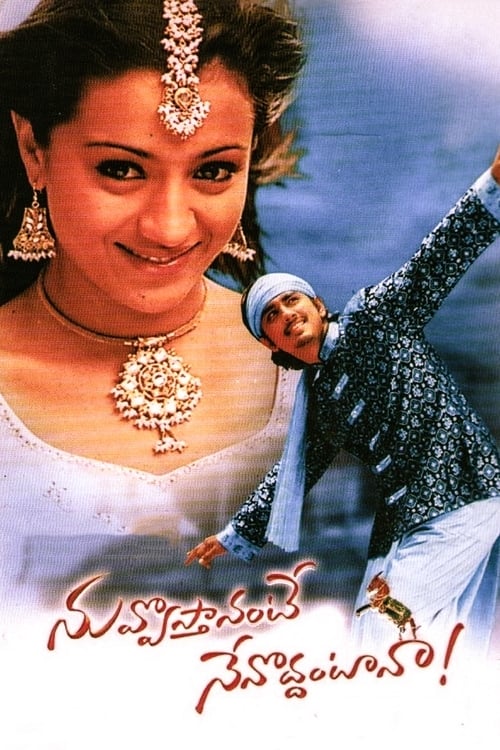
Nuvvostanante Nenoddantana
2005 · Prabhu Deva
For a warm, easy night when you want an old-fashioned love story with music, color, and a family you can root against and then forgive. Pure comfort viewing.
What it's about
Siri and Santosh fall for each other and start planning a life together, only to run into the one obstacle mainstream romance takes most seriously: his mother, who wants no part of the match. What follows is a battle of charm, stubbornness, and family pride, with the young couple trying to win over the household standing between them and a wedding.
The experience
Bright, broad, and unabashedly emotional — a song-forward crowd-pleaser that moves on star chemistry and big feelings rather than surprise. It's the kind of film that wants you smiling through the sentiment, and mostly gets its way.
Performances
Siddharth and Trisha Krishnan were two of the most likable young leads of mid-2000s South Indian cinema, and their easy chemistry is the engine the whole film runs on.
The craft
This is dancer-choreographer Prabhu Deva's first film as director, and it shows in the best way — the song sequences have real kinetic snap, powered by a hit-stacked Devi Sri Prasad score. The pleasure is in gloss and tempo: it's built like a piece of pop music.
Why it matters
A major Telugu hit of 2005, it launched Prabhu Deva's second career as a commercial director and became a template for the glossy, music-driven family romance of its decade.
Snapshot
Nuvvostanante Nenoddantana is a Telugu-language romantic family drama released in 2005, remembered chiefly as the feature that launched the celebrated dancer-choreographer Prabhu Deva into a career behind the camera. Built on the most durable armature in mainstream Telugu cinema — two young lovers set against the resistance of family and the weight of parental will — the film pairs Siddharth and Trisha Krishnan, two of the most bankable young leads of the mid-2000s South Indian screen, in a story of courtship complicated by a disapproving mother. Its currency was less narrative novelty than tone and texture: a glossy, song-forward, emotionally broad entertainment that leaned on star chemistry, a hit-oriented Devi Sri Prasad score, and the kinetic sensibility of a director who had spent a decade as one of India's most influential film dancers. The picture performed well commercially and helped consolidate both its stars' standing in Telugu cinema, while marking the beginning of Prabhu Deva's improbable and eventually pan-Indian directorial career. It is a representative artifact of the Telugu family-romance cycle of its moment rather than a formal landmark, and it is best read as such.
Industry & production
The film belongs to the Telugu (Tollywood) industry centered in Hyderabad, which by the mid-2000s was among the most productive and commercially aggressive film industries in India. The dominant commercial template of the period fused romance, comedy, family sentiment, and lavish song picturization into a single multi-genre package aimed at a broad family audience — a formula in which star pairing, music, and set-piece songs carried at least as much weight as story. Nuvvostanante Nenoddantana was conceived squarely within that economy.
Its most notable production fact is authorial: it served as Prabhu Deva's entry into film direction. Already a superstar of dance and one of the most sought-after choreographers across Tamil, Telugu, and Hindi cinema, Prabhu Deva brought unusual name recognition to a debut director, and the film was positioned to capitalize on both his reputation and the drawing power of its young leads. The casting of Siddharth — who had broken through in Shankar's Boys (2003) and was building a following as a fresh-faced romantic lead — opposite Trisha Krishnan, then rising rapidly after successes including Varsham (2004), gave the project a contemporary, youth-facing sheen. Specific granular details of the production — budget, precise shooting schedule, and verified box-office figures — are not something I can state with confidence, and I will not invent numbers; the reliable record is that the film was a commercial success and a career-affirming credit for its principals rather than a marginal release.
Technology
Like nearly all mainstream Telugu features of 2005, the film was almost certainly originated on 35mm photochemical film and finished for theatrical projection in that era's standard workflow. The mid-2000s were a transitional moment in Indian cinema, when the digital intermediate (DI) was beginning to move from novelty to norm for higher-profile releases, enabling more controlled color grading and the saturated, high-key palettes fashionable in romantic song sequences of the day. I cannot confirm whether this specific title underwent a full DI pass, so I will not assert it; what can be said is that its visual finish — bright, clean, color-forward — is consistent with the aesthetic ambitions of glossy Telugu romances of the period, whether achieved photochemically or digitally. Sound would have been delivered in a multichannel theatrical format, and the music-heavy structure presumes the robust playback-and-picturization pipeline standard to the industry, in which songs are pre-recorded in studio and lip-synced on location.
Technique
Cinematography
The film's visual approach is idiomatic to the Telugu romance of its era: warm, saturated, and star-flattering, organized around the presentation of its leads and the spectacle of its songs. Exterior and picturesque locations serve the courtship material, while the family-conflict scenes rely on more conventional interior coverage. I do not have a reliably verified cinematographer credit for this title in my knowledge, and rather than attribute the camerawork to a specific individual I will flag that the record on my end is thin; the general style, however, is unmistakably that of the polished commercial romance — pretty, legible, and subordinated to performance and music.
Editing
Structurally the film follows the standard commercial Telugu rhythm: a courtship arc punctuated by comedy tracks and interrupted at regular intervals by song sequences, with the dramatic pressure of the mother's disapproval escalating toward an emotional climax and reconciliation. Editing in this mode is less about elliptical compression than about managing tonal shifts — pivoting between romance, humor, and melodrama — and about servicing the interpolated song numbers, which function as self-contained set pieces. As with the cinematography, I cannot confirm the editor's name and decline to guess.
Mise-en-scène / staging
The staging bears the clearest imprint of its director's background. Prabhu Deva's decade as a choreographer shaped an instinct for the body in motion and for the song as a spatial, performative event, and the film's most characteristic passages are its musical set pieces, where staging, costume, and movement are marshaled into the kind of rhythmically precise spectacle that made his name. In the dramatic scenes, the mise-en-scène is more conventional — the domestic interiors, the family gatherings, and the visual coding of class and propriety typical of the genre. The contrast between the choreographic vitality of the songs and the workmanlike framing of the drama is itself telling about where the film's creative energy concentrates.
Sound
Sound design in a film of this type is organized around dialogue clarity and, above all, music. The songs are the acoustic spine; the score and the placement of numbers dictate the emotional architecture. Devi Sri Prasad's music is foregrounded throughout, and the film's sonic identity is inseparable from his songs and background score. Ambient and effects work serves the drama unobtrusively in the standard commercial manner.
Performance
The film rests on its two leads. Siddharth brings a boyish, contemporary charm suited to the romantic-comedy register, while Trisha Krishnan supplies the warmth and screen presence that had made her one of the most in-demand heroines in South Indian cinema. Their pairing — the film's principal asset — carries the courtship material, and Trisha in particular was well served by the role's blend of romance and sentiment. The supporting ensemble discharges the genre's familiar functions: the disapproving parent as the engine of conflict, and comedy performers threaded through as tonal relief. I cannot verify the full supporting cast with confidence and will not attribute specific roles I am unsure of.
Narrative & dramatic mode
The dramatic mode is romantic melodrama leavened with comedy — the default idiom of mainstream Telugu cinema. The engine of the plot is the classic obstacle-to-love: Siri and Santosh fall in love and intend to marry, but his mother opposes the union, and the film's arc is the working-out of that opposition toward emotional resolution. This is a structure of feeling more than of plot mechanics; its satisfactions come from the audience's investment in the couple, the deferral and eventual overcoming of the parental veto, and the periodic release offered by songs and comedy. The mode is frankly sentimental and audience-pleasing, trading in broadly legible emotions and clear moral alignments rather than ambiguity. Within that framework the film's interest lies in how it modulates between registers — the lightness of courtship, the heat of familial conflict, and the reconciliatory warmth of its resolution.
Genre & cycle
The film sits within the Telugu family-romance cycle that dominated Tollywood's commercial output through the first decade of the 2000s — a lineage of youth-driven love stories negotiated against family, tradition, and parental authority, wrapped in comedy and elaborate music. This cycle prized the pairing of fresh young stars, chart-friendly scores, and a tonal breadth that let a single film function simultaneously as romance, comedy, and domestic melodrama. Nuvvostanante Nenoddantana is a well-made instance of the type rather than a genre innovator; its disapproving-mother premise is one of the cycle's stock conflicts, and its pleasures are those the cycle reliably delivered. Placing it in that context also clarifies its moment: 2005 was a rich year for Telugu cinema across several registers, and this film represented the softer, romance-and-family end of the commercial spectrum rather than the action or period-spectacle end.
Authorship & method
The dominant authorial signature is Prabhu Deva's, and it is worth being precise about what kind of signature that is. He came to direction not from writing or from an art-cinema apprenticeship but from performance — as arguably the most celebrated screen dancer of his generation, whose choreographic imagination had already shaped the look of countless song sequences across Indian cinema. His method, accordingly, is that of a showman attuned to spectacle, movement, and audience pleasure, and this debut reads as the work of a craftsman translating a choreographer's sense of rhythm and staging into feature direction. The film should be understood as the first step in a directorial career that would prove strikingly successful and mobile: Prabhu Deva went on to direct further Telugu films and, later, to cross into Hindi cinema with high-profile commercial hits, becoming one of the rare figures to build a substantial directing career on the foundation of a dancing one.
Among his key collaborators, the most consequential is composer Devi Sri Prasad, whose music is central to the film's identity and commercial appeal; his songs are the element most likely to have carried the picture's popular memory. On the other principal craft credits — cinematographer, editor, and the writing of story and screenplay — I do not have reliably verified attributions and will not manufacture them; the honest position is that the collaborative record beyond the director and composer is thin in my sources. What can be said with confidence is that the film's creative center of gravity lies in the meeting of Prabhu Deva's staging sensibility and Devi Sri Prasad's music, deployed in service of the star pairing.
Movement / national cinema
The film is a product of Telugu cinema, one of the major regional-language industries of India and, within the national picture, a powerhouse of commercially formulated entertainment. It belongs to no self-conscious artistic movement; rather, it is an expression of the mainstream industrial aesthetic that defined Tollywood in the 2000s — an aesthetic of stars, songs, sentiment, and spectacle. In the broader map of Indian national cinema, the film exemplifies the regional commercial mode that ran parallel to, and often outperformed locally, both Hindi-language Bollywood and the parallel/art cinema traditions. Its significance for national cinema is less as a text than as a node in a career: Prabhu Deva's subsequent movement from Telugu direction into Hindi blockbusters is part of the story of increasing cross-regional traffic among Indian film industries in the late 2000s.
Era / period
Situated in 2005, the film belongs to a confident, expansionist phase of Telugu cinema, when production values were rising, young stars were being minted rapidly, and the family-romance formula was at a commercial peak before the genre and industry began absorbing new influences later in the decade. The mid-2000s were also, as noted, a moment of technological transition toward digital finishing and, eventually, digital acquisition; this film sits on the film-to-digital cusp. In career terms, it captures several trajectories at an early, ascendant point: Prabhu Deva as a first-time director, Siddharth and Trisha as fast-rising leads, and Devi Sri Prasad in a prolific run as a go-to commercial composer.
Themes
The film's thematic material is that of its genre, handled sincerely. Foremost is the tension between romantic love and family authority — the perennial Indian-cinema question of whether individual desire can be reconciled with parental sanction and social propriety. The disapproving mother figure crystallizes this: she embodies the claims of family, tradition, and control against which the couple's love must define itself, and the film's resolution is, characteristically, one of reconciliation rather than rupture — love vindicated without the family destroyed. Adjacent themes cluster around this core: the negotiation of marriage as a matter for both the heart and the household; the comedy of courtship; and the affirmation of romantic constancy as a value that ultimately earns its social legitimacy. These are not subversive themes but consoling ones, and the film's craft is bent toward making their working-out emotionally satisfying.
Reception, canon & influence
Critically and commercially, the film registered as a successful mainstream romance and a strong debut for its director, and it reinforced the popular standing of Siddharth and Trisha in Telugu cinema; its songs contributed materially to its popularity. I am not able to cite specific verified reviews, awards, or box-office figures for this title, and I will not fabricate them — where the granular reception record is thin, that limitation should be stated plainly rather than papered over.
On the question of influence — backward and forward — the honest account is that this is a film shaped by tradition more than one that reshaped it. Looking backward, it draws on the deep well of the Telugu (and broader Indian) family-romance, inheriting its obstacle-to-love structure, its song-and-comedy architecture, and its melodramatic mode from decades of precedent; the choreographic flair of its set pieces reflects the song-picturization culture in which its director had risen. Looking forward, its most significant legacy is not textual but career-shaping: it inaugurated Prabhu Deva's directorial path, which would grow into one of the more remarkable second acts in recent Indian film — a leading dancer becoming a bankable commercial director across languages. As a standalone work, the film's influence on later cinema is modest; as the first entry in that directorial filmography, it occupies a real place in film history. It endures, in short, as a well-executed example of its cycle and as an origin point, rather than as a canonical landmark in its own right — and the scholarly record on several of its production specifics remains genuinely thin, a fact any responsible account should acknowledge rather than conceal.
Reception
A monster blockbuster on release in 2005 — sweeping Nandi and Filmfare South awards — it has since aged into pure 2000s Telugu nostalgia, its Valentine's Day re-release two decades on playing to packed houses of people who grew up on it.
How Nuvvostanante Nenoddantana was received, from release to now →
Influences: the films it descends from and the films it influenced
- Kadhalan (1994) — Prabhu Deva's star-making lead performance here forged the athletic, geometric, beat-precise song-picturization vocabulary he later imported wholesale into his direction, staging feature set-pieces the way a choreographer blocks a number.
- Sagara Sangamam (1983) — Established the Telugu convention of the dance number as a self-contained narrative set-piece with the body as primary expressive instrument — the picturization-first grammar Prabhu Deva inherited and treated as the film's structural spine.
- Maine Pyar Kiya (1989) — Codified the obstacle-to-love-versus-family-authority template with its song-and-comedy architecture and reconciliation-over-rupture resolution — the exact melodramatic scaffolding the seed reproduces beat for beat.
- Geethaanjali (1989) — Set the standard for glossy, star-flattering Telugu romance photography and lyrically staged song interludes, modeling the polished visual register the seed adopts for its lead pairing.
- Nuvvu Naaku Nachav (2001) — An immediate Telugu-cycle precedent for the family-sanctioned romance whose central obstacle is parental/household authority, supplying the domestic-comedy-plus-songs blueprint the seed extends.
- Premikudu (1994) — The Telugu incarnation of Prabhu Deva's breakout dance idiom, embedding his large-scale, precision-choreographed number-making directly into Telugu-audience memory as the picturization standard he would later direct toward.
- Pournami (2006) — Reunites the director with Trisha and Devi Sri Prasad and builds its narrative around classical dance, the fullest early expression of Prabhu Deva's choreographer-as-director staging following the seed.
- Wanted (2009) — Prabhu Deva's Hindi crossover launched the pan-Indian directing career the seed inaugurated, carrying his rhythm-driven action-and-song staging into Bollywood masala.
- Rowdy Rathore (2012) — Extends the director's showman craft — high-impact item-number picturization and heightened commercial spectacle — into a bankable Hindi remake, the mature payoff of the debut's staging instincts.
- ABCD: Any Body Can Dance (2013) — Makes dance itself the subject, fully realizing the choreographer's-eye direction that was latent in the seed's song set-pieces and closing the loop on his performer-to-director arc.
- Arya (2004) — Devi Sri Prasad's landmark youth-romance score here crystallized the mid-2000s Telugu sound — the same composer method and sonic identity that carries the seed's popular memory a year later.
- Bommarillu (2006) — Reunites Siddharth and Devi Sri Prasad in a love-versus-paternal-authority romance, extending the seed's exact star register and composer-driven emotional architecture with sharper writing.
- Main Hoon Na (2004) — A parallel choreographer-turned-director debut whose spectacle-first, movement-led staging demonstrates the same translation of a dance sensibility into feature direction that defines Prabhu Deva's method.
- Style (2006) — Another Telugu choreographer-turned-director debut foregrounding dance as spectacle, a direct peer in the mid-2000s pattern of picturization specialists claiming the director's chair.
- Pokiri (2006) — A defining mid-2000s-Telugu-peak commercial hit scored by Devi Sri Prasad whose song-interrupted mass structure and glossy hero framing share the seed's Tollywood-commercial machinery.
- Om Shanti Om (2007) — A choreographer-director's spectacle-maximalist entertainer built on lavish song picturization and star iconography, the same showman-attuned formal priorities that govern the seed.
Similar films
- Meiyazhagan (2024) — shared sensibility
- Vaaranam Aayiram (2008) — shared sensibility
- 96 (2018) — shared sensibility
- RRR (2022) — shared sensibility
- Kannathil Muthamittal (2002) — shared sensibility
- Bangalore Days (2014) — shared sensibility
- Ghilli (2004) — shared sensibility
- Soorarai Pottru (2020) — shared sensibility