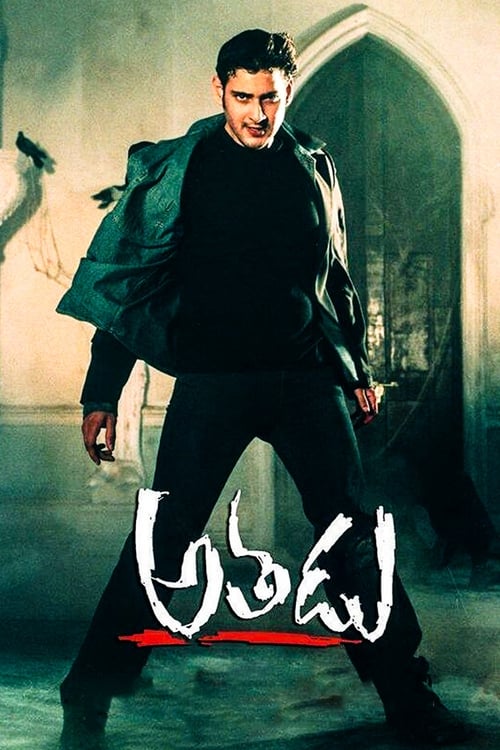
Athadu
2005 · Trivikram Srinivas
For when you want a full-meal crowd-pleaser — action, comedy, family sentiment, and star swagger in one sitting — the kind of film you put on to be thoroughly entertained, not challenged.
What it's about
Nandu, a contract killer, is hired to fake the assassination of a politician — but when the target actually dies, he's framed for the murder. On the run, he slips into the identity of a dead stranger and lands in that man's family home, a sprawling household that hasn't seen its long-lost son since childhood. The hunted hitman suddenly has a grandfather, cousins, and a place at the table he never asked for.
The experience
A big, confident entertainer that shifts gears from slick thriller to warm family comedy and back, with punchy action and crackling one-liners along the way. The fun is watching a cold professional slowly thaw inside a home full of people who think they know him.
Performances
Mahesh Babu's coolly understated turn as Nandu became one of his signature roles — a star performance built on stillness and dry wit rather than volume.
The craft
Trivikram Srinivas's writing is the engine: dialogue with a famous snap to it, and a structure that folds a fugitive thriller into a comedy of assumed identity without dropping either thread. The action set pieces bookending the family story give it real scale.
Why it matters
Widely regarded as one of Mahesh Babu's defining films and a benchmark for Telugu cinema's blend of stylish action and family drama, it cemented Trivikram's reputation as a star writer-director.
Snapshot
Athadu ("The One" or, loosely, "That Man") is a Telugu-language action thriller written and directed by Trivikram Srinivas, released in 2005 and headlined by Mahesh Babu opposite Trisha Krishnan. On its surface it is a fugitive-on-the-run picture: Nandu, a contract killer, is set up to take the fall for a political assassination he did not commit, and escapes the manhunt by stepping into the identity of a dead stranger. But the film's lasting reputation rests on how thoroughly it converts that thriller premise into a family melodrama and a comedy of assumed identity. When Nandu arrives at the home of the man whose name he has borrowed — a household that has not seen its long-absent son since childhood — the hunted killer finds the family and belonging he never had. Athadu is widely regarded as one of Mahesh Babu's defining performances and as a signature work of Trivikram's early directorial career, prized in Telugu film culture for its dialogue, its tonal control, and its rewatchability rather than for spectacle alone.
Industry & production
Athadu was produced by M. S. Raju under the Sumanth Art Productions banner, a prominent Telugu production house of the period, with Trivikram Srinivas directing from his own screenplay. The film sits at a specific commercial juncture: mid-2000s Telugu cinema was a star-driven, high-budget industry centered in Hyderabad, in which the "family entertainer" — a masala mode braiding action, romance, comedy, and domestic sentiment — was the dominant idiom for a top hero. Mahesh Babu, son of veteran star Krishna, was consolidating his standing as a leading man in this window, and Athadu is regularly cited as one of the vehicles that cemented that status.
The production reflects the scale conventions of a major Telugu release of its day: a marquee hero, an ensemble of established character and comedy actors, elaborate song sequences, and a music score positioned as a marketing asset in its own right. Precise, independently verifiable budget and box-office figures for the film are not something I can cite reliably from the historical record, and I will not invent them; in Telugu popular memory the film is remembered as a commercial success and, more durably, as a critical and cult favorite whose stature grew after its theatrical run. Its afterlife on television and home video has been substantial, which is part of why it is so frequently invoked as a "repeat-watch" title.
Technology
Athadu was made in the mid-2000s, when mainstream Telugu features were still originated on 35mm film and finished largely through conventional photochemical and increasingly digital post-production pipelines. Whether the film employed a full digital intermediate for its color grade is not something I can confirm from the record, and I will flag that rather than assert it; the digital-intermediate workflow was diffusing across major Indian-language cinema in exactly these years, so its use would be plausible without being documented here. What is safe to say is that the film's technological ambition lived less in image-capture novelty than in the standard mid-decade apparatus of large-scale song picturization: crane and track-heavy camerawork, choreographed set-pieces, location shooting staged for scale, and a heavily produced, multi-track music mix. The action and stunt work follow the physically staged, sometimes stylized conventions of Telugu action cinema of the era rather than the CGI-forward spectacle that would come to dominate the industry a decade later.
Technique
Cinematography
The cinematography is credited to Chota K. Naidu, one of the more sought-after Telugu directors of photography of the period. His work on the film serves its tonal split cleanly: the assassination and pursuit passages are shot with the harder, cooler, more kinetic grammar of a thriller, while the extended family-home stretch — the emotional core — is lit and framed for warmth and intimacy, favoring the readable, character-centered compositions that let performance carry the scenes. The song sequences follow the glossy, movement-rich picturization standard for a star vehicle of this scale. The camera's job across the film is less to announce itself than to keep the audience oriented through a plot built on concealment and mistaken identity, and to hold on faces during the domestic scenes where the drama is essentially about what a hardened man is quietly feeling.
Editing
The film's construction depends on a confident tonal architecture: a taut, propulsive thriller opening; a long middle movement that slows into comedy and family sentiment; and a convergence in which the buried thriller plot resurfaces to force a resolution. That pacing — the willingness to let the story breathe in the household before tightening again — is central to the film's effect. I want to be candid that the specific editing credit for Athadu is not something I can attribute with confidence from readily verifiable sources, so I will not name an individual rather than risk a wrong attribution; what can be said on firm ground is that the cutting rhythm, and especially the modulation between genres, is one of the film's most discussed craft achievements.
Mise-en-scène / staging
The staging draws a deliberate contrast between two worlds. The killer's milieu is transient and rootless — anonymous spaces, transit, the machinery of a contract hit and a frame-up. Against it stands the family home: a settled, populated domestic space full of relatives, routines, and the texture of belonging, into which the protagonist is dropped as an impostor. Much of the film's comedy and pathos is blocked around this intrusion — the fugitive learning, improvising, and being tested by a household that believes he is their own. The production design and staging of the home function almost as a character, the thing the protagonist comes to want to protect. Set-piece staging in the action and climax segments follows the broader, more presentational conventions of Telugu commercial cinema.
Sound
Music by Mani Sharma is one of the film's most important elements and a major part of its enduring popularity; the soundtrack is among the better-remembered of the composer's collaborations of the period. The songs are not merely interludes but do real tonal work — carrying the romance and the family warmth that the plot cannot state directly — and several became lastingly popular in Telugu music culture. Beyond the songs, the score and sound design support the genre split, sharpening tension in the thriller passages and softening into sentiment in the home. Dialogue delivery is itself a sonic signature here: Trivikram's writing is built for spoken rhythm and comic timing, and the film's audio foregrounds that verbal texture.
Performance
Athadu is, above all, a performance showcase for Mahesh Babu, and it is routinely cited as one of his finest turns. The role asks him to hold two registers at once — the still, guarded interiority of a professional killer and the improvised, increasingly sincere warmth of a man performing a stranger's family role — and the film's emotional success rests on his underplaying, on stillness and restraint rather than demonstrativeness. Trisha, as the heroine, anchors the romance and the household's younger generation. The supporting ensemble is deep: Sonu Sood appears as Nandu's associate in the killing trade, and Brahmanandam, the era's preeminent Telugu comedian, contributes the broad comic register the family section leans on. The film's texture depends heavily on this ensemble of character and comedy actors filling out the household; I'll avoid over-specifying individual role names where I'm not certain, but the collective effect — a crowded, lived-in family surrounding a solitary protagonist — is essential to the design.
Narrative & dramatic mode
The screenplay is a study in genre transposition. It opens in the mode of a political-conspiracy thriller — a staged assassination that goes lethally real, a frame-up, a fugitive with the state closing in — and then executes a decisive tonal pivot into domestic comedy-drama once the protagonist assumes the dead man's identity. The engine of the middle is dramatic irony: the audience knows the truth of the impostor while the family does not, which generates both comedy (the fugitive bluffing his way through a life he doesn't know) and pathos (the orphaned killer accumulating attachments he cannot honestly claim). The identity-swap conceit — a rootless man taking a dead stranger's place and finding, in the borrowed life, the family he lacked — is the film's true subject; the thriller plot is the frame that puts pressure on it and eventually collapses back in to force the climax. Trivikram's dialogue is a load-bearing element of the mode: the film is remembered as much for its verbal wit and quotable exchanges as for any single event, and the humor is character-driven rather than detachable.
Genre & cycle
Athadu belongs to the Telugu "family entertainer" tradition — the commercially dominant masala mode that fuses action, romance, comedy, and domestic sentiment within a single star vehicle. Its particular contribution to that cycle is the grafting of a hard-genre thriller spine onto a family-drama body, and doing so with enough writerly control that the seams read as design rather than compromise. Within the broader landscape of 2000s Indian cinema, the assumed-identity/impostor-joins-a-family premise is an old and pan-cultural device; Athadu's version is notable for weaponizing the fugitive-thriller stakes to raise the emotional cost of the deception. In the arc of Telugu star cinema, it stands as a well-regarded example of how the family-entertainer template could be elevated by strong writing rather than escalated by spectacle.
Authorship & method
Athadu is centrally an authorial work of Trivikram Srinivas, and it is best understood in the context of his career path. Trivikram came to directing from screenwriting: he built his reputation as a dialogue writer whose verbal wit earned him nicknames in the industry press, and he carried that writer's sensibility into direction. Athadu was an early feature in his directing career, following his debut, and it is frequently treated as the film that established his authorial signature — the fusion of sharp, quotable dialogue, comic timing, and a sentimental family core wrapped inside a commercial genre frame. His method is writer-first: the screenplay and its language are the organizing intelligence of the film, and staging, performance, and even music are marshaled to serve the script's tonal choreography.
The key collaborators reinforce that reading. Cinematographer Chota K. Naidu supplied a flexible visual grammar able to hold both thriller and domestic registers. Composer Mani Sharma provided a soundtrack that did essential emotional work and became one of the film's most durable assets. The producing role of M. S. Raju under Sumanth Art Productions placed the project within an established commercial machinery. As noted above, I am not able to attribute the editing credit with confidence and decline to guess. The presiding creative authority, by wide consensus, is Trivikram's.
Movement / national cinema
The film is a product of the Telugu-language film industry based in Hyderabad — one of the largest and most commercially vigorous of India's regional cinemas, and part of the broader landscape of Indian popular cinema that Anglophone shorthand often flattens under "Bollywood" but which is in fact a federation of distinct linguistic industries. Athadu is not an art-cinema or parallel-cinema work; it belongs squarely to mainstream Telugu commercial filmmaking, and it exemplifies that cinema's characteristic strengths in the mid-2000s: star-centered storytelling, the integration of song and dance into narrative, a high tolerance for tonal range within a single film, and a premium on dialogue and comedy as core pleasures rather than ornament. It is a useful representative text for understanding how regional Indian commercial cinema of the period balanced genre ambition against the fixed conventions of the star vehicle.
Era / period
2005 sits in a transitional stretch for Telugu cinema — still firmly in the pre-CGI-spectacle era, before the pan-Indian, VFX-driven blockbuster model that would later reshape the industry's ambitions and export reach. In this period the top-hero family entertainer was the reigning form, and the industry's craft energy went into writing, music, star performance, and the choreography of song and action rather than into technological spectacle. Athadu is very much of this moment, and its enduring esteem partly reflects nostalgia for a mode of Telugu filmmaking in which a mid-scale, dialogue-driven, emotionally grounded star vehicle could become a lasting favorite. It also marks a career-defining period for its principals — a formative stretch for Trivikram as a director and a consolidating one for Mahesh Babu as a leading man.
Themes
The film's governing theme is belonging — specifically, the hunger of a rootless, orphaned man for family, and the moral complication of finding it through deception. Identity is the second axis: the protagonist quite literally lives under another name, and the drama tracks the gap between the self he performs and the self he is, until the performance begins to become sincere. Related motifs run through the film: the contrast between a life of transactional violence and a life of domestic attachment; the redemptive pull of ordinary family love on a man defined by killing; and guilt and concealment as the constant pressure beneath the comedy. There is also a quieter thematic irony in the premise — that a man wins a genuine emotional home only by occupying a dead man's place, so that his belonging is founded on a lie he will eventually have to answer for. These themes are handled through situation and dialogue rather than overt statement, which is part of the film's craft.
Reception, canon & influence
Critically and popularly, Athadu is remembered as one of the standout Telugu films of its year and as a high point in both Trivikram Srinivas's and Mahesh Babu's filmographies. Its reputation has been notably durable: rather than fading after its theatrical life, it grew into a cult and rewatch favorite, frequently cited in Telugu film discourse for its dialogue, its tonal balance, and Mahesh Babu's restrained performance. I want to be precise about the limits of what I can verify: I can characterize this consensus reputation with confidence, but I won't attach specific box-office totals, award tallies, or particular published quotations to it, since I cannot confirm those from the record without risk of fabrication.
Looking backward, the influences on the film are best located in traditions rather than single sources: the fugitive/wrong-man thriller lineage, the long pan-cultural history of assumed-identity and impostor-in-a-family narratives, and — most proximately — the established conventions of the Telugu family entertainer, which supplied the template Trivikram both honored and refined. The decisive shaping "influence," in an authorial sense, is Trivikram's own background as a dialogue writer, which is what distinguishes the film from its genre peers.
Looking forward, Athadu's legacy is felt most clearly in the arc of its makers' subsequent careers and in Telugu popular memory. It helped establish the Trivikram signature — the writer-director whose commercial films are carried by dialogue, comedy, and family sentiment — that his later work would extend, and it is a recurring reference point when Mahesh Babu's best performances are discussed. Its status as a much-imitated, much-quoted, endlessly rewatched title makes it a small canonical fixture of 2000s Telugu cinema. Reports that the film was adapted or remade in other languages circulate in popular accounts; because I cannot confirm the specifics reliably, I'll note that possibility without asserting particular titles. What is not in doubt is the shape of its influence at home: Athadu is one of the films by which a certain kind of intelligent, sentimental, dialogue-first Telugu commercial cinema is measured.
Reception
A modest performer in theaters in 2005, Athadu became a phenomenon afterwards — endless TV reruns turned it into one of the most re-watched Telugu films ever, and it's now routinely called a modern classic.
How Athadu was received, from release to now →
Influences: the films it descends from and the films it influenced
- The 39 Steps (1935) — Codifies the fugitive-on-the-run structure in which a hunted man survives by slipping in and out of borrowed identities while momentum carries the plot forward — the picaresque wrong-man engine Athadu's first act runs on.
- North by Northwest (1959) — Establishes the mistaken-identity thriller where a man is relentlessly pursued for being someone he isn't, and pioneers the tonal cross-cut of suspense with light comedy that Athadu adopts as its default register.
- The Return of Martin Guerre (1982) — Provides the core device of an impostor who quietly takes an absent man's place inside a family and home that never knew the original — precisely the mechanics of Nandu living as Pardhu among strangers who accept him as kin.
- Sommersby (1993) — Restages the Martin Guerre premise so the impostor becomes a better man than the one he replaces, redeemed through domestic belonging — the exact emotional arc by which Athadu converts a contract killer into a son.
- While You Were Sleeping (1995) — Perfects the warm dramatic-irony comedy of a lonely outsider mistaken for family and adopted into its household, sustaining audience tension over a secret identity through affection rather than menace — Athadu's home-stretch tonal recipe.
- Aha Naa Pellanta (1987) — Anchors the Telugu writer-director tradition in which verbal wit and comic timing, not spectacle, organize the film — the dialogue-first authorial lineage Trivikram inherits and carries into direction.
- Nuvve Kavali (2000) — Trivikram's breakout screenwriting credit that established his quotable, wit-driven dialogue signature; Athadu is that same verbal intelligence finally under his own direction.
- Manmadhudu (2002) — Showcases Trivikram's battle-of-wits, dialogue-as-set-piece writing where scenes turn on language rather than event — the verbal texture Athadu extends into a thriller frame.
- Nuvve Nuvve (2002) — His directorial debut, where he first fuses a sentimental family core with commercial genre machinery and dialogue comedy — the authorial template Athadu refines and hardens.
- Khaleja (2010) — The director-star reunion re-runs Athadu's mode — a quietly restrained Mahesh, dialogue-driven comedy, and a thriller structure transposed onto an unlikely genre (destiny/belief) rather than played straight.
- Dookudu (2011) — Builds a Mahesh Babu vehicle on rapid tonal modulation between action, comedy, and sentiment plus impersonation set-pieces, extending the genre-blending and editing rhythm Athadu normalized for the star.
- Julayi (2012) — Wraps a heist-thriller plot in a light, wisecracking protagonist and family sentiment, continuing Athadu's specific balance of crime mechanics carried by dialogue comedy.
- Attarintiki Daredi (2013) — Re-runs Athadu's central conceit as reconciliation comedy: the hero infiltrates an estranged household under a false role, letting sustained dramatic irony drive both laughs and sentiment before the reveal.
- Jalsa (2008) — Consolidates the Trivikram signature Athadu launched — quotable dialogue, comic interludes, and a sentimental core embedded inside an action frame — into a repeatable authorial formula.
- Ala Vaikunthapurramuloo (2020) — Reprises the outsider-slots-into-a-family engine via a swapped-at-birth premise, using the same dialogue-first method and 'home as character' staging to make a stranger's entry into a household the film's emotional spine.
- Pokiri (2006) — Pairs Mahesh Babu's restrained, minimal-affect menace with a concealed-identity protagonist (an undercover cop living as a rowdy), extending in the same era the assumed-identity-plus-underplaying combination Athadu built around him.
Similar films
- Drishyam (2015) — shared sensibility
- Drishyam (2013) — shared sensibility
- Vikram (2022) — shared sensibility
- Asuran (2019) — shared sensibility
- Mahanadhi (1994) — shared sensibility
- Andhadhun (2018) — shared sensibility
- Vikram Vedha (2017) — shared sensibility
- Virumaandi (2004) — shared sensibility