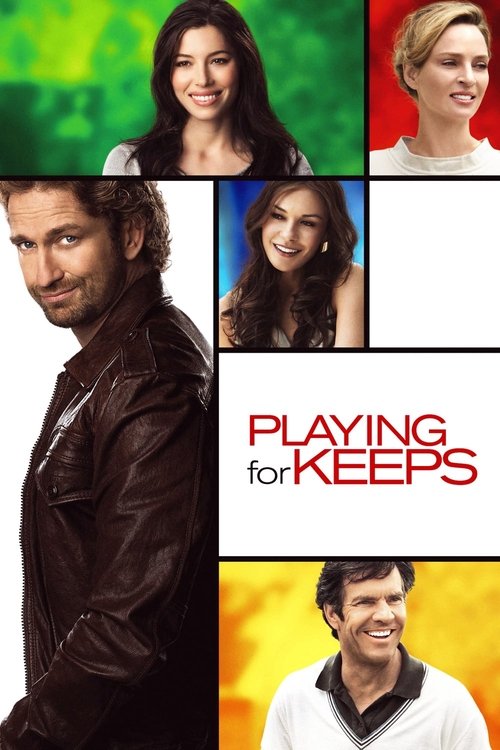
Playing for Keeps
2012 · Gabriele Muccino
For a zero-effort night when you want something warm, familiar, and low-stakes on in the background — comfort food, not a challenge. Good for when you're in the mood for a redemption story with training-montage energy.
What it's about
A retired soccer star, broke and adrift in suburban Virginia, reluctantly takes over coaching his young son's youth team as a last shot at putting his life back together — which mostly means winning back his ex-wife before she remarries. Complicating things: a sideline full of soccer moms and dads with agendas of their own.
The experience
Light, glossy, and sentimental — an easygoing mix of romantic comedy and second-chances drama that asks very little of you. It coasts on charm more than surprise; you'll see most of its moves coming, and that's sort of the point.
The craft
Muccino gives it a polished, sunlit sheen, and the sheer wattage of the supporting cast — Dennis Quaid, Uma Thurman, Catherine Zeta-Jones, Judy Greer orbiting Gerard Butler and Jessica Biel — is the most striking thing about the production. Nothing here demands a big screen; it's built for the couch.
Why it matters
It landed as a notable critical and box-office disappointment despite its stacked cast, and it's now mostly remembered as a cautionary tale of the fading early-2010s star-vehicle rom-com.
Snapshot
Playing for Keeps is a romantic comedy-drama released in December 2012, directed by the Italian filmmaker Gabriele Muccino in his third English-language feature. It stars Gerard Butler as George Dryer, a retired professional soccer player adrift in suburban Virginia, who reluctantly takes over coaching his young son's youth team and, in doing so, attempts to repair his relationship with his ex-wife (Jessica Biel) and reassemble a coherent adult life. The ensemble around Butler is conspicuously stacked — Dennis Quaid, Uma Thurman, Catherine Zeta-Jones, and Judy Greer all appear as parents and partners orbiting the team — yet the film is remembered less for that wattage than for the gap between its cast list and its reception. It arrived as a high-profile commercial and critical disappointment, and it occupies a particular place in Muccino's career as the project that effectively closed out his Hollywood studio period.
The dossier that follows treats the film honestly as a minor work. Its production history, authorship, and reception are reasonably documented; its technical craft was not the subject of sustained critical attention, and where the granular record is thin this account says so rather than inventing detail.
Industry & production
The screenplay is credited to Robbie Fox, and the project had an unusually long gestation. Fox's script circulated for years under the working title Playing the Field — a phrase that survives in some international release titles — and the finished film bears the marks of a vehicle assembled around a marketable star and an ensemble rather than around a fresh authorial idea. Gerard Butler was attached not only as lead but as a producer through his Evil Twins banner, which situates the film within the period when Butler was actively shaping his own star vehicles across romantic comedy and action.
The film was produced independently and distributed in North America by FilmDistrict, the distributor active in the early 2010s before its absorption into Focus Features. This places Playing for Keeps squarely in the post-recession independent-studio ecosystem: mid-budget, star-driven adult entertainment financed outside the major studios but aiming at a wide commercial release. That category was already contracting in 2012 as the majors concentrated on franchises and tentpoles, and the film's December release pitted a modest romantic comedy against the crowded year-end prestige and blockbuster calendar.
Commercially and critically the film underperformed badly, and that outcome is the best-documented fact of its industrial life. Rather than cite specific grosses, which I will not invent, it is accurate to say it was widely reported as a flop and was received by reviewers as one of the weaker wide releases of its season. The disappointment had consequences for its director's trajectory, discussed below under Authorship.
Technology
Playing for Keeps was produced and finished on the conventional digital-and-DI pipeline standard for a mid-budget American release of 2012, a transitional moment when digital capture had become the default for this tier of production. The film makes no claim to technological novelty — there is no signature format, no stereoscopic or large-format ambition, nothing in the visual program that announces a tool or technique as part of its meaning. Its soccer sequences, the one area where a sports film sometimes invests in specialized rigs or capture, are staged at an intimate youth-league scale rather than as spectacle, so they did not demand the high-speed or stabilized camera systems that a professional-sports drama might. In short, the technological story here is one of competent, invisible industry standard rather than innovation, and the surviving record reflects that: technical making-of documentation for the film is sparse.
Technique
Cinematography
Cinematography is credited to Peter Menzies Jr., a cameraman whose résumé leans heavily toward large-scale action and effects pictures. His presence on a small relationship comedy is itself notable, and the film's look is accordingly clean, bright, and conventionally glossy — warm suburban exteriors, soft domestic interiors, an unfussy coverage style built to serve dialogue and movie-star faces. There is little evidence of an expressive or signature visual scheme; the photography is in service of legibility and star presentation rather than authorial vision. This is consistent with how the film was reviewed: almost no critical attention was paid to its images, which is itself a fair indicator that the cinematography was serviceable rather than distinctive.
Editing
The film's cutting follows mainstream romantic-comedy grammar: scene-driven, dialogue-led, with the episodic rhythm of a protagonist moving between several romantic and parental relationships. The detailed editorial credit and any account of the cutting-room history are not well documented in the public record, and I will not attribute the work to a particular editor without confidence. What can be said from the finished film is structural: the editing has to juggle an unusually large number of subplots — George's relationships with multiple women, his bond with his son, his stalled sportscasting ambitions — and the picture's tonal unevenness, frequently noted by reviewers, is at least partly a problem of structure and pacing as much as script.
Mise-en-scène / staging
The world of the film is affluent suburban Virginia, and the staging trades on the iconography of comfortable American family life: manicured fields, well-appointed homes, the social theater of the sideline at a children's soccer game. The youth-soccer setting functions as the film's central stage, a place where parents perform their anxieties and desires, and the most legible staging idea in the film is the sideline as a social arena. Beyond that organizing conceit, the production design is naturalistic and unremarkable, designed to read as aspirational normalcy rather than to carry thematic weight.
Sound
The score is by Andrea Guerra, the Italian composer who is Muccino's most consistent collaborator and who scored the director's American breakthrough, The Pursuit of Happyness. Guerra's idiom — melodic, emotionally direct, string-forward — is well suited to Muccino's sentimental register, and his presence is one of the clearest threads of authorial continuity across Muccino's Hollywood films. Beyond the score, the film's sound design is conventional for the genre; there is no record of a notable sonic strategy, and the soundtrack's contemporary-pop dimension, if any, was not a subject of critical comment.
Performance
Performance is where the film's interest, such as it is, concentrates, simply because of who is in it. Gerard Butler plays George with the rumpled, roguish charm that anchored his romantic-comedy persona in this period; the role asks him to be charismatic, irresponsible, and ultimately redeemable, and the performance lives or dies on his likability. The supporting ensemble is the film's most-discussed feature: Jessica Biel as the grounded ex-wife and emotional center; Dennis Quaid and Uma Thurman as a wealthy, volatile couple; Catherine Zeta-Jones as a former sportscaster who dangles a career lifeline; and Judy Greer in a comic-pathetic register. Critics frequently observed that this concentration of talent was underused — that the actors were more accomplished than the material gave them room to be. That mismatch between cast and vehicle is, in retrospect, the defining performance story of the film.
Narrative & dramatic mode
The film operates in the mode of the redemptive romantic comedy-drama built around a charming-but-arrested male protagonist who must grow up. Its dramatic engine is familiar: a former somebody, now a nobody, is given a second chance through proximity to his child and re-entry into his ex-wife's life, and the coaching plot supplies both the literal mechanism of his redemption and the metaphor for it — a man who never learned to be a team player learns to coach a team. Around this spine, the script multiplies romantic temptations and comic complications, so that the dramatic mode oscillates between sincere family drama and broad farce.
That oscillation is the film's central structural problem and was widely identified as such. The sentimental father-son material pulls toward earnest melodrama in Muccino's characteristic key, while the subplots involving the sideline parents pull toward sex comedy; the two modes do not reconcile cleanly, and the result is a tonal instability that undercuts the emotional payoff the structure is engineered to deliver.
Genre & cycle
Playing for Keeps belongs to two overlapping cycles. The first is the early-2010s star-driven adult romantic comedy, a category that was commercially fading even as the film was made — the kind of mid-budget, grown-up date movie that the studios were increasingly ceding. The second is the youth-sports family comedy, a durable American subgenre in which an unlikely or reluctant adult coaches a team of children and is improved by the experience. By 2012 that subgenre carried decades of accumulated convention, and the film hews closely to its template of the redeemed coach.
What distinguishes the film within these cycles is mostly its European-directed sensibility grafted onto American genre materials, and its unusually starry ensemble. Neither distinction proved enough to give it a durable place in either cycle; it reads now as a late, minor entry in both.
Authorship & method
Gabriele Muccino is the authorial figure of interest here, and the film is best understood in the arc of his career. Muccino emerged in Italy as a chronicler of the romantic and generational anxieties of his contemporaries, achieving a major domestic success with L'ultimo bacio (The Last Kiss, 2001), a film whose emotional volatility and ensemble structure became his signature. That success brought him to Hollywood, where he directed Will Smith twice — The Pursuit of Happyness (2006), a substantial commercial and awards success, and Seven Pounds (2008). Playing for Keeps was his third American feature and his first not built around Smith.
The continuities of method are visible: an emotionally heightened, sentimental sensibility; an interest in fathers, sons, and second chances; and the recurring collaboration with composer Andrea Guerra. The discontinuity is the absence of the strong central star-and-director partnership that had organized his most successful American work. Key collaborators on this film — cinematographer Peter Menzies Jr., composer Andrea Guerra, and writer Robbie Fox — form a less unified team than on his Smith films, and the result lacks the focus of those pictures. In career terms, Playing for Keeps marked the end of Muccino's Hollywood studio period; he subsequently returned to working primarily in Italy, where he resumed the kind of ensemble relationship dramas that first made his name. The film therefore functions as a hinge: the point at which his American experiment closed.
Movement / national cinema
The film sits at an awkward but genuinely interesting intersection of national cinemas. Muccino is a product of post-neorealist Italian popular cinema — specifically the commercially successful, emotionally extravagant relationship dramas that dominated Italian box offices around the turn of the millennium — and his Hollywood films represent an attempt to translate that sensibility into American studio idiom. Playing for Keeps is American in every external respect: setting, cast, genre, financing, language. Its only meaningful claim on Italian cinema is the sensibility of its director and the continuity of his Italian composer. As a case study, it is most useful as an example of the difficulties of authorial transplantation — of a distinctly national directorial voice operating inside a generic American vehicle that gave it little to shape. The film belongs to no movement; it is an industry product with a transplanted author at its head.
Era / period
The film is very much of its moment, December 2012, in ways that now read as period markers. It is a late specimen of the mid-budget, star-driven adult comedy at precisely the point when that model was collapsing under the pressure of franchise economics and changing distribution. It captures a particular post-recession American suburban affluence as aspirational backdrop. And it belongs to the brief independent-distributor moment represented by FilmDistrict. Within Gerard Butler's career it sits in his early-2010s run of romantic-comedy leads, between his action work; within Muccino's it is the closing bracket of his American years. As a time capsule of a dying commercial category, it is more interesting in retrospect than it was on release.
Themes
The film's explicit themes are redemption, fatherhood, and arrested male maturity. Its protagonist embodies the figure of the former athlete who peaked early and never learned to live an ordinary life, and the film is structured as his belated education in responsibility — to his son, to his ex-wife, and to himself. The coaching conceit makes the central metaphor literal: a man who succeeded as an individual must learn the ethic of the team. Secondary themes circle around temptation and fidelity, the performance of success, and the anxieties of affluent suburban parenthood as enacted on the youth-sports sideline.
A more critical reading notes the film's uneasy gender politics — the protagonist is surrounded by women who function largely as temptations or rewards in his arc — and several reviewers raised exactly this objection. Whether the film fully endorses or merely depicts George's self-absorption is left unresolved by its tonal instability, and that unresolved quality is itself part of the film's thematic texture.
Reception, canon & influence
Critical reception was poor. The film was widely panned, with reviewers concentrating their criticism on its tonal incoherence, its formulaic redemption arc, and above all the waste of a remarkably deep cast on thin material. It was also a notable commercial disappointment relative to its profile; I will not cite specific box-office figures, but its failure was reported clearly enough that the outcome is not in doubt.
The influences on the film are generic and authorial rather than specific: the long tradition of the reluctant-coach youth-sports comedy, the conventions of the star-vehicle romantic comedy, and Muccino's own sentimental, ensemble-driven Italian sensibility carried over from his earlier work. There is no evidence of a distinctive set of cinematic models being consciously invoked; the film draws on templates, not touchstones.
Its legacy forward is correspondingly slight, and honesty requires saying so. The film shaped no cycle and influenced no subsequent filmmakers in any traceable way. Its real significance is biographical and industrial: it stands as the end point of Gabriele Muccino's Hollywood career, after which he returned to Italian filmmaking, and as a frequently cited example of the early-2010s phenomenon of the over-cast, underwritten star vehicle — a film whose ensemble promised far more than its script delivered. Within Sightlines' atlas of influence, Playing for Keeps is best understood not as a node that radiates lines outward but as a terminus: the place where a transplanted authorial experiment quietly ended.
A Deleuzian reading
The clearest image in *Playing for Keeps* isn't on the field.
The full Deleuzian reading of Playing for Keeps →
Reception
Savaged on arrival — it landed a rare 0% era-defining drubbing from critics and bombed hard at the box office — and unlike some flops, no reappraisal ever came; it's remembered, when at all, as one of 2012's biggest misfires.
How Playing for Keeps was received, from release to now →
Influences: the films it descends from and the films it influenced
- L'ultimo bacio (2001) — Establishes Muccino's signature method directly carried into this film: restless handheld camera roaming a multi-couple ensemble whose scenes pivot abruptly between comic banter and emotional crisis — the same tonal-instability-by-design machinery.
- Ricordati di me (2003) — Muccino's template of braiding four family members' parallel redemption subplots and cross-cutting their crises toward a synchronized emotional climax — the multi-subplot ensemble architecture grafted onto a Hollywood star cast here.
- The Pursuit of Happyness (2006) — Muccino's American fatherhood-and-second-chances mode paired with Andrea Guerra's swelling string cues to cue uplift — the same director/composer sentimental-scoring partnership reused, minus the disciplining central star.
- Seven Pounds (2008) — Refines Muccino's glossy-Hollywood manipulation of audience affect through Guerra's melancholic score and held close-ups on a guilt-ridden man seeking absolution — the redemption-arc grammar repeated.
- I vitelloni (1953) — Originates the post-neorealist study of arrested provincial men loitering at the edges of adult life, idly observing from the sidelines — the arrested-male-maturity and observational-loitering craft Muccino's Italian cinema descends from.
- C'eravamo tanto amati (1974) — Codifies the Italian popular-ensemble structure of interweaving a friend-group's romantic and generational disappointments across time with comic-melancholic tonal shifts — the commedia-all'italiana lineage feeding Muccino's ensemble sensibility.
- The Bad News Bears (1976) — Founds the reluctant-coach youth-sports comedy template — a dissolute, immature adult man redeemed by reluctantly coaching kids, with the playing field as moral proving ground — the exact genre scaffold borrowed here.
- Jerry Maguire (1996) — Models the fusion of a sports milieu with a romantic-redemption arc for an arrested charming man, using the athletic world as the arena where emotional maturity is finally earned.
- Love Actually (2003) — Popularizes the star-saturated multi-strand romantic-comedy mosaic that intercuts numerous loosely linked couples toward a collective holiday-warm payoff — the over-cast ensemble interweaving this film imitates.
- The Ugly Truth (2009) — Establishes the Gerard Butler roguish-cad rom-com persona — gruff, sexually frank charm softened into commitment — the precise star-image deployed as this film's romantic engine.
- Kicking & Screaming (2005) — Contemporary youth-soccer reluctant-coach comedy staging the sideline as a social arena where suburban adult anxieties play out among parents — the same sideline-as-stage blocking.
- The Bounty Hunter (2010) — Builds an entire mid-budget studio comedy around Gerard Butler's roguish-charm-meets-grudging-decency persona as load-bearing structure — the sibling deployment of the same star vehicle logic.
- Valentine's Day (2010) — Exemplifies the early-2010s over-cast, underwritten star-ensemble — a deep roster of name actors thinly distributed across interlocking romantic vignettes — the same industrial pathology the dossier diagnoses.
- New Year's Eve (2011) — The immediate sibling in the over-cast holiday-ensemble cycle: a marquee cast underserved by a mosaic script engineered for poster star-count rather than character depth.
- He's Just Not That Into You (2009) — Shares the saturated-cast romantic-comedy mosaic that cross-cuts many couples' parallel arrested-relationship subplots toward synchronized emotional resolutions.
- Hotel Rwanda (2004) — Showcases composer Andrea Guerra's signature aching-strings emotional underscoring method — the collaborator technique recruited to manufacture sentiment in Muccino's films, including this one.
Similar films
- Jerry Maguire (1996) — influence & lineage
- The Pursuit of Happyness (2006) — influence & lineage
- No Hard Feelings (2023) — shared sensibility
- Jay Kelly (2025) — shared sensibility
- Jersey (2019) — shared sensibility
- How to Lose a Guy in 10 Days (2003) — shared sensibility
- The Fabelmans (2022) — shared sensibility
- The Wrestler (2008) — shared sensibility