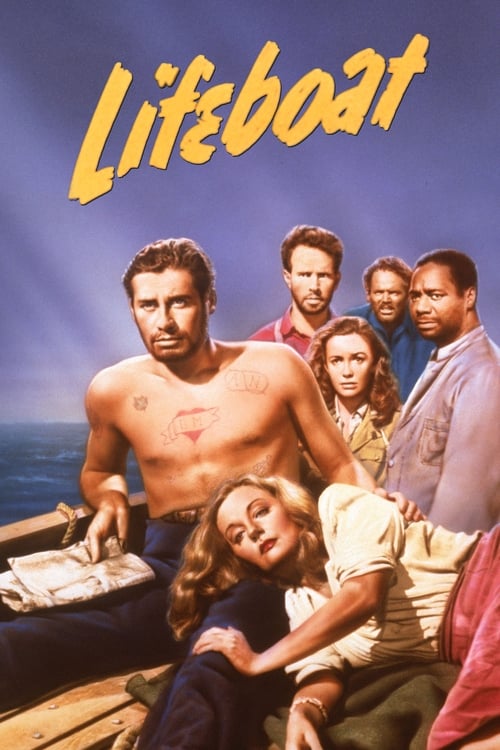
Lifeboat
1944 · Alfred Hitchcock
For when you want smart, high-tension drama in one confined space — a film that makes you argue with yourself about what you'd do in that boat. Gripping rather than comforting; great for a night when you want your morals tested along with your nerves.
What it's about
After a German U-boat torpedoes their ship in the mid-Atlantic, a handful of survivors — a glamorous journalist, an industrialist, a nurse, a radio operator, a merchant seaman, a steward, a grieving mother — crowd into a single lifeboat. Then they pull one more man from the water: a German from the very submarine that sank them. With supplies dwindling and no rescue in sight, the question of what to do with him — and who among them is actually fit to lead — becomes a matter of survival.
The experience
Claustrophobic and coiled, a pressure-cooker drama that keeps tightening as thirst, weather, and suspicion do their work. It's talky in the best way — every conversation is a power struggle — and it builds to moments of genuine shock.
Performances
Tallulah Bankhead is magnetic as the mink-wearing journalist who treats the apocalypse as good copy — one of the great larger-than-life star turns of the 1940s — and Walter Slezak is unnervingly capable as the rescued German.
The craft
Hitchcock sets himself an audacious constraint — an entire feature inside one small boat, no cutaways to shore — and turns the limitation into suspense, wringing endless variety from a few square feet of space. The black-and-white photography and shifting seas keep the frame alive, and the script sharpens survival logistics into political parable.
Why it matters
Released mid-war and immediately controversial for making its German the most competent man aboard, it became the founding model for the single-setting survival thriller and one of the boldest formal experiments of Hitchcock's American career.
Snapshot
Lifeboat is Alfred Hitchcock's most severe formal wager: a feature-length film confined entirely to a small open boat adrift in the Atlantic, with no cutaways to shore, no rescue-ship intercutting, and no relief from the horizon line. Eight survivors of a torpedoed passenger freighter — a celebrity journalist, an industrialist, a merchant seaman, a nurse, a radio operator, a Black steward, a shell-shocked mother, and a wounded engine-room worker — pull aboard a ninth man who turns out to be from the U-boat that sank them and was itself sunk in the exchange. What follows is a parable of democratic disunity, staged as a survival narrative and prosecuted as a chamber drama.
Made at Twentieth Century-Fox during Hitchcock's loan-out years away from David O. Selznick, released in January 1944 while the war's outcome was still in the balance, the film arrived into an argument rather than a market. It was praised for its audacity and attacked — most famously and consequentially by Bosley Crowther in The New York Times — for appearing to grant the Nazi the virtues of competence, stamina, and foresight while the Allied passengers bickered, drank, and drifted. Fox pulled back on the release. The controversy has shadowed the film ever since, and it is also the reason Lifeboat remains one of the most argued-over titles in Hitchcock's filmography: a wartime propaganda object that refuses to behave like one.
Seen now, it reads as both a laboratory experiment in spatial constraint — the direct ancestor of Rope, Dial M for Murder, and Rear Window in Hitchcock's confinement cycle — and as a genuinely uncomfortable political film about what a coalition of individualists does when it has to agree on a direction.
Industry & production
Lifeboat belongs to the peculiar middle stretch of Hitchcock's American career, when he was under long-term contract to Selznick but worked mostly on loan to other studios, with Selznick collecting the differential. The loan-out to Twentieth Century-Fox put Hitchcock under Darryl F. Zanuck's studio at the moment Zanuck was deeply enmeshed in the war effort, and it gave Hitchcock access to Fox's large-tank facilities — a necessity, since the film could not be made any other way.
The literary origin is unusual and well documented in outline: Hitchcock developed the premise and sought a major novelist to write the source narrative, and John Steinbeck produced the story that the screenplay was built from. Jo Swerling received the screenplay credit. Steinbeck subsequently and publicly disliked what the film became, objecting in particular to the treatment of the Black character, Joe — a dispute that is part of the historical record and is worth stating plainly rather than smoothing over, because it bears on how the film's politics were contested from the inside as well as from the reviewing press. Ben Hecht is generally reported to have contributed uncredited work, as he did on other Hitchcock projects of the period; the precise apportionment of writing labor among Steinbeck, Swerling, and other hands is the sort of thing studio credit arbitration flattens, and the granular record is thinner than the credits imply.
Production was physically punishing in ways that shaped the finished film. Shooting took place largely in studio tanks with wind and wave machines, process screens, and a boat rigged on a gimbal. Tallulah Bankhead — a stage star whose screen career had never quite taken — plays Constance Porter, and her performance is the film's engine. The cast, drawn substantially from character players and stage actors rather than top-billed Fox contract stars, was assembled for ensemble balance rather than marquee weight: Walter Slezak as the German, John Hodiak as the stoker Kovac, William Bendix as Gus, Hume Cronyn as Stanley, Mary Anderson as Alice, Henry Hull as the industrialist Rittenhouse, Heather Angel as Mrs. Higley, and Canada Lee as Joe.
The release was complicated by the reception (see below). Fox's handling of the film after the initial reviews is usually described as a curtailed push rather than a formal withdrawal; either way, Lifeboat did not have the commercial life a Hitchcock war picture might have expected in 1944, and its reputation was rebuilt slowly, mostly by later critics and by the auteurist reappraisal of the 1950s and 1960s.
Technology
The film is a catalog of mid-1940s studio water technology deployed at the limit of what it could do. The essential problem: an open boat, sky and sea in every direction, no land, no other vessels for most of the running time, and the camera obliged to stay in or immediately around the boat. Practical location shooting at sea would have made continuity, sound, and lighting impossible over a feature's length.
The solutions were the standard ones, but concentrated: large studio tanks, wave and wind machines, rain effects, and extensive rear and process projection to supply horizon and sky behind the players. The boat itself was mounted so it could be rocked and pitched under control, which is what allows the actors to be jolted on cue and the frame to tilt in coordination with the performance rather than at the mercy of real swells. Miniatures and optical work carry the sinking, the U-boat, and the later ship material.
The technology is visible — modern viewers see the process screens — and that visibility is part of why the film's realism has always been argued about. But the trade was deliberate: Hitchcock bought absolute control over eyelines, light, and the rhythm of physical disturbance, and spent it on staging. The film's tonal register depends on being able to move from glassy calm to storm and back on a schedule, and on the actors' faces staying legible in both.
The other technological substrate worth naming is the Production Code and the wartime information apparatus. Films of this period were shaped by the Office of War Information's expectations about how the enemy and the Allied coalition should be depicted; Lifeboat's trouble was precisely that it fell outside those expectations. That regulatory environment is as much a production technology as the wave machine.
Technique
Cinematography
Glen MacWilliams shot the film and received an Academy Award nomination for black-and-white cinematography — the only Oscar nomination of his career, and a reasonable index of how difficult the assignment was recognized to be. The constraint is unforgiving: a boat is a small stage with no walls to hide lights behind, no ceilings, and a background that must read as continuous open water.
MacWilliams and Hitchcock work the space in three registers. First, tight and grouped: the boat's interior geometry — thwarts, gunwales, the mast — is used to compose figures in tiers, so that four or five faces can occupy a frame at different depths without the image going flat. Second, the isolating close-up: because there is nowhere for a character to physically withdraw to, privacy has to be manufactured optically, and the film repeatedly cuts a single face out of the group to signal interior retreat. Third, the disorienting: during the storm, camera and boat move together and the horizon ceases to stabilize the frame, which is the film's most direct translation of political disorder into optical disorder.
Lighting shifts carry the passage of time — hard high sun for the days of exposure and thirst, low key for night and for the moral turns that happen in darkness. The visible artifice of the process backgrounds sits oddly against the physical grit of the foreground; whether that seam damages the film is one of the durable critical disagreements about it.
Editing
Dorothy Spencer edited. In a film without locations to cut between, editing does the work that geography normally does: it decides who is in the argument and who has been excluded from it. The cutting pattern is essentially juridical — reaction shots function as votes, and Hitchcock repeatedly builds sequences in which a proposal is made and the camera polls the boat.
Two sequences show the method at its sharpest. The amputation of Gus's leg is built from the group's faces and from what is withheld from view, generating its effect entirely by displacement — a straightforward demonstration of the Kuleshov logic Hitchcock talked about all his life. And the killing of Willi, late in the film, is cut as a collective act: the point is not who struck first but that the boat becomes a single body, and the editing has to make a mob out of individuals who have spent the film refusing to cohere. The subsequent silence, and the group's inability to look at one another, is also an editing effect — held shots that refuse the relief of a cut.
Mise-en-scène / staging
This is the film's principal achievement. Hitchcock treats the lifeboat as a stage with fixed seating, and the drama becomes a matter of who sits where, who moves, and what changes hands. Position in the boat is position in the argument: the tiller is authority, the bow and stern are poles of a political geography, and the middle is where the uncommitted sit.
Objects do enormous work because there are so few of them. Connie's possessions — the camera, the typewriter, the mink, the bracelet — are stripped from her one by one, a running structural device by which the film divests its most modern, most transactional character of everything she brought aboard. Willi's concealed water and his compass are the film's central asymmetry made physical: he has the means of survival and of navigation, and the others do not know it. The bracelet as bait, at the end, closes a circle that the film has been drawing all along about what the group's values are actually worth in extremity.
Hitchcock's own cameo — his most ingenious solution to a problem he had created, since there is no crowd to walk through — appears as a before-and-after weight-loss advertisement in a newspaper in the boat. It is a joke, but it is also a note about the film's method: everything must be brought inside the boat or it does not exist.
Sound
The soundscape is close to a continuous environmental score: water against the hull, wind, the creak of the boat, and — in the storm — an overwhelming noise field. Hugo Friedhofer is credited with the music, but the film is notable for how little conventional underscoring it uses in its long central stretches. Rather than a score commenting on the action, the film mostly lets ambience carry mood, which sharpens the moments when music does enter.
Voice is the other sonic subject. Language is a plot mechanism: Willi's initial pretense of not speaking English, and the group's discovery that he understands them, turns the boat into a space where speech is never private. Bankhead's low, dry delivery and Slezak's controlled, accented calm are set against Bendix's Brooklyn cadence and Canada Lee's quieter register, and the film's arguments are audibly class arguments as much as ideological ones. Song functions as the group's only collective non-verbal act; Joe's flute is the film's other instrument, and its placement — a Black character given music rather than a vote, for much of the running time — is precisely what the film's critics, including Steinbeck, have objected to.
Performance
Bankhead's Constance Porter is one of the great American screen performances of the decade and won the New York Film Critics Circle award for best actress. The role is a gift and a trap: an armored, wisecracking professional whose glamour is comprehensively destroyed over the running time. Bankhead plays the arc as a stripping rather than a softening — Connie does not become nice, she becomes real — and her theatrical scale, which had defeated her earlier film work, is exactly right in a space where everyone is always visible to everyone else.
Walter Slezak's Willi is the performance the controversy was about. He plays the U-boat captain as unfailingly courteous, physically indefatigable, and quietly certain of his superiority — never as a snarling caricature. That choice is what makes the film's argument possible and what made it politically combustible in 1944.
Canada Lee, one of the most significant Black stage actors of his era, gives Joe a watchfulness that the script does not always reward; the character's marginalization is a limitation of the film, not of the performance. William Bendix's Gus carries the film's physical suffering, and Hume Cronyn, Henry Hull, John Hodiak, Mary Anderson, and Heather Angel fill out an ensemble in which no one is permitted a scene alone.
Narrative & dramatic mode
Lifeboat is a unity-of-place drama in the strictest sense available to cinema, closer to the theatrical tradition of the single-set play than to conventional 1940s narrative film. Its dramatic mode is deliberative: the plot advances by proposals, arguments, and votes rather than by action. Where should we steer — Bermuda or the British Isles? Do we keep the German? Do we let him navigate? Do we amputate? Each is a scene of collective decision, and each is resolved in favor of whoever has the most competence, will, or information at that moment.
The structure is therefore a slow transfer of authority. The Allied survivors possess numbers, sentiment, and a shared cause but no navigational skill, no unified command, and no agreement on ends; Willi possesses skill, discipline, concealed resources, and a single clear objective. He does not seize the boat. He is handed it, incrementally, by people acting on reasonable-seeming grounds — and this is the film's thesis, presented as narrative mechanics rather than as speech.
The turn is Gus. The revelation of what Willi has done reverses the film's moral field instantly and produces the killing — a moment of collective violence that the film neither celebrates nor condemns cleanly. The coda, with the second German, refuses to close the question: the boat has learned that unity requires an enemy, and has not learned what to do the next time one is in front of them. That refusal is why the film reads less like propaganda than like an argument about the difficulty of propaganda.
Genre & cycle
The film sits at the intersection of three cycles. It is a wartime home-front-adjacent combat picture without combat, part of the 1942–1945 boom in films dramatizing the Atlantic war and the merchant marine. It is a survival-at-sea narrative, a form with a long literary pedigree — open-boat stories in the tradition of Crane and of shipwreck accounts generally — that Hollywood periodically returns to. And it is a chamber drama: the ensemble-in-a-confined-space picture, which in this decade also includes films built around trains, aircraft, apartments, and rooms.
Within Hitchcock's own output it belongs to the wartime group with Foreign Correspondent (1940) and Saboteur (1942), and to the confinement experiments that follow: Rope (1948), Dial M for Murder (1954), Rear Window (1954). Lifeboat is the earliest and most extreme of these, and the one where the constraint is a condition of the story rather than a stylistic overlay.
It also anticipates a subgenre that would not have a name for decades: the microcosm-as-society film, in which a small isolated group is made to allegorize a polity. That lineage runs forward through countless lifeboat, bunker, island, and spacecraft variants.
Authorship & method
Lifeboat is a nearly pure demonstration of Hitchcock's working method, because the constraint removes almost everything else. He was a director who pre-designed on paper and regarded shooting as execution; a single set with fixed sightlines makes that method not merely possible but obligatory. Every setup had to be planned against a boat that could only be shot from a limited number of angles, and the film's coherence is the coherence of a solved problem.
The collaborators matter individually. John Steinbeck supplied the source narrative and then repudiated the result — an authorship dispute unusually well attested for a studio picture of this period, and a reminder that the film's politics were contested before a single review appeared. Jo Swerling wrote the screenplay; the wisecracking, class-conscious dialogue that carries much of the film's texture belongs to that layer. Glen MacWilliams solved the photographic problem and was recognized for it. Dorothy Spencer, one of the most durable editors in the American industry, built the film's deliberative rhythm. Hugo Friedhofer's music is deployed with restraint that is itself an authorial decision.
Two Hitchcockian signatures are unmistakable. First, suspense as unequally distributed knowledge: the audience learns about Willi's water and compass at moments calibrated to make us complicit in watching the others fail to see. Second, the moral implication of the viewer — we admire Willi's competence for much of the film, and the film knows we do, which is what makes the killing land as an accusation rather than a catharsis.
The MacGuffin logic is inverted here. Ordinarily the object everyone chases is meaningless; in Lifeboat the objects — water, compass, direction — are the only things that matter, and it is the characters' professed values that turn out to be the empty tokens.
Movement / national cinema
The film is an American studio production, but its director was an English émigré making wartime films with a divided address: to an American audience being told a story about coalition, and to a Britain he had left and was frequently criticized for leaving. That biographical friction is legible in the film's skepticism about American self-regard — Connie's careerism, Rittenhouse's boardroom instincts, Kovac's class resentment — which is sharper than most 1944 Hollywood pictures permitted themselves.
Formally, Lifeboat has a European inheritance. The unity-of-place construction, the psychological chamber-drama register, and the willingness to build a whole film out of an ethical dilemma among a handful of people belong more to the Continental theatrical and cinematic tradition than to Hollywood's. Hitchcock's British-period training in silent-derived visual storytelling is what allows the film to convey so much without dialogue in its physical sequences.
Its position in wartime propaganda cinema is oblique. Compared with the British documentary-realist war films or with Hollywood's more direct combat pictures, Lifeboat is an argument film, and its refusal to make the enemy contemptible is exactly what set it apart from the norms of both national traditions in 1944.
Era / period
January 1944 is the film's most important fact. The Allied position was improving but the outcome was not settled; the invasion of France was months away; the full scale of Nazi atrocity was not yet publicly established in the way it would be within eighteen months. In that moment, a film in which the German is the most capable person aboard was not a provocation in the abstract — it was a live political statement, and it was received as one.
The film also belongs to a specific American domestic moment: a wartime coalition of labor, capital, and professional classes that was pulling together officially and grinding against itself in practice. Kovac the engine-room man and Rittenhouse the owner are not incidental character types; they are the domestic argument, put in a boat. Joe's position — his vote questioned, his role largely as observer and servant — registers the era's racial arrangement, and modern criticism has been right to press on it.
Technically, the film sits at the peak of the studio system's craft capacity: the resources to build an ocean indoors, a deep bench of character actors, and a production apparatus that could absorb an experiment of this kind at all. Few other moments in film history could have produced it.
Themes
Competence versus consensus. The film's hardest idea is that a group with the right values and no agreement loses to an individual with the wrong values and a plan. It does not resolve this in favor of the strongman — the ending insists the group can act — but it refuses to pretend the problem away.
The cost of civility. Every step by which Willi gains control is taken by decent people making decent choices: don't kill a helpless man, use the skill available, defer to the person who can navigate. The film argues that liberal proceduralism is exploitable, without concluding that it should be abandoned.
Stripping. Materially and morally, the film is a subtraction. Possessions, glamour, health, limbs, illusions, and finally restraint are removed one at a time. What remains at the end is a group that has discovered what it is capable of, which is not entirely good news.
Complicity and the pleasure of order. Willi is easy to watch because he is efficient. The film cultivates that pleasure and then presents the bill — a strategy Hitchcock would use for the rest of his career.
The uncounted. Joe's marginal position, whether read as the film's critique or the film's failure, makes the boat's claim to be a democracy inspectable. Steinbeck's objection and later scholarship both center here, and the honest account is that the film gestures at the problem more than it confronts it.
Reception, canon & influence
Critical reception. Lifeboat was met with immediate and serious controversy. The central charge, pressed hardest in the American press and associated above all with Bosley Crowther's New York Times review, was that the film flattered Nazi capability and made the democratic characters look weak — a reading Hitchcock disputed, arguing that the picture was a warning about Allied disunity rather than an endorsement of German strength. The debate was not confined to reviewers: Steinbeck's own dissatisfaction, on different grounds, is part of the same record. Fox's promotional support was curtailed and the film underperformed relative to its director's standing.
Alongside the controversy came recognition. Bankhead won the New York Film Critics Circle award for best actress. The film received Academy Award nominations including Steinbeck for original story, Hitchcock for direction, and MacWilliams for cinematography — a spread that indicates the industry took the picture seriously as craft even as its politics were disputed.
Influences on the film (backward). The literary open-boat tradition supplies the situation; the single-set stage play supplies the dramatic form; Hitchcock's own British silent training supplies the visual grammar for conveying information without dialogue. Steinbeck's fiction of collective struggle and class friction supplies the character architecture — the boat as a cross-section of a society, a device recognizable from his novels.
Legacy (forward). Three lines run out of Lifeboat.
The first is Hitchcock's own. The film established that a self-imposed spatial constraint could be a generative principle, and he returned to it deliberately: Rope's apartment and continuous-take conceit, Dial M for Murder's single room, and above all Rear Window, where the confinement is the entire epistemology of the film. Lifeboat is the proof of concept.
The second is the microcosm-allegory film. The template — a handful of strangers, an enclosed space, a scarce resource, an outsider whose expertise is also a threat — has been reworked continuously in survival cinema, in siege and bunker films, in single-location science fiction, and in the modern one-location thriller. Later directors returning to extreme confinement, including Hitchcock's admirers among the New Hollywood and after, work in territory this film mapped.
The third is the argument itself. Lifeboat remains a standard case study in how wartime cinema negotiates the depiction of an enemy, and in the risks of ambiguity in propaganda. Scholarship on Hitchcock's politics, on Hollywood and the Second World War, and on race in 1940s American cinema regularly returns to it — not as a settled classic but as an unresolved one, which is a more useful kind of canonical status.
Its critical stock has risen considerably since 1944. It is now generally read as a major work of Hitchcock's American period: not his most pleasurable film, but arguably his most rigorous, and the one where his formal appetite for constraint and his moral appetite for implicating the audience meet with the least cushioning between them.
A Deleuzian reading
A man's leg is coming off, and Hitchcock points the camera at everyone except the leg.
The full Deleuzian reading of Lifeboat →
Reception
In 1944 it was a scandal, not a triumph — columnist Dorothy Thompson famously gave it 'ten days to get out of town,' and critics accused Hitchcock of making the German character dangerously competent while Allied survivors squabbled. Today it's reappraised as one of his boldest experiments, the ancestor of every single-location thriller.
How Lifeboat was received, from release to now →
How to watch Lifeboat: what to notice on a first viewing
- Notice who sits where in the boat. Hitchcock treats seating as politics: the tiller means authority, bow and stern are opposing poles, and the middle is where the uncommitted sit. You can read the boat's power structure just from where people are sitting.
- Watch how the camera isolates a single face from the group. Because nobody can physically withdraw on a small open boat, MacWilliams cuts a face out of the group whenever privacy is needed, manufacturing it optically. A close-up becomes the only door anyone on this boat can close.
- Listen for how little conventional music plays under long stretches. Hugo Friedhofer's score mostly stays out of the way, letting water against the hull, wind, and the creak of the boat carry the mood instead. Ambience does the work a score usually does, which makes the boat feel real.
- Notice how few objects exist for the group to fight over. A camera, a typewriter, a mink, a bracelet: what little Connie brought aboard gets stripped from her piece by piece across the film. With this few possessions on board, every object carries outsized weight.
The whole guide to watching Lifeboat, with the keys for a rewatch →
Influences: the films it descends from and the films it influenced
- Battleship Potemkin (1925) — Hitchcock's reaction-shot-as-vote — a collective decision constructed only in the cut between scrutinized faces rather than spoken in dialogue — is Eisenstein's quarterdeck montage grammar, the Kuleshov principle Hitchcock repeatedly named as the basis of his own editing.
- The Passion of Joan of Arc (1928) — Establishes the isolating close-up as juridical evidence — faces severed from spatial context so a tribunal plays as a mosaic of examined expressions — which MacWilliams applies to the boat's improvised trial of Willi.
- The Petrified Forest (1936) — The Hollywood template for the single-set filmed play: coverage that re-blocks a fixed room by reseating and regrouping bodies rather than relocating the camera, with an arriving armed outsider forcing the group into talk.
- La Grande Illusion (1937) — Renoir's von Rauffenstein makes the uncaricatured enemy officer a solvable craft problem — competence and courtesy played straight — and his use of German/French/English as literal barrier and bridge is the model for language-as-plot-mechanism in Willi's concealed fluency.
- The Lady Vanishes (1938) — Hitchcock's own rehearsal for the conveyance as political microcosm: a sealed carriage, an ensemble of national types who must be argued into acting, and critical information routed through a non-verbal channel only one passenger can decode.
- Stagecoach (1939) — Dorothy Spencer's cutting of a vehicle-bound ensemble — reaction chains around a cramped interior in which the seating order carries the class hierarchy — is the identical method she brings to Lifeboat, where who holds the tiller is the film's argument.
- The Long Voyage Home (1940) — Ford's O'Neill adaptation fixes a merchant crew as a stratified society bounded by the gunwales, and its long unscored passages carried by water, wind and rigging supply the ambient-score-substitution model.
- Foreign Correspondent (1940) — The clipper ditching and survivors clinging to a floating wing is the literal prototype — Hitchcock already testing the tank, the unstable horizon, and suspense built on a shrinking piece of floating debris.
- Rope (1948) — Pushes the self-imposed spatial constraint Lifeboat proved generative to its formal limit — one apartment, continuous takes — with every setup again pre-solved on paper because the set admits no escape angle.
- Dial M for Murder (1954) — Returns to unity of place as a deliberative device: a single flat where the plot advances through objects (latchkey, scissors, telephone) whose positions in the room are the narrative's actual structure.
- Rear Window (1954) — Converts confinement from survival premise into epistemology — the immobilized protagonist can only look and infer — making Lifeboat's discipline of knowing nothing the boat cannot see into the entire subject of the film.
- 12 Angry Men (1957) — The deliberative plot distilled: seating as politics around one table, a progressive lens and eyeline scheme that tightens the room, and the reaction-shot-as-vote made literal in the show of hands.
- Abandon Ship! (1957) — A direct reworking of the overloaded-boat moral arithmetic — who goes over the side and who is authorized to decide — restaging Lifeboat's premise as an explicit command tribunal at sea.
- The Flight of the Phoenix (1965) — Rebuilds Willi precisely: crash survivors dependent on a German technician whose expertise is indispensable and whose authority is intolerable, the group's fate turning on trusting the competence of the man they distrust.
- Das Boot (1981) — Inherits the hull-bound fixed sightlines and the refusal to caricature a German crew, and replaces score outright with hydrophone pings, rivet stress and engine noise as the film's dramatic clock.
- The Thing (1982) — The blood test weaponizes reaction-shot-as-vote — a confined group polling each other's faces for guilt — over Lifeboat's outsider-expertise-as-threat structure, where the one who knows how to survive may be what you are surviving.
- All Is Lost (2013) — Builds an entire feature from objects-as-structure — sextant, water can, bailing tin marking narrative stages — with near-total ambient-score substitution and the horizon kept deliberately unstable in frame as the sole index of jeopardy.
- Knife in the Water (1962) — Stages an entire feature within the physical confines of a single boat, the spatial-confinement template Polanski transplants onto the sailboat to trap his cast under continuous pressure.
- No Man's Land (2001) — Pioneers the single-confined-location war microcosm in which an enemy combatant is stranded among adversaries, the whole conflict compressed into one cramped space and tested through forced proximity.
- One Hundred and One Dalmatians (1961) — Tallulah Bankhead's fur-draped, cigarette-punctuated drawl is the acknowledged model for Betty Lou Gerson's Cruella — the specific vocal attack of a woman performing her own glamour as aggression.
- The Ox-Bow Incident (1943) — A contemporaneous Fox deliberative-plot picture in which the drama is entirely a group talking itself into an execution, staged so the camera polls faces for assent — the same reaction-shot-as-vote grammar transferred to a lynch mob.
- Five Graves to Cairo (1943) — The other 1943 wartime attempt at an antagonist written with real intelligence instead of caricature, and one that likewise makes fluency in the enemy's language the mechanism generating every reversal.
Similar films
- Das Boot (1981) — influence & lineage
- Foreign Correspondent (1940) — influence & lineage
- Rope (1948) — influence & lineage
- The Long Voyage Home (1940) — influence & lineage
- Rear Window (1954) — influence & lineage
- The Lady Vanishes (1938) — influence & lineage
- The Flight of the Phoenix (1965) — influence & lineage
- A Night to Remember (1958) — shared sensibility