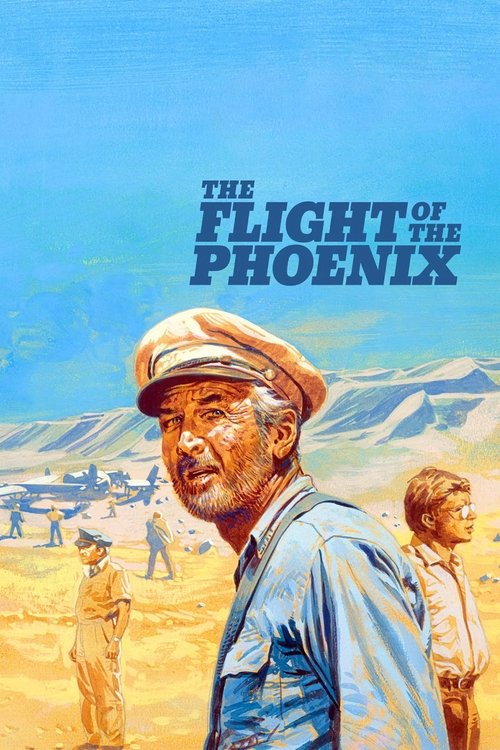
The Flight of the Phoenix
1965 · Robert Aldrich
For when you want old-school survival storytelling that respects your intelligence — men against the elements, no shortcuts. A long sit that rewards the commitment.
What it's about
A cargo plane goes down in a Saharan sandstorm, stranding a dozen men — oilmen, soldiers, a washed-up pilot — with dwindling water and no hope of rescue. Then a precise, abrasive German aircraft designer proposes something close to madness: cut the wreck apart and build a smaller plane from its remains. Survival becomes a fight over whose competence, and whose pride, the group can afford to trust.
The experience
A slow-tightening vise — sweat, grit, and escalating desperation, with the tension coming from clashing egos as much as the desert. It's absorbing the way a great problem is absorbing, and the payoff is earned inch by inch.
Performances
James Stewart, cast against his warmth as a proud, failing pilot, grinds against Hardy Krüger's coldly logical designer in one of the great two-hander antagonisms, with Richard Attenborough and Ernest Borgnine deepening the ensemble.
The craft
Robert Aldrich strips the disaster film of every convention — no rescue subplot, no romance, no cutaways — and stays in the sand for nearly two and a half hours, building drama purely from labor, hierarchy, and engineering. The heat feels physical; the flying sequences were done for real, at real cost.
Why it matters
It became the touchstone for the engineering-survival story — the template every 'stranded crew builds their way out' film gets measured against — and stands among Aldrich's toughest ensemble pictures.
Snapshot
A twin-boom cargo plane goes down in a Saharan sandstorm; a dozen men, most of them oilfield workers and company employees, are left with a wrecked airframe, a dwindling water supply, and a German designer who proposes to cut the machine apart and build a smaller one out of its remains. Robert Aldrich's The Flight of the Phoenix takes that premise — adapted by Lukas Heller from Elleston Trevor's 1964 novel — and refuses almost every escape route available to it. There is no rescue subplot, no romance, essentially no women, no cutaways to a search operation. The film stays in the sand for close to two and a half hours and makes its drama entirely out of labor, hierarchy, and the question of whose competence the group should trust.
What results is one of the purest problem-solving films the studio era produced, and also one of its most quietly savage studies of male authority. James Stewart's pilot, Frank Towns, is a man whose expertise has just failed catastrophically; Hardy Krüger's Heinrich Dorfmann is a man whose expertise is untested and unlikable. The film's central reversal — that Dorfmann's professional practice is not full-scale aeronautics but model aircraft — reframes the entire enterprise as a wager on abstraction over experience. Aldrich shoots it with the harsh, wide-lensed, low-angled attack he brought to Kiss Me Deadly and Attack!, and lets the desert do the rest.
Industry & production
The film was produced by Aldrich's own Associates and Aldrich Company for release through 20th Century Fox, at a moment when Aldrich had leverage he had not enjoyed since the mid-1950s. After the commercial and critical collapse of his late-1950s European period, What Ever Happened to Baby Jane? (1962) and Hush…Hush, Sweet Charlotte (1964) had returned him to the front rank as a producer-director who could deliver hard-edged genre material on a controlled budget. The Flight of the Phoenix was made in that window of credit, two years before The Dirty Dozen (1967) gave him the windfall he used to buy his own studio facility.
Principal location work was carried out in the dune country of the American Southwest — the Buttercup Valley sand fields near Yuma, Arizona, standing in for the Sahara — with interiors completed at Fox. The choice mattered: Aldrich wanted a real dune horizon behind his actors rather than a soundstage cyclorama, and the film's flat, blown-out daylight exteriors depend on it.
The production is inseparable from its central catastrophe. On 8 July 1965, the veteran stunt pilot Paul Mantz was killed when the purpose-built Tallmantz "Phoenix P-1" broke up during a low pass over the dunes; a second man aboard the aircraft was seriously injured. Mantz was among the most accomplished motion-picture aviators in the industry, and his death is commemorated by a dedication card in the finished film. The precise apportionment of the remaining aerial photography after the accident is not documented with the specificity one would want; what is clear is that the sequence was completed and that the film's release carried the weight of a fatality incurred in service of an image.
Commercially, the picture is generally recorded as a disappointment relative to expectations, notwithstanding strong reviews and two Academy Award nominations — Ian Bannen for Best Supporting Actor and Michael Luciano for Film Editing. Reliable figures for its budget and returns are not consistently reported, and I would rather flag that thinness than repeat numbers I cannot stand behind.
Technology
The film is, at bottom, about a machine, and its production reflects that. The wrecked aircraft is a Fairchild C-82 Packet, the twin-boom, high-tailed cargo hauler whose distinctive silhouette — a fuselage pod slung between two booms — is what makes Dorfmann's scheme legible to an audience. The plan only reads as plausible because the C-82's architecture is visibly modular: cut away the pod, keep one boom and one wing, and you have something that already looks like the skeleton of a smaller airplane. Casting the aircraft was a dramaturgical decision as much as a logistical one.
The flying "Phoenix" was a bespoke hybrid assembled by Tallmantz Aviation from existing airframe components rather than a modified C-82, built to look like the improvised craft while actually being airworthy. Its construction is a nice inversion of the film's own fiction: a real aircraft cobbled from parts, pretending to be a fake aircraft cobbled from parts. The crash, the ground work, and the flying were achieved through a combination of the full-scale aircraft, mock-ups, and conventional process and second-unit photography — the film predates any digital augmentation, and every load, every hoist, every man-hauled section of wing on screen is a physical event being photographed.
One further piece of hardware carries the climax: the Coffman starter cartridge. The engine can only be turned over a finite number of times, and each attempt spends an irreplaceable shell. That single constraint converts an engineering problem into a dramatic clock, and the argument over whether to expend a cartridge merely to clear the cylinders is the film's most concentrated collision between practical airmanship and theoretical rigor.
Technique
Cinematography
Joseph F. Biroc, Aldrich's regular cameraman, shot the film in DeLuxe Color in flat widescreen rather than the anamorphic format Fox still favored — a format choice that suits a film about enclosure better than Scope would have. The visual scheme is built on a single hard opposition: exteriors bleached toward white, with the sky drained of color and the dunes offering almost no tonal information, against fuselage interiors that are close, shadowed, and hot with reflected light. Biroc lets faces go shiny and unflattering; there is very little of the diffusion or fill that a 1965 studio picture would ordinarily grant a star of Stewart's standing.
Aldrich's compositional signature is fully present — wide-angle lenses that distort foreground figures, low camera positions that make the wrecked airframe loom, and staging that packs several actors into depth so that a scene's power relations are readable in the geometry. The recurring high or extreme-wide shot of the wreck as a dark smear on an otherwise featureless field does the film's thematic work without a line of dialogue.
Editing
Michael Luciano's Oscar-nominated cutting is the film's least showy and most consequential achievement. The problem it solves is duration: a narrative in which nothing changes location for two hours must generate rhythm out of process. Luciano builds the construction passages as accumulating work montages — measured, matter-of-fact, resisting the temptation to speed them into a highlight reel — and reserves rapid cutting for the flashes of crisis. The crash and the final start-up sequence are the two places where the cutting becomes aggressive, and the contrast registers precisely because so much of the film has been paced against it.
Mise-en-scène / staging
The set is the film. The wreck functions as a stage with defined zones — cockpit, cargo bay, shade under the wing, open sand — and Aldrich choreographs status by who occupies which. Towns's authority erodes as he is progressively displaced from the cockpit; Dorfmann accrues authority by claiming the drafting space. The gradual dismantling of the C-82 is also the gradual dismantling of the set, so the physical environment degrades in step with the social order, and the emergent Phoenix takes shape in the same frame in which the old aircraft disappears.
Sound
The dominant sonic element is wind and grit. Frank De Vol's score is used sparingly and pointedly — a martial, rising figure attached to the construction effort and the flight — with long stretches carried by ambient noise, hammering, breathing, and the dry mechanical sounds of tools. The engine start is the film's aural payoff: the whump of the cartridge, the reluctant catch, the failure, the silence afterward. Aldrich understood that after two hours of wind, an engine note is an emotional event.
Performance
Stewart gives one of the hardest performances of his late career — Towns is stubborn, self-lacerating, and frequently wrong, and Stewart plays the guilt without softening it into likability. It is worth remembering that Stewart's star image was bound up with aviation (a decorated wartime bomber pilot, later a reserve general, and the screen's Lindbergh in 1957); casting him as a pilot whose judgment has just killed people, and whose experience is then declared insufficient, is a deliberate detonation of that image.
Richard Attenborough's navigator, Lew Moran, supplies the film's conscience and its most sustained moral calculation, including the decision to withhold from Towns what he learns about Dorfmann. Hardy Krüger — a German star known internationally from The One That Got Away and Hatari! — plays Dorfmann as almost aggressively unsympathetic: pedantic, contemptuous, physically stiff, and correct. Peter Finch's Captain Harris embodies a code of duty that the desert simply does not reward, and Ronald Fraser's malingering Sergeant Watson is its corrosive shadow. Ernest Borgnine's Trucker Cobb, disintegrating psychologically, and Ian Bannen's needling, insubordinate Crow — the performance that drew the film's acting nomination — complete an ensemble in which nearly every man represents a different relationship to work and obedience.
Narrative & dramatic mode
The film's mode is the procedural under a hard clock, closer to a laboratory experiment than a conventional adventure. Aldrich strips out nearly everything extrinsic: no external rescue narrative, no flash-forwards, no omniscient reassurance. The one substantial departure is a brief interpolated fantasy interlude featuring the dancer Barrie Chase, which stands out precisely because the film otherwise admits no relief.
Dramatically, the engine is a legitimacy contest. Towns holds formal authority and has forfeited moral authority; Dorfmann holds technical authority and has no social standing; Moran brokers between them. The plot advances by attrition — men die, water diminishes, sections of the aircraft come off — and by successive tests of whether the group will continue to consent to Dorfmann's plan. The model-airplane revelation is the structural hinge: it reframes the entire project as an argument about whether principles scale, and it obliges the audience to decide, alongside Towns, whether expertise is a matter of experience or of method.
Genre & cycle
The Flight of the Phoenix belongs to the mid-century survival-group film and, more specifically, to the desert-attrition cycle descending from John Ford's The Lost Patrol (1934), through Zoltan Korda's Sahara (1943) and J. Lee Thompson's Ice Cold in Alex (1958). Its debt to The Lost Patrol is structural: a stranded party in the sand, thinning out, menaced by an Arab presence that remains almost entirely unseen. It also sits in the Hawksian professionalism tradition — Only Angels Have Wings (1939) is the obvious antecedent for its aviators-and-competence ethic — while systematically souring the Hawksian faith that the group coheres around a leader.
Within Aldrich's own filmography it is a keystone of the men-under-assignment cycle that runs from Attack! (1956) through The Dirty Dozen (1967), Too Late the Hero (1970), Emperor of the North (1973), and The Longest Yard (1974): closed male societies, contested command, work as the medium of both solidarity and cruelty.
Authorship & method
Aldrich came to directing through an unusually distinguished apprenticeship as an assistant director — for Jean Renoir, Lewis Milestone, William Wellman, Charles Chaplin, Abraham Polonsky, Robert Rossen, and Joseph Losey — and the influence of that left-leaning, Popular Front–adjacent Hollywood is legible in his persistent interest in institutional rot and the abuse of rank. (He was, by biographical irony, a grandson of Senator Nelson W. Aldrich and a member of one of the country's most powerful Republican families.)
He worked with a standing repertory of collaborators, and Phoenix is a clean instance: Lukas Heller on script, Biroc on camera, Luciano cutting, De Vol scoring — the same core team behind Whatever Happened to Baby Jane? and, shortly after, The Dirty Dozen. Heller's adaptation is notably austere, resisting the novelistic interiority available in Trevor's book in favor of externalized argument. De Vol, best known for the lush and the parodic elsewhere, writes here with unusual restraint. The consistency of the unit is part of what allows a film with this little conventional incident to sustain its length.
Movement / national cinema
Formally the film is American studio filmmaking in its last coherent phase, but its personnel are conspicuously international — British (Attenborough, Finch, Bannen, Fraser), Australian-born (Finch), German (Krüger), French and Italian (Christian Marquand, Gabriele Tinti) — reflecting the mid-1960s Hollywood practice of assembling international casts for global playoff. That casting is also thematic: the group is a miniature of the postwar Western order, an American in nominal command, a British officer class holding to a code, and a German technocrat whose competence the others must decide to trust twenty years after the war.
Aldrich's critical standing was always higher in France than at home. The Paris journals — Positif especially, and Cahiers du cinéma in its regard for Kiss Me Deadly — treated him as a major American auteur, while Andrew Sarris in The American Cinema filed him under "Strained Seriousness." The Flight of the Phoenix is a useful test case for that split: its bluntness reads as crude or as bracing depending on which critical tradition one stands in.
Era / period
1965 is a hinge year. The Production Code was in its final, visibly failing phase; the contract system had effectively dissolved; the producer-director with a personal company was ascendant; and Fox, having nearly destroyed itself on Cleopatra, was being rescued that same year by The Sound of Music. A film this severe, this male, and this uninterested in spectacle was already an outlier on that release slate.
Its setting is also of the moment. The men work for an oil concession in the Sahara — a milieu created by the postwar North African petroleum boom, and by the wave of decolonization that had made Algeria independent in 1962. The film registers the extraction economy as simple background fact: Western technicians on the far edge of a landscape they neither own nor understand. It does not, however, extend any curiosity to the people who live there. The Bedouin are rendered as an unseen lethal presence, a device inherited from The Lost Patrol and, in retrospect, the film's clearest ideological limitation.
Themes
The governing theme is the crisis of legitimate authority. Towns's command rests on experience, and experience has just failed; Dorfmann's rests on calculation, which has never been tested. The film declines to resolve this into a simple triumph of the modern over the traditional — the flight succeeds only because Towns's flying instinct and Dorfmann's arithmetic are both applied, and because Moran manipulates the men into cooperating.
Related to this is the film's insistence on work as the only meaningful action. Salvation is not granted; it is fabricated, in heat, by hand, incrementally. Aldrich treats labor with a seriousness that borders on the sacramental while refusing to sentimentalize the laborers: Watson's cowardice, Crow's malice, and Cobb's collapse are treated as equally natural products of the same pressure.
There is also a sustained interrogation of codes. Harris's officer ethic is portrayed as admirable and fatal; the film suggests that inherited hierarchies of class and rank are precisely the things the desert has no use for. And beneath everything runs guilt — Towns's for the crash, Moran's for enabling him — which the film treats as a debt payable only in effort.
Reception, canon & influence
Contemporary notices were largely respectful, praising the ensemble, the sustained tension, and Stewart's willingness to appear diminished; the two Academy nominations reflect where the admiration concentrated, on Bannen's performance and Luciano's editing. The film's reputation has risen steadily since, and it is now widely regarded as one of Aldrich's three or four best pictures and a benchmark of the survival genre — helped by home-video circulation and by the standard practice of exhibiting it as the superior counterpart to its remake.
Looking backward, its lineage runs through The Lost Patrol for the desert-attrition structure, Sahara and Ice Cold in Alex for the wartime North African survival film, Hitchcock's Lifeboat (1944) for the confined-group moral laboratory, Clouzot's The Wages of Fear (1953) for extended sequences of technical labor as suspense, and Hawks for the professional ethic it inherits and then contests.
Looking forward, its most durable legacy is the "engineering under duress" narrative — the film that established that competent people solving a physical problem, shown honestly and at length, is sufficient dramatic material. Its structural descendants are easy to trace in Apollo 13 (1995) and, still more directly, in The Martian (2015), where improvisation from salvaged parts becomes the entire plot engine. Within Aldrich's own work it fed straight into The Dirty Dozen, which took the assembled-misfits-under-task structure and made it a commercial phenomenon. John Moore's 2004 remake, relocating the story to the Gobi with an oil-rig crew, was received poorly and has mainly served to clarify what the original achieved: not the cleverness of the premise, which survives translation, but the patience and the refusal of comfort, which did not.
A Deleuzian reading
Aldrich keeps coming back to one shot.
The full Deleuzian reading of The Flight of the Phoenix →
Reception
A box-office disappointment in 1965 despite a stacked cast, it's since settled into classic status as one of the great ensemble survival films — and the tepid 2004 remake only sharpened the consensus that the original got it right.
How The Flight of the Phoenix was received, from release to now →
How to watch The Flight of the Phoenix: what to notice on a first viewing
- Notice the wreck shot from high and very far away. Aldrich keeps returning to a high, distant shot of the crashed plane as a dark smear on empty sand, with no landmark or scale to measure it against. The shot tells you how big the situation is before anyone in it says a word.
- Track how blown-out white the outdoor shots look. Biroc bleaches the exteriors toward white with a colorless sky and toneless dunes, then shoots the fuselage interior close, shadowed, and hot with reflected light. The two looks divide the film into an unbearable outside and a cramped, sweaty inside, with nowhere comfortable in between.
- Spot who stands in the cockpit and who doesn't. The wreck is staged with clear zones, cockpit, cargo bay, shade under the wing, open sand, and Aldrich choreographs the group's shifting status by who occupies which one. You can track who actually has authority at any moment just by watching where people are allowed to stand.
- Listen for how little music plays under the labor. De Vol's score stays sparse and pointed, while long stretches are carried only by wind, hammering, breathing, and the dry sound of tools against metal. The near-absence of music makes the ordinary sounds of work carry the film's real tension.
- Watch Stewart play guilt without asking for sympathy. Stewart plays Towns as stubborn and frequently wrong, letting the guilt over the crash sit on him without ever softening it into likability. Casting a famous screen aviator as a pilot whose judgment just failed people is doing quiet work on your expectations.
The whole guide to watching The Flight of the Phoenix, with the keys for a rewatch →
Influences: the films it descends from and the films it influenced
- The Lost Patrol (1934) — Establishes the desert-attrition architecture Aldrich reuses wholesale — a fixed sand-bounded playing area, a dwindling roster picked off or broken one at a time, and dialogue scenes blocked around a single immovable landmark that the camera returns to as a spatial anchor.
- Only Angels Have Wings (1939) — Supplies the professional-competence code — pilots judged solely by whether the job gets done, grief absorbed and moved past — which Aldrich inherits in Towns/Dorfmann and then deliberately contests by making the most competent man a designer of model aircraft with no moral authority at all.
- Sahara (1943) — The North African survival procedural built on rationed-resource bookkeeping: screen time given over to counting water, timing the seep of the well, and negotiating who drinks — the same conversion of logistics into suspense that Phoenix applies to fuel, dates and starter cartridges.
- Lifeboat (1944) — The confined-group moral laboratory in its purest form — one vessel as the entire set, no cutaways to rescue efforts, and a leadership contest resolved by whoever can actually navigate; Aldrich's wreck-as-single-set and refusal of exterior relief descend directly from it.
- The Treasure of the Sierra Madre (1948) — Location-shot desert work in which a star is systematically de-glamorized — Bogart sun-cracked, sweat-stained and shot without fill — the precedent for Biroc's unflattering hard-light treatment of Stewart and for group psychology degrading in step with physical conditions.
- The Wages of Fear (1953) — Proves that extended, technically legible manual labor is itself the suspense engine — the oil-pool crossing and the boulder demolition are shot in near-real time with the mechanics fully explained, exactly the method behind Phoenix's cartridge-count and wing-assembly sequences.
- Attack (1956) — Aldrich's own prototype, also shot by Joseph Biroc: a closed male unit whose commander's authority is illegitimate, staged in low-angle wide-lens compositions that let a ceiling or a wall crowd the frame and make rank feel physically oppressive.
- 12 Angry Men (1957) — The single-location lens progression — longer focal lengths and rising heat giving way to wider, lower setups as the space seems to shrink — is the grammar Aldrich and Biroc adapt for the fuselage interior, where the same handful of seats are re-covered from steadily more distorting angles.
- The Bridge on the River Kwai (1957) — Makes an engineering project the literal plot spine: survey, design argument, construction montage, deadline: with the engineer's expertise inseparable from his monomania — the Nicholson/Dorfmann template of the technician whose competence is real and whose judgment is not.
- Ice Cold in Alex (1958) — The vehicle as protagonist and repair as narrative: the hand-cranked reverse ascent of the escarpment is a task shown step by step until the audience understands the mechanism, the model Aldrich follows in tracking the Phoenix from salvaged boom to fired cartridge.
- The Dirty Dozen (1967) — Takes the assembled-misfits-under-a-single-task structure and, crucially, the work-process montage — Luciano cutting training drills to a De Vol cadence exactly as he cut the aircraft build — and converts it into a commercial formula.
- Das Boot (1981) — Extends set-degrades-with-story to its limit — one hull, progressively wrecked, shot on extreme wide lenses that bend the confinement — and stakes long passages on repair procedure understood by the audience before it becomes suspenseful.
- Apollo 13 (1995) — The CO2 scrubber sequence is the Phoenix build reproduced in miniature: a fixed inventory of salvage dumped on a table, the constraint stated aloud, and the solution improvised on screen — engineering under duress as the film's actual climax rather than a setup for one.
- Cast Away (2000) — Commits fully to the Phoenix premise that competent people solving physical problems, shown honestly and at length, is sufficient drama — fire-making, tooth extraction and raft construction played in near-silence with sparse ambient wind and no score to carry them.
- Flight of the Phoenix (2004) — Inherits the structure beat for beat — wreck as single set, the model-designer reveal, the cartridge count — but replaces Luciano's patient assembly cutting with short-take action coverage, which is precisely why the original's dependence on duration became legible in retrospect.
- The Martian (2015) — Makes improvisation from a closed parts inventory the entire plot engine, with each fix explained in working detail before it is attempted — the Phoenix procedural extended to feature length and dependent on the same wager that watching a build is dramatic.
- Hush…Hush, Sweet Charlotte (1964) — The immediately preceding outing of the same standing unit — Heller writing, Biroc lighting, Luciano cutting, De Vol scoring — and the same policy of pointing hard sourceless light at an aging star's face rather than protecting it, applied to Davis there and Stewart here.
- Ulzana's Raid (1972) — Aldrich returning to desert attrition with the same flat-widescreen, blown-out exteriors and no romanticizing filtration, and again splitting authority between formal rank (the green lieutenant) and demonstrated expertise (McIntosh) with the film refusing to fully endorse either.
Similar films
- The Martian (2015) — influence & lineage
- Apollo 13 (1995) — influence & lineage
- Lifeboat (1944) — influence & lineage
- The Wages of Fear (1953) — influence & lineage
- The Treasure of the Sierra Madre (1948) — influence & lineage
- The Dirty Dozen (1967) — influence & lineage
- Only Angels Have Wings (1939) — influence & lineage
- Society of the Snow (2023) — shared sensibility