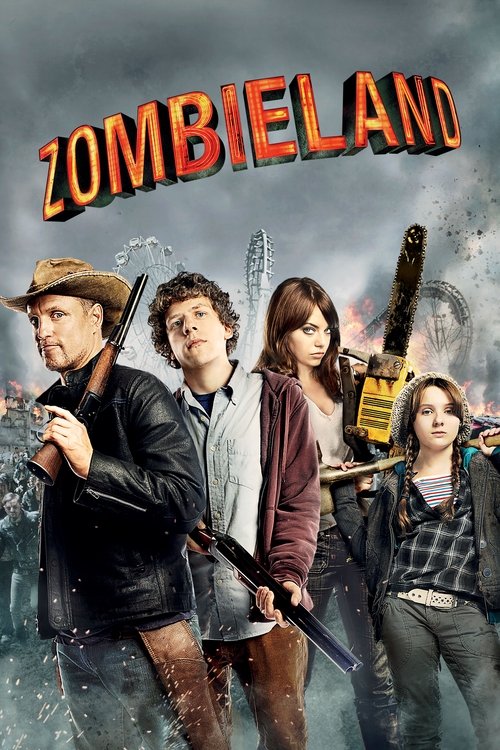
Zombieland
2009 · Ruben Fleischer
For a fun, low-commitment night — pizza, friends, and something that makes gore feel like a party. Comfort viewing for horror fans and a painless entry point for people who don't usually do zombies.
What it's about
America has fallen to fast, ravenous infected, and a neurotic college kid survives by obeying his own obsessive list of rules — until he hitches a ride with Tallahassee, a swaggering zombie-killer on a holy quest for the last Twinkie on Earth. Together with two con-artist sisters headed for a rumored zombie-free amusement park, they form the world's most dysfunctional road-trip family.
The experience
A gleeful, gory blast — more laugh-out-loud comedy than horror, moving at road-movie pace with splattery action, running gags, and an unexpectedly warm heart about found family. It's the rare apocalypse movie that leaves you grinning.
Performances
Woody Harrelson has never had more fun on screen than as Tallahassee, Jesse Eisenberg's anxious voiceover carries the whole film, and a young Emma Stone shows exactly the sly charisma that made her a star — plus a celebrity cameo that's become legendary on its own.
The craft
Its signature trick is rendering the survival rules as on-screen text that lives physically inside the world — shattering, sliding, getting knocked over by the action — a visual gag that's endlessly imitated since. Rhett Reese and Paul Wernick's script is joke-dense and structurally tight, and the opening slow-motion credits sequence is an all-timer.
Why it matters
It proved American audiences would show up in droves for a zombie comedy, launched Ruben Fleischer's directing career, and put Reese and Wernick on the path to writing Deadpool. Its rules-and-cameo formula echoes through a decade of genre comedies.
Horror · Horror comedy & camp · Zombie. A joke-dense zombie road trip of splattery comic kills, deadpan survival rules and a found family; more grin than scare, gore as a party.
Snapshot
Zombieland is a horror-comedy road movie set in a depopulated United States overrun by fast-moving infected. It follows Columbus (Jesse Eisenberg), a neurotic college-age survivor who has outlived the apocalypse by obeying a self-authored list of rules; Tallahassee (Woody Harrelson), a Twinkie-obsessed zombie-killing hedonist; and two con-artist sisters, Wichita (Emma Stone) and Little Rock (Abigail Breslin), who are trying to reach a rumored zombie-free amusement park. The film's signature formal gambit is to render Columbus's survival rules as animated on-screen typography woven physically into the frame, and its most celebrated set piece is a self-parodying cameo by Bill Murray as himself. It was the feature directorial debut of Ruben Fleischer and the breakout screen credit for writers Rhett Reese and Paul Wernick. Tonally it belongs to the post-Shaun of the Dead "zom-com" lineage, prioritizing character comedy, pop-cultural self-awareness, and kinetic spectacle over dread.
Industry & production
Zombieland was produced and distributed through Columbia Pictures (Sony), with Relativity Media among the financing partners of that era. Its origin is notable: Reese and Wernick first developed the material as a television pilot rather than a feature, and elements of that episodic conception — the rules as a recurring device, the loose picaresque structure, the emphasis on a small recurring ensemble — survive in the final film. When the TV version did not proceed, the script was reworked as a movie and became a well-regarded property before production.
Fleischer, whose background was in music videos, commercials, and short-form directing, was an unproven feature choice, and the film functioned as a relatively contained studio bet: a modest budget by studio-tentpole standards paired with a cast anchored by one established star (Harrelson) and rising talent (Eisenberg, Stone, Breslin). Contemporary reporting placed the production budget in the low-to-mid twenty-million-dollar range; I flag that as an approximate figure rather than an audited one. Principal photography took place largely in Georgia, with the climactic amusement-park sequence shot at a real Southern theme park standing in for the fictional "Pacific Playland." The film was rated R for its gore and language, positioning it as an adult-skewing genre release rather than a four-quadrant blockbuster.
Commercially, Zombieland substantially outperformed its cost, becoming one of the more profitable genre successes of its year and, by widely repeated accounts at the time, among the highest-grossing zombie films at the domestic box office to that point. I state that distinction cautiously: the "highest-grossing zombie movie" claim circulated in press coverage and was later overtaken (notably by World War Z in 2013), so it should be read as a period assertion rather than a fixed record. Its success established Fleischer as a bankable comedic-genre director and made Reese and Wernick sought-after screenwriters — a trajectory that led them, several years later, to Deadpool (2016), whose meta, fourth-wall-aware sensibility is clearly continuous with their work here.
Technology
Zombieland is a late-2000s digital-era studio production that leans on visual-effects compositing and digital finishing rather than on any single technological breakthrough. Its zombie gags — arterial sprays, dismemberments, a memorable crushing-by-falling-object beat, and vehicular carnage — combine practical prosthetic and makeup effects with digital augmentation and blood enhancement, a hybrid pipeline standard for the period. The film does not depend on the large-scale crowd-simulation technology that later defined World War Z; its infected appear in modest numbers and are handled through performers, makeup, and selective effects work.
The most technologically distinctive feature is the integrated motion-graphics treatment of Columbus's rules and the animated title design, which situate numbers and text as if they exist within the diegetic space — resting on the ground, sliding across surfaces, being knocked over by the action. This is a compositing-and-graphics achievement rather than a camera one, and it reflects Fleischer's music-video and commercial background, where such kinetic typography was idiomatic. I do not have a reliable single attribution for the specific visual-effects vendor(s) and so decline to name one.
Technique
Cinematography
The cinematography, credited to Michael Bonvillain, favors a glossy, saturated, high-contrast look that reads as comic-book adjacent rather than grim or naturalistic. The film opens with a slow-motion montage of zombie attacks and desperate flight scored to heavy music, a stylized overture that announces the movie's ironic register before any dialogue lands. Bonvillain's compositions accommodate the on-screen typography, frequently staging action with enough negative space for the animated rules to occupy, and the camera is mobile and often theatrical — swooping, whip-quick, or lyrically slowed — in keeping with the music-video vocabulary Fleischer brought to the project. The palette skews warm and bright for a horror film, a deliberate genre inversion that keeps the tone buoyant even in scenes of carnage.
Editing
The editing (credited to Alan Baumgarten and Peter Amundson) is central to the film's comic engine. The picture cuts crisply between visceral action beats, deadpan reaction shots, and the recurring rule-inserts, using rhythm and timing to convert gore into punchlines. The slow-motion opening montage is an editorial showcase, and throughout, the film relies on precise comic timing — the beat before a reveal, the smash-cut to a rule appearing — more than on sustained suspense. The episodic, chaptered feel inherited from the material's TV-pilot origins is managed through editing that treats set pieces as discrete comic movements linked by the road-trip throughline.
Mise-en-scène / staging
Production and set design render the apocalypse as an ironic still life: abandoned convenience stores, a ransacked grocery, a lonely stretch of highway, and — in the film's fullest expression of tone — a fully lit, functioning amusement park at night, turned into a shooting gallery. Two staged environments deserve specific note. The first is the Bill Murray sequence, set in a lavish celebrity home whose luxury underscores the joke of a movie star hiding in plain sight. The second is the theme-park climax, where the mise-en-scène weaponizes leisure infrastructure — a drop tower, a carousel, midway lights — as an arena for zombie combat, literalizing the film's Rule about "enjoying the little things." Props carry thematic weight, above all the Twinkie, whose scarcity organizes Tallahassee's arc and functions as the film's running symbol of lost small pleasures.
Sound
The soundtrack pairs a score by David Sardy with prominent needle-drops, most famously a hard-rock cue driving the slow-motion opening montage. Sardy, himself a musician and producer, delivers scoring that reinforces the film's blend of adrenaline and irony rather than conventional horror menace. The sound design emphasizes punchy, exaggerated impacts — gunfire, splatter, breaking glass — mixed for comic and visceral effect. Beyond the confidently deployed opening track, I avoid cataloging specific songs I cannot verify precisely.
Performance
Performance is where the film earns its affection. Harrelson plays Tallahassee as a swaggering, grief-shadowed force of nature, and the role became one of his defining comic turns; the character's bravado is repeatedly undercut by an unspoken loss that Harrelson lets surface without sentimentality. Eisenberg's Columbus is the film's anxious voice-over narrator, and his fast-talking, socially phobic register — later a recognizable Eisenberg mode — anchors the audience. Stone, in an early leading role, gives Wichita a guarded, quick-witted charisma that presages her subsequent stardom, and Breslin grounds Little Rock with unfussy naturalism. The ensemble chemistry among the four is the film's connective tissue. The Bill Murray cameo, in which the star gamely plays a lampooned version of himself, is a performance-as-event that has become the film's most quoted sequence.
Narrative & dramatic mode
The film operates in a comic picaresque mode: episodic, voice-over-narrated, and structured as a road trip toward a destination (the supposedly safe amusement park) that matters less than the makeshift family formed en route. Columbus's narration and his enumerated rules give the film a self-annotating, quasi-instructional frame, positioning survival as a set of legible mechanics — a sensibility indebted to video-game logic and to comedy's love of rules and lists. Dramatically, the stakes are emotional rather than civilizational: the apocalypse is a given backdrop, and the real arc concerns four isolated, damaged people learning to trust and depend on one another. The tonal contract is established immediately and held consistently: violence is spectacle and comedy, sincerity is doled out sparingly, and the film earns its warmth by keeping irony and feeling in balance.
Genre & cycle
Zombieland sits squarely within the horror-comedy or "zom-com" cycle catalyzed by Shaun of the Dead (2004), which demonstrated that the zombie film could be repurposed as character comedy without abandoning genre pleasures. It also participates in the broader 2000s zombie revival, whose defining formal shift — the fast, running infected of 28 Days Later (2002) and Zack Snyder's Dawn of the Dead remake (2004) — it adopts wholesale over George A. Romero's shambling archetype. Crucially, it hybridizes the zombie film with the American road movie and the dysfunctional-family comedy, so that its genre identity is as much National Lampoon's Vacation as it is Night of the Living Dead. Within its cycle it is distinguished by its meta, rules-based conceit and its unusually bright, comic-forward tone.
Authorship & method
As a debut feature, Zombieland is best read as a convergence of a distinctive writing voice and a director translating short-form craft to features. Ruben Fleischer brought a music-video and commercial sensibility — kinetic camera, graphic overlays, montage-driven set pieces, confident needle-drops — that suits the material's ironic tone; the film launched a career that continued through 30 Minutes or Less (2011), Gangster Squad (2013), and the studio-scale Venom (2018). Rhett Reese and Paul Wernick, the writing team, are arguably the film's primary authors: the rules device, the self-aware narration, and the comic-meta cameo structure are continuous with the sensibility they later brought to Deadpool. Among key collaborators, cinematographer Michael Bonvillain supplied the glossy genre-inverting look; composer David Sardy delivered the score; and editors Alan Baumgarten and Peter Amundson shaped the comic timing that carries the film. The method, in sum, is ensemble-driven comedy staged with music-video verve and organized by a screenwriting conceit that turns survival into a game.
Movement / national cinema
This is a mainstream American studio film, not a work of any avant-garde or national-cinema movement. Its relevant lineage is Hollywood genre comedy crossed with the transatlantic influence of British genre-comedy (Edgar Wright and Simon Pegg's Shaun of the Dead), which had recently proven the commercial and creative viability of affectionate genre pastiche. Its aesthetic DNA also draws on American music-video and advertising craft of the 2000s, filtered through Fleischer, and on video-game culture, whose scorekeeping and rule-systems the film cheekily adopts.
Era / period
Released in 2009, Zombieland arrives at the crest of the decade's zombie boom and amid a broader late-2000s vogue for meta, pop-culturally saturated, ironically inflected genre entertainment. It is a product of the pre-streaming theatrical marketplace in which a mid-budget R-rated genre comedy could open wide and become a sleeper hit on word of mouth. Its TV-pilot origins also mark it as an early instance of the era's fluid movement of ideas between television and film development. The apocalyptic-but-fun tenor resonates with a moment shadowed by financial-crisis anxiety yet answered with escapist comedy rather than despair, though I offer that cultural reading as interpretation, not documented intent.
Themes
The film's central theme is the reconstruction of family and human connection out of isolation: four solitary survivors, each defined by loss or self-protection, become a chosen family, and the movie argues — gently, beneath the gore — that attachment is worth the risk it entails. Columbus's rules dramatize a related theme: the tension between rigid self-protection and the vulnerability required to actually live, a tension resolved when he breaks his own rules to act heroically. Tallahassee's Twinkie quest and the recurring injunction to "enjoy the little things" articulate a philosophy of savoring small pleasures amid catastrophe, and his buried grief gives the comedy an undertow of mortality and loss. Consumer culture and celebrity are treated satirically — the ransacked stores, the theme-park playground, and above all the Bill Murray sequence, which turns fame itself into both punchline and casualty.
Reception, canon & influence
Critically, Zombieland was warmly received as a sharp, energetic, and unexpectedly heartfelt entry in the horror-comedy field, with particular praise for Harrelson's performance, the ensemble chemistry, the inventive rules device, and the Murray cameo; reservations, where they appeared, tended to note its slightness and episodic structure. Commercially it was a clear success relative to its budget and became one of the more beloved genre films of its year.
Influences on the film (backward): The most direct antecedent is Shaun of the Dead (2004), which legitimized the affectionate zom-com; the fast-infected template derives from 28 Days Later (2002) and the Dawn of the Dead remake (2004); the consumerist and satirical undercurrents descend from Romero, especially the mall-set Dawn of the Dead (1978); and the road-trip, found-family structure draws on the American family-vacation comedy tradition exemplified by National Lampoon's Vacation (1983). Its scorekeeping, rule-based frame reflects the pervasive influence of video-game culture.
Legacy (forward): Zombieland consolidated the mainstream viability of the studio zom-com and became a durable cult and rewatch favorite, its rules and Twinkie motif entering popular shorthand. It launched Fleischer's feature career and elevated Reese and Wernick, whose meta sensibility fed directly into Deadpool. It marked an important early step in Emma Stone's rise and reinforced Eisenberg's and Harrelson's comic profiles. The property proved sturdy enough to sustain a decade-later sequel, Zombieland: Double Tap (2019), reuniting the principal cast and writing-directing team. A short-lived Amazon television reboot pilot was also developed, a fitting echo of the material's original conception as a TV series. Within genre history, the film stands as a defining late-2000s example of the ironic, self-aware zombie picture — proof that, after Shaun of the Dead, the undead could reliably carry comedy as readily as horror.
Reception
A sleeper smash in 2009 — it became the highest-grossing zombie movie in the US until World War Z overtook it — and it's since settled into comfort-rewatch status, helped by the retro glow of pre-Social Network Jesse Eisenberg and pre-stardom Emma Stone. The long-delayed 2019 sequel mostly reinforced how lightning-in-a-bottle the original was.
How Zombieland was received, from release to now →
How to watch Zombieland: what to notice on a first viewing
- Notice the survival rules typed onto the screen itself. Fleischer leaves negative space in his compositions so Columbus's rules can sit inside the physical world, not float above it, and get knocked over or destroyed as things happen. Survival becomes a set of visible mechanics, turning the apocalypse into something legible and almost game-like rather than purely dreadful.
- Watch how bright and saturated the color stays during violence. Bonvillain shoots gore in warm, comic-book-glossy light instead of grim shadows, keeping carnage visually cheerful rather than frightening. This inverts horror's usual palette, signaling early that the film wants laughs, not dread.
- Listen for the hard-rock track under the opening slow-motion montage. Sardy and the editors pair chaos and carnage with propulsive music and stylized speed changes, announcing an ironic register before any dialogue. The music tells you how to feel about the violence before the story does: excited, not scared.
- Watch Tallahassee's bravado for cracks of unspoken grief underneath. Harrelson plays swagger and violence as performance, but Fleischer lets small, unsentimental moments surface the loss driving him. The comedy carries real feeling because the toughest character is also the most wounded.
The whole guide to watching Zombieland, with the keys for a rewatch →
Influences: the films it descends from and the films it influenced
- Shaun of the Dead (2004) — Established the affectionate zom-com template Zombieland runs on, including comic set pieces of zombie-killing choreographed to an ironic needle-drop (Queen's 'Don't Stop Me Now').
- 28 Days Later (2002) — Introduced the fast, sprinting 'infected' — not shamblers — which is the specific locomotion template for Zombieland's runners and its chase-based staging.
- Dawn of the Dead (2004) — Its documentary-collage opening credits cut to a needle-drop supplied the model for Zombieland's kinetic apocalypse-montage-over-pop-song sequences.
- Dawn of the Dead (1978) — Its mall-set consumerist satire is the source of Zombieland's use of retail-looting and the amusement-park spree as satire of American consumption.
- National Lampoon's Vacation (1983) — Supplied the episodic cross-country family-vacation picaresque — a dysfunctional unit driving toward a payoff destination (there Walley World, here Pacific Playland).
- Fight Club (1999) — Modeled the first-person voice-over married to animated on-screen graphic labels and freeze-frames that annotate the frame — Zombieland's 'Rules' overlays descend directly from this device.
- Snatch (2000) — Ritchie's freeze-frame character introductions stamped with printed on-screen name-tags and comic narration prefigure Zombieland's kinetic-typography rule cards.
- Natural Born Killers (1994) — Pioneered the music-video montage grammar of stylized, tempo-cut violence that Fleischer's commercial-honed set pieces inherit.
- Kill Bill: Vol. 1 (2003) — Its chaptered, rule-bookish stylization and slow-motion blood-ballet scored to pop cues informs Zombieland's slow-motion kill montages and game-like framing.
- Trainspotting (1996) — Boyle's needle-drop-propelled voice-over picaresque, with a narrator itemizing survival rules, is a formal blueprint for Columbus's narration.
- Deadpool (2016) — Reese and Wernick carried Zombieland's meta, fourth-wall-breaking narration and rule-listing comic voice directly into their Deadpool screenplay.
- Zombieland: Double Tap (2019) — The decade-later sequel reprises the identical rules-overlay device, self-aware narration, and Fleischer's music-video kill montages with the same writing-directing team.
- Scott Pilgrim vs. the World (2010) — Extends Zombieland's video-game logic literally, rendering combat with on-screen HUD scores, kinetic typography, and level-up structure.
- Warm Bodies (2013) — A post-Zombieland studio zom-com built on the same ironic first-person zombie/survivor voice-over carrying comedy through the apocalypse.
- Crank (2006) — Runs on the same explicit video-game survival logic — a protagonist working through rules and objectives with on-screen graphic interjections and kinetic editing.
- The World's End (2013) — Wright's later apocalypse-comedy sustains the shared craft of a road-trip found-family battling an outbreak, staged with needle-drop-timed genre set pieces.
Similar films
- Dawn of the Dead (1978) — influence & lineage · same viewing thread
- Shaun of the Dead (2004) — influence & lineage · same viewing thread
- 28 Days Later (2002) — influence & lineage
- Tucker and Dale vs. Evil (2010) — same viewing thread
- The Return of the Living Dead (1985) — same viewing thread
- The Cabin in the Woods (2012) — same viewing thread
- Night of the Living Dead (1968) — same viewing thread
- One Cut of the Dead (2017) — same viewing thread
All the films related to Zombieland →
Watch it with: curated runs of related films
- The Undead, Played for Laughs — A run of horror comedy — vampire flatmates bickering over the dishes, slackers fumbling through the zombie apocalypse — set against the Romero classic they're all winking back at.
- Horror That's In on the Joke — A run of horror comedies that know the rules — the slasher's final girl, the cabin in the woods, the zombie survival list, the deadly family tradition — and have a blast bending them, so watching them together turns each one's genre jokes into a running conversation.
- Romero's Dead and Their Heirs — A run that starts with Romero's farmhouse, mall and bunker, where the dead rise and the living turn on each other, then follows his shamblers into the comedies that grew from them: the pub, the road trip and Peter Jackson's suburban splatter.