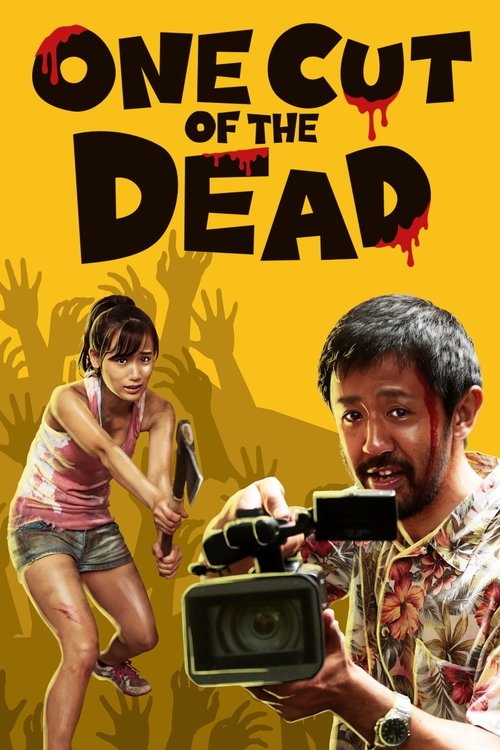
One Cut of the Dead
2017 · Shinichiro Ueda
For a night when you want pure delight — ideally with friends who know nothing about it and a pact not to look anything up. Go in blind; it's the rare crowd-pleaser that genuinely earns the word.
What it's about
A ragtag crew is shooting a cheap zombie movie in an abandoned warehouse rumored to be the site of human experiments — and then actual zombies show up. It opens with a single unbroken 37-minute take of the ensuing chaos, played rough, awkward, and strangely paced, and what the film does from there is best discovered cold.
The experience
It starts scrappy and slightly bewildering, then blossoms into one of the most joyful, laugh-out-loud experiences in modern comedy — the kind of film that rewires your first hour in retrospect. Trust it; the patience it asks for gets repaid with interest.
The craft
Made for roughly $25,000 with a cast of unknowns from an actors' workshop, and every yen of that scrappiness is the point: the film's structure is its masterstroke, a piece of comic engineering where nothing is wasted. Beneath the gore and slapstick sits a surprisingly tender portrait of low-budget filmmaking — the duct tape, the compromises, the weird family a crew becomes.
Why it matters
It became one of the most profitable films in Japanese history, grossing over a thousand times its budget on word of mouth alone, and turned into a global cult object through festival midnight screenings.
Shot for roughly three million yen — about $25,000 — with a cast of unknowns from an actors' workshop, Shinichiro Ueda's debut became one of the most profitable films in Japanese history, riding word of mouth from a two-screen Tokyo release to a gross more than a thousand times its budget. It opens with a 37-minute unbroken take: a low-rent zombie shoot in an abandoned warehouse overrun by the real thing, played ragged, awkward, and oddly paced. Trust it. The film asks for patience precisely so it can repay it, and saying more would rob you of one of the great structural pleasures in modern comedy. Beneath the gore and slapstick sits a genuinely moving portrait of low-budget filmmaking itself — the compromises, the duct tape, the strange familial devotion of a crew. Its cult spread through festival midnight slots worldwide, and Michel Hazanavicius remade it in France as Final Cut, which opened Cannes in 2022 — proof that the shabbiest-looking 37 minutes of the decade concealed a nearly perfect machine.
A Deleuzian reading
A handheld camera chases an actress across a concrete floor, hunting focus, losing her, finding her again.
The full Deleuzian reading of One Cut of the Dead →
Reception
It opened in Japan on just two tiny Tokyo screens in 2017 and word of mouth turned it into a genuine phenomenon — a ~$25k indie that ended up grossing over a thousand times its budget and sweeping Japanese Academy Prize nominations. Abroad it arrived pre-hyped as 'the zombie movie you must go into blind,' and that reputation has only hardened.
How One Cut of the Dead was received, from release to now →
Influences: the films it descends from and the films it influenced
- Rope (1948) — Pioneers the single-take illusion stitched from hidden cuts (whip-pans into a dark back or object) that One Cut's 'seamless' 37-minute opening emulates.
- Russian Ark (2002) — The genuine unbroken Steadicam oner as a pure technical dare — the aspiration One Cut's continuous opening both pretends to and later exposes as fakeable.
- Timecode (2000) — Real-time unbroken-performance experiment that foregrounds the choreography risk of a whole cast and crew sustaining one uninterrupted live take.
- Day for Night (1973) — Establishes the film-about-filmmaking structure where the real drama is the crew improvising fixes to on-set catastrophes mid-shoot.
- Living in Oblivion (1995) — Mines comedy specifically from micro-budget indie production disasters — blown takes, temperamental actors, failing equipment — the exact register of One Cut's second half.
- Noises Off (1992) — Supplies the backstage-farce architecture: a first act played 'straight,' then replayed from behind to reveal the frantic improvisation holding it together.
- Night of the Living Dead (1968) — The guerrilla no-budget zombie template — regional non-actors, scrappy crew — that One Cut simultaneously parodies and reveres.
- The Blair Witch Project (1999) — Found-footage micro-budget model with unknown cast shooting their own diegetic footage in-character, blurring crew and performer.
- Man Bites Dog (1992) — Absorbs the documentary film crew into the on-screen carnage, making the camera operator a character — the conceit One Cut's opening deploys and then explains.
- REC (2007) — Perfects the continuous handheld single-camera zombie-outbreak 'we can't stop rolling' conceit driving the oner's diegetic logic.
- Victoria (2015) — Opens with a genuine unbroken single-take shot performed live with all its onset risk, then dramatizes the terror of executing a real oner without rescue — a direct meditation on the method Victoria embodies.
- Cecil B. Demented (2000) — Pushes the central gag to its formal limit — a crew ordered to keep the handheld camera rolling through apparently real violence, then a second movement exposing the shrine of wreckage behind the take — the 'suffer for the shot' bit Waters plays as satire, sustained as a stunt.
- Special Actors (2019) — Ueda's own follow-up extends the amateur-cast, late-reveal structural rug-pull and micro-budget devotion into a con-artist premise.
- Final Cut (2022) — The authorized French remake reproduces the tripartite oner-then-behind-the-scenes structure, testing whether the craft gag survives translation.
- Shaun of the Dead (2004) — Genre-affectionate zombie comedy built on precise comic timing and craft rather than gore, prioritizing affection for the form over shock.
- Birdman (2014) — A feature-length 'single take' assembled from concealed cuts, wrapped around a backstage-showbiz meta narrative about performers under live pressure.
- Be Kind Rewind (2008) — Frames DIY 'sweded' remaking as communal low-budget devotion, celebrating enthusiasm and ingenuity over polish.
- Ed Wood (1994) — Celebrates ragged, under-resourced filmmaking powered by sheer collective enthusiasm over technical competence — One Cut's emotional thesis.
Similar films
- Shaun of the Dead (2004) — influence & lineage · same viewing thread
- [REC] (2007) — influence & lineage
- Night of the Living Dead (1968) — influence & lineage
- Man Bites Dog (1992) — influence & lineage
- Dawn of the Dead (1978) — same viewing thread · often watched together
- The Return of the Living Dead (1985) — same viewing thread
- What We Do in the Shadows (2014) — same viewing thread
- Bullet Ballet (1998) — often watched together
All the films related to One Cut of the Dead →
Watch it with: curated runs of related films
- The Undead, Played for Laughs — A run of horror comedy — vampire flatmates bickering over the dishes, slackers fumbling through the zombie apocalypse — set against the Romero classic they're all winking back at.