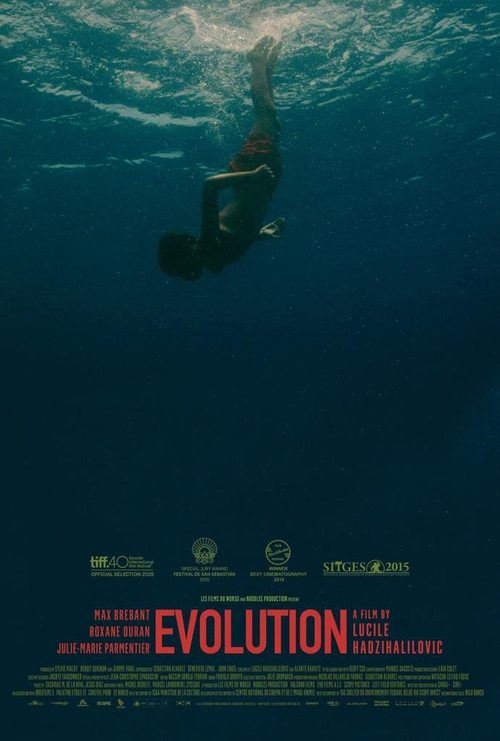
Evolution
2016 · Lucile Hadžihalilović
For when you want to be submerged rather than entertained — a film to chew on for days, not a Friday-night crowd-pleaser. Reach for it when you're craving mystery without answers and dread without jump scares.
What it's about
Eleven-year-old Nicolas lives on a remote volcanic island whose only inhabitants are pale, quiet women and boys his own age, and whose only active building is a hospital. After he sees something disturbing while swimming, he starts questioning the island's routines — the strange meals, the women's nighttime gatherings, and the medical treatments all the boys must undergo. The more he watches, the less the world he's been given makes sense.
The experience
Hypnotic and quietly skin-crawling — there's almost no dialogue and no conventional scares, just mounting wrongness delivered through texture, water and silence. It moves like a slow tide and leaves a residue of unease that lasts well past the credits.
The craft
The underwater and shoreline photography is extraordinary — inky seas, red starfish, hospital greens — and the sound design makes the ocean feel like a living presence. At a lean 81 minutes it tells its story almost entirely through image and texture, a discipline very few films attempt. Good speakers and a dark room transform it.
Why it matters
It cemented Lucile Hadžihalilović's reputation as one of the most distinctive sensory filmmakers working, and became a touchstone for a wave of quiet, body-focused art horror.
Snapshot
Evolution is Lucile Hadžihalilović's second feature, made more than a decade after Innocence (2004). It is an 81-minute marine fable about a boy, Nicolas (Max Brebant), who lives on a volcanic island. The only people there are pale, expressionless women and boys of about ten. While swimming, Nicolas sees a dead boy on the seabed with a red starfish on his belly. When he reports it, the adult he calls his mother (Roxane Duran) dismisses him. From then on he notices more: the green, worm-like gruel served at every meal, the women who gather on the beach at night, and a hospital where the boys are given "treatments" that turn out to be gestation. The boys carry embryos for a species whose adults seem to be partly marine.
The film gives almost no explanation and has very little dialogue. It works through image, texture and sound, and the result is less a puzzle to solve than a sustained mood of bodily unease. It reverses the ordinary positions of the reproductive body: here boys are pregnant and women are clinicians. That reversal has made it a key text in discussions of 21st-century European body horror and of the "slow" art-horror that emerged in the 2010s.
Industry & production
Evolution was a European co-production between France, Belgium and Spain, the kind of financing that is typical for auteur cinema of modest scale. Hadžihalilović has said in interviews that the project goes back a long way. She developed early versions before or around the time of Innocence, and the long gap between the two features was largely due to the difficulty of financing such an unconventional, near-wordless genre film. The French production side involved Sylvie Pialat's Les Films du Worso, a company known for backing demanding auteur work. The full roster of Belgian and Spanish partners is best confirmed from the film's credits, not summarised here.
The film was shot on Lanzarote in the Canary Islands. The island's black volcanic rock, low whitewashed buildings and Atlantic coast supply the film's otherworldly geography without much visible artifice. A substantial part of the shoot was underwater, which brought the logistical demands of marine filming to a modestly budgeted production.
Evolution premiered on the autumn 2015 festival circuit. At the San Sebastián International Film Festival it won the Special Jury Prize, and Manuel Dacosse received the award for best cinematography. It opened in French cinemas in early 2016. In the United States it was handled by a genre-oriented specialty label (IFC Midnight) and released in late 2016, which placed it in the horror market rather than the arthouse market proper, a positioning that reflects how hard the film is to categorise. Reliable box-office figures are sparse, and its commercial footprint was small, as expected for a film of this kind.
Technology
The film was shot digitally. Dacosse, a Belgian cinematographer, worked to give the digital image a dense, painterly quality: deep blacks, saturated sea-greens and blues, and highlights that sit close to monochrome. Underwater cinematography is central both to the film's look and to its production challenges. The opening shots and the later nocturnal sequences depend on housed cameras and on lighting through water, which diffuses and colours the image. Visual effects are used sparingly and mostly in service of practical illusion. Examples include the suckers on the women's backs, the foetal forms glimpsed in the hospital, and the creature-like bodies in the sea, where prosthetics, puppetry and digital compositing are blended rather than put on display. Detailed accounts of the effects pipeline are not widely documented.
Technique
Cinematography
Dacosse is known for his work with Hélène Cattet and Bruno Forzani (Amer, The Strange Colour of Your Body's Tears). On Evolution he used a far more restrained grammar than in those giallo-derived films. The compositions are mostly static and frontal, often symmetrical. Interiors are shadowy chambers lit from single sources, so that faces emerge from darkness like figures in a Dutch or Spanish Baroque painting. Exteriors are flattened by overcast Atlantic light. The palette is narrow, mostly dark greens, aquatic blues, chalk white and volcanic black. The few intrusions of red therefore land with real force: the starfish, a drop of blood, the coral-red of a sea creature. The underwater footage has a weightless, almost liturgical stillness. It turns the sea into the film's true interior, a place of both origin and threat.
Editing
The editing is patient and elliptical. Scenes often end without resolution, and the film moves by accumulating details rather than by cause and effect. Information is held back, then revealed in a single cut. A typical example is the shift from Nicolas's watching eye to a view of what the women do on the beach at night, without establishing how he got there. Sound often carries continuity across cuts that are spatially disjunctive. The short running time is significant: the film is spare rather than languid, and it ends abruptly once its central reversal has been fully disclosed. (The editor's credit should be confirmed from the film's titles; it is not cited here.)
Mise-en-scène / staging
The island village is a geometric, almost abstract set: identical whitewashed houses, narrow lanes, a sea wall. Its institutional counterpart, the hospital, has peeling tiles, fluorescent strip-lights and tanks of water, a ruinous modernity that looks as much like an aquarium as a clinic. The women's uniform hair (pulled back), plain dresses and nurse's whites remove individuality. The boys' bowl cuts and shorts make them interchangeable too. Food, bodies of water and the hospital's specimen jars form a chain of visual rhymes about ingestion, immersion and gestation.
The most-discussed staged images include:
- the women's nocturnal gathering on the rocks, where their bodies move together in a heap as the sea washes over them;
- a training video of a caesarean section that is shown to nurses in a darkened room;
- Nicolas's drawings of a Ferris wheel and a car, objects that should not exist in this world, which point to some memory or knowledge from elsewhere.
Sound
Sound is arguably the film's leading register. The score is credited to Jesús Díaz and Zacarías M. de la Riva. It blends with an expansive sound design of surf, dripping water, low drones and the muffled pressure of submersion. Hadžihalilović uses sound to blur the boundary between inside and outside the body: hospital interiors sound submarine, and underwater passages sound oddly intimate. Dialogue is sparse and flat. Since most meaning is carried acoustically and visually, the film relies on the audience's sensory attention rather than on exposition.
Performance
Performances are deliberately reduced. Max Brebant, a non-professional child actor, plays Nicolas with a watchful reserve. Fear and curiosity come through his eyes rather than through emotional display. Julie-Marie Parmentier plays Stella, a nurse whose growing protectiveness toward Nicolas is the film's only clear emotional arc. She brings a fractional warmth to a performance that is otherwise just as controlled. Roxane Duran, as the mother, is cool and opaque. Like the other women, she seems to be playing a role whose purpose she understands and the boy does not. This uniformly hushed style of acting is a formal decision. It makes the adult world closed to the child's understanding, and therefore to ours.
Narrative & dramatic mode
The film is built as a child's investigation. Nicolas notices an anomaly, the dead boy, and gradually realises that the adults are lying, that his body is not his own, and that he is part of a process he cannot see. The structure echoes the fairy tale and the coming-of-age narrative: a sheltered child, a forbidden place, a sympathetic guardian, and an escape. The mode, however, is anti-explanatory. The film never says who or what the women are, where the boys come from, or what the industrial city glimpsed on the horizon at the end represents.
The narrative works by dream logic and allegory rather than science-fiction worldbuilding. Its key reversal, that boys are the vessels of pregnancy, is revealed without commentary. It is left to work as a primal image rather than a premise to be explained.
Genre & cycle
Evolution sits where several genres meet:
- Body horror, in the line of David Cronenberg: the body as a site of colonisation and transformation.
- Medical-institutional horror: hospitals, trials and clinical authority.
- Marine or "Lovecraftian" weird fiction: a coastal community that harbours an aquatic, non-human secret.
- The European art-fable.
It belongs to the 2010s cycle of art-house horror that favoured atmosphere, ambiguity and slow pacing over shock. In that respect it is often grouped with Jonathan Glazer's Under the Skin (2013), another film about an alien female presence studying and harvesting human bodies by the sea. It also fits a European strand of "uncanny childhood" cinema in which children face adult worlds that are opaque or predatory.
Authorship & method
Hadžihalilović, born in Lyon in 1961 to Bosnian parents, emerged from French independent cinema of the 1990s. With Gaspar Noé she co-founded the production company Les Cinémas de la Zone. She edited and produced Noé's early work, including Carne and Seul contre tous (I Stand Alone). Her own films include:
- La Bouche de Jean-Pierre (1996), a mid-length film;
- Innocence (2004), adapted from Frank Wedekind's novella Mine-Haha, set in a secluded boarding school for girls;
- Nectar (2014), a short;
- Earwig (2021), after Evolution.
Across this body of work there are consistent concerns: children in enclosed institutions, the ritual management of bodies approaching puberty, and the adult world seen as an opaque system. Evolution is widely read as a counterpart to Innocence. The earlier film follows girls being prepared for an unknown future, and Evolution follows boys. Hadžihalilović has said in interviews that the film draws on childhood memories, including a hospital stay and the strangeness of the adult body seen from a child's point of view. Where she goes beyond that, the details of her accounts vary and should not be over-specified.
Key collaborators:
- Screenplay: Hadžihalilović co-wrote with Alanté Kavaïté, the Lithuanian-French director of The Summer of Sangailė (2015). Further writing collaboration is credited to Geoff Cox, who later co-wrote Earwig.
- Cinematography: Manuel Dacosse, whose pictorial lighting and colour control define the look of the film.
- Music: Jesús Díaz and Zacarías M. de la Riva, whose score is closely woven into the sound design.
Her method is slow and image-led. She develops projects over many years, starting from visual and sensory ideas rather than plot. Her films are short, minimal in dialogue, and built from controlled tableaux.
Movement / national cinema
Evolution is a French-led film, but its making and its look are pan-European. It has Belgian technical talent, Spanish locations and co-producers, and the volcanic Canary Islands stand in for a placeless "elsewhere". Critics sometimes connect Hadžihalilović to the New French Extremity because of her association with Noé, but Evolution is close to the opposite of that movement's confrontational violence: it is quiet, unexplicit and hypnotic. It is better understood as part of a continental art-horror tradition that also includes:
- the Belgian giallo pastiches of Cattet and Forzani, which share a cinematographer with it;
- the Spanish fantastic cinema of the 1970s, including The Spirit of the Beehive (1973) and Who Can Kill a Child? (1976);
- the French tradition of poetic fantasy that reaches back to Jean Cocteau and Georges Franju.
Era / period
The film was made at a moment when festival programmers, distributors and critics were embracing a horror cinema that brought art-film form to genre premises. The trend was later marketed, sometimes reductively, as "elevated horror". It belongs to the same years as Under the Skin, The Witch (2015) and It Follows (2014). Unlike most of those films, it never reached a wide audience, and it remained a festival and cult object.
Its period setting is deliberately ambiguous. The clinic's technology looks mid-20th-century, and the only clue to the outside world is a distant industrial city. That keeps the film outside any identifiable historical present.
Themes
- Reproduction and the inversion of gender. The central horror is male pregnancy. Reproductive labour, medical vulnerability and the loss of control over one's body are moved onto boys, and authority over the body is given to women. The reversal makes visible the experiences usually assigned to female bodies, both in medicine and in the horror genre.
- Childhood and the opacity of adults. Like Innocence, the film takes the child's point of view on an adult world that has its own codes, rituals and purposes. Growing up becomes a frightening initiation into a design one did not choose.
- The sea as origin. Water is both womb and abyss. The title points to evolutionary origins in the sea, and the film imagines a species, or a social order, for which the boundary between human and marine life is fluid.
- Motherhood, care and instrumentality. The women's care is administrative and cold, with the exception of Stella's turn toward real tenderness. The film asks whether nurturing can be told apart from use.
- Institutional medicine. The hospital, its experiments and the boys' docile compliance echo histories of clinical experiment on subjects who cannot consent, without pointing to any specific case.
- Escape and the unknown world beyond. The ending sends Nicolas toward an industrial shore. It suggests a return to the human world, or to another institution, and it leaves the question open.
Reception, canon & influence
Critical reception. Evolution was well received in critical circles, especially among critics interested in art-horror and the cinema of the senses. Reviewers praised Dacosse's images, the sound design and the film's control of atmosphere. Many described it as dreamlike, hypnotic or "weird" in the literary sense. Some reviewers found its opacity frustrating and its characters too remote, a predictable split for a film that withholds explanation so strictly. Its San Sebastián prizes, the Special Jury Prize and best cinematography, helped establish its standing, and it has since become a regular title in lists and retrospectives of 21st-century art-horror and body horror.
Influences on the film (backward). Critics have connected Evolution to:
- David Cronenberg's body horror;
- the coastal-cosmic dread of H. P. Lovecraft, particularly The Shadow over Innsmouth;
- Village of the Damned and other films about alien children or alien reproduction;
- Spanish fantastic cinema of the 1970s that frames childhood as uncanny;
- the Alien series and its imagery of parasitic pregnancy;
- the painterly stillness of the European art film.
Hadžihalilović's own work is the most direct antecedent: Innocence is the clear twin of Evolution. Not all of these comparisons are attested as conscious influences by the director, and they should be read mainly as critical frameworks.
Legacy (forward). It is hard to show direct influence from a film with such limited distribution. Evolution is nonetheless part of the conversation about a wave of gender-conscious European body horror that grew more prominent in the following years, most visibly Julia Ducournau's Titane (2021), which also features a non-normative pregnancy. That link is thematic affinity, not documented lineage. The film firmly established Hadžihalilović as one of the leading auteurs of European fantastic cinema, and it led directly to Earwig (2021), her English-language follow-up, which is just as hermetic and again centres on a child held within a mysterious adult regime. Within Hadžihalilović's work, Evolution is the purest statement of her method: a cinema of sensation, enclosure and transformation, in which the horror lies less in what happens than in the slow realisation of what one's body has been made for.
Influences: the films it descends from and the films it influenced
- L'Hippocampe (1934) — Painlevé's underwater footage of seahorse males carrying and birthing young sets the template for Evolution's aquarium-lit marine photography, which shows male gestation as eerie natural spectacle rather than as fantasy.
- Village of the Damned (1960) — Its collective of identically groomed, flatly spoken beings stages menace through uniformity of performance, the same affectless group acting Hadžihalilović gives the island's pale, identical mothers.
- The Spirit of the Beehive (1973) — Erice withholds adult explanation and filters an unexplained adult world through a child's wordless perception, and Luis Cuadrado's dim amber interiors set the model for Evolution's elliptical, child-limited point of view and its painterly low-key lighting.
- Who Can Kill a Child? (1976) — This Spanish fantastic film sets its horror on a sun-bleached, near-empty island where children act in unexplained concert, an isolated coastal community with a hidden collective agenda that Evolution reverses so the adults become the inscrutable cohort.
- Eraserhead (1977) — Lynch and Alan Splet's continuous industrial ambient drone under an unexplained monstrous birth shows how a submerged, ever-present soundscape can carry reproductive dread without dialogue, as Evolution's submarine sound design does.
- Alien (1979) — Its parasitic implantation and wet, biomechanical incubation imagery (Giger's designs) provide the visual grammar for the larval forms growing inside Evolution's boys and for the clinic's ovoid, organic surgical horror.
- The Brood (1979) — Cronenberg places externalised, unnatural reproduction inside a remote therapeutic institute run by calm, evasive caretakers, the clinical-institution structure Evolution repeats in its seaside hospital.
- Dead Ringers (1988) — The ritual crimson surgical gowns against cold clinical blue-grey anticipate Evolution's restricted palette, where red accents in a desaturated operating space turn gynaecological procedure into ceremony.
- Innocence (2004) — Hadžihalilović's first feature builds the method Evolution reverses for boys: children in a sealed institution, static symmetrical framing of daily rituals, a dense ambient-nature soundtrack in place of exposition, and a destiny that is never explained.
- The Wild Boys (2017) — Mandico sends boys to a fecund, unexplained island that transforms their bodies sexually, and shoots it in lush artificial chiaroscuro, carrying Evolution's island of gender metamorphosis into continental queer fantastique.
- Vivarium (2019) — An enclosed, artificial habitat produces an uncanny child raised by an unexplained system, and Finnegan stages it in static symmetrical framing and a restricted palette that echo Evolution's controlled tableaux of breeding as an institution.
- Earwig (2021) — Co-written with Geoff Cox, it extends Evolution's method of a child kept in an opaque adult regime of bodily maintenance (here ice-teeth), told through near-silent ritual, sealed interiors and complete withholding of motive.
- Titane (2021) — Its prosthetic, impossible pregnancy carried by a body that defies gender norms continues Evolution's anatomical body horror of non-normative gestation in the newer wave of gender-conscious French art-horror.
- Lamb (2021) — A stark volcanic Nordic landscape frames an unexplained hybrid birth, told in sparse dialogue and long static compositions, the same use of elemental terrain plus withheld explanation that Evolution draws from Lanzarote.
- Crimes of the Future (2022) — Cronenberg's late film treats new organs grown inside a male body as a matter for ritual surgery in shadowy, ceremonial operating theatres, close to how Evolution turns male gestation into a ritual of the clinic.
- Amer (2009) — Shot by Manuel Dacosse, it shows the same sculptural chiaroscuro, extreme close-ups of skin and texture, and sensation-led storytelling that Dacosse later turned toward Evolution's colder, aquatic baroque.
- Upstream Color (2013) — It tells of an organism passing through human hosts across an unexplained life cycle in elliptical, sound-driven montage, the same strategy of withholding and leaving the parasitic logic for the viewer to assemble.
- Under the Skin (2013) — Glazer mixes non-professional performers with an affectless, otherworldly lead and stages bodily harvesting in an abstract liquid void scored with Mica Levi's alien texture, the same sensory, anti-explanatory approach to European art-horror.
- The Ice Tower (2025) — The same authorial system of water, cold, and metamorphosing bodies, with sensory immersion and designed soundscape standing in for narrative cause.
Similar films
- Goodnight Mommy (2015) — shared sensibility
- Thelma (2017) — shared sensibility
- Skinamarink (2023) — shared sensibility
- Ivy (2015) — shared sensibility
- The Autopsy of Jane Doe (2016) — shared sensibility
- Enys Men (2023) — shared sensibility
- Repulsion (1965) — shared sensibility
- Blue Heron (2026) — shared sensibility
All the films related to Evolution →
Watch it with: curated runs of related films
- The Vanishing Self — A run of 1960s–70s modernist art cinema where identity comes undone — people simply vanish, faces are remade, memory bleeds into hostile landscape — that rewards being watched in a stretch, each film deepening the last's dread.