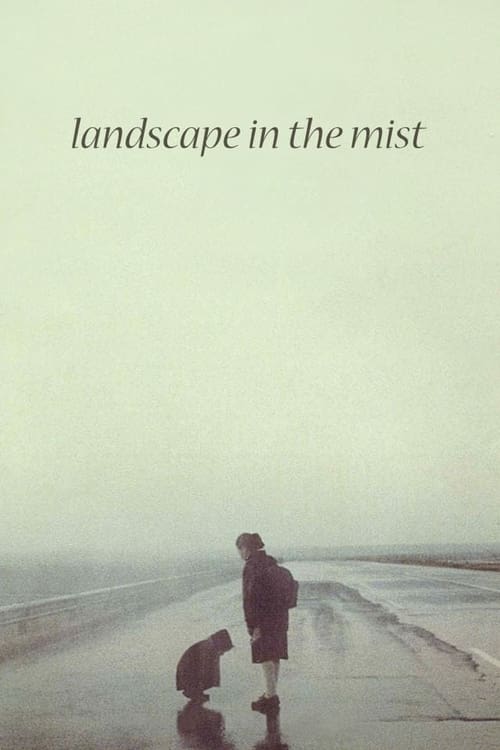
Landscape in the Mist
1988 · Theo Angelopoulos
For when you want a film that moves like a poem and leaves you staring at the wall afterward — a good cry of the solemn, wintry kind. This is a challenge and a commitment, best met when you're ready to feel something.
What it's about
An eleven-year-old girl and her younger brother slip away from home in Athens and head north by train, searching for a father they've been told lives in Germany. Across a wintry, rain-soaked Greece they're stopped, exploited, helped, and moved along — crossing paths with a disbanding theater troupe and a young actor who briefly takes them under his wing — while 'Germany' recedes ahead of them like a horizon.
The experience
Slow, hushed, and quietly devastating — a fable told in long gray takes where small moments of tenderness cut through relentless bleakness. It builds toward images of such strange beauty that the sadness feels earned rather than punishing.
The craft
Angelopoulos composes in long, gliding takes and vast misty tableaux — highways, snowfall, train platforms — where the choreography of a single unbroken shot can carry a whole chapter of story. The images have a monumental, painterly stillness that demands a big screen and your full surrender; Eleni Karaindrou's mournful score is inseparable from the film's spell.
Why it matters
Widely considered Angelopoulos's masterpiece and the summit of his 'Trilogy of Silence,' it cemented his standing as one of Europe's great filmmakers and remains a defining work of Greek cinema.
Snapshot
Landscape in the Mist (Topio stin omichli) is Theo Angelopoulos's spare, devastating fable of two children — eleven-year-old Voula and her younger brother Alexander — who slip away from their home in Athens and set off northward by train toward Germany, where their mother has told them their father lives. The father, it emerges, is a fiction: the children are illegitimate, and "Germany" functions less as a destination than as a horizon, a name for the unattainable. Across a wintry, rain-soaked Greece the two are repeatedly stopped, exploited, and moved on, their journey punctuated by encounters with a disbanding theatrical troupe and a young actor, Orestes, who briefly becomes their guardian and, for Voula, the object of a first awakening. The film closes the loose "Trilogy of Silence" that Angelopoulos had built across the 1980s, and it is among the most concentrated and emotionally direct works in his austere, long-take cinema. It won the Silver Lion at the 1988 Venice Film Festival and remains, for many viewers, the most accessible entry point into a body of work otherwise governed by historical density and political allegory.
Industry & production
The film was produced within the model that sustained most of Angelopoulos's mature work: a European art-cinema co-production anchored by the Greek Film Centre and Greek state television (ERT), with French and Italian partners. This tri-national structure — Greece, France, Italy — was characteristic of the period, when ambitious auteur cinema on the continent depended on pooled subsidy, festival prestige, and television pre-sales rather than commercial returns. Angelopoulos had by 1988 become Greece's preeminent festival export, and Landscape in the Mist was positioned squarely for the international circuit, premiering at Venice. The presence of the Italian screenwriter Tonino Guerra in the writing credits reflects the cross-border literary culture of this cinema as much as it does any single national industry; Guerra, who had written for Antonioni, Fellini, and Tarkovsky, became a regular Angelopoulos collaborator in these years. Concrete budget and box-office figures for the film are not reliably documented in the standard English-language record, and I will not invent them; what is clear is that the film operated in the economy of prestige and subsidy, not of mass distribution. Its commercial life played out through art houses, festivals, and the canonizing apparatus of European film culture.
Technology
The film was shot on 35mm in widescreen, the format Angelopoulos and his cinematographer favored for its capacity to hold figures small within vast, deframed landscapes. The production's defining technical demands were environmental rather than mechanical: long location shoots across northern Greece in winter, working with rain, mist, snow, and failing light — conditions that the film does not merely depict but depends upon for its entire visual register. The most conspicuous set-piece, the recovery of a colossal stone hand from the sea and its airlift by helicopter over Thessaloniki, required practical staging of a large sculptural prop and aerial coordination; it is the rare moment where the film's technical ambition becomes spectacle. Otherwise the technology is subordinated to duration and weather. There is no recourse to optical trickery; the fog that gives the film its title is real atmospheric fog, and the climactic dissolve of the world into white is achieved in-camera and through the landscape itself rather than through effects.
Technique
Cinematography
The images are the work of Giorgos Arvanitis, Angelopoulos's cinematographer of long standing and one of the essential collaborators of his career. The palette is leached and cold — slate grays, wet blacks, the bruised blue-white of snow and mist — with color drained almost to monochrome. Arvanitis and Angelopoulos compose for the wide frame in depth, placing the two small children against railway platforms, empty highways, industrial edgelands, and the indifferent expanse of the sea. The camera moves with a slow, deliberate sovereignty: panning, tracking, and craning in extended takes that refuse to cut toward the children's faces in conventional close-up, instead holding them within the totality of a hostile world. The film's signature gesture is the withholding and then granting of revelation through camera movement rather than editing — most famously when the great severed hand rises dripping from the harbor and is borne aloft across the sky, the camera following it in a single sustained movement that the children, and we, simply watch.
Editing
Angelopoulos's cinema is, by design, a cinema of few cuts. The editing — the film's cutting is credited to his regular editorial collaboration of the period — works at the level of the sequence-shot rather than the shot, so that the "edit" is often internal to the take, accomplished by the movement of camera and figures. Scenes are allowed to run to and past the point of conventional resolution; ellipses between episodes are abrupt, leaving the mechanics of the journey unexplained so that the film advances as a series of stations, almost liturgical in their succession. The effect is to slow perception and to make the viewer dwell, without relief, in each encounter — the long takes hold us inside duration the way the children are held inside their ordeal.
Mise-en-scène / staging
Staging is the true engine of the film. Angelopoulos choreographs figures within the frame as a theater director blocks a stage, and several of the most celebrated passages are single-take tableaux: the wedding at which a horse collapses and dies in the road while the children watch; the sudden snowfall that freezes a street of pedestrians into stillness as Alexander stands transfixed; the disbanding of the travelling players, who recite and gesture in the empty civic spaces of provincial Greece. The recurrence of the theatrical troupe is itself a structural device — a self-citation of Angelopoulos's own The Travelling Players (1975) — and it makes the film's world feel like a depopulated stage across which history's residue drifts. The colossal hand, raised with its index finger broken off, is the supreme emblem of this mise-en-scène: a fragment of a vanished monumental order, pointing at nothing.
Sound
Eleni Karaindrou's score is inseparable from the film's emotional identity. Working in the mournful, processional idiom she developed with Angelopoulos, Karaindrou builds the music from a small palette of strings and winds around a recurring, elegiac theme that functions almost as the film's interior voice — the lyricism the images themselves refuse. Against this, the location sound is sparse and exposed: wind, rain, the mechanical noise of trains and engines, long silences. Dialogue is minimal and often flattened, the children's exchanges reduced to a few repeated phrases. This restraint is thematically loaded — the "silence" of the trilogy is audible here as a near-absence of human speech against an indifferent ambient world, with Karaindrou's music carrying the grief that the characters cannot articulate.
Performance
The film rests on its two child performers, Tania Palaiologou as Voula and Michalis Zeke as the small, grave Alexander, and on Stratos Tzortzoglou as Orestes, the young actor and soldier who befriends them. Angelopoulos directs the children away from sentiment; their performances are watchful, contained, almost solemn, which makes the film's cruelties land without the cushioning of cuteness. Voula in particular is asked to carry an enormous burden — protector, surrogate parent, and a girl on the threshold of a sexuality she does not understand — and the performance registers this through stillness and gaze rather than emoting. The supporting figures, including the players of the troupe, are staged more as archetypes than as psychologized individuals, consistent with Angelopoulos's anti-naturalist method.
Narrative & dramatic mode
The narrative is a quest stripped to myth. Two children search for a father who does not exist, crossing a country toward a border that stands for the limit of the possible. Angelopoulos organizes the story as a road film without the road film's momentum or freedom: each leg of the journey delivers the children into a new station of suffering or wonder — the train, the police, the wedding, the snow, the truck, the troupe, the sea, the final river. The dramatic mode is allegorical and elliptical rather than causal; we are rarely shown how the children get from one place to the next, only that they arrive, as if drawn forward by need. The film's most notorious episode — the rape of Voula, committed off-screen in the back of a truck by a driver who has given them a lift, registered through Angelopoulos's refusal to show it and the child's blank devastation after — exemplifies the method: the worst is withheld from view and thereby made unbearable. The ending is deliberately unresolved: the children cross a fog-bound river toward an unseen "other side," a tree materializes from the whiteness, and they run to embrace it. Whether they have reached Germany, an imagined paradise, or death is left open; the mist is both literal and the figure of the film's refusal of certainty.
Genre & cycle
Nominally a drama, the film sits at the intersection of the European art film, the mythic road movie, and the children's-journey narrative, but it resists each of these genre identities even as it invokes them. It is most precisely understood as the third panel of Angelopoulos's self-described Trilogy of Silence, following Voyage to Cythera (1984) and The Beekeeper (1986). Angelopoulos characterized the three films as treating, in turn, the silence of history, the silence of love, and — in Landscape in the Mist — the silence of God: a metaphysical abandonment under which two children search for an absent father who is also, transparently, a figure for the divine. This places the film within a cycle defined by theme and tone rather than by industrial genre.
Authorship & method
The film is a near-perfect instance of Angelopoulos's authorship and of the collaborative "school" he sustained around it. He co-wrote the screenplay with Tonino Guerra and the Greek writer Thanassis Valtinos, blending Guerra's poetic-allegorical sensibility with Angelopoulos's own preoccupations. The images are by Giorgos Arvanitis, his cinematographer across the defining films; the score is by Eleni Karaindrou, whose music became a constitutive element of his late style; the editing belongs to his established working method of the sequence-shot. Angelopoulos's method is recognizable in every choice: the refusal of close-up and shot/reverse-shot, the construction of meaning through camera movement and figure choreography within unbroken takes, the recurrence of borders and traveling players, the absent father, and the weaving of Greek myth (the name Orestes; the gestures toward the Oresteia and toward his own earlier films) into contemporary landscapes. The film is also among his most self-referential, folding the troupe of The Travelling Players into its world as a company now dispersing — an authorial signature made narrative.
Movement / national cinema
Angelopoulos is the towering figure of post-war Greek art cinema, and Landscape in the Mist belongs to the tradition of the "New Greek Cinema" that emerged in the late 1960s and 1970s, much of it shaped in opposition to, and the aftermath of, the military junta (1967–1974). His sensibility also draws on the broader currents of European modernist cinema — the long-take contemplative tradition associated with Antonioni and Tarkovsky, mediated in part through the shared collaborator Tonino Guerra. Yet the film is unmistakably Greek in its geography and its melancholy: the wintry north, the borderlands, the sea, the weight of a classical past surviving only as broken monument. Within Balkan and European cinema it stands as a key statement of a regional art cinema preoccupied with frontiers, exile, and displacement — concerns Angelopoulos would deepen in the 1990s.
Era / period
Made and released in 1988, the film sits at the threshold of an epochal shift. Angelopoulos completed a trilogy about silence, absence, and metaphysical abandonment on the eve of the collapse of the Eastern Bloc; within a year of its release the borders that haunt his cinema would begin to dissolve and reconfigure. The film's imagery of frozen pedestrians, a dying horse, a broken monumental hand airlifted over a port, and children moving north toward a Germany that is about to be reunified reads, in retrospect, as the work of an artist registering the exhaustion of one order before the arrival of another. It belongs to the late-1980s moment of European art cinema's mature, subsidized auteurism, just before that ecosystem and the political map it inhabited were both transformed.
Themes
The film's central theme is the search for the absent father — at once literal, social (the illegitimate child's missing origin), and theological (the silence of God, the absent author of the world). Around this cluster the film's other preoccupations: borders and frontiers, the line beyond which lies an imagined fulfillment; the journey as ordeal and as the structure of a life; childhood confronted by adult cruelty and indifference; innocence and its violation, condensed in the unseen rape; vision and blindness, threaded through the recurring strip of film that Orestes gives the children, on which the boy can see "nothing" but fog — an image of the film's own refusal of clarity. Above all there is the mist itself: the medium of uncertainty, of border and threshold, of a world that withholds its meaning. The final tree emerging from the white is the film's irreducible image of faith without confirmation.
Reception, canon & influence
Landscape in the Mist was received as a major work and consolidated Angelopoulos's international standing, winning the Silver Lion for Best Director at the 1988 Venice Film Festival. It was widely honored on the European festival and awards circuit at the close of the decade; I want to be careful not to overstate the specifics of every prize, but the film's prestige reception is well documented and it is routinely cited among his finest achievements. Critically it has often been singled out as the most emotionally immediate of his films — the work in which his formal severity and his pathos are most exactly balanced — and it is frequently the title through which new viewers enter his cinema.
Its influences run backward into the modernist long-take tradition (Antonioni's emptied landscapes, Tarkovsky's spiritual gravity), into Greek myth and tragedy, and into Angelopoulos's own prior films, which it cites directly; the airlifted hand also resonates with the famous opening of Fellini's La Dolce Vita, where a statue of Christ is flown over Rome — a deliberate echo that recasts spectacle as desolation. Forward, the film's standing as a canonical work of contemplative cinema has made it a reference point for later filmmakers working in the "slow cinema" mode and for any cinema of children's journeys and border-crossings. Angelopoulos himself extended its concerns into the 1990s "border" films, above all Ulysses' Gaze (1995) and Eternity and a Day (1998), the latter of which won the Palme d'Or — so that Landscape in the Mist now reads as the pivot on which his career turned from historical allegory toward the more intimate, metaphysical register of his major late work. Its closing image of two children and a tree in the fog has become one of the enduring emblems of European art cinema's late-century melancholy.
A Deleuzian reading
A street in a provincial town, and then it begins to snow.
The full Deleuzian reading of Landscape in the Mist →
Reception
Acclaimed from the start — Silver Lion at Venice in 1988, then the European Film Award (the 'Felix') for Best Film in 1989 — it has since settled in as the Angelopoulos film even non-Angelopoulos people love, and his death in 2012 only deepened its standing.
How Landscape in the Mist was received, from release to now →
Influences: the films it descends from and the films it influenced
- L'Avventura (1960) — Establishes the emptied-landscape long take in which figures are subordinated to architecture and terrain, and narrative information is withheld through off-screen action — the deframing grammar Angelopoulos adopts for his sequence-shots.
- The Travelling Players (1975) — Angelopoulos's own founding template of the sequence-shot historical fresco and the itinerant theatrical troupe, whose company is literally folded into this film as a troupe now dispersing — self-citation as authorial signature.
- Ivan's Childhood (1962) — Frames the child traversing a war-marked, misted terrain in poetic compositions, treating the displaced minor as a vessel for off-screen violence and absence rather than as an object of pathos.
- Nostalgia (1983) — Angelopoulos hired Tonino Guerra as co-screenwriter — the same collaborator who structured Nostalgia — and the film directly extends its fog-laden lateral-tracking long-take aesthetic and exile-meditation into Greek political landscape; Yiorgos Arvanitis's near-monochromatic winter cinematography echoes Lanci's bleached Tuscany as a shared visual argument for spiritual desolation.
- Red Desert (1964) — Yorgos Arvanitis's telephoto compression and fog-saturated frames—empty industrial and rural Greek spaces held in real-time duration—extend Antonioni's Ravenna visual grammar to a Balkan post-industrial context, with two children's dissolving journey standing in for Giuliana's psychic traverse.
- El Sur (1983) — Children journey in long elliptical takes toward an unreachable elsewhere in search of an unknowable father — Erice's unattainable 'South' rendered as literal quest.
- Ulysses' Gaze (1995) — Extends the mythic border-crossing quest and the unbroken traveling take across frontiers, deepening the Karaindrou-scored, leached-palette road movie that this film inaugurated as his late register.
- The Painted Bird (2019) — Two child protagonists as passive picaresque witnesses moving through a landscape of adult violence, shot with Angelopoulos's signature extended static long takes and available-light compositions that treat landscape as an absorbing force rather than backdrop, provide a formal European art-cinema precedent for The Painted Bird's treatment of childhood in extremity.
- The Wild Pear Tree (2018) — Builds narrative from peripatetic movement across landscape rendered in extended long takes, the walking-and-talking-through-terrain construction Ceylan adopts for his roaming dialogues.
- Fat Girl (2001) — Yorgos Arvanitis's camera holds the exterior of a truck while a child is raped inside, refusing the reaction shot and the cut — the exact elliptical-violence patience Arvanitis brings to Fat Girl's roadside ending and to the held two-shots of the bedroom.
- Stalker (1979) — Models the slow, dread-laden tracking shot through leached, drizzle-gray landscape as a spiritual quest, and the use of duration itself as the carrier of metaphysical weight that Angelopoulos secularizes into a children's journey.
- La Dolce Vita (1960) — Its opening airlift of a Christ statue over Rome is directly quoted in the helicoptered giant hand pulled from the sea — spectacle recast as desolation, a deliberate intertextual citation.
- Germany Year Zero (1948) — Pioneers the non-sentimental child protagonist wandering a ruined adult landscape, the unadorned neorealist gaze on a minor whose innocence is steadily stripped without melodramatic cueing.
- Voyage to Cythera (1984) — Immediately precedes this film's turn toward intimate myth, establishing the Karaindrou/Arvanitis collaboration, the absent/returning father motif, and borders as the recurring stage for the sequence-shot.
- Eternity and a Day (1998) — Completes the intimate-metaphysical pivot begun here, pairing a child border-crosser with an adult in single-take tableaux and theatrical blocking, the Karaindrou score as constitutive structural element.
- Sátántangó (1994) — Inherits the punishing long take across rain-greyed flatland and the choreography of figures within unbroken duration, formalizing Angelopoulos's deframed-landscape grammar into the slow-cinema canon.
- The Turin Horse (2011) — Distills the leached monochrome palette, sparse diegetic sound, and the sequence-shot as endurance into an austere endgame of the contemplative tradition this film helped codify.
- Taste of Cherry (1997) — Continues the road-movie-as-mythic-quest in long static and tracking takes with off-screen withholding and a famously open ending, the contemplative wandering-vehicle structure shared with Angelopoulos.
- The Spirit of the Beehive (1973) — Sustains the unsentimental child's-eye journey through a hushed, golden-leached landscape, building meaning through silence, ellipsis, and refusal of the reaction close-up.
- Goodbye, Dragon Inn (2003) — Extends the single-take tableau and sparse diegetic soundscape, with the dispersing theatrical/cinema troupe as elegiac subject — the static long take as a meditation on vanishing performance.
- Werckmeister Harmonies (2000) — Carries forward the choreographed long take in which a wide-eyed innocent walks a desolate town toward an inexplicable monumental spectacle — a structural echo of the giant hand's surreal intrusion.
- The Return (2003) — Reworks the absent-father myth as a children's quest across bleak northern terrain in austere wide compositions with off-screen violence and an open, wounding ending.
Similar films
- Eternity and a Day (1998) — influence & lineage · often watched together
- The Travelling Players (1975) — influence & lineage · often watched together
- L'Avventura (1960) — influence & lineage · often watched together
- Satantango (1994) — influence & lineage · often watched together
- Ulysses' Gaze (1995) — influence & lineage
- The Turin Horse (2011) — influence & lineage
- Stalker (1979) — influence & lineage · often watched together
- The Spirit of the Beehive (1973) — influence & lineage · often watched together
All the films related to Landscape in the Mist →
Watch it with: curated runs of related films
- Grief with Nowhere to Land — Watch these together when you can sit with loss — widows, addicts, and lost children drifting through worlds that refuse to hold still.