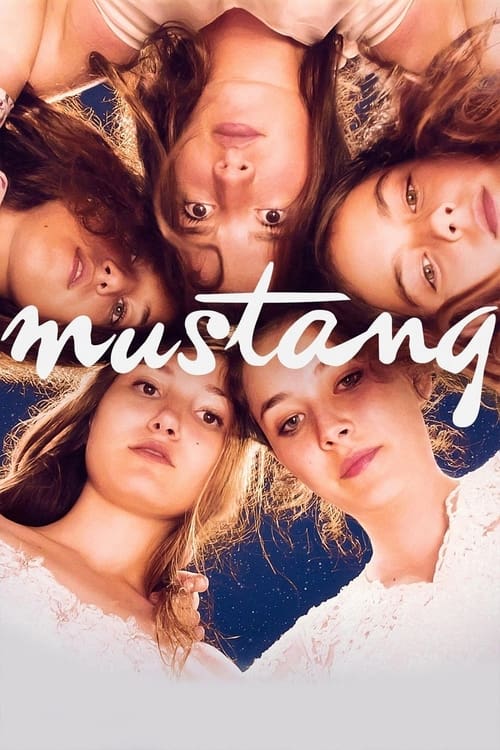
Mustang
2015 · Deniz Gamze Ergüven
For when you want to feel outraged and exhilarated at once — a film about injustice that refuses to be joyless. A challenge with a warm, beating heart, best when you're ready to care hard about its characters.
What it's about
Five orphaned sisters in a Turkish village on the Black Sea are caught doing nothing worse than playing in the sea with boys — and the scandal locks their world shut. Their guardians turn the family home into a training ground for marriage, bars on the windows, suitors at the door, while the youngest and wildest sister looks for a way out. It's a story of girlhood under siege, told from inside the house.
The experience
Fierce and alive rather than grim: the sisters' laughter and tangled closeness keep breaking through the confinement, which makes each loss cut deeper. It moves fast, runs on defiance, and leaves you somewhere between heartbreak and a fist in the air.
Performances
The five young actresses feel less like a cast than a single organism — all limbs, hair, and shared glances — and Güneş Şensoy, as the youngest sister, carries the film with a glare that could stop traffic.
The craft
Ergüven shoots the sisters sprawled together in shafts of summer light, so every arranged marriage plays like an amputation from one shared body. Warren Ellis's score threads melancholy under the rebellion, and the house itself — filmed room by room as it hardens into a prison — becomes the film's second lead.
Why it matters
A debut that landed like a thunderclap out of Cannes, earned an Oscar nomination for Best Foreign Language Film, and became a flashpoint in arguments over women's lives in Turkey.
Deniz Gamze Ergüven's debut arrived from Cannes' Directors' Fortnight like a shot of pure kinetic defiance: five orphaned sisters in a Black Sea village, locked down by their guardians after an innocent afternoon at the beach scandalizes the neighbors, their home converted room by room into what one of them calls a wife factory. The Virgin Suicides comparison is inevitable — girls mythologized behind windows — but Ergüven, a Turkish-born, Paris-trained director, tells it from inside the house, through the eyes of the youngest and most untamable sister. Her camera films the five as a single organism, a tangle of limbs and long hair sprawled across beds in shafts of summer light, so that each arranged marriage feels like an amputation. Warren Ellis' score threads melancholy through the rebellion. The film became a flashpoint in debates over Turkey's direction, and France, not Turkey, submitted it for the Academy Award, where it landed a nomination. Ergüven has said she wanted to film girlhood as a five-headed hydra; the image holds.
A Deleuzian reading
Five girls on a bed.
The full Deleuzian reading of Mustang →
Reception
A Cannes Directors' Fortnight breakout that rode a wave of critical love all the way to an Oscar nomination and four Césars, it's since settled in as one of the defining debut features of the 2010s — the reference point people reach for when talking about that decade's wave of women-directed breakthroughs.
How Mustang was received, from release to now →
Influences: the films it descends from and the films it influenced
- The Virgin Suicides (1999) — Ergüven's acknowledged model: five sisters sequestered by family and filmed as one gauzy, sun-drenched collective body, observed elegiacally from an outsider's yearning gaze.
- Picnic at Hanging Rock (1975) — Over-exposed, diffuse summer light and adolescent girls staged as a single languid, white-clad sensual organism rather than individuated characters.
- The 400 Blows (1959) — Coming-of-age built as escalating confinement resolved by a break for freedom, its runaway final movement echoed in Mustang's flight to Istanbul.
- Cría Cuervos (1976) — Sisters sealed inside one repressive household, adult cruelty filtered through the watchful point of view of the youngest child.
- Yol (1982) — Foundational Turkish social-realist drama of honor codes, arranged unions and patriarchal imprisonment that Mustang updates for a female generation.
- Dogtooth (2009) — Domestic-confinement staging of children caged in the family home by walls and fences, culminating in a violent bid for escape.
- The Assassination of Jesse James by the Coward Robert Ford (2007) — Showcases the spare, keening Warren Ellis string writing whose plaintive method Ergüven hired him to reprise for Mustang's score.
- Head-On (2004) — A Turkish-diaspora auteur transposing the freedom-versus-belonging melodrama onto young women confined by tradition, pairing lyrical mobile camera with the doomed-transgression structure Akin legitimized.
- The Beguiled (2017) — Extends the hothouse staging of women and girls sealed in a single house under a single summer's diffuse, honeyed light.
- Divines (2016) — Camera d'Or debut of kinetic young women's collective energy pushing against social and familial enclosure, in Mustang's festival-breakout lineage.
- Papicha (2019) — Young women resisting imposed dress and marriage codes, staging the home and dormitory as sites of both confinement and defiant sisterhood.
- Capernaum (2018) — MENA-region social drama anchored to a child's point of view indicting oppressive family and marriage structures through naturalistic performance.
- Rocks (2019) — Naturalistic ensemble of teenage girls built from non-professional casting and workshopped improvisation, extending Mustang's sisterhood-as-organism approach.
- Yuni (2021) — Its naturalistic ensemble of adolescent girls resisting arranged marriage, rendered through their sensory autonomy and bodies under surveillance, is Yuni's most direct girlhood-under-patriarchy model.
- Girlhood (2014) — Contemporary French film that likewise photographs a female friend-group as a tactile, pulsing collective, privileging bodily intimacy over plot.
- Water Lilies (2007) — Close, sensuous observation of pubescent female desire and the group dynamics of girlhood as its own subject and formal texture.
- Wadjda (2012) — A woman director frames a young girl's small, tactical rebellions against patriarchal enclosure, using an object of freedom as narrative engine.
- The Wonders (2014) — Rural ensemble of sisters bathed in golden, hazy summer light, adolescence rendered through sensory naturalism and non-professional casting.
- The Little Sister (2025) — Young women's awakening against family and religious constraint, built from a non-professional ensemble and an accretive, season-marked structure.
- Tomboy (2011) — Co-written by Sciamma, it carries her signature of observing girls' bodies and their social confinement through group physicality and faces rather than exposition — a direct authorship link, not just theme.
- Lingui, the Sacred Bonds (2021) — Extends the female-solidarity drama in which sisters/kin close ranks against enforced patriarchal control of their bodies, sharing Lingui's warm palette and character-aligned intimacy over didactic distance.
Similar films
- Dogtooth (2009) — influence & lineage
- The Little Sister (2025) — shared sensibility
- Sirāt (2025) — shared sensibility
- Yuni (2021) — shared sensibility
- Sound of Falling (2025) — shared sensibility
- The Assassin (2015) — shared sensibility
- Head-On (2004) — shared sensibility
- Beasts of No Nation (2015) — shared sensibility
All the films related to Mustang →