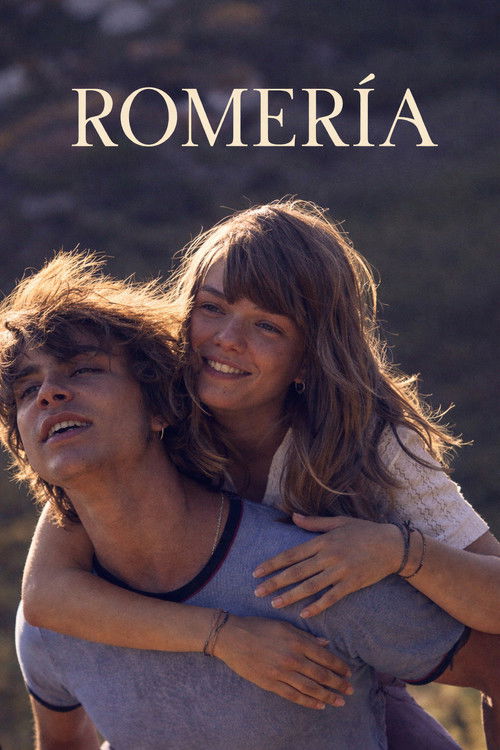
Romería
2025 · Carla Simón
For when you want to feel something real without being overwhelmed — a film that handles loss with gentleness and precision. Also for anyone drawn to the weight of family secrets and what parents leave behind.
What it's about
Marina is eighteen and needs a bureaucratic signature — her paternal grandparents' authorization for a film-school scholarship — from a family she doesn't really know on Galicia's Atlantic coast. The errand becomes a pilgrimage into the past her biological parents left behind: the heroin epidemic of the 1980s, the AIDS crisis, and the people who survived them. It is set in 2004, when Marina is just old enough to ask the hard questions and just young enough to be undone by the answers.
The experience
Intimate and achingly careful — the film holds its grief with the lightness of someone who has carried it long enough that it has become part of the air. It has the quality of a letter written to people who can no longer receive it.
Performances
Newcomer Llúcia Garcia is present and unguarded as Marina, carrying the film's emotional load without telegraphing it.
The craft
Simón photographs Galicia's coast with the same close attention she gave Catalonia in her earlier films — a raw, overcast landscape that suits the material's refusal of easy consolation. The pilgrimage structure gives the film shape without making it schematic; the mundane bureaucratic quest keeps it grounded even as the emotional stakes rise.
Why it matters
Closes Simón's family trilogy — after Summer 1993 and the Berlin Golden Bear-winning Alcarràs — with its most direct autobiographical statement, cementing her as one of European arthouse cinema's sharpest practitioners of memory and grief.
Snapshot
Romería is the third feature by Catalan director Carla Simón, and the film with which she closed what critics have come to call her "family trilogy," following Estiu 1993 / Summer 1993 (2017) and the Berlin Golden Bear winner Alcarràs (2022). Where the first two films transposed Simón's biography into the lives of fictional surrogates, Romería turns to the wound at the center of her life and addresses it most directly: the death of her biological parents from drug addiction and AIDS in the 1980s. The film follows Marina (newcomer Llúcia Garcia), an eighteen-year-old aspiring filmmaker who travels to Vigo, on Galicia's Atlantic coast, in 2004 to obtain a signature from her paternal grandparents needed for a film-school scholarship. The bureaucratic errand becomes a pilgrimage — the romería of the title names a Catholic devotional procession — into a family that has buried its dead and the circumstances of their deaths. It premiered in competition at the 78th Cannes Film Festival in May 2025. Critical response, surveyed below, was admiring of its sensory beauty and bolder formal reach while frequently noting that it is Simón's most ambitious and least emotionally settled film to date.
Industry & production
Romería is a Spanish production led by María Zamora, Simón's long-standing producer (Elastica Films / Avalon), the same producorial axis behind Alcarràs; Zamora is among the most significant figures in contemporary Spanish art-house production. International sales were handled by MK2 Films, a pedigree that reflects both Simón's festival standing after the Golden Bear and the project's positioning as a Cannes-competition title rather than a domestic release first. The casting follows Simón's established practice: the lead, Llúcia Garcia, was a non-professional discovered through an open search, a method central to all three of her features. The supporting ensemble mixes seasoned Spanish performers — Tristán Ulloa, José Ángel Egido, Sara Casasnovas, Miryam Gallego — with the kind of regionally grounded and first-time players Simón favours. Notably, the production folded Simón's own relatives into the film, with an uncle reportedly appearing as the notary, extending the autobiographical project from script into the act of filming itself. The film shot on location in Galicia, principally around Vigo and its coastline, a choice with documentary as well as dramatic weight, since the region was an epicentre of the events the film recalls.
Technology
Romería was photographed digitally on the Arri Alexa 35, the camera widely adopted across high-end festival production in the mid-2020s for its expanded dynamic range and the latitude it affords in mixed natural light — capacities the film exploits in its bright, salt-glared coastal exteriors and dim interiors. Beyond the capture format, Romería is not a technologically forward or effects-driven film; its means are conventional for contemporary European auteur cinema. Where technology bears most visibly on the work is in the recreation of the past: the film reconstructs the early-1980s milieu of Simón's parents, a period evoked through production design, costume and grain-of-image texture rather than through digital trickery. The detailed technical record (lenses, color pipeline, mix specification) is thin in the publicly available material at the time of writing, and I will not invent particulars beyond the confirmed Alexa 35 capture.
Technique
Cinematography
The cinematography is by Hélène Louvart, the French director of photography whose collaborations with Alice Rohrwacher, Eliza Hittman and others have made her one of the defining lensers of contemporary world cinema, and who also shot Simón's Alcarràs. Romería is, by broad critical consensus, a visually ravishing film, and Louvart's handling of the Galician Atlantic was singled out as its most immediate pleasure. The camera is mobile and tactile, attentive to the physical sensations of place — sunburned skin, the glint and chop of the sea, the texture of seawater — so that landscape operates less as backdrop than as an emotional register, the ocean's turbulence mirroring Marina's interior state. This sensuous, body-close naturalism is continuous with Simón's earlier work while pushed toward something more lyrical and, in places, more openly subjective.
Editing
The editing is credited to Sergio Jiménez. The film's central structural device is temporal layering: the present-tense 2004 narrative is threaded with voiceover drawn from the diaries and letters of Marina's late mother, which conjure the early-1980s world the film cannot otherwise witness directly. The cut must therefore hold two time-frames in suspension and modulate between sober present-day observation and more rhapsodic, memory-inflected passages. Reviewers noted that the film's rhythm is deliberately diffuse and that its most striking editorial decision arrives late, when a sustained sequence is retroactively revealed to be fantasy rather than event — a structural reveal that reorganizes how the preceding material is to be read.
Mise-en-scène / staging
Simón stages family as an ecosystem rather than a set of principals, a method honed on the sprawling clan of Alcarràs: meals, gatherings and the choreography of relatives moving through domestic and coastal spaces carry as much information as dialogue. Against this, Marina is frequently framed as an observer and an outsider entering a household whose codes of silence she does not yet know. The mise-en-scène also carries the period reconstruction, dressing the recalled 1980s with sufficient specificity to register the texture of that lost generation. Production design is by Mónica Bernuy.
Sound
Sound is credited to Eva Valino, among the most respected sound professionals in Spanish cinema. Romería leans on the ambient sound of the Atlantic — surf, wind, the acoustic of coastal and interior spaces — as part of its sensory immersion. The original score is by Ernest Pipó. Detailed accounts of the mix and music design are limited in the early record; I note their authorship without elaborating beyond it.
Performance
The performances center on Llúcia Garcia's Marina, a deliberately opaque creation. Critics repeatedly observed that Marina withholds: her interior life surfaces less through her own expression than through her dead mother's narrated words, producing an interpretive distance that some found beguiling and others emotionally frustrating. Garcia's presence was described as elusive yet grounding, an apt instrument for a protagonist defined by what she does not yet know about herself. The surrounding ensemble — grandparents, uncles, cousins — supplies the warmth, evasion and buried grief against which Marina's reticence registers.
Narrative & dramatic mode
Romería operates in the mode of autofiction. It is unmistakably drawn from Simón's life, yet it abstracts that life through the invented figure of Marina and openly embraces fiction as a tool for constructing meaning where memory and record fall silent — Simón has been explicit that she invented what the story needed to function. The dramatic engine is an inquiry plot of a quiet kind: a young woman seeking documents, and then seeking the truth those documents gesture toward, against a family organized around not-telling. The mother's diary voiceover gives the film a confessional, epistolary layer, while the late turn into acknowledged fantasy signals that this is not strictly a realist reconstruction but a meditation on the impossibility of fully recovering the past. The result is a coming-of-age narrative braided with an elegy and an act of historical witness.
Genre & cycle
Nominally a drama, Romería sits at the intersection of several cycles: the contemporary European autobiographical art film; the coming-of-age picture; and a small but growing body of work reckoning with the social trauma of Europe's 1980s heroin epidemic and the AIDS deaths it produced. In Spanish terms it belongs to a recent cycle of intimate, female-authored memory cinema that has gained international festival prominence. It is also, self-consciously, a film about filmmaking — its protagonist an aspiring director assembling her own origins — which aligns it with the long tradition of the artist's-formation film while keeping the meta-cinematic dimension understated.
Authorship & method
Romería is a thoroughly authored film, the capstone of a trilogy through which Carla Simón has converted her biography into a body of work. Her method is consistent and distinctive: non-professional or first-time leads cast through extended searches; immersive location shooting in the specific places of her family history; ensemble staging that treats kinship as a living system; and a naturalism warmed by sensory attention and, here, by lyricism. What distinguishes Romería within her authorship is its formal risk-taking — the diary voiceover, the temporal cross-cutting, the dissolution of realist contract in the fantasy sequence — and its directness in confronting the parental deaths that the earlier films approached obliquely. Her key collaborators reinforce the authorial signature: cinematographer Hélène Louvart, who carries forward the tactile naturalism of Alcarràs; producer María Zamora; editor Sergio Jiménez; composer Ernest Pipó; sound designer Eva Valino; and production designer Mónica Bernuy. The participation of Simón's actual relatives in the cast is itself a methodological statement, collapsing the distance between the film and the family it depicts. (Simón has co-written previous features with Arnau Vilaró; I have not been able to confirm the writing credits for Romería beyond Simón herself from the sources at hand, and so leave the screenwriting attribution to her direction.)
Movement / national cinema
Romería belongs to a remarkable wave of twenty-first-century Spanish — and specifically Catalan — auteur cinema that has restored Spain to prominence on the festival circuit. Simón is a central figure in this generation, alongside filmmakers such as Pilar Palomero and the producer-led ecosystem around María Zamora, characterized by intimate, often female and regionally rooted storytelling, frequently in languages and locales beyond Castilian Madrid. By setting the film in Galicia, with its own distinct identity, history and Atlantic geography, Romería extends Simón's interest in regional specificity (rural Catalonia in Alcarràs) into a new corner of the Iberian map, and engages directly with a piece of Spanish national memory — the heroin epidemic of the post-Franco years — that the country's cinema has only intermittently confronted.
Era / period
The film is double-dated. Its present action unfolds in 2004, with Marina at eighteen, and it reaches back through the mother's diaries to the early 1980s — the years after the death of Franco, when a generation's new freedoms collided with a devastating influx of heroin. Galicia, a major entry point for narcotics in that period, was among the hardest-hit regions, and the resulting wave of overdoses and AIDS deaths is the historical ground on which the film stands. Romería thus functions as a period work twice over: it reconstructs the early 1980s as remembered, and it treats the early 2000s as its own now-receding past, the moment at which a child of that lost generation comes of age and tries to look back.
Themes
The film's governing themes are inheritance and silence: what a family transmits, and what it refuses to speak. Around this cluster identity formation after parental loss; the social stigma attached to AIDS and addiction, and the shame that drives a family to bury not only its dead but the manner of their dying; and the question of class and complicity, sharpened by the grandfather's reported attempt to buy off Marina's questions with cash. Threaded through all of it is a reflexive theme — filmmaking, and storytelling more broadly, as an instrument of reclamation, the means by which an orphaned daughter constructs a usable past where documentary memory has failed. The sea recurs as the film's central image, at once a site of beauty, danger and continuity.
Reception, canon & influence
Reception. Premiering in competition at Cannes 2025, Romería drew respectful, broadly positive but qualified reviews. Critics were nearly unanimous in praising its visual splendor, with Louvart's Galician coast and Garcia's grounded, elusive lead performance repeatedly singled out. The recurring reservation was emotional: several critics found the film Simón's most ambitious and complex yet also her most uneven, with Marina's interiority kept so guarded that viewers grasp the filmmaker's intent more clearly than the character's feeling. The late fantasy sequence divided opinion, read by some as a tantalizing glimpse of a wilder film left unmade. It was characterized across outlets as a step toward greater scale and abstraction after the contained naturalism of her first two features.
Influences ON the film (backward). The film's deepest source is Simón's own biography and her two preceding features, which it completes and answers. Beyond the autobiographical, it sits within the lineage of sensory European naturalism — the tradition Louvart has helped shape through her work with Alice Rohrwacher and others — and within the broad current of literary autofiction that has migrated into art cinema. Its coming-of-age framework and its use of the dead parent's voice place it in dialogue with a long tradition of memory and mourning films, though I will not assign specific direct models the public record does not support.
Legacy / what it shaped (forward). As a 2025 release, Romería has no settled critical canon or measurable influence yet, and it would be premature to claim either. Its immediate significance is as the keystone of Simón's trilogy, consolidating her standing as one of the leading European directors of her generation and reinforcing the international visibility of contemporary Spanish auteur cinema and of the producorial model around María Zamora. Its contribution to the small cinema of the Spanish heroin-and-AIDS generation may prove its most durable legacy, but that assessment must remain provisional given how recent the film is.
Sources: Wikipedia), The Hollywood Reporter, IndieWire, TIME, Festival de Cannes, IMDb.
A Deleuzian reading
Marina arrives in Vigo to collect a signature.
The full Deleuzian reading of Romería →
Reception
Landed in Cannes Competition 2025 carrying Golden Bear expectations after Alcarràs — and left prize-less, with critics split between 'her most ambitious film yet' and 'her most uneven'. A year on, it reads less like a stumble and more like Simón deliberately loosening her own formula.
How Romería was received, from release to now →
How to watch Romería: what to notice on a first viewing
- Notice how rarely Marina speaks up in a room. Simón gives Marina almost nothing to do against a family that has agreed not to talk. She mostly watches, listens, and waits at the edges of meals and gatherings. There's no scheme for her to enact. Watching itself becomes the only action available to her.
- Listen for the voiceover speaking from a different time. Marina's dead mother's diary and letters narrate over 2004 footage of Vigo, a voice from the early 1980s laid across images it never could have seen. The voice and the picture are telling two different stories at once, and neither one folds into the other.
- Notice the camera lingering on skin, sea, and light. Hélène Louvart's camera stays close to physical sensation, sunburn, the glint of the water, wet skin, treating the Atlantic coast as feeling rather than scenery. The landscape is doing Marina's interior work for her, since she rarely says what she feels out loud.
- Watch how the family moves as one group at meals. Simón stages the grandparents, uncles, and cousins as a single living system, overlapping talk and shared motion, with Marina positioned just outside its rhythm. You can see she's an outsider inside her own family before anyone tells you why.
- Notice the bright coastal light against the family's silence. The Galician coast is shot bright, salt-glared, almost overexposed in places, a sensory beauty set directly against a household built on things nobody says. The gorgeous light doesn't comfort you. It makes the family's withholding feel even more pointed.
The whole guide to watching Romería, with the keys for a rewatch →
Influences: the films it descends from and the films it influenced
- Summer 1993 (2017) — Simón's own debut establishes the child-eye autofiction template Romería completes — opaque young lead cast through extended searches, immersive shooting in actual family locations, and grief held just off-screen rather than dramatized.
- Alcarràs (2022) — Directly hands forward its method: Hélène Louvart's handheld, dust-and-skin tactile naturalism and the ensemble staging that choreographs an extended family as a single living organism with overlapping, unprivileged dialogue.
- The Wonders (2014) — A foundational Louvart collaboration whose 16mm-grained, sun-soaked sensory naturalism and porous family-as-ecosystem framing of adolescence is the European tradition Romería's cinematography explicitly carries forward.
- Happy as Lazzaro (2018) — Louvart's grounded realism here breaks its own contract midway into fable — the precedent for Romería's late fantasy sequence that dissolves the realist register the film had patiently built.
- The Spirit of the Beehive (1973) — The origin point of Spanish art cinema's opaque child observer, where a silent young protagonist's gaze and the family's coded silences carry historical trauma the film never states aloud.
- Cría Cuervos (1976) — Pioneers the layered fantasy-memory device Romería inherits — a child summons and converses with a dead parent, collapsing past and present without marking the seam between real and imagined.
- The Tree of Life (2011) — Model for the hushed diary-voiceover braided over sensory image-flux, where parental death is processed through fragmentary, associative memory rather than linear narrative.
- Deprisa, deprisa (1981) — Founding text of the Spanish heroin-generation cinema Romería excavates, shooting non-professional working-class youth in real margins with a near-documentary immediacy.
- El Pico (1983) — Quinqui-era chronicle of the heroin epidemic that orphaned Romería's protagonist, giving the film its historical and iconographic source for the addiction-and-AIDS stigma it inherits.
- La Chimera (2023) — Shares the Louvart-shot grammar of digging into a buried family past where the dead become tangibly present, and the same lyrical slippage between documentary texture and myth.
- The Lost Daughter (2021) — Another Louvart film built on coastal ambience and an opaque, guarded female protagonist whose interiority is deliberately withheld, with the camera close on the body but the feeling kept at arm's length.
- Invisible Life (2019) — Louvart's saturated, sweat-and-foliage sensory melodrama of a fractured family and unspoken loss, demonstrating the same painterly tactility she brings to the Galician coast.
- Never Rarely Sometimes Always (2020) — A Louvart-shot inquiry plot driven by a near-silent young woman whose quest organizes the film while her affect stays illegible — the same vérité-of-the-withheld-face approach as Marina's search.
- Petite Maman (2021) — Literalizes the encounter with a parent across time as Romería's fantasy reveal does, using a spare, controlled rupture of realism to stage mourning rather than explain it.
- Aftersun (2022) — Built on the same retroactive-reveal architecture — a guarded, diaristic reconstruction of a lost parent whose meaning detonates only late, with the protagonist's grief withheld until a final formal breach.
- Uncle Boonmee Who Can Recall His Past Lives (2010) — Shares the technique of letting the dead quietly re-enter a naturalistic frame so that the film's reality bends late and without alarm — the same unannounced dissolution of the realist contract.
Similar films
- Summer 1993 (2017) — influence & lineage
- Invisible Life (2019) — influence & lineage
- Petite Maman (2021) — influence & lineage
- Roma (2018) — shared sensibility
- The Mysterious Gaze of the Flamingo (2025) — shared sensibility
- Deaf (2025) — shared sensibility
- Love Letters (2025) — shared sensibility
- Sound of Falling (2025) — shared sensibility
All the films related to Romería →
Watch it with: curated runs of related films
- Home for the Funeral — A run of return-to-the-village films where a death draws someone back to the family they left, and the days of mourning unearth what was buried — old secrets, forbidden desire, the true shape of who's gone.