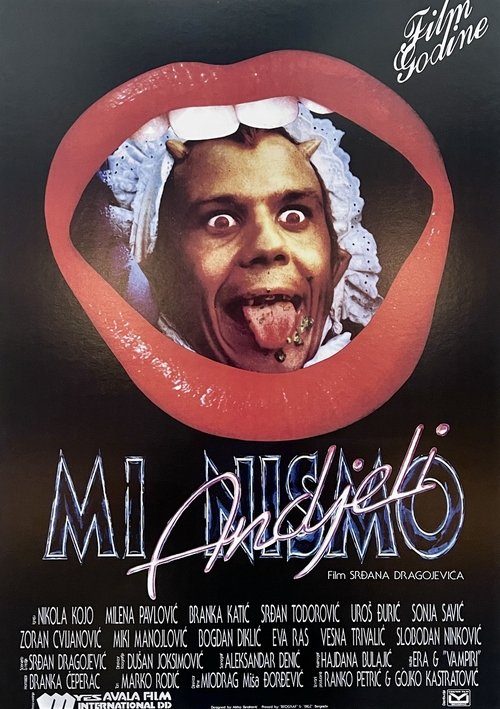
We Are Not Angels
1992 · Srđan Dragojević
For a light, funny date-night pick with an offbeat edge — when you want romance played as a cosmic tug-of-war rather than a weepie. Easy company, with more pop-culture swagger than sentiment.
What it's about
A Belgrade playboy gets a teenage girl pregnant and walks away — so an Angel and a Devil, visible to us but not to the mortals around them, go to war over his conscience. What follows is a pop-soaked romantic comedy about whether a charming, selfish young man can be nudged toward doing the right thing.
The experience
Bright, brash, and irreverent — a comedy that moves with the energy of a music video and treats its supernatural premise as a running gag rather than a sermon. It's cheeky about sex and responsibility in a way that still feels loose and youthful.
The craft
Srđan Dragojević's debut is fluent in borrowed grammars — sitcom rhythms, music-video cutting, morality-play allegory — stitched together with real commercial confidence. The angel-and-devil device gives the film a theatrical playfulness that keeps the simple story visually alive.
Why it matters
A defining domestic crowd-pleaser of early-1990s Serbia — a hit made as the country around it was ceasing to exist — it launched Dragojević's career and spawned a franchise that ran into the next decade.
Snapshot
We Are Not Angels (Mi nismo anđeli) is a Belgrade romantic comedy with a fantastical conceit: an Angel and a Devil, both visible to the audience but not (fully) to the mortals around them, contend for the conscience of a young urban playboy after he leaves a teenage girl pregnant. Released in 1992, it was the feature debut of Srđan Dragojević, then a poet and screenwriter in his late twenties, and it announced a filmmaker fluent in the visual grammar of pop culture — music video, sitcom, morality-play allegory — at a moment when the country producing the film was ceasing to exist. The picture became one of the defining domestic crowd-pleasers of early-1990s Serbia and seeded a franchise that ran into the following decade. It is best understood not as an art-cinema statement but as a commercially confident, tonally light entertainment whose very lightness is historically loaded: it was made and consumed in the first months of the Yugoslav wars and international sanctions.
Because the film's scholarly and English-language documentation is genuinely thin — it has been written about far less than Dragojević's subsequent Pretty Village, Pretty Flame (1996) — several below-the-line credits and precise production details cannot be stated here with full confidence, and those gaps are flagged in the relevant sections rather than filled by conjecture.
Industry & production
The film was produced in Serbia (then the rump Federal Republic of Yugoslavia) in 1992, an exceptionally hostile environment for filmmaking. The Socialist Federal Republic of Yugoslavia had disintegrated over 1991–92; war was underway in Croatia and Bosnia; and United Nations sanctions imposed in the spring of 1992 helped push Serbia into hyperinflation and economic isolation. The centralized, state-supported production model that had sustained Yugoslav cinema for decades was collapsing, and film financing had to be improvised amid currency instability and shrinking budgets.
Against that backdrop, We Are Not Angels is notable precisely for being a slick, audience-facing commercial comedy rather than a war film or an art-house work. Its economic logic was domestic: it targeted the local youth and popular audience with recognizable Belgrade settings, contemporary music, and star-driven comedy. The exact production company, budget, and grosses are not something the surviving public record documents reliably, and no figures are asserted here; what is well established is that the film was a substantial popular success on home ground and became a touchstone of the era's domestic output. Its commercial performance was strong enough to make a franchise viable, with sequels following in the mid-2000s (2005 and 2006), a rare instance of a Serbian film generating a multi-part brand.
Technology
The film was shot on 35mm — the standard theatrical format of the period — and finished for conventional cinema exhibition; digital acquisition and editing were not options in 1992. Beyond that baseline, the more meaningful "technology" of the film is aesthetic rather than mechanical: Dragojević arrived with a sensibility shaped by the international music-video culture of the 1980s. The picture deploys the visual devices that television and pop promos had normalized — the direct integration of songs into scenes, a brisk cutting rhythm, and effects work used for comic rather than spectacular ends. The Angel-and-Devil premise required in-camera and optical trickery to place the two supernatural figures alongside the mortal action; the film handles this with the playful, deliberately unpretentious approach typical of a low-to-mid-budget comedy of its moment rather than with effects-driven realism.
Technique
Cinematography
The photography serves the comedy and the pop-cultural surface: bright, legible, contemporary Belgrade interiors and streets, framing that keeps the two allegorical figures in visual relation to the human protagonist so the audience can read the moral tug-of-war spatially. The style is closer to television and music video than to the long-take, socially observant realism of the earlier Yugoslav tradition. The specific director of photography is not something the available record lets me attribute with confidence, so the credit is left open here rather than guessed.
Editing
Cutting is one of the film's signatures. Dragojević edits to musical rhythm and comic timing, using the pop soundtrack as a structuring device and leaning on the quick, punchy transitions of the video era. The Angel/Devil conceit is fundamentally an editing and staging problem — the film must repeatedly cut between the mortal's behavior and his supernatural commentators — and the picture solves it through brisk intercutting that keeps the moral argument moving as gag and as plot. The individual editor's credit is likewise not reliably documented in accessible sources and is not asserted here.
Mise-en-scène / staging
The staging is built around a single bold device: rendering abstract conscience as two embodied characters who share the frame with the protagonist. This externalization of the inner moral struggle — the good and bad angel of medieval morality drama and of countless cartoons — is the film's organizing visual idea, and the mise-en-scène repeatedly arranges the playboy between his two tempters. The world around them is emphatically contemporary and urban: the Belgrade of nightlife, apartments, and youth culture, dressed to feel of-the-moment rather than timeless. The contrast between mundane 1990s settings and the overtly theatrical supernatural figures is the engine of much of the film's humor.
Sound
Sound and, above all, music are central. We Are Not Angels belongs to a lineage of films that use a contemporary pop/rock soundtrack as both texture and commentary, and its music is a large part of why it lodged in popular memory. The songs function almost as a chorus, coloring the comic and romantic beats. The precise composer and the full soundtrack credits are not something I can attribute reliably from the available record, so no name is placed here; what can be said with confidence is that the film's musical identity was strong enough to become part of its cultural footprint.
Performance
The performances pitch broadly, as befits the material. Nikola Kojo, strongly associated with the lead, plays the playboy as a charming, feckless urban operator whose appeal and irresponsibility are both the point — the film needs him likable enough that his redemption matters and caddish enough that it is in doubt. The supernatural roles are played in a deliberately heightened, comic-theatrical register, with Srđan Todorović prominent among the cast in the film's fantastical dimension; Todorović would go on to recur in Dragojević's work and become one of the more recognizable faces of 1990s–2000s Serbian genre cinema. The young woman at the center of the plot's moral stakes is the emotional counterweight to the playboy's antics. Where I cannot confidently confirm a specific performer's name or character name, I have declined to state one rather than risk error.
Narrative & dramatic mode
Structurally, the film is a morality play folded into a romantic comedy. Its dramatic mode is allegory-made-literal: the interior life of the protagonist is dramatized as an external contest between two personified forces, so that the story's "argument" — will this man take responsibility for what he has done? — is staged rather than merely implied. This lends the narrative a fable-like clarity. The engine is a familiar comic-romantic arc (an irresponsible man is forced by consequence toward maturity and love), but the supernatural framing gives it a self-aware, presentational quality: the audience is always slightly outside the realism, watching a parable about conscience. The tone stays light and reconciliatory, steering the material toward warmth and resolution rather than moral severity.
Genre & cycle
The film sits at the intersection of romantic comedy and fantasy/supernatural comedy, with the ancient "good angel / bad angel" device as its generic backbone. Within Serbian and ex-Yugoslav cinema it belongs to a commercial, youth-oriented comedy strain that gained prominence in the early 1990s — a cinema that turned toward genre pleasure, pop music, and urban milieu just as the surrounding country turned toward war. It is emphatically post–Black Wave: where the Yugoslav Black Wave of the 1960s–70s had been oppositional, allegorically political, and formally daring, We Are Not Angels is populist and accessible, using allegory for comic-moral rather than dissident ends. Its most consequential contribution to the "cycle" is that it effectively launched a domestic comedy brand, with sequels extending the Mi nismo anđeli title into the mid-2000s.
Authorship & method
The authorial signature here is Dragojević's. Born in Belgrade in 1963 and trained at the Faculty of Dramatic Arts, he came to directing from writing (including poetry) and screenwriting, and We Are Not Angels was his first feature. It reveals, in embryo, the method that would define his career: a magpie fluency in popular forms — music video, genre comedy, television — married to allegory and a strong sense of Belgrade as a specific cultural place. He is generally credited as the film's writer as well as director, consistent with his authorial control over his subsequent projects, though I flag that the full writing credit and any collaborators are not something I can enumerate with certainty here.
The film also inaugurated Dragojević's recurring working relationships with performers who would populate his later films — Srđan Todorović being the clearest through-line into Pretty Village, Pretty Flame and beyond. On the key craft collaborators below the line — cinematographer, composer, editor — the accessible record is thin enough that I will not attribute specific names, because doing so responsibly would require sources I cannot verify. What can be said is that the film's identity is coherent and personal enough to read as an authored work rather than an anonymous commercial product, and that Dragojević emerged from it as a filmmaker to watch.
Movement / national cinema
We Are Not Angels is a document of Serbian cinema at the exact hinge between Yugoslav and post-Yugoslav identity. Produced in 1992 as the federation dissolved, it belongs to the first cohort of films made under the new, contracted, sanctions-bound conditions of Serbian production. Dragojević would shortly become, alongside Emir Kusturica, one of the most internationally legible names of 1990s Serbian film — but where Kusturica worked in a magic-realist, Balkan-baroque idiom aimed partly at festivals, Dragojević's debut is inward-facing and popular, made for the home audience in the home vernacular. It thus represents the commercial-national pole of 1990s Serbian cinema: films that kept a domestic audience in theaters through genre and pop appeal even as the industry's infrastructure crumbled.
Era / period
The period stamp is inseparable from the film's meaning. 1992 in Serbia meant the onset of the Bosnian war, UN sanctions, international isolation, and the beginnings of catastrophic hyperinflation. A light romantic comedy about an angel and a devil quarreling over a Belgrade playboy is, in that context, a form of escape — and part of the film's retrospective interest is the gap between its sunny, pop-scored surface and the darkening world just outside the frame. It captures a particular early-1990s Belgrade youth culture — its music, its slang-inflected sensibility, its urban self-image — at the last moment before the full weight of the decade's wars, emigration, and immiseration set in. Read today, that lightness carries an elegiac charge its makers may not have fully intended.
Themes
At its center are sin, conscience, and redemption, treated comically but sincerely: the film literalizes the moral interior as a debate between good and evil impulses and asks whether a charming man can be argued or shamed into responsibility. Closely bound to this is the theme of fatherhood and consequence — the pregnancy is the plot's moral fulcrum, forcing the question of accountability for one's actions. There is a sustained interest in masculinity and the playboy ideal, held up for affectionate mockery and ultimately for correction. Running beneath the comedy is a tension between the sacred and the profane — angels and devils dropped into a world of nightlife and pop songs — and a strong sense of place, with Belgrade urban youth culture rendered as a subject in itself. Finally, escapism and reconciliation are thematic as well as tonal: the film chooses warmth and resolution, a choice that reads as pointed given its moment.
Reception, canon & influence
Reception. Domestically, We Are Not Angels was a broad popular success and became one of the more fondly remembered Serbian comedies of its generation, its music and its central conceit passing into cultural shorthand. Critically it has generally been received as an accomplished, likable commercial entertainment rather than a major auteurist work — the film that proved Dragojević's populist instincts before Pretty Village, Pretty Flame proved his ambition. I have not cited specific reviews, ratings, or box-office totals here because I cannot verify particular figures or quotations from the available record.
Influences on the film (backward). The clearest lineage is the "good angel / bad angel" morality device — rooted in medieval morality drama and long since domesticated by cartoons, television, and Hollywood comedy — which the film imports and localizes. Aesthetically it draws on 1980s music-video and television culture, translating that fast, song-driven visual idiom to feature length. And it stands in deliberate contrast to the earlier Yugoslav Black Wave: it inherits that cinema's taste for allegory while rejecting its politics and severity in favor of popular comedy.
Legacy / what it shaped (forward). The film's most concrete legacy is threefold. First, it launched Srđan Dragojević, who within a few years became one of the internationally recognized voices of Serbian cinema. Second, it helped establish a viable model of commercial, pop-scored domestic comedy at the very moment the national industry was under existential pressure — demonstrating that Serbian audiences would turn out for home-grown genre filmmaking. Third, it generated a lasting brand: the Mi nismo anđeli title returned in sequels in the mid-2000s, an unusual continuity for the national cinema and evidence of the original's durable place in popular memory. In the longer arc of Dragojević's career, it reads as the confident, crowd-pleasing overture before the far darker and more celebrated war films that would define his reputation.
Reception
A smash hit in 1992 Belgrade — escapist froth landing just as Yugoslavia fell apart and UN sanctions cut cinemas off from Hollywood — it has since settled into beloved ex-Yu cult classic status, its glow only heightened by the two 2000s sequels widely seen as inferior.
How We Are Not Angels was received, from release to now →
Influences: the films it descends from and the films it influenced
- Here Comes Mr. Jordan (1941) — Established the benign-supernatural romantic-comedy machine in which a celestial functionary literally intervenes in a mortal's fate, the template of divine bureaucracy-as-plot-engine that Dragojević localizes into an angel/devil managing a Belgrade sinner.
- A Matter of Life and Death (1946) — Turns an abstract moral question into a literal celestial tribunal and intercuts staged heaven with earthly action — the allegory-made-literal-plus-conscience-intercutting device the film reuses to visualize a soul being argued over.
- It's a Wonderful Life (1946) — Dramatizes an unseen moral ledger through an embodied guardian angel earning his reward, giving the morality play a warm populist comic register rather than medieval severity — exactly the tone Dragojević inherits.
- Bedazzled (1967) — A Faustian tempter-versus-conscience comedy in which the Devil is a wisecracking mod companion, pairing sacred/profane bargaining with a swinging pop idiom — the good-angel/bad-angel double externalized as comic duet.
- WR: Mysteries of the Organism (1971) — The Yugoslav Black Wave montage of pop-culture, sex and ideology as sacred/profane collage — the allegorical, magpie-assembly inheritance Dragojević formally keeps while jettisoning its political severity for comedy.
- A Hard Day's Night (1964) — Pioneered the pop-song-as-structure feature with jump-cut, rhythm-driven cutting — the music-video visual grammar (later codified by MTV) that the film scales up into song-scored set pieces.
- Pretty Village, Pretty Flame (1996) — Carries the same pop-scored, magpie-populist method into war, turning the tunnel into a literalized national allegory — the darker application of the crowd-pleasing craft the debut rehearsed.
- The Wounds (1998) — Extends the Belgrade-specific, pop-soundtrack-as-chorus mode into a moral fable of youth, keeping the debut's fusion of television/pop idiom with allegory of sin and corruption.
- We Are Not Angels 2 (2005) — Directly revives the original's angel/devil externalized-conscience conceit and brand identity, an unusual franchise continuity in Serbian cinema built on the first film's durable pop-morality template.
- Tears for Sale (2008) — A Serbian pop-fantasy comedy that inherits the debut's model of commercial genre filmmaking built on optical/effects trickery and a music-video visual surface applied to folkloric material.
- Underground (1995) — Pairs relentless brass-band pop energy with a literalized national allegory (the cellar-as-Yugoslavia), the same post-Yugoslav strategy of driving allegory-made-literal with wall-to-wall music.
- Black Cat, White Cat (1998) — Shares the heightened Balkan carnival-comic register and music-as-continuous-chorus scoring, the regional idiom of frantic pop-driven farce Dragojević helped make commercially viable.
- Trainspotting (1996) — Deploys needle-drop pop-soundtrack-as-chorus and kinetic, music-video-trained cutting to structure a moral tale — the same technique of letting curated pop songs carry narrative and comment on conscience.
- Fight Club (1999) — Externalizes conscience as an embodied alter-ego character and cuts with music-video-honed velocity, the literal-second-self-plus-MTV-editing device operating in the same register as the film's angel/devil pair.
- Dogma (1999) — An irreverent, literalized theology comedy in which angels walk among mortals and salvation is played as pop-cultural farce — the same domestication of medieval morality drama into cheeky contemporary comedy.
Similar films
- Pretty Village, Pretty Flame (1996) — influence & lineage
- Black Cat, White Cat (1998) — influence & lineage
- Dogma (1999) — influence & lineage
- Underground (1995) — influence & lineage
- Fight Club (1999) — influence & lineage
- Trainspotting (1996) — influence & lineage
- A Hard Day's Night (1964) — influence & lineage
- It's a Wonderful Life (1946) — influence & lineage