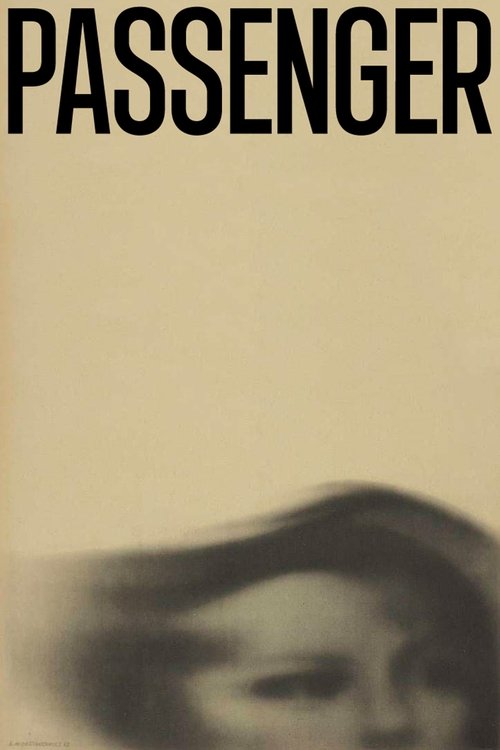
Passenger
1963 · Andrzej Munk
For when you want to be confronted, not consoled — a demanding, serious film to reach for when you're ready to think hard about memory and complicity. Definitely challenge, not comfort, and worth every minute of it.
What it's about
On an ocean liner bound for Europe, a German woman glimpses a face in the crowd that drags her past into the present: during the war she was an SS overseer at Auschwitz, and the woman she thinks she sees is a prisoner she once singled out. What follows is her account of the camp — told to her husband, and retold in versions that don't quite agree — as memory, guilt, and self-justification wrestle over what really happened between the two women.
The experience
Stark, rigorous, and haunting — the camp sequences have a chilling, matter-of-fact precision, and the film's fragmentary form makes you an active, uneasy witness rather than a passive viewer. It's short, but it stays with you for a long time.
The craft
Director Andrzej Munk died in an accident mid-production, and his collaborators refused to fake a finished film: they assembled his completed Auschwitz footage with production stills and spoken commentary, releasing it as an openly fragmentary work. The result — moving image against frozen photograph, fiction against absence — is one of cinema's most formally daring answers to the question of how to depict the camps at all.
Why it matters
A cornerstone of the Polish Film School and one of the most discussed Holocaust films ever made, its incompleteness has come to seem essential — proof that some subjects may only be honestly approached as fragments.
Snapshot
Passenger (Pasażer) is one of the great unfinished films of world cinema — and, in a paradox that has come to define its meaning, one of the most complete meditations on memory, guilt, and the impossibility of narrating Auschwitz. Andrzej Munk, a central figure of the Polish Film School, died in a car accident in September 1961 while the film was still in production, having shot the concentration-camp sequences but little or none of the modern-day frame story set aboard an ocean liner. Rather than hand the material to another director to finish conventionally, Munk's collaborators assembled the surviving footage together with production still photographs and a spoken commentary, releasing the result in 1963 as an avowedly fragmentary object. The film thus exists in two registers at once: the fiction of a former SS overseer confronting a face from the camp, and the meta-fiction of a film confronting its own author's death and its own incompletion. Adapted from Zofia Posmysz's autobiographically grounded material about Auschwitz, it runs roughly an hour and remains a touchstone of Holocaust representation and of modernist reflexivity alike.
Industry & production
The film was produced within the Polish state-socialist studio system, under the "film unit" (zespół filmowy) model that organized Polish production into semi-autonomous creative collectives during the late 1950s and early 1960s. Munk had by 1961 established himself as a bankable and prestigious director on the strength of Man on the Tracks (1957), Eroica (1958), and Bad Luck (1960), and Passenger was conceived as a serious literary adaptation of exactly the kind the Polish School favored — a treatment of the war and occupation refracted through individual conscience.
The production's defining fact is its catastrophe. On 20 September 1961 Munk was killed in a car accident while traveling in connection with the film. The material he left was uneven: the Auschwitz flashbacks existed as more or less finished dramatic footage, while the contemporary shipboard frame — the encounter and the wife's confession that motivates the whole recollection — was largely unrealized. Faced with this, Munk's associates, led by his collaborator Witold Lesiewicz, chose not to fake a finished film. They constructed a hybrid: the completed scenes were retained, the missing scenes were represented by sequences of still photographs, and a narrator's voice-over (written by the poet Wiktor Woroszylski) explains Munk's death, describes what was never filmed, and reflects openly on the questions the director left unresolved. The film was released in this form in 1963. Precise budget and box-office figures are not part of the well-documented public record and are not asserted here.
Technology
Passenger was shot on 35mm black-and-white film with the standard optical, photochemical, and magnetic-sound apparatus of a European studio production of the very early 1960s. There is nothing exotic in its base technology; its interest lies entirely in how ordinary means were repurposed. The most consequential "technological" decision is retrospective and editorial rather than photographic: the incorporation of production still photography as a load-bearing element of the finished film. Frozen frames stand in for absent motion, and the grain, contrast, and stillness of the photographic image become the visual language of everything Munk did not live to shoot. The result is that the film's technology of representation is deliberately heterogeneous — moving footage for the past that was completed, static images for the present that was not — and the seam between them is left visible rather than concealed.
Technique
Cinematography
The camp sequences, photographed by Krzysztof Winiewicz, work in a hard, high-contrast monochrome appropriate to the Polish School's documentary-inflected realism. The camera observes the mechanics of Auschwitz — roll calls, the sorting of prisoners, the routines of surveillance — with a controlled, unsentimental exactness that refuses spectacle. Compositions frequently place the overseer Liza in positions of vantage and the prisoners within grids of fences, ranks, and architecture, so that the visual field itself encodes the asymmetry of power. Because the surrounding frame story survives largely as stills, the film's overall look is defined by the tension between the mobile, fully realized camp footage and the arrested photographic images: the moving image belongs to the perpetrator's vivid, self-serving recollection, while the still image marks the zones of memory and present-day reckoning that resist being brought fully to life.
Editing
Editing is where Passenger becomes extraordinary, because the assembly is not merely craft but authorship-by-necessity. The finished film cross-cuts between three levels — the shipboard present (stills), Liza's narrated recollections, and the commentary that frames both — and the montage must continually negotiate between motion and stasis, between what was filmed and what can only be pointed to. The still-photo sequences are edited rhythmically, sometimes with camera movement across the image or with successive frames, so that a semblance of temporal flow is coaxed from immobile pictures. The cutting also serves the story's central device: Liza offers more than one version of her relationship to the prisoner Marta, and the edit stages these competing accounts against each other, allowing the spectator to feel the gap between the exculpatory story she tells and the more troubling reality it conceals.
Mise-en-scène / staging
The camp is staged with restraint and specificity: barracks, wire, uniforms, and the bureaucratic apparatus of the Effektenkammer and roll-call yard are rendered without melodramatic excess. Munk's staging concentrates on the micro-relations of authority — how an overseer's small gestures of favor, cruelty, or attention structure a prisoner's survival. The dyad of Liza and Marta is blocked so that proximity itself becomes charged: the SS woman's interest in the prisoner reads at once as protection and as domination, and the staging refuses to resolve which it truly is. On the ship, the frozen tableaux of the well-dressed postwar couple set the bourgeois normalcy of the present against the images it suppresses.
Sound
Sound is central to the finished film's meaning. Tadeusz Baird's score supplies a modern concert-composer's idiom to the camp material, and the spoken commentary — the narrator's grave, essayistic voice — becomes a structural instrument rather than a mere gloss, binding stills to footage and naming the film's own gaps. The relationship between image and voice is essayistic and interrogative: the narration does not simply explain the plot but poses questions the images cannot answer, so that the soundtrack carries the film's reflexive, mournful self-awareness about its own unfinished state.
Performance
Aleksandra Śląska plays Liza, the former overseer, and her performance anchors the film. Śląska — an actress associated with such roles — gives Liza a composed, controlled surface beneath which unease and self-justification circulate; the character is neither a cartoon monster nor a redeemed penitent but a woman managing her own memory, editing herself in real time. Anna Ciepielewska plays Marta, the prisoner whose face on the ship triggers the recollection and whose interiority the film can only approach from the outside, through Liza's compromised account. The performances are pitched to the film's realist register, avoiding histrionics, so that the moral ambiguity resides in glance and inflection rather than declaration.
Narrative & dramatic mode
The narrative is a memory structure with an unreliable narrator built into its core. A woman aboard an ocean liner returning to Europe glimpses a face that recalls the camp; prompted, she tells her husband that she was an Auschwitz overseer — and that she saved the life of a particular prisoner. The dramatic engine is the discrepancy between this self-flattering account and what the flashbacks and framing commentary imply actually occurred, in which "saving" is entangled with power, manipulation, and self-interest. The mode is thus confessional but corroded: every recollection is suspect because it is authored by the person most in need of absolution. The film's incompletion radicalizes this design. The narrator's commentary about Munk's death and the unfilmed scenes folds the theme of unreliable, incomplete memory outward from the fiction onto the film itself, so that Passenger becomes a story about the limits of narration told by a film that literally cannot finish narrating.
Genre & cycle
Formally the film sits between war drama, psychological chamber piece, and cinematic essay. Within the Holocaust film it belongs to the small, rigorous cycle of early European works that approached the camps through moral and epistemological complexity rather than through rescue narratives or spectacle — an art-cinema lineage adjacent to Alain Resnais's Night and Fog (1955) and Hiroshima mon amour (1959) in its concern with memory's failures. It also belongs to the Polish School's cycle of reckonings with the war years. But its posthumous, still-photograph construction places it, uniquely, in the tiny category of films whose genre is partly determined by their own material incompleteness — closer in some respects to the essay film than to conventional narrative fiction.
Authorship & method
Andrzej Munk (1921–1961) was, with Andrzej Wajda, the leading figure of the Polish Film School, but temperamentally its ironist and skeptic. Where Wajda tended toward romantic, tragic Polishness, Munk specialized in deflating heroic myth — Eroica and Bad Luck are corrosive, ironic examinations of wartime and national self-image. Passenger extends that skepticism to the terrain of guilt and self-exculpation. The film is inseparable from its literary source: Zofia Posmysz, herself an Auschwitz survivor, developed the material (a radio play and subsequent prose treatment of a former overseer and her prisoner) that became the basis of the adaptation, and she was involved in the screenplay alongside Munk. The key craft collaborators are cinematographer Krzysztof Winiewicz, composer Tadeusz Baird, and — crucially for this film's very existence — Witold Lesiewicz, who supervised the posthumous assembly, together with poet Wiktor Woroszylski, who authored the framing commentary. The film's "method," finally, is collaborative reconstruction: an ethics of completion that chose transparency about the missing over the illusion of wholeness. That decision is itself a form of authorship, and it is what makes the released Passenger a document about Munk as much as a film by him.
Movement / national cinema
Passenger is a landmark of the Polish Film School, the movement that flourished from the mid-1950s political thaw into the early 1960s and used the relative liberalization of the period to confront the Second World War, the occupation, and their moral aftermath with unprecedented candor. The School fused a documentary realism inherited from Polish nonfiction traditions with modernist ambition and a preoccupation with national myth. Munk represented its analytic, ironic wing. Coming at the movement's close — and by an author who did not survive it — Passenger reads almost as the School's summation and its epitaph, carrying its subject matter (the war, individual conscience under totalitarian conditions) into a reflexive, self-questioning register that anticipates later European modernism.
Era / period
The film was made and released at the hinge of the early 1960s, when the postwar generation across Europe was beginning to ask how, and whether, the camps could be represented at all — the same moment that produced the debates around Resnais and, in criticism, the enduring arguments about the limits of Holocaust representation. Within Poland it belongs to the tail of the thaw-era opening. Its production period, 1960–1961, and its posthumous release in 1963 bracket a moment when European art cinema was turning decisively toward memory, subjectivity, and formal self-consciousness, and Passenger stands as one of the era's most severe test cases for all three.
Themes
The film's governing theme is the unreliability of memory in the service of guilt — the way a perpetrator narrates the past to make herself bearable to herself. Around this cluster its other concerns: the moral ambiguity of "help" offered from a position of total power, and whether any kindness inside Auschwitz can be separated from domination; the persistence of the camp into the affluent postwar present, surfacing through a single recognized face; and the ethical problem of representation itself — what can and cannot be shown of the camps, dramatized by a film that reaches the limits of its own ability to show. The incompletion makes silence and absence into themes in their own right: the still photographs and the narrator's admissions of what was never filmed turn the gaps into the film's most eloquent statements about the unsayable.
Reception, canon & influence
Passenger has been received less as a conventional feature than as an event in film history — the great "what might have been" of the Polish School, and simultaneously a work whose unfinished form is inseparable from its power. Critics have long treated it as a major, if singular, achievement in the cinema of the Holocaust and of memory, valued precisely because its fragmentary construction refuses the consolations of a well-made rescue story. It is routinely cited in scholarship on Holocaust representation and on cinematic reflexivity, and Munk's early death has secured his stature as one of the tragic losses of postwar European film. (Beyond this general consensus, the granular contemporary critical record is thinner in widely available English-language sources, and specific reviews or awards are not asserted here where they cannot be responsibly confirmed.)
Backward, the film draws on the Polish School's documentary realism and ironic anti-heroism, on Posmysz's survivor testimony, and on the wider early-1960s European turn toward memory and subjectivity exemplified by Resnais. Forward, its influence runs along two channels. As a treatment of perpetrator memory and moral ambiguity in the camps, it helped establish a rigorous alternative to sentimental Holocaust drama. And Posmysz's underlying story had a substantial afterlife of its own, most notably as the basis for Mieczysław Weinberg's opera The Passenger (Pasażerka), which brought the material to international audiences decades later. But the film's most distinctive legacy is formal: its transformation of enforced incompletion into meaning — the visible seam between motion and stillness, presence and absence — remains a reference point for how cinema can make its own limits, and its own losses, into art.
Reception
Released two years after Munk's death as an avowedly unfinished film, it was embraced almost immediately — honored at Cannes in 1964 — and has since hardened into canon as one of the great works of Holocaust cinema, its incompleteness now read as essential rather than as a flaw.
How Passenger was received, from release to now →
How to watch Passenger: what to notice on a first viewing
- Watch the camera record roll call without any flourish. Munk photographs the sorting, ranks, and surveillance of the camp in hard, high-contrast black and white, holding a controlled, documentary distance rather than dramatizing it. The plainness keeps you from turning the horror into spectacle, and makes you look at the mechanics instead.
- Notice the grids of fencing and ranks around prisoners. Munk composes prisoners inside fences, ranks, and camp architecture while placing Liza in positions of vantage above them. The frame itself encodes who holds power over whom. You see the hierarchy in geometry before a single line of dialogue states it.
- Listen for the narrator asking questions the images don't answer. A grave, essayistic voice binds the still photographs to the footage. It does not explain the plot so much as name what the film cannot show. The commentary turns missing footage into part of the film's meaning instead of hiding the gap.
- Watch Śląska's face for the calm she keeps working to hold. Aleksandra Śląska plays Liza with a composed, controlled surface. Underneath it, small shifts in glance and inflection carry unease and self-justification she never states outright. The performance lets you watch someone edit her own memory in real time.
- Watch the ship scenes for photographs standing in for motion. Because the frame story was never fully filmed, its shipboard scenes are built from edited still photographs, sometimes with movement across the image, coaxing flow from what is frozen. You feel the difference between the vivid, moving camp footage and the arrested present, which is the film's own argument about memory.
The whole guide to watching Passenger, with the keys for a rewatch →
Influences: the films it descends from and the films it influenced
- Night and Fog (1955) — Its essayistic commentary laid over camp imagery, and its montage cutting archival stills against tracking shots of the ruined present, is the direct model for Passenger's voiceover-plus-arrested-image method.
- Hiroshima mon amour (1959) — Resnais's grammar of the past erupting as involuntary flashback that destabilizes the present-tense frame supplies Passenger's memory-flashback structure and its unreliable subjective narration.
- Letter from Siberia (1957) — Marker's model of the essay-film — image sequences reframed by a reflexive, argumentative commentary track — underwrites Woroszylski's framing voiceover over Munk's fragments.
- The Last Stage (1948) — Directed by an Auschwitz survivor and shot on the actual camp grounds, it established the women's-camp documentary realism and overseer/prisoner hierarchy that Posmysz's testimony and Munk's staging extend.
- Eroica (1958) — Munk's own ironic deflation of Polish heroic myth supplies the skeptical, anti-consolatory method he redirects onto perpetrator self-exculpation in Passenger.
- The Shop on Main Street (1965) — Centers the guilt and self-deception of an ordinary complicit perpetrator rather than victim heroism, extending Passenger's rigorous alternative to sentimental rescue drama.
- Shoah (1985) — Its refusal of reenactment and reliance on absence, testimony, and the unsayable extends Passenger's ethic of making the missing visible instead of reconstructing a false wholeness.
- The Act of Killing (2012) — Builds its whole method on perpetrator memory and self-narrated exculpation, the moral terrain Passenger opened against sentimental victim-centered drama.
- Ida (2013) — Revives Polish high-contrast monochrome and static, power-asymmetric two-shot blocking to interrogate Holocaust memory and guilt with the same withholding restraint.
- Son of Saul (2015) — Imposes a single rigorous formal constraint — the shallow-focus over-the-shoulder frame that keeps atrocity at the edge of vision — that, like Passenger's stills, refuses spectacle and the well-made rescue arc.
- The Zone of Interest (2023) — Generates horror from off-screen sound and the banality of perpetrator domestic life — absence-and-the-unsayable — carrying forward the perpetrator-memory perspective Passenger inaugurated.
- Muriel (1963) — A contemporaneous excavation of buried wartime guilt built from fragmentary, elliptical editing in which memory is withheld and unreliable rather than illustrated.
- La Jetée (1962) — Marker builds narrative motion almost entirely from still photographs, the same photo-montage-of-stills device that Munk's enforced incompletion turned into Passenger's shipboard framing.
- Bad Luck (1960) — Its retrospective, self-justifying narrator recounting a compromised life through ironic flashback is the same untrustworthy first-person memory architecture Liza uses aboard the ship.
- Kanal (1957) — Shares the Polish School's claustrophobic wartime realism and high-contrast monochrome, but Munk answers Wajda's tragic romanticism with cold, deflating irony.
- Ashes and Diamonds (1958) — Polish School expressive deep-focus monochrome and ironic anti-heroism, deployed to complicate rather than celebrate national myths of resistance.
- Kapò (1960) — Treats the same female camp-overseer/prisoner power dynamic, and is the sentimental foil — Rivette's attack on its aestheticized tracking shot — against which Passenger's austere refusal of consolation reads as ethical rebuke.
Similar films
- Shoah (1985) — influence & lineage
- Kanal (1957) — influence & lineage
- Son of Saul (2015) — influence & lineage
- Ida (2013) — influence & lineage
- The Zone of Interest (2023) — influence & lineage
- Ashes and Diamonds (1958) — influence & lineage
- Night and Fog (1956) — shared sensibility
- Fatherland (2026) — shared sensibility