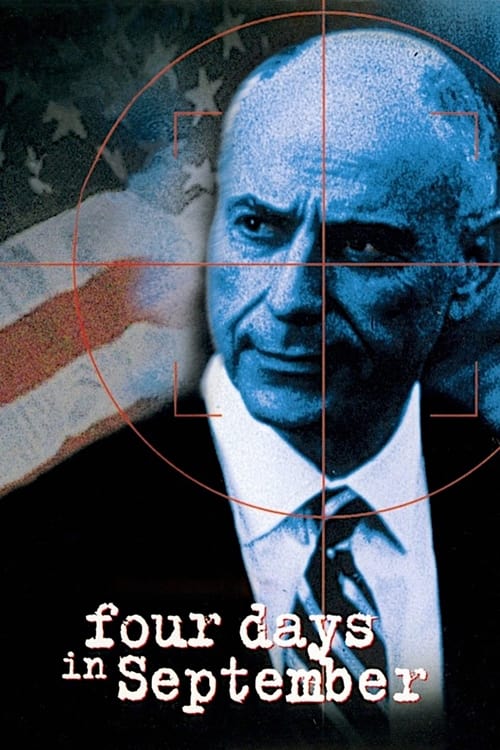
Four Days in September
1997 · Bruno Barreto
For when you want history that plays like a suspense film — something true, morally knotty, and worth arguing about afterward. Engrossing, but it asks you to think, not just root.
What it's about
Rio de Janeiro, 1969, under military dictatorship. Fernando, a young journalist, joins the underground resistance group MR-8, and after a comrade is captured, the cell plans its most audacious operation: kidnap the American ambassador and trade his life for fifteen political prisoners. Drawn from the memoir of a man who was actually there, it follows both the inexperienced militants holed up in a safe house and the man they're holding.
The experience
A tense, claustrophobic four-day countdown that keeps complicating your sympathies — the kidnappers are idealistic amateurs in over their heads, their hostage is disarmingly human, and the state hunting them is more brutal than either. It's gripping without ever being a simple thriller.
Performances
Alan Arkin gives the film its quiet center as the kidnapped ambassador — dignified, frightened, and unexpectedly warm, he turns what could have been a symbol into a person.
The craft
Barreto stages the whole thing with docudrama restraint: cramped safe-house interiors, period Rio streets, tension built from waiting and radio bulletins rather than action set pieces. The script keeps cutting between captors, captive, and police, so the pressure comes from every direction at once.
Why it matters
One of the most internationally visible films of the Retomada, the mid-90s rebirth of Brazilian cinema, and an Oscar nominee for Best Foreign Language Film — it helped reopen the conversation about Brazil's dictatorship years on screen.
Snapshot
Four Days in September — released in Brazil as O Que É Isso, Companheiro? ("What's This, Comrade?") — dramatizes the September 1969 kidnapping of Charles Burke Elbrick, the United States ambassador to Brazil, by a cell of young urban guerrillas operating under the banner of the MR-8 (with participation drawn from the ALN). Directed by Bruno Barreto and adapted from the memoir of the same Portuguese title by Fernando Gabeira, a journalist who took part in the operation, the film reconstructs the four days during which the militants held Elbrick in a Rio de Janeiro safe house and bargained his life against the release of fifteen political prisoners. It arrived as one of the most internationally visible products of the Retomada, the mid-1990s rebirth of Brazilian feature production, and earned a nomination for the Academy Award for Best Foreign Language Film at the 70th Academy Awards. Its distinguishing gambit is structural: rather than mount a partisan tribute to the resistance, the film cross-cuts between the amateurish, idealistic kidnappers and the apparatus of the dictatorship — torturers and security men included — granting interiority to figures the militants would have regarded only as enemies. That even-handedness made the film a critical success abroad and a lightning rod for controversy at home.
Industry & production
The film is a product of the Barreto family's long-running production house, L.C. Barreto Produções, the firm built by Luiz Carlos and Lucy Barreto that had anchored Brazilian commercial cinema since the 1970s. Bruno Barreto directed; his family produced. This places the film squarely within the Retomada — the recovery of Brazilian filmmaking after the collapse of the state agency Embrafilme, dismantled at the start of the Collor government in 1990, which had briefly left the national industry nearly without features. The revival was powered substantially by the Audiovisual Law and the Rouanet Law, fiscal-incentive mechanisms that let companies channel tax obligations into film financing; the Barretos were among the most adept operators of this system. The family's standing was such that they had placed O Quatrilho (1995), directed by Bruno's brother Fábio Barreto, in the Oscar foreign-language race only two years earlier, so Four Days in September extended an unusual run of international recognition for a single production lineage.
The project was conceived with an eye to crossover reach. Casting the American character actor Alan Arkin as Ambassador Elbrick, and including the American actor Fisher Stevens among the embassy/American figures, signaled an ambition to travel beyond the Lusophone market, as did the eventual English-language release title. Miramax handled the U.S. release, the standard route by which a 1990s foreign film reached American art-house screens and awards attention. Hard, verifiable budget and box-office figures for the production are not part of the well-documented record, and I will not invent them.
Technology
Technologically the film is conventional for a mid-budget 1997 production: it was shot photochemically on 35mm and finished by traditional means, with no claim to formal innovation in capture or post-production. Its resources went into period reconstruction — late-1960s Rio, vehicles, wardrobe, the textures of safe houses and interrogation rooms — rather than into any technical novelty. This is worth stating plainly because the film's interest lies entirely in dramaturgy and performance, not in apparatus; there is no technological story to tell here that the historical record would support.
Technique
Cinematography
The photography is credited to Félix Monti, the distinguished Argentine cinematographer associated with Luis Puenzo's The Official Story and, later, films such as The Motorcycle Diaries and XXY — a major figure in the New Argentine and broader Latin American cinema. His work here favours a controlled naturalism appropriate to a thriller built on confinement. Much of the drama unfolds in interiors — the kidnappers' rented house, the room where Elbrick is held, the spaces of the security services — and the camera privileges proximity and tension over spectacle, using the cramped geography of the hideout to keep the threat of exposure constantly legible. Exteriors reconstruct a period Rio without lapsing into postcard tourism. The palette and lighting serve the film's sober, almost procedural register rather than any expressionist heightening.
Editing
The film's most consequential formal choice operates at the level of editing and structure: it intercuts the militants' plot with the parallel world of the regime's police and torturers, so that the audience is repeatedly moved across the line dividing hunters from hunted. This cross-cutting is the engine of both the suspense and the moral argument — it is what allows the film to humanize figures on both sides and to build the ticking-clock pressure of the four-day deadline. The cutting is classical and legible, prioritizing clarity of the negotiation's stakes over montage flourish. I am not confident enough in the editor's name to attribute it here without risk of error.
Mise-en-scène / staging
Staging is keyed to authenticity and to the gulf between the young revolutionaries' romantic self-image and the squalid practicality of what they are actually doing. The safe house is rendered as a place of improvisation and dread; the guerrillas are shown as students and intellectuals out of their depth, debating ideology while fumbling the logistics of an armed operation. Against this, the regime's spaces — offices, interrogation rooms — are staged with a bureaucratic coldness that the film deliberately refuses to caricature. The hostage scenes between the captors and Elbrick are built around enforced intimacy: people thrown into a room together, ideology gradually giving way to recognition of the human across the divide.
Sound
The score is by Stewart Copeland, best known as the drummer of The Police and, by the 1990s, an established film and television composer. His music supports the thriller architecture without overwhelming the period setting, underscoring the tension of the deadline and the claustrophobia of the hideout. Beyond the score, the soundscape leans on the period and on dialogue-driven scenes of negotiation and argument rather than on aggressive sound design.
Performance
Performance is where the film's reputation chiefly rests. Alan Arkin's Ambassador Elbrick anchors the captivity scenes; rather than a passive victim, Arkin plays him as a cultivated, watchful man who comes to engage his captors as people, and the role drew the strongest international notices. The Brazilian ensemble is deep: Pedro Cardoso as the Gabeira surrogate at the center of the cell, Fernanda Torres, Marco Ricca, Luiz Fernando Guimarães, Cláudia Abreu, Selton Mello and Matheus Nachtergaele among the militants and their world, with veteran Nelson Dantas among the older figures. Crucially, the film also gives full-blooded performances to the agents of repression — most controversially in its sympathetic, three-dimensional treatment of a state torturer — and it is the quality and humanity of those performances, as much as anything, that ignited the domestic debate.
Narrative & dramatic mode
The film operates as a political thriller wedded to a chamber drama. Its outer shape is the suspense of a kidnapping and a hostage negotiation under a hard deadline — will the prisoners be freed, will the cell be caught, will Elbrick survive — and it deploys the cross-cutting grammar of the genre to sustain that tension. But its inner mode is closer to moral drama: a study of conviction, fear and recognition staged in confined rooms. The dramatic question is less "what will happen" than "who are these people to one another," and the film keeps shifting vantage points so that no party holds a monopoly on the audience's sympathy. It is told largely in a realist, observational register, with the memoirist's retrospective awareness that the operation was at once historically serious and, in its execution, perilously amateur.
Genre & cycle
Generically the film sits at the intersection of the political thriller, the historical reconstruction, and the hostage drama. It belongs to a transnational cycle of films revisiting the armed left and state terror of Latin America's dictatorship years — a reckoning that gathered force across the continent's cinema in the 1980s and 1990s as democracy returned and filmmakers turned to the recent traumatic past. Within Brazil specifically it is part of the Retomada's appetite for national history and identity, a wave that also produced internationally successful works oriented toward Brazilian experience. Its choice to dramatize a real, named operation drawn from a participant's memoir aligns it with the docudrama tradition while retaining the propulsion of commercial genre cinema.
Authorship & method
Bruno Barreto is the film's auteur of record, a director whose earlier landmark Dona Flor and Her Two Husbands (1976) had been one of the most commercially successful Brazilian films ever made; his career has moved between Brazilian and American productions. His method here is one of deliberate even-handedness — a refusal to make a hagiography of the resistance — which is the film's defining authorial signature and the source of its controversy.
The adaptation works from Fernando Gabeira's memoir O Que É Isso, Companheiro?, the firsthand account by a man who participated in the Elbrick kidnapping and later became a prominent journalist and politician. The screenplay is credited to Leopoldo Serran, a veteran Brazilian screenwriter, who reshaped the memoir's first-person testimony into a multi-perspective dramatic structure. The Argentine Félix Monti photographed the film, bringing the gravitas of his New Latin American Cinema credentials, and Stewart Copeland supplied the score. The collaboration of a Brazilian production lineage, an Argentine cinematographer, an American star and an Anglo-American composer is itself characteristic of the internationalised mode in which the Retomada's flagship films sought to compete.
Movement / national cinema
The film is a touchstone of the Retomada do cinema brasileiro. After the near-total collapse of feature production at the start of the 1990s, a combination of new incentive legislation and a generation of filmmakers eager to address national history rebuilt the industry over the middle of the decade. Four Days in September exemplified the movement's outward-facing strain — the films that aimed for festival circulation and Oscar recognition — and its consecutive foreign-language nomination (following the Barreto family's O Quatrilho) helped re-establish Brazil's presence on the international stage. It should be distinguished from the more avant-garde, politically radical Cinema Novo of the 1960s that depicted the same era's ferment from within; Barreto's film is a retrospective, reconciliatory account made a quarter-century later, in a different industrial and ideological climate.
Era / period
The film is set in 1969, at the height of the Brazilian military dictatorship's repression, in the period following the December 1968 institutional act (AI-5) that suspended civil liberties and inaugurated the regime's most violent phase. The kidnapping of Ambassador Elbrick was among the most spectacular acts of the armed urban resistance, and the film treats this moment with documentary specificity. It was made, however, in the late 1990s, three decades on and well into Brazil's restored democracy — a temporal gap central to its meaning. The film's measured tone and its willingness to humanize the regime's agents are products of that distance, an attempt at a post-dictatorship national reckoning rather than a dispatch from the barricades.
Themes
The film's governing themes are the moral ambiguity of political violence, the gap between revolutionary idealism and its lethal practical consequences, and the possibility of recognition across enemy lines. It is preoccupied with youth and conviction — the militants are students and intellectuals whose courage is inseparable from their inexperience — and with the question of whether ends justify means when the kidnappers themselves are uneasy about holding an innocent man hostage. By portraying the torturer as a person rather than a monster, the film advances a difficult thesis about how ordinary individuals become instruments of state terror, and about the corrosive logic of authoritarianism. Underlying all of it is the larger theme of national memory: how a society narrates a violent past once the dictatorship is over and former combatants must live alongside their former captors.
Reception, canon & influence
Internationally, the film was well received and reached its critical apex with the Academy Award nomination for Best Foreign Language Film at the 70th Academy Awards (Brazil's official submission); the award that year went to the Dutch film Character. Alan Arkin's performance and the film's evenhanded structure drew particular praise from English-language critics, and Miramax's American release gave it durable art-house visibility.
In Brazil the reception was sharply divided, and the controversy is inseparable from the film's legacy. Veterans of the armed struggle and figures on the left objected that the film trivialized the resistance — portraying the militants as bungling amateurs — while extending undue sympathy to the regime's repressive apparatus, above all in its humanized torturer. The debate over whether the film falsified or fairly complicated the historical record became a significant episode in Brazil's ongoing public reckoning with the dictatorship years, and the film is frequently cited in that context.
Influences on the film (backward): Its essential source is Gabeira's participant memoir, and behind that the real 1969 operation and the historical literature on Brazil's armed left. Formally it draws on the international political-thriller and hostage-drama traditions, and it belongs to the broader Latin American cinema of post-dictatorship reckoning whose dignified, testimonial mode — exemplified by Monti's own earlier work on The Official Story — it shares.
Legacy / what it shaped (forward): As one of the Retomada's most internationally awarded titles, it helped consolidate Brazilian cinema's renewed standing abroad and reinforced the appetite for films confronting the dictatorship — a vein later mined by Brazilian features and documentaries revisiting torture, disappearance and resistance. Its most lasting contribution may be the controversy itself: by dramatizing a celebrated act of resistance without idealizing it, the film durably framed the debate about how Brazilian cinema should represent the armed struggle and the agents of the state, a debate that has recurred whenever later films return to that period. Beyond this documented impact, claims of specific direct influence on named subsequent works are not something the record clearly supports, and I will not manufacture them.
A Deleuzian reading
Somewhere in a rented house in Rio, a handful of students are arguing about Marx and revolution while, in a back room, the American ambassador sits and watches them — watches the way you'd watch children handle a loaded gun.
The full Deleuzian reading of Four Days in September →
Reception
An Oscar nominee for Best Foreign Language Film in 1998, it was fiercely contested in Brazil — former militants of the era publicly disputed its portrayal of the guerrillas — and then quietly faded abroad; the recent wave of interest in Brazilian dictatorship cinema after I'm Still Here has sent some viewers back to it.
How Four Days in September was received, from release to now →
Influences: the films it descends from and the films it influenced
- The Battle of Algiers (1966) — Establishes the even-handed docudrama grammar Barreto adopts — newsreel naturalism and cross-cutting that grants both the clandestine guerrilla cells and the humanized repressive apparatus their own procedural logic.
- State of Siege (1972) — The direct template: a Latin American urban-guerrilla kidnapping of a U.S. official, built from cross-cut interrogation and the captor-captive dialectic, dramatized with cool procedural detachment rather than partisan heroics.
- Z (1969) — Reconstructs a real political crime with thriller propulsion and dense parallel editing that intercuts investigators, conspirators and victims into a single accelerating mechanism.
- Dog Day Afternoon (1975) — The hostage chamber drama of enforced intimacy — captors and captives confined to one location, where political stakes emerge through naturalistic, improvisational performance under pressure.
- 12 Angry Men (1957) — Single-room confinement staging in which character and ideology are exposed through enforced proximity and shifting allegiances, the architecture behind Barreto's safe-house and embassy interiors.
- The Official Story (1985) — Shares cinematographer Félix Monti, whose grave, restrained naturalism and testimonial dignity in dramatizing dictatorship guilt carry directly into Barreto's lighting and framing.
- Missing (1982) — Plants an American star inside a Latin American dictatorship reckoning, anchoring state terror through a sympathetic outsider and a procedural, evidence-gathering structure.
- Memories of Prison (1984) — Adapts Fernando Gabeira's first-person memoir on the seed's proposition that the dictatorship is narrated through a detained body and its captors sharing one confined room, not through the movements of the state.
- Hércules 56 (2006) — A documentary reunion of the actual Elbrick kidnappers that directly answers and contests Barreto's dramatization of the very same 1969 operation.
- Marighella (2019) — Returns to the armed-struggle leader behind the kidnapping and reignites the exact representational debate Barreto opened — but inverts his even-handedness toward overt heroic portraiture.
- Batismo de Sangue (2006) — Dramatizes the torture and the Dominican friars' aid to the same guerrilla network, extending the dictatorship-reckoning vein in the dignified testimonial mode Barreto helped legitimize abroad.
- Cabra-Cega (2005) — Distills Barreto's confinement and enforced-intimacy staging into a single safe house, rendering the claustrophobia and moral attrition of clandestine militant life as chamber drama.
- Rumble Fish (1983) — Showcases Stewart Copeland's percussive, ostinato-driven scoring method — the same rhythmic, propulsive underscoring he applies to Barreto's mounting tension.
- Garage Olimpo (1999) — Extends the humanized-agent-of-the-state device into the torture center itself, building suspense from the unbearable intimacy between interrogator and victim that Barreto's sympathetic torturer broaches.
- The Baader Meinhof Complex (2008) — Dramatizes a national armed-left movement in docudrama mode while wrestling with the same problem Barreto faced — depicting militants without hagiography or idealization.
- Munich (2005) — A political-violence thriller built on deliberate moral even-handedness and cross-cut parallel action between operatives and targets, refusing to let either side stand uncomplicated.
- Carlos (2010) — A de-glamorized procedural portrait of a guerrilla that treats revolutionary violence with clinical even-handedness, extending the anti-hagiographic stance into long-form docudrama.
- United 93 (2006) — Renders a real-time hijacking confinement through handheld documentary naturalism and multi-perspective intercutting, the same compressed, you-are-there parallel construction Barreto uses across the four days.
Similar films
- State of Siege (1972) — influence & lineage
- Missing (1982) — influence & lineage
- The Baader Meinhof Complex (2008) — influence & lineage
- Z (1969) — influence & lineage
- Dog Day Afternoon (1975) — influence & lineage
- The Official Story (1985) — influence & lineage
- The Secret Agent (2025) — shared sensibility
- September 5 (2024) — shared sensibility
All the films related to Four Days in September →