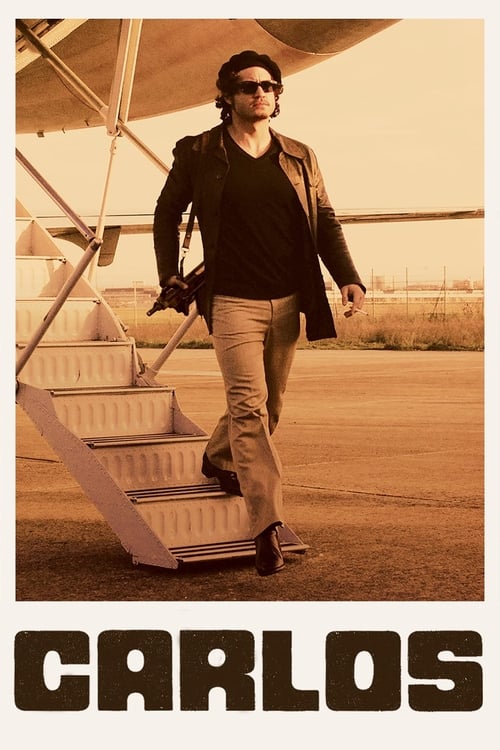
Carlos
2010 · Olivier Assayas
For when you want to disappear into something big — a whole-weekend commitment that pays off like the best prestige TV, with a thriller's pulse and a biography's sweep. Challenge more than comfort, but never a slog.
What it's about
A Venezuelan militant reinvents himself as "Carlos the Jackal," the most wanted freelance terrorist of the 1970s, moving between Palestinian armed struggle, European safe houses, and the audacious 1975 raid on the OPEC ministers' conference in Vienna. Shot as a three-part epic spanning two decades, several languages, and half the map of the Cold War, it follows a man who treats revolution as a career — and watches the career slowly go bad.
The experience
Propulsive and coldly clear-eyed at once: long stretches play like a taut procedural thriller, then the film steps back to watch its antihero's glamour curdle into vanity and obsolescence. The full cut runs over five hours and earns it — you settle into its rhythm the way you would a great novel.
Performances
Édgar Ramírez is astonishing — he plays Carlos across twenty years, multiple languages, and a startling physical transformation, making charisma and self-delusion feel like the same trait.
The craft
Olivier Assayas directs with restless, globe-hopping energy, staging the OPEC raid as an extended set piece of remarkable tension and precision. The multilingual, on-location shooting gives it a documentary charge; it moves like an action film but thinks like history.
Why it matters
A landmark in the blurring of cinema and long-form television, it redefined what a 'miniseries' could be and confirmed Assayas as a major international filmmaker while making Ramírez a star.
Snapshot
Carlos is Olivier Assayas's epic, multilingual chronicle of Ilich Ramírez Sánchez — the Venezuelan-born militant who, as "Carlos the Jackal," became the most notorious freelance terrorist of the Cold War's long 1970s. Conceived and broadcast as a three-part television production and circulated theatrically in a condensed cut, the work runs roughly five and a half hours in its full version, tracing Carlos from his arrival in the Palestinian armed struggle of the early 1970s, through the 1975 raid on the OPEC ministerial conference in Vienna, to his slow obsolescence and 1994 capture in Sudan. Édgar Ramírez, in a career-defining performance, plays Carlos across two decades, several languages, and a striking physical transformation. The film is at once a propulsive thriller and a coldly analytic study of revolution curdling into vanity, mercenary opportunism, and self-mythology. It marked a scaling-up of Assayas's recurring interests — global mobility, the porousness of borders, bodies and ideologies in transnational circulation — to the dimensions of a geopolitical fresco.
Industry & production
Carlos was produced for the French pay-television channel Canal+ as a co-production between Daniel Leconte's Films en Stock and the German company Egoli Tossell Film, a structure typical of large-scale European television financing. That television origin is the central fact of the project's industrial identity: it determined the budget that made a continent-spanning shoot possible, the three-part broadcast form, and — consequentially — its festival status. When Carlos screened at the 2010 Cannes Film Festival it was shown out of competition, because a work made for television was ineligible for the Palme d'Or. Assayas and his editors prepared both the long version and a substantially shorter theatrical cut (on the order of two and three-quarter hours) for cinema distribution in markets, including the United States, where IFC Films handled release.
The production was genuinely transnational, with shooting spread across multiple countries to stand in for the film's many settings — Paris, London, Beirut, Vienna, Budapest, Aden, Khartoum, and beyond. Period reconstruction across two decades and numerous national milieus, combined with the demands of the long form, made this one of the most logistically ambitious projects of Assayas's career. The screenplay was written by Assayas with the novelist and screenwriter Dan Franck, drawing on the extensive public and journalistic record of Carlos's activities; the filmmakers were careful to flag, both within the work and around it, that contested or unverifiable episodes were dramatized as such. The real Ramírez Sánchez, imprisoned in France, objected to the film through his lawyer, a reminder that the project waded into still-living legal and political controversy.
Technology
Carlos was made in the period when high-end European television drama was migrating decisively toward a cinematic image, and the film reflects that transitional moment in tools and finishing rather than in any single radical innovation. It was shot to deliver theatrical-grade image quality while serving broadcast, and its real technological achievement is one of scale and control: matching footage shot in disparate locations and conditions into a coherent period world, and sustaining that consistency across an extraordinary running time. The needle-drop music strategy (discussed below) also reflects a particular technological-economic reality of the era — the licensing of an extensive catalog of existing recordings in place of a composed score. Beyond these, the record does not support claims of distinctive bespoke technology, and it would be invention to assert otherwise.
Technique
Cinematography
The photography is restless, handheld, and observational, favoring mobility and proximity over composed stillness — a register Assayas had been refining across his earlier work and that here serves the film's thesis that Carlos lives inside a permanent state of motion. The camera tends to attach itself to the body in transit: through airports, hotel corridors, safe houses, and the streets of a dozen cities. Crucially, this kineticism is not undisciplined; it is calibrated. In the great central set piece — the OPEC raid and the ensuing hostage flight — the handheld grammar tightens into something close to procedural real time, the camera tracking the chaos of bodies, weapons, and negotiation within the confined geometry of the headquarters and, later, the aircraft. The cinematography is credited to Yorick Le Saux and Denis Lenoir, both longtime Assayas collaborators; the division of a shoot this large between two directors of photography is consistent with the production's scale, and the result is a remarkably unified visual surface across locations and time periods.
Editing
Editing is where the film's architecture is most visible, and it is the discipline that makes the running time feel like momentum rather than mass. Cut by Luc Barnier — Assayas's editor across many years — with Marion Monnier, the film moves in long propulsive stretches punctuated by hard ellipses, vaulting across months or years between scenes and trusting the viewer to reassemble the timeline. The structure is essentially that of a rise-and-fall epic: an accelerating first movement of ascent and notoriety, the bravura central crisis, and a long diminuendo of decline. The OPEC sequence is the editorial showpiece, sustaining tension across an extended duration through rhythmic control rather than fragmentation. Across the whole, the cutting balances the analytic distance the film wants from its subject against the kinetic intimacy that keeps the spectator gripped.
Mise-en-scène / staging
Assayas stages the film as a tour of the period's geopolitical interiors — the cramped apartments and anonymous hotel rooms, the airport lounges and ministerial conference halls that are the true habitat of stateless militancy. Production and costume design track Carlos's two-decade arc with precision, from lean revolutionary chic to the bloated, self-indulgent figure of his final years. The staging repeatedly frames Carlos as a man performing for an audience — posing with a weapon, admiring his own reflection, holding court — so that the mise-en-scène itself becomes an argument about terrorism as theater and self-presentation. Crowds, security details, and the bureaucratic apparatus of states and intelligence services are blocked with documentary plausibility, grounding the spectacle in a recognizable institutional world.
Sound
The most distinctive sonic decision is the rejection of an original orchestral score in favor of an assembled soundtrack of existing post-punk and new-wave recordings — artists such as Wire, The Feelies, New Order, and Dead Kennedys figure among the needle drops. The effect is deliberately anachronistic and abrasive: rather than scoring the action with period-faithful pop, Assayas uses the propulsive, ironic energy of post-punk to comment on the action, lending Carlos a charge of cool dangerousness while subtly undercutting his self-seriousness. The choice aligns the film with a tradition of using contemporaneous-but-oblique rock music as critical counterpoint. Otherwise the soundscape is dense and naturalistic — the polyglot babble of dialogue, gunfire, aircraft, telephones, and televised news — anchoring the film's geopolitical realism.
Performance
Édgar Ramírez's performance is the film's spine and its great feat. He plays Carlos in Spanish, Arabic, French, English, and German, modulating not only language but bearing and physique across twenty years — from the magnetic, athletic ideologue of the early scenes to the paunchy, self-pitying relic of the Khartoum endgame. The performance refuses both demonization and glamorization: it locates the seduction of the man (his charisma, conviction, and nerve) without flinching from his cruelty, narcissism, and ultimate hollowness. The surrounding ensemble — comrades, handlers, intelligence officers, and the shifting cast of state sponsors — is played in a naturalistic, often clipped register that keeps the political machinery legible.
Narrative & dramatic mode
Carlos operates in the mode of the political-biographical epic, but inflected with the cool, analytic detachment of the procedural. It is structured as a chronicle: a more or less linear march through events, organized around set-piece operations and the long stretches of waiting, travel, and negotiation between them. The dramatic engine is not psychological depth in the conventional sense — the film withholds easy interiority and origin-story explanation — but the spectacle of a self in performance and the slow exposure of the gap between revolutionary rhetoric and personal appetite. Tension is generated procedurally (Will the operation succeed? Who is betraying whom? Which sponsor will turn?) rather than through melodrama. The long form is essential to the design: only at this duration can the film enact, rather than merely describe, the erosion of a cause into careerism and the dwindling of a feared figure into an irrelevance the great powers no longer need.
Genre & cycle
The film sits at the intersection of the historical thriller, the terrorist/political-action film, and the biographical epic. It belongs to a cycle of serious twenty-first-century reckonings with the political violence of the 1970s and the Cold War's proxy conflicts — works that treat militancy and counter-terror not as genre spectacle but as historical and moral inquiry. Within that company Carlos is distinctive for its transnational sweep and its television-scale duration, which let it function simultaneously as a gripping heist-and-hostage thriller (the OPEC raid) and as a panoramic study of an entire ecosystem of armed struggle, state sponsorship, and intelligence gamesmanship. It also extends Assayas's own recurring genre experiments with the thriller of globalization, here pushed to historical and continental scale.
Authorship & method
Carlos is recognizably an Assayas film despite its scale and television origin. Assayas — a former critic at Cahiers du Cinéma before becoming a filmmaker — has long been preoccupied with mobility, borders, global flows of capital and bodies, and the dissolution of fixed identities; films such as demonlover and Boarding Gate had already mapped a placeless, transactional world of international circulation. Carlos applies that sensibility to history, treating its subject as a node in a global network of money, weapons, and ideology rather than as a self-contained psychological portrait. The method is rigorously researched but deliberately undidactic, trusting montage and accumulation over exposition.
The authorship is genuinely collaborative. The screenplay was co-written with Dan Franck. The kinetic, location-spanning image was realized by cinematographers Yorick Le Saux and Denis Lenoir, both frequent Assayas collaborators. The film's tempo and structure owe much to editor Luc Barnier, Assayas's longtime cutting-room partner, working with Marion Monnier. And the conspicuous absence of a composed score — the substitution of a curated post-punk soundtrack — is itself an authorial signature, consistent with Assayas's deep engagement with rock music as both texture and critical commentary. Anchoring the whole is Édgar Ramírez, whose linguistic and physical range makes the film's two-decade span credible.
Movement / national cinema
Carlos is a French film by a director who emerged from the critical-cinephile lineage of Cahiers du Cinéma, the journal that birthed the French New Wave, and who belongs to the generation of French filmmakers that inherited and reworked that tradition. But the film is also a paradigmatic example of the contemporary European transnational co-production — French and German financing, a pan-continental shoot, and a polyglot cast and script that refuse to center any single national perspective. In that sense it embodies a "world cinema" mode of production and address, even as its sensibility and authorship are firmly rooted in a French post-New Wave intellectual culture. It further exemplifies the convergence, around 2010, of prestige television financing with theatrical-quality filmmaking — a French analog to the contemporaneous elevation of the long-form serial.
Era / period
The film depicts the long 1970s and 1980s of Cold War proxy conflict — the years when Palestinian armed struggle, European far-left militancy, Soviet-bloc and Arab state sponsorship, and Western intelligence services formed a single shadow ecosystem, and when "international terrorism" emerged as a recognizable phenomenon. Its narrative arc, from the militant high-water mark of the mid-1970s to the post-Cold-War cleanup of the early 1990s, is also a chronicle of that era's collapse: by the end, the world that gave Carlos his utility has dissolved, and he is handed over almost as a piece of obsolete inventory. Made and released in 2010, the film inevitably reads through the post-9/11 lens of its production era, offering a longue-durée history of political violence at a moment when "terrorism" had become the defining geopolitical category of the day.
Themes
The film's governing theme is the corruption of revolutionary ideals into spectacle, celebrity, and self-interest — the transformation of a "soldier of the revolution" into a brand and a mercenary. Closely bound to this is the motif of the body: Carlos's physical vanity, sexual appetite, and eventual bodily decline literalize the decay of the cause he claims to serve. Carlos is also a study of statelessness and global circulation — a man without a country moving through a borderless underworld sustained by the cynical patronage of nations who use and discard him. It interrogates the theatricality of terror, the way violence is staged for an audience of media and history. And it is, finally, an account of obsolescence: the tragedy and bathos of outliving the geopolitical conditions that made one matter.
Reception, canon & influence
Carlos was met with strong critical acclaim and quickly came to be regarded as one of Assayas's major achievements and one of the most significant works of its year; it figured prominently on numerous year-end critics' lists in 2010. Its festival premiere out of competition at Cannes 2010 raised its profile, and its awards recognition included the Golden Globe for Best Miniseries or Television Film, with Édgar Ramírez singled out for the breadth of his performance. The film also became a touchstone in the era's debates about the dissolving boundary between cinema and prestige television — its dual life as a long-form broadcast work and a theatrical feature made it a frequent reference point in those discussions.
Looking backward, the film draws on a deep lineage of politically serious cinema about militancy and the state — the tradition of the rigorous, procedural political film, and the kinetic handheld realism that runs through Assayas's own filmography and its New Wave inheritance. Its needle-drop aesthetic places it in a line of filmmakers who deploy rock music as ironic historical commentary rather than nostalgic decoration. Looking forward, Carlos contributed to the legitimation of the ambitious long-form historical drama as serious cinema, and it confirmed Assayas's standing as a leading chronicler of globalization; for Édgar Ramírez it was a launching point to an international career. Within the broader cycle of twenty-first-century films reckoning with Cold War political violence, it stands as one of the most expansive and analytically rigorous, a benchmark against which subsequent biographical treatments of militancy are measured. Claims beyond these — precise box-office figures or specific later films directly modeled on it — are not securely established in the record, and I note that rather than manufacture a tidier legacy than the evidence supports.
A Deleuzian reading
Carlos stands in front of a mirror, alone, naked, and studies himself the way a man studies a monument.
The full Deleuzian reading of Carlos →
Reception
A Cannes 2010 sensation that had to screen out of competition because it was technically television — critics crowned it anyway, topping year-end polls, and it now reads as the moment the film-vs-TV border started to crumble, years before 'prestige long-form' was a genre.
How Carlos was received, from release to now →
Influences: the films it descends from and the films it influenced
- The Battle of Algiers (1966) — Establishes the faux-newsreel handheld grammar and procedural anatomy of a clandestine cell versus the state's counterinsurgency apparatus that Carlos adopts to film terror as logistics.
- Z (1969) — Models the kinetic political thriller built from rapid procedural montage of an investigation into state-tolerated violence — the editing rhythm Assayas inherits for his rise-and-fall structure.
- State of Siege (1972) — Treats an urban-guerrilla kidnapping as dispassionate operational logistics rather than melodrama, the undidactic 'accumulation over exposition' method Carlos uses for its hostage set-pieces.
- The Day of the Jackal (1973) — Pioneers the clinical, step-by-step proceduralism that follows an assassin across European borders while withholding psychology — the same refusal of interior access that keeps Carlos a network-node rather than a portrait.
- La Chinoise (1967) — The New Wave handheld portrait of a Maoist student cell that founds the post-New-Wave militant-cinema tradition Assayas, an ex-Cahiers critic, writes from.
- Mean Streets (1973) — Establishes the diegetic rock needle-drop deployed as ironic commentary in place of composed score, the curated-soundtrack-as-authorial-signature device Carlos extends with post-punk.
- The Conformist (1970) — Renders political commitment as embodied performance and shifting physical bearing across a historical span, anticipating Ramírez's two-decade physical transformation.
- demonlover (2002) — Within Assayas's own filmography, maps the placeless, transactional world of global capital and bodies in motion — the network logic Carlos transposes onto Cold War history.
- The Baader Meinhof Complex (2008) — A kinetic handheld ensemble chronicle of 1970s European leftist terror, part of the same cycle reckoning with Cold War militancy through accumulated operational detail.
- Munich (2005) — A transnational counterterror procedural set in the same 1970s milieu, tracking operatives across geopolitical interiors and hotel-room logistics in multiple languages.
- Mesrine: Killer Instinct (2008) — Assayas directly extends the Mesrine format into a three-part theatrical/television hybrid — the French-produced prestige biopic of the international political criminal across decades — deploying period source music, physical-transformation performance, and the multi-part episode structure that Richet's commercial success proved viable.
- Army of Shadows (1969) — Assayas applies Melville's episodic operational chapter structure and procedural clinical distance — missions rendered without psychological editorial commentary, the protagonist's interiority permanently withheld — to 1970s European political terrorism, testing whether Melville's formal grammar of withholding can sustain a fundamentally unsympathetic subject at five-hour scale.
- A Most Wanted Man (2014) — Extends the post-Carlos espionage proceduralism of cramped geopolitical interiors and surveillance logistics, with Corbijn's post-punk-rooted sensibility echoing the needle-drop ethos.
- ZeroZeroZero (2019) — A long-form transnational network procedural that follows money and contraband across continents, applying Carlos's globalization-as-structure logic with a post-rock score standing in for emotional underscoring.
- Wasp Network (2019) — Assayas's own later return to the form — a multilingual, transnational chronicle of a Cuban spy network told through procedural accumulation and elliptical time-jumps inherited directly from Carlos.
- Che (2008) — A two-part, multilingual revolutionary biopic with a lead's physical transformation that refuses catharsis for procedural granularity over a long-form running time — the closest formal twin to Carlos.
- Mesrine: Killer Instinct / Public Enemy No. 1 (2008) — A two-part biopic structured explicitly as rise-and-fall, driven by Vincent Cassel's decade-spanning physical transformation — the same long-form arc and embodiment Carlos uses.
- United Red Army (2007) — A long-form procedural anatomy of a militant cell's ideological self-destruction, prioritizing process and group dynamics over individual heroics like Carlos's later collapse.
- Mesrine: Public Enemy #1 (2008) — Assayas directly adopts the event-release two-part prestige crime biopic format, with a matching desaturated 1970s period palette and the same structural tension between the protagonist's ideological self-image and documentary evidence of his mercenary violence — the closest French formal parallel to Richet's project.
- Four Days in September (1997) — A de-glamorized procedural portrait of a guerrilla that treats revolutionary violence with clinical even-handedness, extending the anti-hagiographic stance into long-form docudrama.
- Che: Part Two (2008) — The exact contemporaneous twin: a five-hour multilingual procedural portrait of an armed internationalist, released in both a segmented and a theatrical cut, with a lead (Ramírez) required to work in three languages and a refusal of psychological origin story in favor of travel documents, safe houses and logistics.
- Marighella (2021) — The long-form episodic accumulation Marighella adopts — a militant's career told as a chain of discrete operations, each with its own crew, city and gear, scored with period pop needle-drops used as dated markers rather than mood — and the same refusal to psychologize between jobs.
Similar films
- The Day of the Jackal (1973) — influence & lineage
- The Battle of Algiers (1966) — influence & lineage
- The Baader Meinhof Complex (2008) — influence & lineage
- Z (1969) — influence & lineage
- The Secret Agent (2025) — shared sensibility
- The Motorcycle Diaries (2004) — shared sensibility
- Mesrine: Public Enemy #1 (2008) — shared sensibility
- Syriana (2005) — shared sensibility