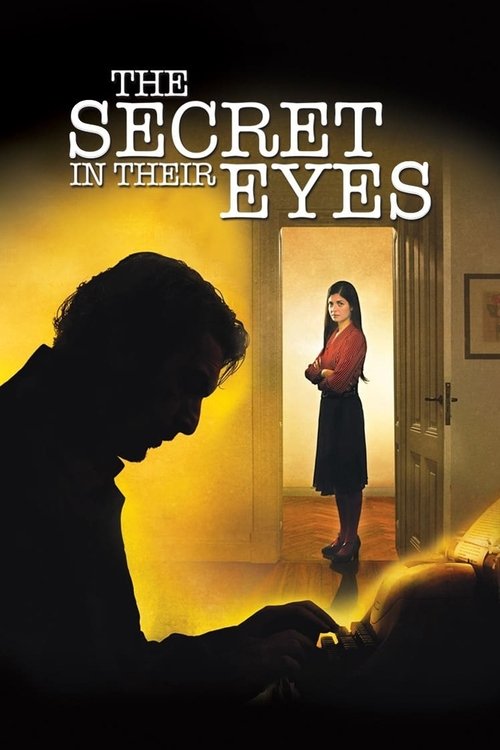
The Secret in Their Eyes
2009 · Juan José Campanella
For when you want a smart, satisfying mystery that also makes you feel something — the rare thriller that works as a date movie. Absorbing rather than punishing; a great pick when you want to be fully swept up.
What it's about
A retired criminal investigator, unable to let go of a decades-old case — the rape and murder of a newlywed — begins writing a novel about it, and the writing pulls him back into the past: the investigation, the injustice that followed, and the judge he has loved in silence for twenty-five years. The story moves between 1970s Argentina, with the shadow of the Dirty War hanging over every courthouse corridor, and the present, where old wounds refuse to close.
The experience
A grown-up thriller with a beating heart — tense and propulsive when the investigation tightens, aching when the romance surfaces, and it lands a final stretch you'll want to talk about immediately. It grips like a page-turner but lingers like a drama.
Performances
Ricardo Darín is magnetic with rumpled gravity as the haunted investigator, and Guillermo Francella — a comedian cast against type — is quietly devastating as his boozy, loyal colleague.
The craft
Juan José Campanella braids procedural, romance and national reckoning with television-honed efficiency, and stages one of modern cinema's great set pieces: a vertiginous, seemingly unbroken pursuit that swoops from the sky into a packed soccer stadium. It's built for a big screen and a crowd.
Why it matters
It won the foreign-language Oscar in a genuine upset over The White Ribbon and A Prophet, became the commercial summit of Argentina's post-crisis film renaissance, and later spawned a Hollywood remake.
Juan José Campanella's mystery-melodrama became the commercial summit of Argentina's post-crisis cinema renaissance, taking the foreign-language Oscar over Haneke's The White Ribbon and Audiard's A Prophet — a genuine upset that still sparks arguments. A retired investigator, played with rumpled gravity by Ricardo Darín, revisits a brutal unsolved case by writing a novel about it, and the film moves between decades with the ache of a country interrogating its own memory: the shadow of Argentina's Dirty War hangs over every judicial corridor and shabby office. Campanella, a veteran of American network television, brings that training's narrative efficiency to a story about the impossibility of closure — grief, unspoken love, and justice deferred braided into a single procedural. The showpiece is a vertiginous pursuit through a packed Huracán football stadium, swooping from aerial view to pitch level in one apparently unbroken five-minute shot, a digital-stitching feat that announced Argentine craft could match anyone's. Hollywood remade it in 2015; nobody remembers the remake.
A Deleuzian reading
The camera hangs over a night match at Huracán, high enough that the crowd reads as texture rather than people.
The full Deleuzian reading of The Secret in Their Eyes →
Reception
A hit from day one — it became one of the biggest Argentine box-office successes ever and won the Best Foreign Language Film Oscar — and rather than fading, it's climbed: now an IMDb Top 250 fixture and a Letterboxd darling that serves as many people's gateway into Argentine cinema.
How The Secret in Their Eyes was received, from release to now →
Influences: the films it descends from and the films it influenced
- Touch of Evil (1958) — Establishes the virtuoso unbroken opening crane-and-tracking shot as a bravura authorial signature, the template the Huracán stadium set-piece consciously chases.
- I Am Cuba (1964) — Pioneers the seemingly impossible continuous crane descent that swoops from an aerial vantage down into a dense human crowd, the exact spatial gesture of the stadium plunge.
- Goodfellas (1990) — The Copacabana Steadicam shot models the single-take immersion that threads a protagonist through a packed venue's back corridors out into a full house, mirrored in the stadium sequence.
- The Official Story (1985) — Founds the Argentine dirty-war reckoning film, prosecuting national guilt through one character's intimate investigation into the fate of the disappeared.
- Z (1969) — Codifies the political-procedural thriller in which a dogged legal/investigative pursuit of a single killing indicts an entire state apparatus of impunity.
- Chinatown (1974) — Neo-noir investigation whose formal payoff is bleak, deferred non-closure — the powerful walk free — which Campanella's 'justicia' finale directly answers.
- Vertigo (1958) — Supplies the structural device of a decades-spanning, unconsummated romantic obsession functioning as the melodramatic engine hidden beneath a crime plot.
- Once Upon a Time in America (1984) — Frame-story architecture of an aged man returning to reopen a decades-old wound of guilt and lost love, cross-cutting present and past timelines — the film's exact nonlinear scaffold.
- Son of the Bride (2001) — Campanella's own Ricardo-Darín-fronted method — braiding comedy, warmth and deferred romantic longing into melodrama — that he then grafts onto genre here.
- Nine Queens (2000) — Post-crisis Argentine genre cinema built on Darín's understated everyman register and a tightly-plotted twist structure, the same industry moment and star instrument.
- Time for Revenge (1981) — Directly inherits the genre-as-camouflage method, smuggling a reckoning with dictatorship-era impunity inside a crime-and-legal thriller whose suspense is built by duration and withheld testimony.
- Martin (Hache) (1997) — Literate classicism prioritizing language, character interiority and a Luppi-generation acting register over plot mechanics, the discursive-prestige line Hache anchors.
- The Secret in Their Eyes (2015) — The direct Hollywood remake, transplanting the frame-story/nonlinear structure and the 'never-closed case' engine while swapping the dirty war for post-9/11 counterterror.
- Wild Tales (2014) — Extends the post-crisis Argentine international-coproduction pipeline (with Ricardo Darín anchoring a segment) that Campanella's Oscar win helped open, marrying genre spectacle to social grievance.
- Argentina, 1985 (2022) — Ricardo Darín again anchoring a dirty-war justice procedural about national memory, inheriting the courtroom-and-testimony method of prosecuting impunity through one investigator's dossier.
- Belén (2025) — Argentine courtroom drama's architectural attention to the tribunal, archive and corridor as institutional geography that shapes how justice is felt as a physical space.
- Children of Men (2006) — Contemporary benchmark for digitally stitching several discrete camera setups into one 'impossible' continuous take, the same invisible-compositing trick that makes the stadium long take physically achievable.
- Zodiac (2007) — Obsessive cold-case procedural whose craft thesis is that the case is never cleanly solved and the pursuer is consumed by the unclosed file — the same 'deferred closure' formal wager.
- Memories of Murder (2003) — An unsolved-murder procedural that fuses tonal whiplash (comedy to dread) with national political trauma, the identical genre-melodrama-history braid on a different nation's wound.
- The Lives of Others (2006) — Reckons with state-terror history through a slow-burn moral procedural and a long-delayed, quiet epilogue of belated recognition rather than active justice.
- On Probation (2005) — Argentine genre-prestige film marrying detective procedural to emotional interiority and a bravura long-take set-piece (the stadium), sharing the era's ambition to fuse craft spectacle with local feeling.
- I'm Still Here (2024) — Structures itself around memory-and-remembrance of an unpunished crime from the dictatorship years, using a decades-later frame to measure the long half-life of state impunity, as Salles does with Eunice's later life.
- A Twelve-Year Night (2018) — Scored by Federico Jusid, whose restrained, silence-serving prestige-cinema scoring method Brechner reuses — the collaborator debt is Jusid's discipline of underscoring rather than swelling over Southern Cone trauma.
Similar films
- Son of the Bride (2001) — influence & lineage
- Argentina 1985 (2022) — influence & lineage
- The Official Story (1985) — influence & lineage
- Nine Queens (2000) — influence & lineage
- Z (1969) — influence & lineage
- Memories of Murder (2003) — influence & lineage
- Talk to Her (2002) — often watched together
- The Secret Agent (2025) — shared sensibility