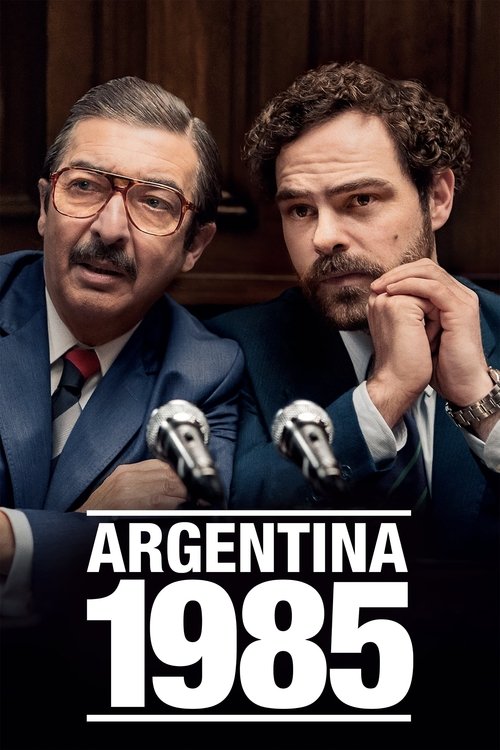
Argentina 1985
2022 · Santiago Mitre
Argentina 1985's populist courtroom triumph now doubles as the reference point in the discourse about Milei-era defunding of Argentine cinema — a national film culture in crisis.
For when you want to believe ordinary people can face down power and win — a rousing, David-versus-Goliath night that earns its lump in the throat. Stirring rather than punishing, despite the dark history underneath.
What it's about
Buenos Aires, 1985. Democracy is barely two years old when federal prosecutor Julio Strassera is handed the case nobody wants: putting the commanders of Argentina's military dictatorship on trial for the kidnappings, torture, and killings of the previous decade. With the establishment against him and the military still dangerous, he and his young deputy Luis Moreno Ocampo build their team from inexperienced kids and set out to gather survivor testimony before time and politics run out.
The experience
A courtroom thriller with a warm, wry pulse — it keeps cracking jokes right up to the moments that knock the wind out of you. The testimony scenes are quietly shattering, and the whole thing builds a momentum that feels like watching history get made in real time.
Performances
Ricardo Darín plays Strassera with a perfect mix of grumbling reluctance and moral steel — a hero who'd rather be home smoking and complaining, which makes his courage land harder.
The craft
Santiago Mitre and co-writer Mariano Llinás balance legal procedure with family comedy so deftly the film never feels like homework, and it all funnels toward a closing argument staged as one of the great courtroom scenes of recent cinema. Handsome period detail, but the real craft is in the pacing — two and a half hours that move like ninety minutes.
Why it matters
It became a national event in Argentina and carried the phrase 'Nunca Más' — Never Again — back into the global conversation, proving the historical courtroom drama still has real power.
Snapshot
Argentina 1985 dramatizes the 1985 Juicio a las Juntas — the Trial of the Juntas — the landmark criminal prosecution of the nine commanders of Argentina's successive military dictatorships responsible for the state terrorism of 1976–1983. Federal prosecutor Julio César Strassera and his young deputy Luis Moreno Ocampo assembled a largely inexperienced legal team, compiling survivor testimonies into a record of systematic kidnapping, torture, and murder at a moment when the military retained significant institutional power. The film climaxes with Strassera's closing argument, which ended with the words "Nunca Más" — Never Again — now among the most resonant phrases in Argentine political history. Directed by Santiago Mitre from a screenplay co-written with Mariano Llinás, the film was produced with Amazon Studios backing and became both Argentina's most successful theatrical release in years and the country's entry for the Academy Award for Best International Feature Film, winning the Golden Globe for Best Non-English Language Film in January 2023.
Industry & production
The film was produced by K&S Films — the Buenos Aires company associated with producer Axel Kuschevatzky, a central figure in Argentine prestige production — in co-production with Amazon Studios. Amazon's involvement secured both the financing for a relatively large-scale period production and a guaranteed global streaming release on Prime Video, a model that has become increasingly central to ambitious national cinema seeking international reach. The platform backing allowed for a scope — recreating 1985 Buenos Aires, staging the Palacio de Justicia courtroom, dressing large crowds in period costume — that Argentina's domestic film-financing structures would have constrained considerably.
Ricardo Darín was cast as Strassera, a decision that anchored the film in the commercial tradition of Argentine prestige drama. Darín is Argentina's most internationally recognized film actor; his involvement functions as a kind of quality certification for domestic audiences, and his range in portraying institutional figures — ironic professionals masking private anxiety — suited the role closely. Peter Lanzani, primarily known at the time for television and lighter dramatic work, was cast as the young Moreno Ocampo. His casting proved among the film's shrewdest decisions: Lanzani's visible energy and the arc of his performance across the film give the mentor-student dynamic its emotional spine, and his role was widely described as a career revelation.
Production took place in Buenos Aires, making extensive use of existing architectural spaces and period dressing rather than studio fabrication wherever possible. The actual 1985 trial took place in the Palacio de Justicia; Mitre and his team recreated the specific courtroom geography that had become familiar to Argentines who watched televised segments of the original proceedings.
Technology
Argentina 1985 was shot digitally, the standard workflow for Argentine production at this scale. The visual approach aimed for a register between the verité intimacy of contemporary political drama and the slightly desaturated warmth of the period, avoiding the overt grain-heavy pastiche that can render period films self-consciously retro. One of the film's more telling technical decisions was the integration of actual archival television footage — news broadcasts from 1985 — into the film's texture, collapsing the distance between dramatic reconstruction and documentary record at strategic moments.
Technique
Cinematography
Cinematographer Javier Julia, a frequent Mitre collaborator, refuses the aestheticization of suffering that courts controversy in films dealing with atrocity testimony. The witness sequences — where survivors describe in legal language what was done to them and to others — are handled with disciplined restraint: cameras close on faces, attentive to the courtroom's institutional architecture, neither sensationalized nor so clinical as to feel distancing. The visual approach in the film's first half, tracking the young legal team through an underequipped office, is looser and more mobile, registering controlled chaos under deadline. As the trial proceeds, compositions stabilize, as though the courtroom's gravity has organized both the characters and the film itself.
Editing
The editing maintains pacing across a narrative that spans months of preparation and weeks of proceedings — a structural challenge in legal procedurals, which must generate urgency from what is, on its face, bureaucratic work. The film's rhythm accelerates and contracts strategically, leaning hardest into the accumulating weight of testimonies. The integration of archival footage into the dramatic fabric without rupturing the film's tone represents one of the more technically demanding aspects of the edit; the cuts between 1985 news material and the dramatization work as continuity rather than illustration.
Mise-en-scène / staging
Mitre's staging throughout the courtroom sequences demonstrates an acute understanding of the architecture of legal ritual — the spatial hierarchy of bench, prosecution, defense, dock, and gallery; the way physical proximity and distance within that room communicate power and vulnerability. The staging of witness testimony is particularly careful: survivors speaking into microphones, bodies rendered small within the institutional space, the camera attending to them without surrounding them with the apparatus of dramatic emphasis. Outside the courtroom, the mise-en-scène registers more loosely — crowded offices, domestic scenes of Strassera with his family, late-night deliberations — using spatial congestion to communicate the pressure under which the prosecution worked.
Sound
The sound design makes sparing use of score during the trial's most charged moments, allowing courtroom acoustics — the resonance of testimony in a large chamber, the ambient noise of a packed gallery — to carry the weight. The choice to approach climactic witness testimonies with near-silence rather than orchestral underlining is among the film's more disciplined formal decisions, trusting the historical material over the manipulations of conventional dramatic grammar.
Performance
Darín's Strassera is characterized by professional irony masking private anxiety — a performance pitched to establish early that this is a man who survived Peronism and prior waves of military rule by being careful, and who now finds himself, somewhat to his own surprise, on the most exposed legal stage in Argentine history. Lanzani's Moreno Ocampo operates as his foil: youthful urgency, and a family name that complicates the moral stakes — Moreno Ocampo's family had military connections, a fact the film dramatizes through scenes of social friction and ostracism. The tension between the young deputy's institutional role and his social background gives the story its most psychologically legible personal arc. The ensemble of young lawyers functions partly as a generational emblem: a cohort who came of age under the dictatorship and must now articulate, in legal language, what that experience meant.
Narrative & dramatic mode
Argentina 1985 belongs to the mode of institutional procedural drama — its tension derives not from individual heroism against a clearly villainous antagonist, but from the grinding collective work of assembling a legal case within and against a compromised institutional environment. The film's closest formal ancestors are American: All the President's Men (Pakula, 1976), Spotlight (McCarthy, 2015). But the procedural mode in Mitre's film carries different political weight, because the institutions being activated — the civilian judiciary, the federal prosecutor's office — are themselves fragile, recently restored, and contested. Argentina had only returned to civilian rule in 1983 under Raúl Alfonsín; the junta trial was one of the first tests of whether civilian institutions could actually compel accountability from a military that had not been defeated but had negotiated its own exit from power.
The film's dramatic tension is therefore partly historiographic: audiences who know the outcome know the prosecution succeeded, but Mitre reconstructs a genuine sense of contingency — the military retained organizational coherence, witnesses faced real intimidation, political pressures to limit the prosecution's scope were constant throughout.
Genre & cycle
Argentina 1985 participates in an international cycle of films dramatizing transitional justice, truth commissions, and accountability processes — alongside, among others, Pablo Larraín's No (2012, on the Chilean plebiscite against Pinochet) and the broader wave of institutional procedural films that gained critical prestige from the mid-2000s onward. Within Argentine cinema specifically, it follows a commercial and critical template established by Juan José Campanella's El Secreto de Sus Ojos (The Secret in Their Eyes, 2009), which won the Academy Award for Best Foreign Language Film and demonstrated that Argentine films engaging with state violence under the dictatorship could reach large domestic and international audiences. Mitre's film updates Campanella's approach, replacing the earlier film's noir atmosphere and melodramatic structure with procedural understatement.
Authorship & method
Santiago Mitre studied at the Universidad del Cine (FUC) in Buenos Aires, the institution that produced many filmmakers associated with Nuevo Cine Argentino. His earlier features — El Estudiante (2011), a sharp study of political maneuvering within a university, and La Cordillera (2017), a presidential-summit political thriller that again starred Darín — established him as a director consistently drawn to the internal workings of institutions and to political actors whose professional demeanor conceals or suppresses more volatile private states. His method tends toward behavioral precision: performances that communicate psychology through professional manner and its suppressions rather than through overt emotional display.
The screenplay was co-written with Mariano Llinás, a juxtaposition that itself carries meaning. Llinás is associated with the experimental wing of contemporary Argentine cinema — his La Flor (2018) runs approximately fourteen hours and constitutes a deliberately anti-narrative decomposition of genre — and his participation in an Amazon-backed mainstream procedural was widely noted as an unusual collaboration. Llinás has described working within classical dramatic structure as its own kind of formal challenge; the co-writing appears to have sharpened the script's architecture while retaining Mitre's behavioral register. The film's composer and the precise boundaries of the post-production workflow are less documented in public sources; the score is present mainly as textural underlining in transitional sequences, with restraint that suits the film's overall formal approach.
Movement / national cinema
Argentina has one of Latin America's oldest and most institutionally developed film cultures, with a state film body (INCAA) and a tradition of political cinema running from the militant Third Cinema of Fernando Solanas and Octavio Getino (La Hora de los Hornos, 1968) through the critical social realism of the 1970s and the Nuevo Cine Argentino of the 1990s and 2000s (Lucrecia Martel, Pablo Trapero, Lisandro Alonso). Argentina 1985 sits at a different point on this spectrum — neither the political-militant pole nor the austere art-house register of Martel — closer to a tradition of crafted mainstream prestige drama with political subject matter, a mode Campanella's Oscar-winning film had already demonstrated as viable and commercially sustainable.
The Amazon co-production marks an ongoing structural shift in Argentine cinema, where streaming platform investment is reshaping what kinds of films can be made at what scales. This condition of platform-backed "quality national cinema" is the material basis for Argentina 1985's existence at its particular level of ambition — and raises questions, which the film does not address, about the relationship between global distribution infrastructure and the narrative choices that structure nationally significant historical material.
Era / period
The film reconstructs Argentina in 1985 — barely two years after the collapse of the military junta and the return of civilian democracy under Alfonsín. The period is defined by transitional vulnerability: the military retained organizational coherence and feared prosecution; the economy was in severe crisis; civil society was reconstituting itself around democratic norms after seven years of systematic terror. The CONADEP (Comisión Nacional sobre la Desaparición de Personas) had published its report Nunca Más in 1984, documenting evidence of nearly nine thousand disappearances — human rights organizations consistently placed the actual toll at approximately thirty thousand. That report provided the foundational evidentiary basis for the prosecution team.
The Trial of the Juntas was, at the time, unprecedented in Latin America: a civilian court successfully prosecuting former military rulers for crimes against humanity. Its completion — five of the nine defendants convicted, with Jorge Rafael Videla and Emilio Eduardo Massera receiving life sentences — set a precedent that influenced transitional justice processes across the region and internationally.
Themes
The film's central thematic concern is the fragility and necessity of institutional accountability: whether civilian legal institutions can actually compel powerful military actors to face judgment, and what it costs those inside those institutions to attempt it. Related to this is its interest in complicity and social inheritance — the way Moreno Ocampo's family background dramatizes the networks within which both perpetrators and bystanders were embedded, the question of whether professional obligation can override the social formations that preceded it.
Argentina 1985 also engages, more quietly, with the emotional and professional costs of prosecutorial work — the controlled dissociation required to process hundreds of testimonies of extreme violence without being destroyed by them, and the forms of civilian courage that don't resemble heroism. Strassera's irony and pragmatism are part of the film's texture throughout; the closing "Nunca Más" lands as earned rather than declaratory because Mitre has spent the entire film in the messy institutional and human material from which that phrase had to be extracted.
Reception, canon & influence
Critical reception and awards
Argentina 1985 received extensive critical acclaim at festival premieres and on wide release, earning consistent praise for its performances, procedural discipline, and willingness to trust historical material without overwriting it. It won the Golden Globe for Best Non-English Language Film (2023) and was nominated for the Academy Award for Best International Feature Film (95th Academy Awards). It was among the most commercially successful Argentine theatrical releases of its period, drawing audiences who might not typically attend domestic-language cinema. Some Argentine critics and commentators raised questions about the film's dramatic simplifications — the heroization of Strassera and Moreno Ocampo, certain conflicts that may have been invented or compressed for dramatic effect — though these critiques were largely outweighed in public discourse by the film's reception as an act of historical memory-work.
Influences on the film
The American legal procedural and political thriller traditions are the film's most legible formal ancestors: All the President's Men's reconstruction of institutional investigation under political threat; Spotlight's ensemble procedure and deliberate emotional restraint; the broader tradition of Costa-Gavras (Z, 1969; Missing, 1982) in staging confrontations between individuals and the apparatus of state power. Within Argentine cinema, El Secreto de Sus Ojos established both the commercial template and a tonal baseline from which Argentina 1985 differentiates itself — and the tradition of Third Cinema provides a deeper political genealogy the film implicitly engages without adopting its methods.
Legacy and forward influence
Argentina 1985's most significant immediate legacy has been its role in renewing international awareness of the Trial of the Juntas and Argentina's specific contribution to the history of transitional justice. Its global distribution through Amazon Prime Video brought the story to audiences with no prior knowledge of Argentine history and positioned the trial alongside better-known instances of post-atrocity accountability in international cultural memory. Whether the film will prove a durable formal influence on the legal procedural cycle or on Argentine political cinema specifically remains to be established; what its commercial success and awards recognition have confirmed, again, is that the institutional procedural — serious, restrained, historically grounded — remains one of the forms through which large audiences are still willing to engage with the recent past.
A Deleuzian reading
Open on a witness.
The full Deleuzian reading of Argentina 1985 →
Reception
It premiered at Venice 2022 (winning the FIPRESCI prize), took the Golden Globe and an Oscar nomination, and has settled in comfortably since — less a reappraisal story than an instant consensus pick that's become the go-to modern Argentine crowd-pleaser.
How Argentina 1985 was received, from release to now →
Influences: the films it descends from and the films it influenced
- Judgment at Nuremberg (1961) — Stages the litigation of state atrocity through sustained witness close-ups and the in-court screening of actual archival footage of the crimes — the direct template for Argentina 1985's restrained-witness framing and archival-footage integration.
- Z (1969) — Builds a kinetic political-thriller procedure around a single magistrate's investigation pressing against the state apparatus, structuring suspense from the accretion of testimony toward judicial reckoning.
- La Hora de los Hornos (1968) — Third Cinema's deployment of archival and documentary montage as political argument — the deeper Argentine genealogy the film engages evidentially without adopting its agitational method.
- All the President's Men (1976) — The explicitly cited model: reconstructs institutional investigation under political threat as a patient document-and-interview procedural, refusing to overscore and letting compositions tighten from mobile to static as the case closes.
- Missing (1982) — Dramatizes the pursuit of truth about Latin American state terror via a protagonist navigating an obstructive official apparatus, favoring behavioral restraint over melodramatic catharsis.
- The Battle of Chile (1977) — Establishes the Latin American practice of treating archival and observational footage as juridical historical evidence, informing the film's archival integration and sense of historiographic contingency.
- El Secreto de Sus Ojos (2009) — Set the Argentine commercial template of a procedural-memory drama anchored by Ricardo Darín's restrained interiority and a judicial frame for metabolizing dictatorship-era violence — the baseline from which the film differentiates its tone.
- La Historia Oficial (1985) — The foundational post-dictatorship Argentine film confronting the desaparecidos, inaugurating the transitional-justice memory-work and institutional-accountability theme the film extends a generation later.
- I'm Still Here (2024) — Extends the same restrained, procedural reckoning with a junta's crimes, dramatizing the belated legal/documentary accounting of the disappeared through understated performance rather than melodrama.
- A Twelve-Year Night (2018) — Continues the Southern Cone testimony tradition's project of bringing dictatorship reckoning to a large international audience through restraint and archival fidelity rather than spectacle, the consolidating civic-cinema role Brechner's film modeled.
- The Mauritanian (2021) — Legal procedural confronting state abuse through document-driven case construction and underplayed performance, extending the restrained institutional-accountability mode into the post-9/11 context.
- Spotlight (2015) — Ensemble investigative procedure built on deliberate emotional restraint, sparse scoring, and trust in the documentary material rather than dramatized confrontation — the closest contemporary tonal model.
- El Estudiante (2011) — Mitre's anatomy of institutional political maneuvering, where his behavioral-precision direction first surfaces — performances communicating psychology through professional manner and its suppressions.
- La Cordillera (2017) — Mitre's prior Darín-led political thriller, refining the depiction of a public official whose composed professional demeanor conceals volatile private states — the same performance register he applies to Strassera.
- La Flor (2018) — The co-screenwriter's fourteen-hour anti-narrative genre decomposition; the dialectic between Llinás's experimental architecture and classical procedural form is what reportedly sharpened the script's structure.
- The Trial of the Chicago 7 (2020) — Contemporary restaging of a politically charged trial that intercuts courtroom testimony with archival and recreated footage of the events under judgment, dramatizing a nation litigating its own recent history.
- Denial (2016) — A courtroom drama in which historical truth itself is the evidentiary stake, foregrounding the procedural marshalling of proof and historiographic contingency over personal melodrama.
- Belén (2025) — Restrained procedural reconstruction of a landmark Argentine trial that treats the courtroom as the stage on which the nation reckons with itself, holding score and rhetoric in check.
Similar films
- The Official Story (1985) — influence & lineage · same viewing thread
- Missing (1982) — influence & lineage · same viewing thread
- The Trial of the Chicago 7 (2020) — influence & lineage · same viewing thread
- Z (1969) — influence & lineage · same viewing thread
- The Secret in Their Eyes (2009) — influence & lineage
- Judgment at Nuremberg (1961) — influence & lineage
- The Secret Agent (2025) — same viewing thread
- A Twelve-Year Night (2018) — same viewing thread
All the films related to Argentina 1985 →
Watch it with: curated runs of related films
- The Long Shadow of the Coup — A run of films tracing political violence from the mutiny and the massacre through martial law to the decades-long reckoning that follows — watch them near each other and the same machinery of power keeps rhyming across continents and eras.
- Great Men, Grand Reckonings — A run of prestige true stories about singular, obsessive men chasing an epochal achievement — the bomb, the moon, the checkered flag, a nation — and reckoning with what it cost them and everyone around them.