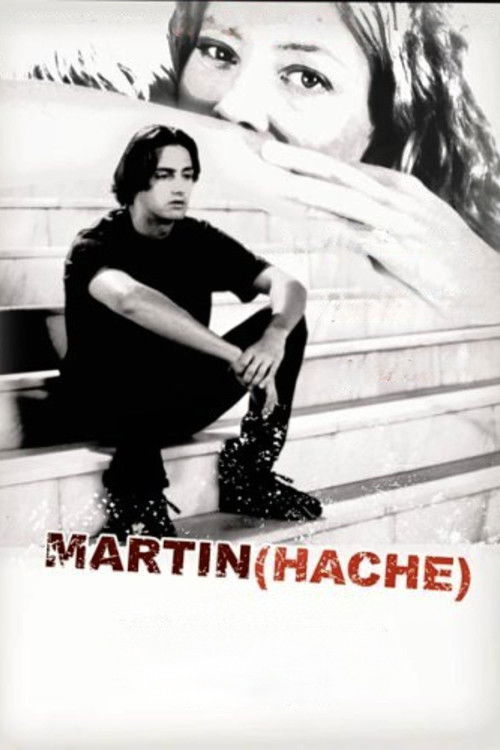
Martin (Hache)
1997 · Adolfo Aristarain
For a late night when you want to sit with smart, wounded people talking about how to live — a film for anyone who's ever left home, or been left. More absorbing than comforting; it gets under your skin slowly.
What it's about
After nearly dying of a drug overdose in Buenos Aires, nineteen-year-old Martín — called 'Hache' to distinguish him from the father whose name he shares — is shipped off to Madrid to live with that father: an expatriate Argentine film director who has built a deliberately rootless life around his much younger lover Alicia and his volatile bisexual actor friend Dante. Four displaced people share close quarters and talk their way through love, freedom, exile, and what a father owes a son.
The experience
Almost nothing 'happens,' and that's the point — the film runs on long, wine-fueled, dazzlingly articulate conversations that keep tipping from banter into confession. It's warm and bruising at once, the kind of talk-heavy drama where an argument about where to live is really an argument about whether anyone can love you.
Performances
Federico Luppi is superb as the father — charismatic, self-justifying, quietly cruel in his detachment — while Cecilia Roth and Eusebio Poncela make Alicia and Dante far more than sounding boards; their monologues are the film's emotional high points.
The craft
Adolfo Aristarain writes conversation the way other directors stage action — long scenes that build, feint, and detonate, with the camera staying patiently on faces. It's chamber filmmaking with the confidence to let language and performance carry everything.
Why it matters
A touchstone of 1990s Argentine cinema and one of the defining films about the Argentine experience of exile in Spain, widely quoted and beloved across the Spanish-speaking world.
Snapshot
Martín (Hache) is a talk-driven chamber drama about exile, fatherhood, and the question of where — if anywhere — a person belongs. When nineteen-year-old Martín, called "Hache" to distinguish him from the father whose name he shares, nearly dies of a drug overdose in Buenos Aires, he is dispatched to Madrid to live with that father: Martín Echenique, an expatriate Argentine film director who has built a self-sufficient, deliberately unrooted life around his much younger lover Alicia and his mercurial bisexual actor friend Dante. Very little "happens" in the conventional sense; the film's engine is conversation, and its subject is the negotiation of intimacy, freedom, and national identity among four displaced people. Directed by Adolfo Aristarain at the height of his powers and anchored by his longtime lead Federico Luppi, it is widely regarded as one of the finest Argentine-Spanish co-productions of the 1990s and a summit of Aristarain's literate, morally serious cinema.
Industry & production
The film is a Spain–Argentina co-production, a model that structured a large share of ambitious Argentine art cinema in the 1990s, when domestic financing was fragile and Spanish partners (often with Televisión Española and public subsidy behind them) supplied budget, distribution reach, and access to the Spanish-language market on both sides of the Atlantic. Aristarain had already worked this circuit successfully with Un lugar en el mundo (1992), and Martín (Hache) extends that arrangement, with the Spanish producer Tornasol Films among the principals. The setting — an Argentine émigré's apartment and the Madrid around it — is not incidental to the financing but continuous with it: the co-production's binational identity is literally the film's theme. Casting reflects the same logic, pairing the Argentine icons Federico Luppi and Cecilia Roth (herself long resident in Spain and a fixture of Spanish cinema) with the Argentine-born, Spain-raised Juan Diego Botto as Hache and the Spanish actor Eusebio Poncela as Dante. Precise budget and box-office figures are not something I can state reliably, and I won't invent them; what is clear is that the film was positioned as a prestige auteur release and traveled the festival and Ibero-American awards circuit rather than the commercial blockbuster track.
Technology
Martín (Hache) is, in technological terms, a conventional 35mm production of its era, and deliberately so. Nothing about the film reaches for spectacle or novelty; the "technology" that matters is the classical apparatus of narrative cinema — anamorphic-or-spherical 35mm capture, naturalistic location and interior lighting, and post-production on photochemical film. The relevant point is negative: at a moment when digital tools were beginning to enter production, Aristarain's method remained resolutely analog and actor-centered, using the camera as a patient recording instrument for performance and speech rather than as a generator of effect. Any more granular claim about specific stocks, lenses, or lab processes would be speculation, and the public record on those details is thin.
Technique
Cinematography
The photography — the cinematographer of record is Porfirio Enríquez, Aristarain's collaborator across this period — serves the dialogue rather than competing with it. The visual grammar is unshowy and classical: measured framings, a willingness to hold on faces and on two- and three-shots as conversations unspool, and a general preference for legibility over stylization. Madrid is rendered as lived-in rather than picturesque, and the apartment interiors that host so much of the drama are shot to feel like a real, inhabited social space. The camera's restraint is itself a rhetorical choice, refusing to editorialize on the characters and instead granting them room to talk themselves into and out of positions.
Editing
The cutting follows the same principle of patience. Scenes are allowed to run to their natural conversational length, and the rhythm is dictated by speech and thought rather than by an imposed tempo. This is a long film (well over two hours) precisely because Aristarain trusts duration: arguments, reconciliations, and evasions need time to accumulate weight. I believe Fernando Pardo, an Aristarain regular of the period, handled the edit, though readers should treat the specific credit as one to verify. What is not in doubt is the editorial ethos — continuity in service of performance, with cuts that clarify rather than accelerate.
Mise-en-scène / staging
Staging is where the film is quietly most sophisticated. Much of Martín (Hache) is effectively theatrical — bodies arranged in domestic rooms, at tables, on balconies — and Aristarain blocks these scenes so that physical position encodes emotional position: who sits, who stands, who leaves the room, who occupies the father's space. The apartment functions as a stage set for a chosen family, and the recurring motif of people talking while doing something ordinary (cooking, drinking, driving) keeps the abundant dialogue from calcifying into filmed theater. The mise-en-scène insists that these are people constructing a way of living, and the rooms they inhabit are the material evidence of that construction.
Sound
Sound is dominated by the human voice; this is a film of talk, and the recording and mixing prioritize the intelligibility and texture of speech. The interplay of Argentine and Peninsular Spanish accents is itself a sonic theme — the film's binational identity is audible in every exchange, and the difference between how the father, the son, and their Spanish milieu speak carries the drama of belonging. On the question of an original musical score and its composer, I don't have a reliable attribution and won't manufacture one; what is safe to say is that music is used sparingly and never allowed to overwhelm the primacy of dialogue.
Performance
Performance is the film's true medium. Federico Luppi, Aristarain's habitual on-screen surrogate, gives the father a weathered gravity — a man whose worked-out philosophy of freedom is both genuinely earned and a defense against feeling. Juan Diego Botto plays Hache as raw, wounded, and searching, the disequilibrium against which the elder generation's certainties are tested. Cecilia Roth's Alicia and Eusebio Poncela's Dante complete a quartet in which each actor must sustain long, articulate exchanges without losing spontaneity; Poncela in particular is given the film's most volatile register, and Roth its most quietly bruised. The acting is naturalistic but verbally dense — closer to the demands of the stage than to screen minimalism.
Narrative & dramatic mode
The dramatic mode is the conversation-driven ensemble drama, structured less as a plot than as a series of encounters that revise the characters' understanding of one another. The inciting event — Hache's overdose and relocation — is a pretext to bring an estranged son into contact with a father who has organized his entire existence around not needing anyone. From there the film proceeds by accretion: what emerges is a portrait of a provisional family and of the ideological arguments (about nation, art, sex, and autonomy) that bind and divide it. Aristarain's storytelling is essayistic without being cold; the characters voice positions, but the film dramatizes the cost of holding them. Resolution, such as it is, comes not through incident but through a shift in what each character is willing to admit.
Genre & cycle
Formally, Martín (Hache) belongs to the intimate auteur drama, with strong affinities to the "exile film" and the father-son reckoning. Thematically it sits within a broader Ibero-American cycle preoccupied with the Argentine diaspora — the generation displaced by dictatorship and economic collapse — and with the reflexive figure of the artist-in-exile. Its heavy reliance on articulate debate also aligns it with a European tradition of the philosophical conversation film. It stands apart, however, from the youth-oriented crime and genre pictures that dominated commercial cinema of the moment, and equally apart from the stripped-down observational aesthetic that the New Argentine Cinema would soon make fashionable.
Authorship & method
Martín (Hache) is a signature Aristarain work, and Aristarain's authorship is inseparable from a small circle of collaborators. He co-wrote the screenplay with Kathy Saavedra, his regular writing partner, and the film's dense, ideas-forward dialogue is the clearest fingerprint of that partnership. Federico Luppi is the other constitutive collaborator: across Tiempo de revancha (1981), Un lugar en el mundo (1992), and this film, Luppi functions as the moral and physical embodiment of Aristarain's worldview, and the director writes toward Luppi's particular blend of stoicism and tenderness. On the technical side, the recurring presence of cinematographer Porfirio Enríquez and (with the caveat noted above) editor Fernando Pardo gave Aristarain a stable craft team whose classicism matched his own. His method is that of the literate classicist — meticulous scripting, extended rehearsal-quality performance, and a camera subordinated to character. He is explicitly a director of the older auteur generation, formed partly by an apprenticeship in genre filmmaking, who brought that craftsmanship to bear on intimate, discursive material.
Movement / national cinema
The film occupies a distinctive position in Argentine national cinema. Aristarain is a bridge figure: he matured under and around the constraints of the dictatorship era (his Tiempo de revancha is a landmark of veiled political filmmaking under censorship) and became one of the most internationally visible Argentine directors of the transition and post-transition decades. Martín (Hache) appears on the very eve of the New Argentine Cinema — the wave associated with Rejtman, Trapero, Martel, and others that crystallized around 1998 — but it belongs to a different lineage: the auteur-classical, co-production-financed, star-driven tradition rather than the low-budget, formally austere new wave. Its binational character also makes it a document of the deep entanglement between Argentine and Spanish cinema in the 1990s, an axis along which talent, money, and audiences flowed in both directions.
Era / period
Made in 1997, the film is a product of the late-1990s moment when Ibero-American co-production was mature and prestige Spanish-language auteur cinema had a reliable festival and awards infrastructure. It is also period-specific in its emotional content: the Argentine expatriate's ambivalence toward a homeland scarred by dictatorship and destabilized by the economic anxieties that would culminate in the 2001 crisis is legible throughout, even when unspoken. The father's insistence that he is "from nowhere" reads as the distilled sentiment of a whole displaced cohort at century's end.
Themes
The film's central theme is belonging — national, familial, and existential. The doubled name, father and son both Martín, literalizes a question of inheritance and identity: what does a son take from a father, and can either escape the other? Around this cluster several linked concerns: exile and the refusal of roots (the father's proud rootlessness set against the son's need for a place and a parent); freedom versus attachment, and whether a philosophy of radical autonomy is wisdom or armor; the ethics and integrity of the artist; sexuality and its fluidity, embodied in Dante; and the destructiveness of drugs and self-abandonment as both literal danger and metaphor for a generation adrift. Underlying all of these is the film's insistence that identity is not given but argued into being — that these people are continuously talking themselves into a way to live.
Reception, canon & influence
Martín (Hache) was received as a major work and helped consolidate Aristarain's standing as one of Argentina's foremost directors; it circulated widely on the Ibero-American awards circuit and drew particular praise for its performances, above all Luppi's. It figured in the Spanish and Argentine awards seasons of its year — the Goyas in Spain and the Cóndor de Plata of the Argentine Film Critics Association — though I would flag that I cannot list its specific wins and nominations with confidence and decline to invent a tally; readers should consult the awards records directly for the exact honors.
Looking backward, the film's influences are the classical, literary, morally serious traditions Aristarain had absorbed — Hollywood classicism filtered through an auteur sensibility, and a theatrical inheritance visible in its trust in dialogue and its chamber structure. It also draws on the specific Argentine experience of exile, giving cinematic form to a diaspora sensibility that literature and testimony had explored before film did.
Looking forward, its legacy is somewhat paradoxical. Martín (Hache) is a canonical title of 1990s Argentine-Spanish cinema and a benchmark for the intelligent, adult, conversation-driven drama — yet it did not found a school, and the Argentine cinema that seized international attention immediately afterward moved in nearly the opposite formal direction. Its lasting influence is better measured as the sustained prestige of the Aristarain–Luppi partnership and the film's standing as a touchstone for filmmakers and viewers who value cinema of ideas and performance over cinema of incident. It remains a reference point whenever the subject is exile, the father-son drama, or the enduring vitality of the Ibero-American co-production model.
Reception
A hit across the Spanish-speaking world in 1997 — festival prizes, Goya glory — it never crossed over internationally, but at home it's only grown: now firmly a '90s classic of Argentine-Spanish cinema and Aristarain's most beloved film.
How Martin (Hache) was received, from release to now →
How to watch Martin (Hache): what to notice on a first viewing
- Watch who sits, who stands, and who leaves a room. Aristarain blocks each argument so physical position encodes emotional position, tracking who claims the father's space and who is pushed to its edge. The room's geometry tells you who is winning an argument before a single word does.
- Watch how long the camera holds on two people talking. The photography is unshowy and classical, favoring measured two- and three-shots that let conversations unspool without cutting away for emphasis. The camera refuses to editorialize, giving the characters room to talk themselves into or out of a position.
- Listen for the difference between Argentine and Spanish accents. The father, the son, and the Madrid milieu around them speak with distinct accents, and that gap is audible in nearly every exchange. The sound of not belonging is built into the dialogue itself, not just its content.
- Notice how rarely the film cuts away from a conversation. Scenes are allowed to run to their natural length, with cuts that clarify rather than accelerate, so arguments accumulate real weight over time. The patience is the point: a reconciliation or an evasion needs time on screen to actually convince you.
- Watch what characters do with their hands while they talk. People keep cooking, pouring drinks, or driving through the dialogue, ordinary tasks that stop the talk from calcifying into filmed theater. The ordinary activity keeps reminding you these are people building a life, not delivering a speech.
The whole guide to watching Martin (Hache), with the keys for a rewatch →
Influences: the films it descends from and the films it influenced
- My Night at Maud's (1969) — Builds drama almost entirely from sustained ethical conversation, holding the camera on speaker and listener rather than cutting for incident — the model for Hache's ideas-forward talk carrying the narrative.
- My Dinner with Andre (1981) — Proves a feature can run on two people talking across a table with dialogue as the sole event, licensing Aristarain's trust in pure conversation to sustain his chamber two- and three-handers.
- Husbands (1970) — Verbally dense, overlapping male-argument naturalism given rehearsal-quality looseness where behavioral performance drives the scene — the naturalistic talk texture behind Aristarain's actor-first method.
- Scenes from a Marriage (1973) — Chamber drama assembled from prolonged domestic confrontation shot in tight, theatrical interior blocking on faces — the domestic-theatrical staging grammar Hache adopts.
- Rio Bravo (1959) — The professional code-of-conduct among stoic men and unhurried naturalistic ensemble dialogue that Aristarain absorbed in his genre apprenticeship and transposed onto the Oscar–Martín bond.
- Tangos, el exilio de Gardel (1985) — First gave the Argentine-in-European-exile diaspora explicit cinematic form — the melancholy of expatriate rootlessness — which Hache re-dramatizes in Madrid a decade later.
- La casa del ángel (1957) — Founding Argentine literary-classicist model: serious literary material rendered as morally weighted chamber drama with the camera subordinated to interior psychology.
- Tiempo de revancha (1981) — Establishes the Luppi-as-moral-and-physical-embodiment persona (stoicism fused with tenderness) through genre — the collaborator method Aristarain writes Hache toward.
- Un lugar en el mundo (1992) — Direct precursor sharing the Saavedra-scripted idealist-patriarch dialogue and Luppi center; Hache reworks its father-figure-and-disciple structure into an exile key.
- El hijo de la novia (2001) — Continues the Argentine adult mainstream of performance-driven, dialogue-rich father-and-family drama that privileges character and talk over incident.
- El secreto de sus ojos (2009) — Literate classicism prioritizing language, character interiority and a Luppi-generation acting register over plot mechanics, the discursive-prestige line Hache anchors.
- Truman (2015) — An Argentine-Spanish coproduction built as a talk-driven chamber two-hander around a single Argentine star (Darín) navigating Madrid — the Hache coproduction-and-conversation model a generation on.
- Lugares comunes (2002) — Aristarain's own reprise — Luppi again, exile poised between Spain and Argentina, ideas-forward teacherly monologues — making it the most direct extension of Hache's craft.
- Cronos (1993) — Extends the Luppi collaboration by casting him as precisely the dignified, humane stoic elder that Aristarain's writing had crystallized, repurposing the persona for genre.
- Miss Mary (1986) — Shares the literate, internationally cofinanced Argentine prestige drama that treats history and belonging through refined chamber performance rather than spectacle.
Similar films
- Son of the Bride (2001) — influence & lineage
- Time for Revenge (1981) — influence & lineage
- La Ciénaga (2001) — shared sensibility
- The Son of a Thousand Men (2025) — shared sensibility
- I Dream in Another Language (2017) — shared sensibility
- Close Your Eyes (2023) — shared sensibility
- Waiting for the Hearse (1985) — shared sensibility
- Bitter Christmas (2026) — shared sensibility