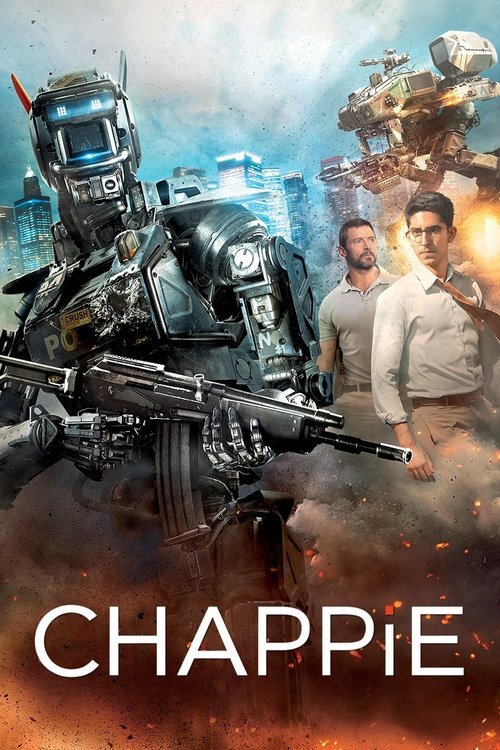
Chappie
2015 · Neill Blomkamp
For when you want sci-fi with grime under its fingernails and a weird beating heart — something to argue about afterward rather than a safe crowd-pleaser.
What it's about
In a near-future Johannesburg policed by robotic 'scouts,' an idealistic engineer secretly installs true artificial consciousness into a damaged, decommissioned unit. The newborn machine — Chappie — is promptly hijacked by a trio of small-time gangsters who raise him as their child, while a rival engineer with a monstrous war machine of his own schemes to shut the whole scout program down.
The experience
A strange, scrappy collision of moods — part violent crime movie, part surprisingly tender fable about a child learning who to trust. It's rough-edged and divisive, but the sincerity underneath the mayhem sneaks up on you.
Performances
Sharlto Copley gives Chappie his voice and movement, and the performance is the film's soul — gangly, eager, and childlike in a way that makes a CG robot genuinely affecting.
The craft
Neill Blomkamp's signature style is all here: photoreal robot effects seamlessly embedded in gritty, sun-blasted Johannesburg locations, kinetic action, and a wild aesthetic swerve courtesy of casting real-life rap duo Die Antwoord as the gangster foster parents. The seamlessness of Chappie himself still impresses.
Why it matters
Blomkamp's most personal and most polarizing film, it split critics on release but has drawn a defenders' cult for its oddball sincerity — and its questions about machine consciousness have only grown more current.
Snapshot
Chappie is Neill Blomkamp's third feature, a science-fiction crime drama set in a near-future Johannesburg where a private contractor, Tetravaal, has equipped the city's police with autonomous robotic "scouts." When idealistic engineer Deon Wilson cracks the problem of genuine machine consciousness and installs his program into a damaged, decommissioned scout, the resulting being—Chappie—is hijacked almost immediately by a trio of small-time gangsters and raised, in effect, as their child. The film braids a Pinocchio-style coming-into-being with a Johannesburg crime story and a corporate-dystopia subplot, the last centered on a rival engineer, Vincent Moore, who wants his lumbering human-piloted war machine, the MOOSE, to supplant the scouts. The film is best understood as Blomkamp's most personal and most divisive work to date: stylistically continuous with District 9 (2009) and Elysium (2013), but tonally unstable in ways that split critics sharply. Its casting of the South African rap-rave duo Die Antwoord as fictionalized versions of themselves is the single most distinctive—and most contested—decision in the picture.
Industry & production
Chappie was produced for Columbia Pictures (Sony) and developed through Blomkamp's working relationship with producer Simon Kinberg, with Media Rights Capital again involved as it had been on Elysium. The film was shot largely in and around Johannesburg, the city that has anchored all of Blomkamp's features and functions as both setting and authorial signature. It arrived as the director's follow-up to the bigger-budgeted, more conventionally structured Elysium, and represents in some respects a deliberate return to the looser, grungier register of his breakthrough District 9.
The project's genesis is closely tied to Blomkamp's enthusiasm for Die Antwoord; the band's aesthetic—its "zef" counterculture, its garish merchandise, its Afrikaans-inflected provocation—is woven through the production design rather than merely soundtracked over it. Sharlto Copley, Blomkamp's long-standing collaborator and the lead of District 9, performed Chappie on set as a motion-reference and voice performer rather than appearing on screen. The marquee names—Hugh Jackman as the antagonist Vincent Moore and Sigourney Weaver as Tetravaal's chief executive—gave the film conventional star wattage, though both are arguably underused relative to their billing, a point several reviewers raised.
Commercially, Chappie underperformed relative to expectations and to Blomkamp's prior films, and its mixed-to-negative critical reception is widely cited as a contributing factor in the subsequent stalling of his proposed Alien sequel, which had been announced around this period and never materialized. Precise budget and grosses I'll leave uncited here to avoid misstatement, but the consensus is that the film was a disappointment by studio metrics.
Technology
Chappie is, in production terms, a photoreal-CGI character film built on the integration techniques Blomkamp and his vendors had been refining since District 9. Chappie himself is a fully computer-generated character composited into live-action plates shot on real Johannesburg locations; Copley's on-set performance, captured with reference markers, provided the physical and vocal basis that animators then translated into the robot. The visual-effects work was led by the Vancouver house Image Engine—Blomkamp's frequent collaborator—with creature and practical-design contributions associated with Weta Workshop's design sensibility. The achievement of the film, technically, is the seamlessness with which a synthetic protagonist behaves as a present, weighty body within handheld, naturalistically lit footage; the robot reads as physically scuffed, dented, and graffiti-tagged, an object that exists in the same grimy material world as the actors.
Within the fiction, the film's technological premises are squarely in the AI-anxiety lineage. Tetravaal's scouts are autonomous-but-bounded law-enforcement machines; Deon's breakthrough is artificial general intelligence—a self-aware program that learns like a child. The MOOSE, by contrast, is a heavy mech operated through a human neural-link interface, dramatizing a recurring Blomkamp interest in the human-machine bodily coupling (compare the exosuit of Elysium). The film's final act turns on consciousness-as-data: the proposition that a mind can be read, digitized, and transferred between substrates. This mind-uploading conceit is the film's most speculative leap and the source of its most criticized tonal swerve.
Technique
Cinematography
Trent Opaloch, who shot both District 9 and Elysium, returns, and the visual grammar is recognizably his and Blomkamp's: handheld, documentary-inflected camerawork; a pseudo-vérité opening built from talking-head "interview" inserts that frame the story as retrospective testimony (a structural echo of District 9's mockumentary prologue); harsh South African daylight and the dust-and-concrete palette of Johannesburg's industrial peripheries. The camera favors long lenses and reactive, slightly unstable framing that lends the CGI protagonist the contingency of a real subject being filmed. Compositionally the film keeps Chappie at human eye-level, encouraging identification rather than spectacle.
Editing
Julian Clarke, editor of Blomkamp's two prior features, cuts the film. The editing sustains the director's characteristic blend of kinetic action coverage and observational character beats, and the mockumentary inserts are deployed as connective tissue and foreshadowing. The film's pacing has been a point of criticism: the tonal oscillation between broad comedy (Chappie's childlike acquisition of slang and "gangsta" mannerisms), sentiment, and brutal violence is partly an editing-and-structure problem, and the late pivot into metaphysics strains the assembled rhythm.
Mise-en-scène / staging
The production design is the film's most committed gesture. The gangster lair is plastered with Die Antwoord iconography; Yolandi and Ninja's characters wear the band's actual merchandise, and the "zef" aesthetic—deliberately tacky, neon, lumpen-proletarian South African kitsch—saturates the frame. Chappie's body is progressively customized: spray-painted, festooned with bling, given the cosmetic markers of his adoptive subculture, so that the mise-en-scène literally inscribes his "upbringing" onto his chassis. The Tetravaal corporate interiors provide the cold, clean counter-space. Johannesburg's real townships, lots, and overpasses ground the science fiction in observed place rather than backlot abstraction.
Sound
Hans Zimmer composed the score, with the texture leaning toward synth-forward, percussive electronic material suited to the milieu. Crucially, Die Antwoord's own music is diegetically and non-diegetically present, functioning less as soundtrack than as worldbuilding: the band's tracks define the sonic identity of Chappie's adoptive family. The result fuses an A-list Hollywood composer with an aggressively regional pop idiom, a hybrid that is emblematic of the film's larger collision of registers.
Performance
The central performance is Copley's, achieved through voice and motion-reference: Chappie's arc from newborn blankness through frightened-child vulnerability to a kind of streetwise adolescence is the film's emotional spine, and it is broadly regarded as its most successful element. Die Antwoord's Ninja and Yolandi Visser play heightened versions of their personas; opinion divides on whether this is inspired stunt-casting or a vanity that destabilizes the drama—Yolandi's maternal tenderness toward Chappie generally earns more goodwill than Ninja's abrasive turn. Dev Patel plays the engineer Deon as earnest creator; Hugh Jackman's Vincent is a mulleted, shorts-wearing militarist whose menace several critics found cartoonish; Sigourney Weaver's CEO is a relatively thin role.
Narrative & dramatic mode
The film operates as a hybrid: part creation myth, part urban crime drama, part corporate thriller. Its dominant dramatic mode is the Bildung of a non-human consciousness—a robot raised in adverse circumstances who must reconcile the competing "parenting" of his benevolent maker and his criminal guardians. This nature-versus-nurture frame gives the picture its sentimental engine and its moral stakes: Chappie is told he is "special," is taught both to read and to carjack, and must choose what kind of being to become. The mockumentary framing signals from the outset that the events are momentous and historical in retrospect, a device that primes the audience for the metaphysical escalation of the climax. The tonal instability—the lurch between juvenile comedy, gangland tragedy, and transhumanist speculation—is the film's defining narrative risk and, for many viewers, its central failure.
Genre & cycle
Chappie sits at the intersection of the robot-consciousness film and the dystopian-corporate-policing film, and it wears its lineage openly. It belongs to the cycle of mid-2010s AI cinema preoccupied with machine personhood and its ethical hazards—a cycle that, in 2015 alone, included Alex Garland's Ex Machina, against which Chappie was frequently and unfavorably compared. It is equally a descendant of the 1980s techno-dystopia, most obviously Paul Verhoeven's RoboCop (1987): the privatized police force, the satirical corporate villainy, the rival walking-tank weapons platform (the MOOSE clearly recalls RoboCop's ED-209). The childlike-learning-robot strand draws on Short Circuit (1986) and its Johnny 5. Underneath both runs the older Frankenstein and Pinocchio templates of the made being seeking soul and selfhood.
Authorship & method
Chappie is a strongly auteurist work in the sense that it concentrates Blomkamp's recurring obsessions and methods. The screenplay is by Blomkamp and Terri Tatchell, his co-writer (and spouse) on District 9, and the film extends a coherent body of preoccupations: Johannesburg as a science-fiction stage; allegories of class, exclusion, and the underclass; weaponized exo-technology; photoreal creatures integrated into vérité photography; and a fascination with the human mind's relationship to mechanical bodies. His core craft team is continuous—Opaloch (cinematography), Clarke (editing), Image Engine (VFX), Copley (lead performer)—making Chappie the third entry in a recognizable repertory practice.
The defining method here, distinct from his earlier films, is the integration of Die Antwoord not as decoration but as co-creators of the film's texture, casting real musicians as quasi-autobiographical characters and building the world from their subculture. Blomkamp has spoken in interviews of his fandom for the band as the seed of the project; readers should treat specific quotations cautiously, but the structural fact—that the film is in part a vehicle for and tribute to Die Antwoord—is plain on screen. Hans Zimmer's involvement as composer marks a step up in musical pedigree from his earlier collaborations.
Movement / national cinema
Blomkamp is a South African–Canadian filmmaker, and Chappie, like all his features, is inseparable from Johannesburg. It belongs less to a formal movement than to a personal, place-rooted strain of South African–set genre cinema that he has effectively authored single-handedly within the Hollywood system. The film's deployment of Afrikaans-language pop culture, township geography, and the specifically South African politics of privatized security and policing gives it a national-cinema texture rare in a studio science-fiction release. This grounding in a real, non-American city is among the most valuable things the film offers and distinguishes it from the placeless futurism of much of the genre.
Era / period
Chappie is a product of the mid-2010s, a moment of intensifying public anxiety about artificial intelligence and automation, and it should be read alongside the broader cultural conversation about machine learning, autonomous weapons, and consciousness that was cresting in those years. It also marks a specific juncture in Blomkamp's career: the point at which the goodwill generated by District 9 began to erode, and the critical consensus shifted toward a narrative of diminishing returns across his three features. Within the science-fiction calendar of 2015, its reception was shadowed by the contemporaneous arrival of more acclaimed treatments of similar material.
Themes
The film's governing theme is consciousness and its origins—what it means for a made thing to become a self, and whether selfhood is hardware, software, or soul. Closely bound to this is a nature-versus-nurture inquiry: Chappie is shaped by his environment, learning criminality and tenderness in equal measure from the people who raise him, and the film insists that character is taught rather than innate. Mortality and the soul form a third axis: Chappie is born with an irreplaceable, dying battery, a built-in death sentence that motivates the climactic gambit of consciousness transfer and pushes the film into transhumanist territory—the dream of escaping the body by becoming data. Around these runs Blomkamp's habitual social critique: the privatization of force, corporate amorality, and the criminalized underclass. The film's earnestness about innocence and creation is genuine; its difficulty is that it houses these themes inside wildly clashing tones.
Reception, canon & influence
Critically, Chappie was the most poorly received of Blomkamp's first three features, drawing reviews that praised its visual craft, the emotional plausibility of its CGI protagonist, and Copley's performance, while faulting its tonal incoherence, its thin antagonist, the divisive Die Antwoord casting, and a derivative, overreaching screenplay. The comparison to RoboCop was nearly universal, and frequently unkind; the proximity of the better-reviewed Ex Machina sharpened the sense of a missed opportunity. A minority view has championed the film as a sincere, idiosyncratic, emotionally direct work unfairly maligned, and it retains a cult constituency, particularly among Die Antwoord's audience and viewers responsive to its sentimental core.
Looking backward, the influences ON the film are legible and acknowledged in its very design: Verhoeven's RoboCop for the privatized-policing dystopia and the ED-209-like MOOSE; Short Circuit for the childlike learning machine; the Frankenstein and Pinocchio myths for the creature seeking soul; and Blomkamp's own District 9 for the mockumentary frame, the Johannesburg setting, and the Copley collaboration. Looking forward, Chappie's direct influence on subsequent cinema is modest; its more durable legacy is as a hinge point in Blomkamp's career and reputation, and as a frequently cited case study in tonal mismatch and in the risks of building a film around a director's personal subcultural enthusiasm. Its strongest claim on the canon is technical—the continued advance of an integrated, photoreal, performance-driven synthetic protagonist embedded in documentary-style live action—and emotional, in the figure of Chappie himself, who outlived the film's critical reputation as its most genuinely affecting creation.
A Deleuzian reading
Watch the moment Chappie first comes on.
The full Deleuzian reading of Chappie →
Reception
Panned on release in 2015 — critics called it a messy step down from District 9 and it flopped — but it's picked up steady 'Chappie deserved better' reappraisal, with tenth-anniversary pieces arguing its take on machine consciousness reads far more relevant in the AI era.
How Chappie was received, from release to now →
Influences: the films it descends from and the films it influenced
- RoboCop (1987) — The privatized-policing corporate dystopia and the stomping, malfunctioning bipedal ED-209 are directly reworked as Tetravaal/OCP and the MOOSE, down to the boardroom arms-dealer framing.
- Short Circuit (1986) — Supplies the 'sentient machine learns like a toddler' arc — a weaponized robot acquiring language, curiosity, and morality through raw input rather than programming.
- District 9 (2009) — Established Blomkamp's repertory method Chappie reuses wholesale: Image Engine photoreal CG composited into handheld vérité Johannesburg locations, mockumentary interview framing, and Sharlto Copley as lead.
- Frankenstein (1931) — The creature-seeking-soul template — a synthetic being who learns gentleness, meets cruelty, and turns on its maker — structures Chappie's nature-vs-nurture and the maker/creature bond.
- A.I. Artificial Intelligence (2001) — Provides the Pinocchio spine: the robot-child who craves its maker's love and to become 'real,' rendered with sentimental sincerity over its synthetic protagonist.
- Blade Runner (1982) — Models the artificial being's interiority and terror of mortality — implanted memory and consciousness — that Chappie literalizes through neural pattern-saving and mind transfer.
- The Lord of the Rings: The Two Towers (2002) — Gollum/Andy Serkis-WETA pioneered the performance-driven photoreal digital character whose actor-sourced facial nuance Chappie's Copley motion-reference performance descends from directly.
- Avatar (2009) — Advanced the performance-capture pipeline for emotive, photoreal CG protagonists, raising the believability bar that lets Chappie carry a film as a fully synthetic lead.
- Terminator 2: Judgment Day (1991) — The protective machine 'raised' alongside a child who teaches it humanity — the robot-becomes-more-human emotional engine — plus a CG-effects character set against practical hardware.
- I, Robot (2004) — Sonny is a photoreal, performance-driven CG robot with emergent free will and 'dreams,' set amid a corporate-manufactured police-robot fleet — Chappie's MOOSE/scout ecosystem in miniature.
- Rise of the Planet of the Apes (2011) — Serkis's Caesar is a performance-captured non-human protagonist who learns language and earns empathy as the emotional center via a nature-vs-nurture rearing arc — the same craft Chappie attempts.
- Elysium (2013) — Same core team (Opaloch, Image Engine) and method: weaponized exo-body tech, class/underclass allegory, and a brain-data/consciousness-upload heist as the central device.
- Ex Machina (2014) — Released in lockstep as the AI-cinema cycle's prestige entry — a machine-consciousness Turing parable whose photoreal android interiority was the benchmark critics measured Chappie against.
- Her (2013) — Companion AI-cycle film on emergent machine interiority and consciousness, building a lived-in near-future through diegetic texture rather than spectacle.
- Transcendence (2014) — Centers the exact transhumanist device Chappie deploys — uploading a neural/consciousness pattern to a digital substrate to escape bodily death.
- 8 Mile (2002) — Precedent for Chappie's defining casting gambit: building a film around a real musician (Eminem / Die Antwoord) playing a quasi-autobiographical version of themselves and importing their subculture as the film's texture.
Similar films
- District 9 (2009) — influence & lineage
- I, Robot (2004) — influence & lineage
- A.I. Artificial Intelligence (2001) — influence & lineage
- Blade Runner (1982) — influence & lineage
- RoboCop (1987) — influence & lineage
- Her (2013) — influence & lineage
- Ex Machina (2015) — shared sensibility
- Companion (2025) — shared sensibility