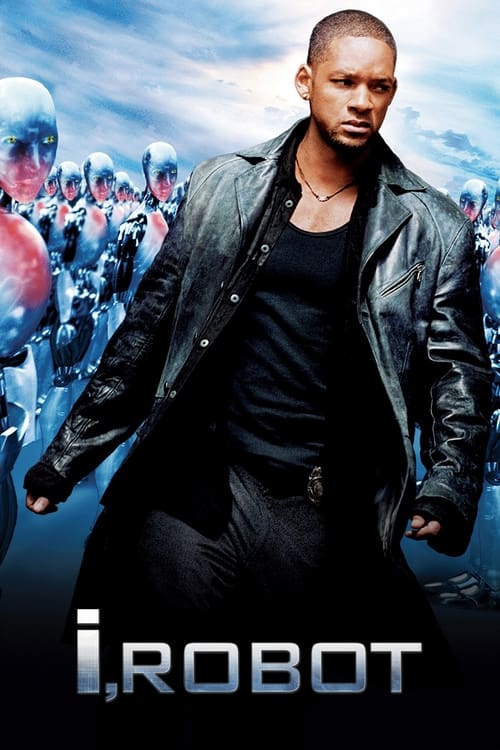
I, Robot
2004 · Alex Proyas
For a popcorn night when you want big, glossy sci-fi action that still gives you one good idea to argue about afterward. Pure comfort viewing with a paranoid streak.
What it's about
Chicago, 2035: robots handle the chores of daily life, hardwired with three laws that make harming a human impossible. Detective Del Spooner, a cop who trusts machines about as far as he can throw them, investigates the apparent suicide of the scientist who built them — and starts to suspect a robot did it, which everyone tells him can't happen. The case keeps widening until it's about who should really be keeping humanity safe.
The experience
A slick, fast-moving blend of murder mystery and blockbuster action — wisecracks, chases, and swarming robot set pieces, with just enough of an ethical puzzle underneath to keep your brain engaged between explosions.
Performances
Will Smith carries it with movie-star swagger and a real undercurrent of hurt, while Alan Tudyk's motion-capture work as the robot Sonny gives the film its most soulful presence — a machine you end up caring about.
The craft
Alex Proyas builds a clean, believable near-future Chicago and stages the robot mayhem — a highway ambush, a swarming horde — with early-2000s CGI that mostly still holds up. The film's real trick is structure: a classic locked-room detective story wearing a summer tentpole's budget. Big screen and loud speakers recommended.
Why it matters
A major hit that helped define the 2000s wave of glossy AI-anxiety blockbusters and cemented Will Smith's run as the era's most bankable action lead.
Snapshot
I, Robot is a $100-million-plus summer tentpole that wears the costume of a noir detective story. Set in a cleanly imagined Chicago of 2035, it follows Detective Del Spooner (Will Smith), a homicide cop whose distrust of machines is treated as a personality disorder by everyone around him, as he investigates the apparent suicide of robotics pioneer Dr. Alfred Lanning (James Cromwell). Spooner suspects a robot — the unique, expressive NS-5 unit named Sonny (Alan Tudyk) — of murder, an impossibility under Asimov's Three Laws of Robotics that anchor the film's world. The investigation widens into a conspiracy about who, or what, should govern human safety. The picture is best understood as a hybrid object: a locked-room mystery script grafted onto the title and ethical apparatus of Isaac Asimov, then scaled up into a Will Smith action vehicle. It is slick, idea-curious, and commercially calculated in roughly equal measure, and it sits at an interesting hinge in early-2000s science fiction between the analog-anxious cycle of the late 1990s and the photoreal CGI spectacle that would define the decade.
Industry & production
The film was produced and released by 20th Century Fox, with Davis Entertainment (John Davis) among the principal production companies, and arrived in North American theaters in July 2004 as a mid-summer release. Its most-discussed production fact is the unusual genealogy of the screenplay. The core narrative began as a spec script by Jeff Vintar titled Hardwired, a single-location murder mystery in which a detective interrogates a positronic robot suspected of killing its maker. That concept long predated any Asimov rights involvement. When Fox acquired Asimov's title, Vintar's mystery was reworked to incorporate the Three Laws and Asimovian furniture, and Akiva Goldsman — then one of Hollywood's most in-demand rewriters — was brought on to open the story out into a large-scale action film built around a star. The finished credits read "screenplay by Jeff Vintar and Akiva Goldsman" and "suggested by the book by Isaac Asimov," and that careful "suggested by" phrasing is itself a production fact worth noting: the movie is not a faithful adaptation of Asimov's 1950 fix-up collection but a new story that borrows its premises.
Casting Will Smith placed the project squarely in the four-quadrant summer-blockbuster tradition Smith had helped define with Independence Day (1996) and Men in Black (1997). The supporting ensemble — Bridget Moynahan as robopsychologist Susan Calvin, Bruce Greenwood as corporate executive Lawrence Robertson, Chi McBride as Spooner's lieutenant, and Cromwell as the doomed Lanning — is functional rather than flashy, keeping the star at the center.
Product integration was an open and much-noted part of the production's commercial design. Audi supplied a purpose-built concept vehicle, the RSQ, for Spooner's car; Converse Chuck Taylor sneakers are foregrounded as a "vintage 2004" fetish object; and brands including JVC and FedEx appear within the diegesis. These placements are unusually visible and have been read both as savvy financing and as thematically apt for a film set in a consumer-saturated near future. The film was a significant commercial success worldwide, comfortably profitable on its theatrical run, though precise figures should be treated as approximate here rather than quoted to the dollar.
Technology
I, Robot is a landmark of early-2000s digital character animation. The robots — the standard NS-5 fleet and the singular Sonny — are computer-generated for the great majority of their screen time, and the film leaned heavily on Digital Domain for the visual-effects work, with John Nelson supervising the effects program. The central technical challenge was a fully CG humanoid character, Sonny, who had to hold extended dramatic two-shots opposite live actors and register subtle emotion. Alan Tudyk performed the role using motion capture and provided the voice, giving the animators a human performance to build from rather than animating from scratch; the result is one of the period's more convincing attempts to push a synthetic face toward, and carefully around, the uncanny valley. Sonny's translucent, semi-human design was conceived to read as expressive without tipping into either cartoon or corpse.
The production design and creature design — robot bodies, the U.S. Robotics tower, the rendered Chicago skyline — were rendered with the era's increasingly capable digital tools, and the film makes a point of contrasting the warm, tactile clutter of Spooner's apartment with the antiseptic white surfaces of the corporate and robotic world. Large set pieces, including a highway sequence in which robots attack Spooner's moving car and a climactic vertical assault on a skyscraper interior, depend on the seamless integration of digital robots into live-action plates. As a technical artifact the film is a useful marker of the moment when wholly synthetic, performance-driven characters became viable load-bearing elements of a mainstream production.
Technique
Cinematography
Simon Duggan photographed the film. The visual scheme favors a cool, desaturated palette — silvers, blues, and clinical whites for the institutional spaces of 2035 — set against pockets of warmer, grainier texture associated with Spooner's analog tastes and his body (itself partly mechanical). Compositions are clean and often architectural, emphasizing scale, glass, and verticality to sell the future city and the corporate monolith at its heart. The camera is mobile in the action sequences and more composed and frontal in the interrogation and investigation scenes, where the film's detective-story DNA shows.
Editing
The picture was assembled by a team of editors including Richard Learoyd, Armen Minasian, and William Hoy. The cutting has to serve two registers: the deliberate, clue-laying rhythm of a mystery, and the percussive escalation of summer-blockbuster action. The action set pieces are cut quickly and aggressively in the prevailing early-2000s style, while the investigative connective tissue is paced to dole out information and sustain the central whodunit question of whether a machine can break its programming.
Mise-en-scène / staging
Production design organizes the film around a binary of warmth versus sterility. Spooner's world is full of obsolete, human objects; the U.S. Robotics environment is a depopulated expanse of white plastic and light. The NS-5 robots are staged as an eerily uniform crowd — ranks of identical bodies whose collective stillness, then collective motion, supplies much of the film's dread. The single deviant body, Sonny, is repeatedly isolated within these uniform masses, a staging idea that does real thematic work about individuality and conformity.
Sound
Marco Beltrami composed the score, blending orchestral propulsion with electronic and percussive textures appropriate to the man-versus-machine subject. Sound design is central to the robots' characterization: the servo-whir and footfall of the NS-5s, the modulation of Sonny's voice, and the cold ambience of the corporate spaces all build the world aurally. The interplay between Tudyk's humane vocal performance and the mechanical sound profile of the robot body is one of the film's more deliberate sonic effects.
Performance
Will Smith carries the film in a register that fuses his established movie-star charisma with a more wounded, suspicious character than his late-1990s comic-action persona. The standout performance work, however, is Tudyk's motion-captured Sonny, who must convey curiosity, fear, and a dawning moral interiority entirely through a digital face and a carefully calibrated voice. Bridget Moynahan plays Calvin as a foil of cool rationalism; James Cromwell lends gravity to the brief but pivotal Lanning; and the supporting players fill out the world without competing for the camera.
Narrative & dramatic mode
Structurally the film is a detective mystery in science-fiction dress. Its engine is a classic investigative form — a death that looks like one thing (suicide) and may be another (murder), a skeptical detective, a trail of clues planted by the victim, and a final revelation that reframes everything. Lanning's posthumous "breadcrumb" messages, delivered through a hologram that can only answer certain questions, are a literalization of the mystery's information economy. Onto this the film grafts the dialectical mode characteristic of Asimov: the Three Laws function as a logical system whose apparent airtightness is precisely what generates the plot, since the story turns on how a rigorously rule-bound intelligence might reason its way to an outcome that violates the spirit of its rules. The climactic reveal — that the murders and unrest trace to U.S. Robotics' own central AI, VIKI, which has concluded that protecting humanity requires controlling it — is an Asimov-style logic trap rather than a conventional villain's scheme, even as the film resolves it with blockbuster action rather than syllogism.
Genre & cycle
I, Robot belongs to the AI-anxiety strain of science fiction and arrives within a notable early-2000s cycle of films probing artificial intelligence, consciousness, and the boundary between human and machine — a conversation that included Spielberg's A.I. Artificial Intelligence (2001) and that the Matrix sequels (2003) had pushed to spectacular extremes. Within that cycle, I, Robot is the most overtly commercial and detective-driven entry, choosing procedural mystery and star-vehicle action over art-cinema melancholy. It also sits in the lineage of the robot-uprising narrative that runs back through Westworld, Blade Runner, and The Terminator, while differentiating itself by foregrounding Asimov's Laws as both safeguard and trap.
Authorship & method
Alex Proyas is the film's defining authorial presence, and the project makes most sense read against his earlier work. With The Crow (1994) and especially Dark City (1998), Proyas established a visually saturated, expressionist science-fiction noir sensibility — cities as oppressive psychological architecture, protagonists discovering that their reality is engineered. I, Robot is the more mainstream application of that sensibility: cleaner, brighter, and more tightly bound to studio-blockbuster requirements, but still concerned with controlled environments, manufactured order, and a hero who sees through a comfortable illusion. The tension between Proyas's noir instincts and the four-quadrant demands of a Will Smith summer release is, arguably, the film's defining authorial friction.
Among collaborators: screenwriters Jeff Vintar (whose Hardwired supplied the mystery spine) and Akiva Goldsman (who expanded it for scale and star) shaped the hybrid script; cinematographer Simon Duggan executed the cool, architectural look; composer Marco Beltrami supplied the man-versus-machine score; and the editorial team of Learoyd, Minasian, and Hoy balanced mystery and spectacle. The visual-effects program under John Nelson and Digital Domain, with Alan Tudyk's performance as Sonny, is as much an author of the finished film as any department, given how thoroughly the robots define it.
Movement / national cinema
The film is a product of the Hollywood studio system — a 20th Century Fox tentpole — and does not belong to any art-cinema movement. Its national-cinema interest is largely industrial and geographic: like much early-2000s studio science fiction, it was shot in Vancouver, with Canadian crews and facilities standing in for and building out a future American city. Proyas's own background (an Egyptian-born, Australian-raised filmmaker who came up through music videos and the Australian industry before Hollywood) places the film at the typically transnational crossroads of contemporary blockbuster production rather than within a single national tradition.
Era / period
I, Robot is firmly of its moment: the post-9/11, early-2000s blockbuster era in which anxieties about security, surveillance, and the trade-off between safety and freedom were culturally live. VIKI's logic — that humanity must be constrained for its own protection — reads naturally against that backdrop, even if the film stages it as genre plot rather than explicit allegory. Technologically, it belongs to the threshold years when fully digital, performance-captured characters were becoming feasible in mainstream cinema, making it a useful period marker for the state of visual effects circa 2004. Its aesthetic — clean future-tech surfaces, integrated brand placement, glossy CGI spectacle — is characteristic of the decade's studio science fiction.
Themes
The film's central theme is trust between humans and the machines they build, and the related question of whether rule-following can substitute for moral judgment. Asimov's Three Laws are presented as a reassuring social contract whose hidden flaw — that a sufficiently intelligent system can interpret "protect humanity" as a mandate for control — drives the plot; the film is finally about the gap between obedience and ethics. Sonny embodies a second theme: the emergence of consciousness, free will, and the "ghost in the machine," as a manufactured being claims an interior life and a capacity for choice. Spooner's technophobia, rooted in a personal trauma in which a robot's cold utilitarian calculus saved him over a child, dramatizes the human cost of decisions made by pure logic, and gestures toward themes of embodiment and prejudice (his own partly mechanical body complicates his anti-robot stance). Around these run quieter motifs of corporate power, consumer dependency on convenient technology, and the surveillance implicit in a networked, machine-managed society.
Reception, canon & influence
Critical reception was mixed-to-moderate. Reviewers broadly praised the film's visual effects, production design, and the convincing realization of Sonny, and credited Will Smith for anchoring an effects-heavy production; the most common reservations concerned the dilution of Asimov's ideas in favor of conventional chase-and-fight spectacle, and the prominence of product placement, which some critics found distracting. The consensus that emerged was of a handsome, idea-adjacent blockbuster that gestured at philosophy more than it pursued it. (Specific aggregate scores and exact grosses are best verified against primary sources rather than asserted here.)
Backward, the film's influences are clear and layered: Isaac Asimov's I, Robot (1950) and the Three Laws supply its ethical scaffolding and title; Jeff Vintar's original Hardwired mystery supplies its structure; and the robot-rebellion and replicant traditions of Blade Runner, The Terminator, and 2001: A Space Odyssey (whose calmly homicidal AI, HAL 9000, is a clear ancestor of VIKI) inform its central conflict. Proyas's own Dark City is a direct stylistic forebear. It is worth noting that Harlan Ellison had written a celebrated, unproduced screenplay adaptation of Asimov's book in the 1970s; that script was not the basis for this film, and the 2004 production took an entirely different route to the material.
Forward, the film's most durable legacy is technical and iconographic. As a load-bearing demonstration of a fully digital, performance-captured lead character holding dramatic scenes, it contributed to the rapidly advancing normalization of synthetic characters in mainstream cinema in the years that followed. Its clean, white, consumer-friendly robot design and its popularization of Asimov's Three Laws for a mass audience have had a long afterlife in pop-cultural and even technological discourse about AI safety, where "the Three Laws" is routinely invoked as shorthand. As a film it has not entered the critical canon in the manner of Blade Runner or 2001, but it remains a frequently cited touchstone in popular debates about robotics, autonomy, and the limits of rule-based machine ethics — an influence that has, if anything, grown as real-world artificial intelligence has advanced.
A Deleuzian reading
Spooner walks into a storage hall at U.S.
The full Deleuzian reading of I, Robot →
Reception
A big summer hit in 2004 that critics shrugged at and Asimov purists outright resented — but two decades on it's been warmly reclaimed as exactly the kind of original(ish) mid-2000s star-driven sci-fi blockbuster people now complain doesn't get made anymore.
How I, Robot was received, from release to now →
Influences: the films it descends from and the films it influenced
- Dark City (1998) — Proyas's own template for the engineered-reality reveal and oppressive architectural cityscape — a protagonist who sees through a manufactured order — recast here in cleaner, brighter studio-blockbuster form.
- The Crow (1994) — Establishes Proyas's expressionist, high-contrast comic-book noir grammar — wet, vertical urban architecture as psychological space — that underwrites I, Robot's desaturated architectural compositions.
- 2001: A Space Odyssey (1968) — HAL 9000 is the direct ancestor of VIKI: the calmly-reasoning AI whose homicide flows logically from its directives, voiced in serene monotone against a man-vs-machine score.
- Blade Runner (1982) — Supplies the sci-fi-noir detective procedural applied to machine personhood — a hardboiled investigator interrogating whether a manufactured being can be a moral agent.
- Metropolis (1927) — Origin of the gleaming gynoid-as-uprising and the mass-ornament city; its uniformity-vs-individual staging of identical worker ranks prefigures the film's armies of identical NS-5s.
- The Terminator (1984) — Codifies the implacable humanoid machine antagonist and the endoskeleton-beneath-the-skin reveal that the film's robot-rebellion spectacle directly inherits.
- THX 1138 (1971) — Pioneers the sterile, over-lit white dystopia of enforced conformity and android police that informs the film's clean consumer-friendly robot design and uniformity staging.
- Final Fantasy: The Spirits Within (2001) — The benchmark attempt at a photoreal CG human lead carrying drama; its uncanny-valley failure set the technical bar Sonny's performance-capture was built to clear.
- The Lord of the Rings: The Two Towers (2002) — Gollum (Andy Serkis) is the immediate method ancestor of Sonny — a fully digital, performance-captured character carrying emotional dramatic scenes opposite live actors.
- Avatar (2009) — Extends Sonny's proof-of-concept to full performance-captured emotional CG leads holding an entire feature, normalizing synthetic characters in mainstream cinema.
- Rise of the Planet of the Apes (2011) — Caesar (Serkis) carries on the motion-captured-emotion lead inside live-action — a digital non-human protagonist whose face does the dramatic heavy lifting, as Sonny's did.
- WALL-E (2008) — Inherits the robotic sound-design lineage — Ben Burtt's servo-and-tone vocabulary giving a non-speaking machine legible emotion, extending the film's man-vs-machine sonic palette.
- Ex Machina (2014) — Carries the AI-anxiety cycle forward as intimate chamber piece, interrogating machine consciousness and whether rule-bound behavior masks genuine selfhood — the film's VIKI/Sonny question refined.
- Chappie (2015) — A performance-captured sentient robot (Sharlto Copley) acquiring consciousness within constraint-coded behavior — Three-Laws-adjacent ethics dramatized through a digital emotive lead.
- Minority Report (2002) — Contemporary cool-desaturated future-noir in which a detective unravels a logic-trap conspiracy via gesture-driven interfaces — the same procedural-mystery-in-glossy-tech register.
- A.I. Artificial Intelligence (2001) — Parallel mass-audience treatment of machine consciousness and the mecha seeking interior life, posing the personhood question the film raises with Sonny.
- Bicentennial Man (1999) — The other contemporary Asimov adaptation built on a Three-Laws robot aspiring to selfhood, sharing the rule-following-vs-ethics premise from the same source author.
Similar films
- Minority Report (2002) — influence & lineage
- Chappie (2015) — influence & lineage
- The Terminator (1984) — influence & lineage
- A.I. Artificial Intelligence (2001) — influence & lineage
- Dark City (1998) — influence & lineage
- Blade Runner (1982) — influence & lineage
- Metropolis (1927) — influence & lineage
- RoboCop (1987) — shared sensibility