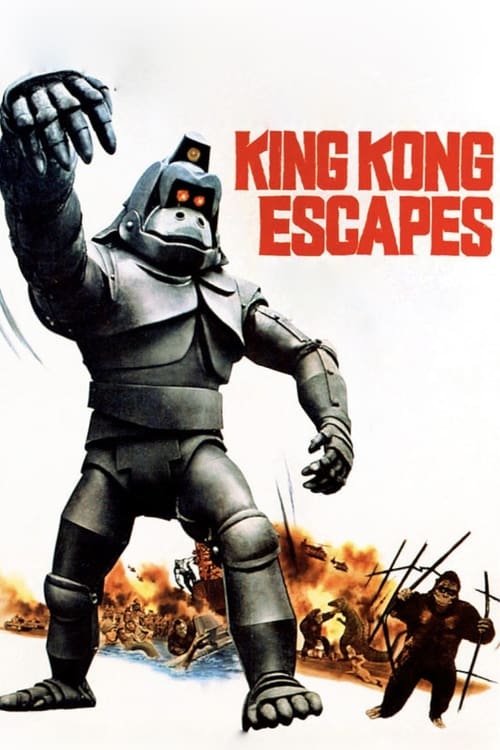
King Kong Escapes
1967 · Ishirō Honda
For a popcorn night when you want giant monsters smashing miniature cities and zero homework — great with friends, kids, or anyone who needs ninety minutes of uncomplicated spectacle.
What it's about
A mad scientist calling himself Dr. Who builds a robot double of King Kong to mine a radioactive element at the North Pole for a scheming foreign power. When Mechani-Kong breaks down, he kidnaps the real Kong from his island home to finish the job — setting up ape versus machine in a rampage that climaxes atop Tokyo Tower, with a UN submarine crew caught in the middle.
The experience
Pure Saturday-matinee pleasure: bright, fast, and cheerfully absurd, with a villain who cackles, a robot ape with a searchlight in its head, and a monster brawl every twenty minutes. It never asks to be taken seriously and is all the more fun for it.
The craft
This is the classic Toho monster machine at full tilt: Ishirō Honda directing, effects master Eiji Tsuburaya staging the suitmation battles across lovingly detailed miniature sets, and Akira Ifukube supplying a thunderous score. The Tokyo Tower finale is a small marvel of practical-effects staging, and the candy-colored production design pops on a big screen.
Why it matters
Toho's last King Kong picture and a strange artifact of trans-Pacific pop culture — a Japanese live-action film adapted from an American cartoon about an American monster — it introduced Mechani-Kong, the robot-double idea that would echo through later giant-monster movies.
Snapshot
King Kong Escapes (Kingu Kongu no Gyakushū, roughly "King Kong's Counterattack") is Toho's second and last King Kong film. It was made as a co-production with the American company Rankin/Bass Productions and draws its characters and premise from the Rankin/Bass animated series The King Kong Show (1966–69), so it is a Japanese live-action adaptation of an American cartoon about an American movie monster. Ishirō Honda directed, Eiji Tsuburaya supervised the special effects and Akira Ifukube wrote the score, the same core team behind most of Toho's kaiju eiga. The film adds a mechanical double of Kong to the giant-monster formula. The villain, Dr. Who, builds Mechani-Kong to mine the radioactive Element X at the North Pole. When the robot fails, he kidnaps the real Kong from Mondo Island to do the job. Meanwhile a United Nations submarine crew led by Commander Carl Nelson, Lieutenant Commander Jirō Nomura and Lieutenant Susan Watson tries to stop him. Madame Piranha, an agent of an unnamed foreign power, is financing Dr. Who but grows uneasy about him. The story ends in a fight between Kong and Mechani-Kong on Tokyo Tower.
The film is not one of the major works of Toho's monster cycle. It matters to an influence map for three reasons:
- The robot double. Mechani-Kong is the first robot doppelgänger of an established Toho monster. Mechagodzilla later made the idea central to the franchise.
- Spy-film overlap. The film is a clear example of the mid-1960s crossover between monster films and Bond-style spy adventure.
- Transnational production. It shows Japanese studio production being shaped by American television licensing and American distribution.
Industry & production
The film grew out of a failed earlier project. Rankin/Bass had licensed the King Kong character to produce The King Kong Show, and it approached Toho about a live-action feature. Toho first developed a Kong story set on a South Seas island, which Rankin/Bass turned down. That script was reworked with Godzilla in Kong's place and became Ebirah, Horror of the Deep (1966), whose island setting and Kong-like behaviour (Godzilla revived by lightning, Godzilla's interest in a young woman) still show where it came from. Toho and Rankin/Bass then developed a second script that followed the cartoon more closely. It took the island name Mondo, the villain Dr. Who and the friendly bond between Kong and a young woman from the series.
Toho had used Kong once before, in King Kong vs. Godzilla (1962), under a licence arranged through the American producer John Beck. That film was one of the studio's biggest commercial successes in the genre. King Kong Escapes therefore went back to a proven draw, but under a different rights arrangement and in a more crowded market. By 1967 Toho was releasing monster films almost every year, Daiei had Gamera, and Shochiku and Nikkatsu each released one-off monster films that year (The X from Outer Space and Gappa).
The Japanese release came in July 1967, as a summer holiday attraction. Universal handled the American release in 1968. The co-production arrangement explains why American actors play two of the leads. Rhodes Reason and Linda Miller performed in English on set and were dubbed in the Japanese version, while the Japanese cast was dubbed for the English version. Detailed budget and box-office figures are not reliably documented in standard English-language sources, so they are not given here.
Technology
The effects follow the standard Tsuburaya method of the period: performers in suits on miniature sets, wire-worked props, mechanical models, optical compositing, and process and matte work combining live-action actors with effects footage. Two features of this film stand out:
- The Kong suit. The suit is newly made and is widely regarded, by fans and critics alike, as one of the weakest Kong designs. It has a long, flat face, a stiff mouth and a body that reads as a costume. The suit from King Kong vs. Godzilla is often criticised too. In both cases the problem is the same: a gorilla design, unlike a reptile, invites comparison with Willis O'Brien's stop-motion original, and a man in a suit looks worse by that comparison.
- Mechani-Kong. The robot was built as a suit plus separate props and models for specific shots. Its design is blocky and riveted, with lamp-like eyes and an antenna on its head. It is the most successful design in the film and the image most often reproduced from it.
The film was shot in colour and widescreen (Tohoscope), the standard format for Toho's effects films by then. The Gorosaurus fight on Mondo Island, the Arctic mining sequences and the Tokyo Tower climax each needed large miniature sets. The Tokyo Tower model in particular shows the studio's continuing habit of placing monster fights on recognisable modern Japanese landmarks.
Technique
Cinematography
The live-action photography is credited to Hajime Koizumi, Honda's regular cinematographer on the monster films. It is bright and evenly lit, with saturated colour that suits both the cartoon source and the film's spy-glamour sets: Dr. Who's polar base, the submarine interiors and the villains' modernist décor. The effects unit worked separately under Tsuburaya, so the film alternates between Koizumi's clean, functional framing of actors and the effects team's low-angle shots, which give the suit performers scale. The North Pole scenes rely on blue-white palettes and artificial snow. The Tokyo night climax uses illuminated miniatures and the tower's lattice to give the fight a vertical structure, a deliberate visual echo of the Empire State Building in 1933.
Editing
The film cuts between three settings: the UN submarine team, Dr. Who's base and Kong. Its pacing is quicker and more episodic than earlier Honda monster films, which fits its origin in a half-hour cartoon and its spy-serial plotting (captures, escapes, a hypnosis device, a turncoat). The surviving record does not clearly establish which editor shaped the cutting, so specific editorial choices cannot be credited with confidence. The English-language version contains some re-editing, as most American releases of Toho films did, but this film was changed far less than King Kong vs. Godzilla, whose American version was heavily restructured.
Mise-en-scène / staging
The film stages three kinds of space:
- Mondo Island. A jungle set where Kong fights the dinosaur Gorosaurus. The fight ends with Kong prying open the dinosaur's jaws, a direct quotation of Kong's fight with the tyrannosaur in the 1933 film.
- Dr. Who's Arctic base. Spy-film décor with control rooms, consoles and gadgetry, closer to Bond production design than to the military command rooms of earlier Toho films.
- Tokyo. The urban climax, ending at Tokyo Tower.
The staging makes Kong sympathetic. His protective attachment to Susan Watson is played as innocent devotion rather than threat. Susan can calm him or give him orders by shouting. This comes straight from the cartoon, and it defines the film's tone.
Sound
Akira Ifukube's score uses his recognisable vocabulary: driving ostinatos, heavy low brass and strings, and march themes. Like his scores for Toho's other monster films in these years, it carries much of the epic weight that the effects cannot always supply. Kong's roar and the robot's mechanical sounds come from Toho's sound-effects library. Many sources say the Kong roar was reused or adapted from earlier Toho effects, but the exact origins of individual effects are not well documented. The English-language version uses its own dubbing, and some English-speaking viewers know the film mainly through that version.
Performance
Eisei Amamoto plays Dr. Who as a theatrical, gaunt grotesque, and this is the performance most often singled out. Mie Hama plays Madame Piranha with the cool glamour of a femme fatale. Her role had extra resonance in 1967 because she also appeared as Kissy Suzuki in the Bond film You Only Live Twice that year. Madame Piranha's growing conscience and final sacrifice give the film its only real character development. Rhodes Reason and Linda Miller are stiff leads, a common complaint about Western actors in Japanese co-productions. Akira Takarada, a Toho regular since Godzilla (1954), gives solid support. Haruo Nakajima, Toho's leading suit actor and the Godzilla performer since 1954, played Kong. Credits for the other suit performers vary between sources.
Narrative & dramatic mode
The film is an adventure serial with a monster at its centre. It is not tragedy or allegory. The 1933 King Kong ends with Kong's death and with Carl Denham's remark that "it was beauty killed the beast." The Toho film gives the beauty-and-beast relationship a protective, child-friendly tone instead: Kong rescues Susan, follows her and obeys her. Kong is the hero, the robot is his evil twin, and the human plot is a straightforward contest between UN good guys and stateless villains. The original Japanese title, "King Kong's Counterattack," suggests revenge, which fits a story in which Kong is exploited and copied and then strikes back. The ending is restorative rather than mournful. Kong destroys his double and goes home to his island, leaving the human world behind.
Genre & cycle
The film belongs to the kaiju eiga boom of the 1960s, which Toho led. The cycle had shifted from the nuclear dread of Godzilla (1954) to more fantastical, child-oriented entertainment, with monsters cast as heroes. King Kong Escapes mixes that cycle with three other strands:
- the international spy craze that followed the Bond films,
- Toho's own science-fiction adventure films (Atragon, 1963, by the same core team),
- American television animation, through The King Kong Show.
Mechani-Kong is the film's main contribution to the genre's set of stock elements. Building a robot double of a monster turns a creature of nature into an industrial product, and later Toho films returned to the idea repeatedly. The Gorosaurus fight belongs to a longer line of Kong-versus-dinosaur scenes running from 1933 to later remakes.
Authorship & method
- Ishirō Honda (director). Honda directed Godzilla (1954) and most of Toho's major monster films. His usual method was to treat even fantastical premises with procedural sincerity and to keep the human plot moving efficiently while the effects unit worked separately. King Kong Escapes shows his professionalism more than his personal concerns. The anti-nuclear seriousness of Godzilla and the melancholy of Mothra (1961) are largely absent. He went on to direct Destroy All Monsters (1968), which brought back Gorosaurus.
- Eiji Tsuburaya (special effects). Tsuburaya headed Toho's effects department and was by then also running his own television company, Tsuburaya Productions, home of Ultraman. The film comes late in his career; he died in 1970. Some commentators detect a spread of effort across his many projects in its uneven effects work, but this is interpretation rather than documented fact.
- Takeshi Kimura (screenplay). Kimura is credited under his pen name Kaoru Mabuchi. He had written several of Toho's darker science-fiction films (The Mysterians and Matango among them) and later wrote Destroy All Monsters and Godzilla vs. Hedorah. Here his job was to adapt the cartoon's material into a feature for a family audience.
- Hajime Koizumi (cinematography). Koizumi shot most of Honda's monster films in this period.
- Akira Ifukube (music). Ifukube's music connects the film to the earlier Godzilla films and to King Kong vs. Godzilla, which he also scored.
- Arthur Rankin Jr. and Jules Bass (co-producers). The two American producers supplied the property and its main elements. The influence of the cartoon is visible in Dr. Who, Mondo Island and the Kong–Susan relationship.
- Editor. Sources disagree on or do not clearly document the editor's credit, so it is not given here.
Movement / national cinema
Within Japanese cinema the film is a product of the late studio system. In the 1960s the major companies ran genre programmes like production lines, while television was steadily shrinking cinema audiences. Toho's monster films became more dependent on family audiences and summer holiday release slots, and more open to foreign co-production and licensing. King Kong Escapes, along with Frankenstein Conquers the World (1965) and Invasion of Astro-Monster (1965), both co-produced with Henry G. Saperstein, belongs to a group of Toho films in which American partners shaped casting, story and marketing. The film also reflects how far Japanese pop culture and American media had become intertwined. An American cartoon animated in Japan led to a Japanese live-action feature that was then sold back to American audiences.
Era / period
The film's 1967 context includes:
- Spy films. The global spy boom was at its height. You Only Live Twice, shot partly in Japan and featuring Mie Hama, came out the same year.
- Television. Japanese tokusatsu television was taking off. Ultraman had premiered in 1966, and some of the energy behind monster entertainment was moving to the small screen.
- Cold War and the space age. The plot uses a radioactive element as a source of power and stateless villains working for an unnamed government. It reflects Cold War and space-age anxieties, but as background flavour rather than urgent allegory.
The Japanese monster-film boom peaked around this time. Within a few years, falling budgets and the move to child audiences changed the genre sharply.
Themes
- Original and copy. The central conflict sets the natural Kong against a mechanical duplicate built to replace him. The film never develops the idea seriously, but the image of a living creature fighting its machine double carries an implicit opposition between nature and industrial imitation.
- Exploitation of nature. Dr. Who first wants a machine to mine Element X and then captures and hypnotises the real animal to do the labour. In this, the film repeats the theme of the 1933 original, in which Kong is captured and shown as a spectacle for profit, though in a lighter mode.
- Beauty and the beast, made innocent. The Kong–Susan relationship keeps the original's central bond but removes its sexual and tragic undertones, making Kong a devoted protector.
- Conscience and defection. Madame Piranha's turn from mercenary to self-sacrifice gives the film a small moral story about recognising a monstrous ally. It is the film's most human element.
- Internationalism. The heroes serve the United Nations, and the crew is Japanese and American. This reflects the multinational outlook common to Toho's science-fiction films of the decade and the co-production itself.
Reception, canon & influence
Critical reception. The film received little serious critical attention on release in either Japan or the United States. In the American market it was treated as a children's and matinée attraction. Later writing on the film, mostly in the genre press and Toho histories, usually describes it as entertaining but minor. Critics praise Mechani-Kong, Amamoto's villain, Mie Hama and Ifukube's score. They criticise the Kong suit, the stiff Western leads and a cartoonish tone that sits awkwardly next to the 1933 original. It has a nostalgic following among viewers who saw it on American television in the 1970s and 1980s. It is generally not ranked among Honda's or Toho's major achievements.
Influences on the film (backward).
- King Kong (1933), directed by Merian C. Cooper and Ernest B. Schoedsack: the dinosaur fight, the beauty-and-beast relationship and the skyscraper climax.
- The King Kong Show (Rankin/Bass): characters, setting and tone.
- King Kong vs. Godzilla (1962): Toho's earlier version of Kong.
- Ebirah, Horror of the Deep (1966): grew out of the rejected first draft of this film.
- The Bond films and the wider spy-adventure fashion: the villain's lair, the femme fatale and the gadgetry.
- Toho's own science-fiction adventures, especially Atragon: the submarine heroics.
Legacy (forward).
- The robot double. Mechani-Kong is generally seen as the direct ancestor of Mechagodzilla, introduced in Godzilla vs. Mechagodzilla (1974). The robot double became one of the Godzilla series' most frequently revived ideas, through the Heisei, Millennium and later films, including the Hollywood Godzilla vs. Kong (2021). The 1974 film makes the debt explicit, though the direct line of credit between the two designs is a matter of critical consensus rather than a documented production record.
- Gorosaurus. The dinosaur joined Toho's recurring cast of monsters through Destroy All Monsters (1968).
- End of Toho's Kong. This was Toho's last licensed King Kong film. Later Kong films came from American productions: the 1976 Dino De Laurentiis remake, King Kong Lives (1986), Peter Jackson's 2005 remake, and Legendary's MonsterVerse films. In those films the Kong–Godzilla pairing that Toho started returned in a different form.
- Transnational franchises. As an example of a cartoon licence producing a foreign live-action feature, the film is a small but telling case in the history of franchise globalisation.
The film is best understood as a hinge in the Kong line. It turns the 1933 original's tragedy into protective heroism, and it gives the giant-monster genre the mechanical double that Toho's later films returned to many times.
Influences: the films it descends from and the films it influenced
- King Kong (1933) — Honda restages its set pieces almost shot for shot: the island fight in which Kong breaks a dinosaur's jaw (Gorosaurus stands in for the T. rex), the ape carrying the heroine in his palm, and the climb up a tower at the climax.
- King Kong vs. Godzilla (1962) — Toho's first Kong set the house approach: a suit actor in a Kong suit fighting on Tsuburaya's miniature sets, with the ape's sympathies tilted toward humans. That Kong suit is the template the 1967 suit was rebuilt from.
- Mothra (1961) — Mothra first used Tsuburaya's breakable Tokyo Tower miniature as a monster's set piece, when the larva spins its cocoon on it. King Kong Escapes reuses that tower as the ring for the Kong vs. Mechani-Kong climax.
- Atragon (1963) — The Explorer submarine sequences come straight out of Atragon's model work: a heroic super-submarine shot in the tank and a secret villain base stormed by naval adventurers.
- Invasion of Astro-Monster (1965) — This was the first Toho–Henry G. Saperstein co-production built around an imported American lead (Nick Adams). King Kong Escapes repeats that casting setup with Rhodes Reason, a bilingual cast and a villain run as a cold, remote mastermind.
- Frankenstein Conquers the World (1965) — Honda and Tsuburaya first worked out the giant humanoid creature here: an ape-like figure at human scale whose bond with a woman makes him the hero against a monstrous opponent. King Kong Escapes redeploys that pattern with Kong and Susan.
- The War of the Gargantuas (1966) — Its good and evil twin giants, one benevolent and one predatory, are the immediate model for the doubled-giant fight Kong vs. Mechani-Kong turns into, with the 'copy' as the villain.
- Dr. No (1962) — Dr. No is the first Bond film to give its villain an island base with mechanical engineering wonders and a gloved, theatrical mastermind. Dr. Who copies that model: his Arctic Mondo base, the scheme to mine Element X, and Amamoto playing him as a caped grotesque.
- Destroy All Monsters (1968) — Honda and writer Takeshi Kimura carried Gorosaurus, built for King Kong Escapes, into Toho's main monster stable. He gets the Arc de Triomphe attack and a place in the team fight, so a one-off adversary became a recurring cast member.
- Godzilla vs. Megalon (1973) — Jet Jaguar picks up the life-size robot built by a scientist and fought as a suit-actor on miniatures. It reverses Mechani-Kong's role by making the machine a hero that grows to giant size.
- Godzilla vs. Mechagodzilla (1974) — Mechagodzilla takes Mechani-Kong's idea directly: a metal copy of the star monster, at first disguised, built by a villain, and run by remote control from a hidden base. The climax is a fight between the original and its mechanical double.
- Terror of Mechagodzilla (1975) — Honda returned to the robot double in his last feature. He brought back Mechani-Kong's mad-scientist controller and the device that links the human operator to the robot's brain, with a heroine whose body is tied to the machine, echoing Madame Piranha's mixed loyalties.
- King Kong (1976) — This American remake took the property back after Toho's licence ended. It keeps the Japanese films' suit-actor approach, with Rick Baker in an ape suit on miniatures. It also restages the tower climax, updated to the World Trade Center as a modern equivalent of Tokyo Tower.
- Godzilla vs. Mechagodzilla II (1993) — Heisei Mechagodzilla turns the robot double into a human-piloted UN weapon. It keeps the 1967 idea that the 'original and copy' fight works as a mirror, and adds Garuda's docking as a gadget upgrade.
- Godzilla Against Mechagodzilla (2002) — Kiryu goes further with the original-and-copy theme by building the robot around Godzilla's own skeleton. The machine's rebellion takes the double from remote-controlled puppet to a copy with a will of its own.
- Godzilla vs. Kong (2021) — Legendary reunites the two Toho Kong-era lines in one finale. Kong fights a corporate villain's Mechagodzilla, controlled through a telepathic link to a Ghidorah skull, in a neon city, making it a direct descendant of the Kong vs. mechanical-double climax in King Kong Escapes.
- You Only Live Twice (1967) — Shot in Japan with Toho cooperation and released within weeks of Honda's film, it also cast Mie Hama. Both films stage a Japanese volcano or polar lair, a mastermind steering hardware by remote control, and Hama as the spy-genre's Asian female lead.
- Ebirah, Horror of the Deep (1966) — Ebirah began as the rejected first draft of this King Kong project (Operation Robinson Crusoe) and was rewritten for Godzilla. It shares the island-adventure frame, a paramilitary villain group with a secret base, and a giant ape-style hero whose strength comes from lightning.
Similar films
- King Kong (1933) — influence & lineage
- Godzilla (1954) — shared sensibility
- Shin Godzilla (2016) — shared sensibility
- King Kong (2005) — shared sensibility
- Godzilla vs. Destoroyah (1995) — shared sensibility
- Godzilla: King of the Monsters (2019) — shared sensibility
- Godzilla vs. Biollante (1989) — shared sensibility
- Planet of the Apes (1968) — shared sensibility