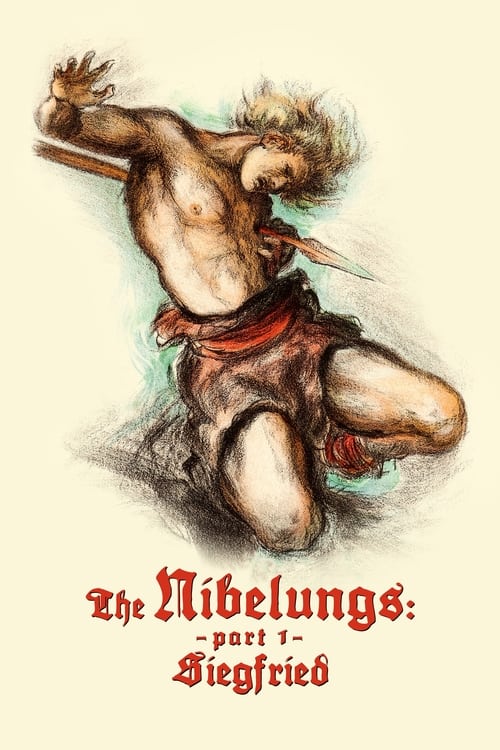
Die Nibelungen: Siegfried
1924 · Fritz Lang
For a night when you want pure cinematic myth — patient, monumental, and strange — or when you're curious where a hundred years of screen fantasy actually began. It asks a little of you (it's silent, and it takes its time) and pays you back in grandeur.
What it's about
The invincible young hero Siegfried forges a sword, slays a dragon, and wins a legendary treasure — then rides to the Burgundian court at Worms to win the hand of the princess Kriemhild. To earn her, he agrees to help King Gunther woo the fierce warrior-queen Brunhild through trickery, a bargain that plants the seeds of court intrigue, jealousy, and betrayal. It's the first half of Fritz Lang's monumental two-part telling of the medieval Nibelungen saga.
The experience
Stately, hypnotic, and genuinely awe-inspiring — this isn't a fast film, it's a procession, every frame composed like a stone carving. The dragon fight and the misty primeval forest still cast a spell a century on, and the slow gathering of doom at court has real weight.
The craft
Lang built an entire legendary world in the studio — geometric castles, a full-scale dragon, a forest of constructed trees shot through drifting mist — trading Expressionism's fevered angles for a cold, architectural grandeur in which human bodies become part of the design. Thea von Harbou adapted the medieval Nibelungenlied directly rather than Wagner's operas. It's one of the most visually formal films ever made, and it demands the biggest screen you can find.
Why it matters
A defining monument of German silent cinema whose imagery — the dragon slaying, the mist-hung forest, the geometric pageantry — flows directly into a century of screen fantasy and epic filmmaking.
Snapshot
Die Nibelungen: Siegfried is the first half of Fritz Lang's two-part monument to Germanic legend, released in 1924 and followed later that year by Kriemhilds Rache (Kriemhild's Revenge). Adapted by Thea von Harbou not from Wagner's operas but directly from the medieval Nibelungenlied, the film recounts how the invincible young hero Siegfried slays a dragon, wins a hoard of treasure and the cloak of invisibility, journeys to the Burgundian court at Worms to woo Kriemhild, wins Queen Brunhild for King Gunther through deception, and is finally murdered by the vassal Hagen. It is one of the defining achievements of the German silent cinema's monumental phase: a film that trades the fevered psychology of Expressionism for a colder, architectural grandeur, in which forests, castles, and human bodies alike are marshaled into rigorously geometric compositions. Produced at the height of UFA's ambitions, it aimed to be nothing less than a national epic in celluloid, and its stylization has been debated ever since as both a summit of design and a troubling premonition of the ornamental aesthetics that would later serve the Third Reich.
Industry & production
The film was produced by Universum Film AG (UFA), Germany's dominant studio, under the aegis of producer Erich Pommer, the same figure who had shepherded Das Cabinet des Dr. Caligari and who would later oversee Metropolis. It was shot on UFA's enormous stages at Neubabelsberg, outside Berlin, where the production's most striking decision was to build essentially its entire world indoors. Rather than film in real German forests, Lang and his designers constructed a stylized woodland on the studio floor, complete with artificial trees, so that every element of the frame could be controlled. This commitment to total construction made the production long, costly, and technically demanding, and it is consistent with UFA's early-1920s strategy of building prestige "Kolossalfilme" capable of competing with Hollywood on the international market.
Precise, verifiable budget and box-office figures for the production are not something I can responsibly quote; the surviving record on the film's exact economics is thin enough that specific numbers should be treated with caution. What is well established is the scale of ambition: two feature-length parts, elaborate custom sets and costumes, a full-size mechanical dragon, and a commissioned orchestral score, all mounted as a self-consciously prestigious cultural statement. The film carried a dedication "to the German people" (Dem deutschen Volke zu eigen), framing it from the outset as a work of national mythmaking rather than mere entertainment.
Technology
The production is a landmark of practical and optical effects craft. Its most famous single object is the dragon Fafnir, realized as a large mechanical creature reportedly operated by a team of technicians who moved its body, head, and limbs and worked its breath and blood — an ambitious animatronic puppet for its moment, filmed so that Siegfried appears to fight and slay a living beast. The effects unit, associated especially with cinematographer Günther Rittau, employed multiple-exposure and matte techniques to stage such marvels as Siegfried's cloak of invisibility (the Tarnkappe), the misty enchantments surrounding Brunhild, and the transformations of the story's magical world.
The most celebrated technological interpolation is the abstract animated "dream of the falcons" (the Falkentraum), Kriemhild's premonitory dream, created by Walter Ruttmann. Ruttmann, a pioneer of German abstract cinema, contributed a stylized non-representational sequence that stands as one of the earliest integrations of avant-garde animation into a mainstream narrative feature — a notable meeting of experimental and commercial filmmaking. Claims sometimes attach other proprietary processes to the film; where the documentary record is uncertain, it is safer to credit the visible achievements — the dragon, the invisibility effects, and Ruttmann's animation — than to assign specific patented techniques that are more securely tied to Lang's later Metropolis.
Technique
Cinematography
Photography is credited principally to Carl Hoffmann and Günther Rittau, two of the finest German cameramen of the period. Their images are defined by controlled, sculptural lighting and by a preference for balance and symmetry over the tilted, clawing shadows of Expressionism proper. Light is used to model volume — to carve the dragon from darkness, to make armor and treasure gleam, to isolate figures against vast blank walls and cavernous halls. The camera is largely stately and composed, favoring the held, frontal, architecturally centered shot; movement, when it comes, tends to be measured and purposeful rather than restless. Original release prints were tinted, and the interplay of color tinting with the graphic compositions was part of the intended effect.
Editing
As was typical of Lang's method, the cutting is subordinated to a precise, almost musical sense of construction. The film builds through the accumulation of strong static tableaux, and its rhythm derives from the deliberate pacing of these images against one another — the slow ceremonial procession, the sudden violent act, the held reaction. Rather than rapid montage in the Soviet sense, Lang pursues a monumental tempo, letting compositions stand long enough to register as designs. The editing thus reinforces the film's ritual, incantatory quality; scenes unfold with the inevitability of a legend already known to its audience.
Mise-en-scène / staging
This is the film's supreme dimension and the reason for its enduring reputation. The design team — Otto Hunte, Erich Kettelhut, and Karl Vollbrecht — created a world of overwhelming, stylized architecture: symmetrical halls, massive stairways, patterned floors, and the famous studio-built forest whose vertical trunks turn the woodland into a colonnade. Lang's staging repeatedly organizes human beings into ornamental patterns, ranks of retainers arranged as living friezes flanking a central axis. The critic Lotte Eisner, in The Haunted Screen, memorably analyzed this reduction of the human figure to architectural motif, and Siegfried Kracauer, in From Caligari to Hitler, read the same tendency politically, seeing in the film's "mass ornament" a chilling anticipation of the regimented crowds of totalitarian spectacle. Whether one accepts Kracauer's teleology or not, the observation that people in Siegfried are composed like masonry is inarguable and central to its style.
Sound
The film is silent, but it was not conceived as silent in the sense of musical improvisation. Gottfried Huppertz composed a full original orchestral score to accompany it, drawing on a leitmotif technique to bind image and music — an approach he would extend for Lang's Metropolis. The score was integral to the intended experience, giving the procession of tableaux their ceremonial weight, and modern restorations have returned to Huppertz's music as the authoritative accompaniment.
Performance
Acting is pitched to match the film's hieratic register. Paul Richter plays Siegfried with a bright, statuesque heroism — youthful, frontal, emblematic rather than psychologically shaded. Margarete Schön's Kriemhild is grave and increasingly stony, her performance deepening across the two parts as maiden hardens into avenger. Hanna Ralph gives Brunhild a fierce, wounded imperiousness, and Hans Adalbert Schlettow makes Hagen von Tronje a figure of grim, single-purposed menace. Theodor Loos's Gunther embodies a weak, image-conscious kingship. The playing is stylized and gestural by design, gestures held like poses, in keeping with a film that treats its characters as figures of destiny rather than rounded individuals.
Narrative & dramatic mode
The dramatic mode is that of legend and tragic inevitability. Von Harbou's screenplay organizes the material as a chain of oaths, deceptions, and reprisals moving toward a doom the audience senses from the outset. Siegfried is introduced as an almost fairy-tale hero — the dragon-slayer bathed in the beast's blood, made invulnerable save for the single spot where a linden leaf fell on his back. That flaw functions as classical hamartia, and the middle of the film turns on a machinery of deceit: Siegfried, wearing the Tarnkappe, subdues Brunhild so that Gunther may claim her, a betrayal whose exposure in the quarrel of the two queens sets the tragedy in motion. The film is thus structured less as psychological drama than as ritual fate-tragedy, its inexorability underscored by the ceremonial staging and Huppertz's leitmotifs. Siegfried ends on the hero's murder, deliberately leaving the arc of vengeance to its companion film.
Genre & cycle
Siegfried belongs to the German "Kolossalfilm" or monumental historical-mythic epic — the prestige spectacle designed to rival the Italian historical epics and Hollywood's large-scale productions. Within Lang's own career it stands beside other genre-defining projects (the Dr. Mabuse films, Metropolis, Die Frau im Mond) that show his ambition to master and elevate popular forms. As fantasy, it is a foundational text: a serious, adult, visually total realization of dragon, treasure, magic, and heroic legend that predates and in many respects sets the template for the cinematic fantasy epic. It is worth stressing that the film draws on the medieval Nibelungenlied rather than Wagner's Ring cycle — a distinction Lang and von Harbou emphasized — even though later reception has often conflated the two Germanic Nibelung traditions.
Authorship & method
Die Nibelungen is a signal example of Lang's collaborative-auteur method during his Weimar years. The screenplay is by Thea von Harbou, Lang's wife and creative partner across this entire period, whose scripts gave his images their mythic and often ideological architecture. Lang himself functioned as a controlling designer-director, obsessed with the geometry of the frame and the precise construction of effect — a temperament that suited a film about turning a whole world into ornament. The cinematography of Carl Hoffmann and Günther Rittau, the effects work associated with Rittau, and above all the production design of Otto Hunte, Erich Kettelhut, and Karl Vollbrecht are inseparable from any account of the film's authorship; the sets are as expressive as any performance. Gottfried Huppertz supplied the score, and Walter Ruttmann the animated dream interlude. Costume design is credited to Paul Gerd Guderian; the record indicates his involvement was cut short during the long production, and one should be cautious about over-detailing the division of that labor. Lang did not typically share editing credit, and the film's cutting reflects his own architectural sense of assembly.
Movement / national cinema
The film sits within Weimar-era German cinema at the moment when UFA was pursuing international prestige. It is often grouped loosely with German Expressionism, but it is more accurately understood as belonging to a parallel, monumental-stylized tendency: where Expressionism externalized psychological states through distortion, Die Nibelungen pursues order, symmetry, and grandeur. It represents German silent film's self-conscious effort to forge a national mythic cinema — a homegrown answer to the epic, and a deliberate cultural counter-statement in the wake of the First World War and the instability of the early Weimar Republic.
Era / period
Siegfried is a product of the mid-1920s German film industry at its most confident, made in a country still convulsed by postwar humiliation, inflation, and political turmoil. Its retreat into legendary German antiquity, and its dedication to "the German people," cannot be separated from that context: it offered a vision of national wholeness, heroism, and order at a time when those things were conspicuously absent from German public life. This is precisely the ground on which Kracauer's later, retrospective reading rests — the argument that Weimar's screen fantasies expressed a collective longing that would find darker political fulfillment. Whether or not one adopts that thesis wholesale, the film is unmistakably a document of its unsettled moment.
Themes
Its governing themes are fate, oath and betrayal, invulnerability and the fatal flaw, and the tension between heroic individual and sworn communal bond. Siegfried's near-invincibility and his single vulnerable spot dramatize the ancient idea that greatness carries the seed of its own destruction. Loyalty (Hagen's murderous fidelity to the Burgundian throne) and treachery are shown to be intertwined, the same virtue turned to ruin. Above these runs the theme of order itself — the film's obsessive geometry proposes a world of hierarchy and design, beautiful and rigid, into which the disruptive forces of desire, jealousy, and vengeance intrude with catastrophic result. The submission of the human figure to ornamental pattern is not merely a stylistic tic but a thematic statement about the individual's place within a monumental order.
Reception, canon & influence
Die Nibelungen was received as a major cultural event and stands securely in the canon of Weimar cinema and of Lang's oeuvre. Critically, its long afterlife has been shaped by two indispensable studies: Lotte Eisner's The Haunted Screen, which prizes its architectural handling of light and mass, and Siegfried Kracauer's From Caligari to Hitler, which reads its ornamental crowds and mythic nationalism as symptomatic of pre-fascist currents in German culture. That the historical Nazi leadership admired the film, and that its imagery of massed, ritualized ranks anticipates the visual language later exploited by the regime, has made it a permanent subject of debate about the politics of spectacle — though it must be said plainly that the film precedes the regime and that the strongest form of the "proto-fascist" claim is an interpretation, not an intention one can document from Lang's own stated aims.
Its influences flowed backward from the medieval Nibelungenlied and the broader nineteenth-century German revival of that saga, and from the tradition of monumental design that UFA had been cultivating. Its influence forward is substantial. Within Lang's own career it fed directly into Metropolis (1927), which shares personnel — Huppertz, Rittau, and members of the design team — and extends the same fascination with human beings arranged as ornament. More broadly, Siegfried helped establish the visual grammar of the serious fantasy epic: the studio-built enchanted forest, the practical monster, the treasure hoard and magic cloak, all rendered with a straight-faced grandeur that later fantasy cinema would inherit. Its compositions and its dragon are frequently cited as touchstones in histories of fantasy and effects filmmaking. As with any influence claim spanning decades, specific lines of descent to individual later films are often asserted more confidently than the evidence supports; what is beyond dispute is that Die Nibelungen: Siegfried remains a foundational monument — technically pioneering, visually overpowering, and morally and politically contested — in the history of the cinema.
A Deleuzian reading
A man rides through a forest that never grew.
The full Deleuzian reading of Die Nibelungen: Siegfried →
Reception
A prestige triumph in Weimar Germany — UFA's great national epic, premiered with full pomp in 1924 — it's since become inseparable from the uncomfortable fact that the Nazis adored it, and modern viewing means holding its staggering beauty and its appropriation in the same hand.
How Die Nibelungen: Siegfried was received, from release to now →
Influences: the films it descends from and the films it influenced
- Cabiria (1914) — Establishes the kolossalfilm's colossal architectural sets and the slow deep-space 'Cabiria movement' tracking through them — the monumental-scale grandeur Lang inherits and freezes into static tableaux.
- Intolerance (1916) — Marshals massed extras into decorative patterns across giant sets, pioneering the human-figure-as-ornament crowd staging that Siegfried geometrizes.
- Das Cabinet des Dr. Caligari (1920) — Makes the fully studio-constructed, designed environment an expressive agent equal to the actors — the built-world aesthetic (and Kracauer's Caligari-to-Hitler through-line) Siegfried monumentalizes.
- Der Golem: wie er in die Welt kam (1920) — Poelzig's sculpted Expressionist architecture plus a Germanic legend enacted through hieratic gesture and a practical creature — Weimar's template for straight-faced folkloric fantasy.
- Anna Boleyn (1920) — UFA's monumental historical spectacle disciplining thousands of extras into ornamental mass — the studio's crowd-handling craft Lang absorbs and formalizes.
- Der müde Tod (1921) — Lang and von Harbou's own fate-tragedy built on symmetrical frontal framing and architecture-as-allegory — the hamartia structure and compositional geometry Siegfried scales into epic.
- Metropolis (1927) — Shares Huppertz, Rittau and the design team, extending human-figure-as-ornament into worker choreography and carrying forward Rittau's matte and multiple-exposure effects craft.
- Berlin: Die Sinfonie der Großstadt (1927) — Ruttmann, who animated Siegfried's abstract 'Dream Falcon' interlude, extends that graphic-abstract motion into a feature-length montage symphony.
- Triumph des Willens (1935) — Renders symmetrical, ritualized massed ranks as ornament from an elevated frontal geometry — the spectacle-politics visual language Kracauer read forward from Siegfried's ornamental crowds.
- Alexander Nevsky (1938) — Prokofiev's through-composed leitmotif score fused to monumental frontal battle staging extends the Huppertz–Lang model of music welded to architectural image.
- Star Wars (1977) — Revives the straight-faced mythic quest — practical creatures, a treasure/destiny arc — scored with Wagnerian leitmotifs, reprising Siegfried's fusion of fantasy grandeur and musical through-line.
- Excalibur (1981) — Stages Arthurian myth with the same grave monumental grandeur and lacquered sculptural lighting on armored figures moving through studio-built forest.
- Dragonslayer (1981) — Its articulated on-set dragon Vermithrax continues Siegfried's built mechanical dragon as a physically staged, in-camera creature rather than a purely optical composite.
- The Lord of the Rings: The Fellowship of the Ring (2001) — Renders the studio-built enchanted forest, treasure-hoard and mythic quest with solemn grandeur — the serious fantasy-epic visual grammar Siegfried founded.
- Woman in the Moon (1929) — Lang's method of choreographing actors as geometric elements within symmetrical, architecturally composed framings — frozen tableau blocking that renders characters symbolic rather than naturalistic, subordinating individual movement to compositional pattern — is carried directly into Woman in the Moon's staging of the rocket assembly and launch-control sequences.
- Nosferatu, eine Symphonie des Grauens (1922) — Contemporaneous Weimar deployment of sculptural chiaroscuro and uncanny environment, sharing the movement's conviction that lighting and setting carry dread as much as performance.
- Die Nibelungen: Kriemhilds Rache (1924) — The cycle's second part extends the massed ritual ranks into rigid geometric formations at the Hun court — human ornament pushed to its purest crystalline arrangement.
- Die Abenteuer des Prinzen Achmed (1926) — Carries the film's abstract-animation-interlude impulse into a full silhouette-animated Germanic-Orientalist fantasy, treating figure and ornament as flat designed pattern.
- Django Unchained (2012) — Source of the Siegfried-rescues-Brünnhilde myth Schultz narrates aloud, structuring Django's quest for 'Broomhilda' as explicit Nibelungen legend.
Similar films
- Die Nibelungen: Kriemhild's Revenge (1924) — influence & lineage
- Metropolis (1927) — influence & lineage
- Triumph of the Will (1935) — influence & lineage
- The Cabinet of Dr. Caligari (1920) — influence & lineage
- Nosferatu (1922) — influence & lineage
- Faust (1926) — shared sensibility
- Hitler: A Film from Germany (1978) — shared sensibility
- Dr. Mabuse, the Gambler (1922) — shared sensibility