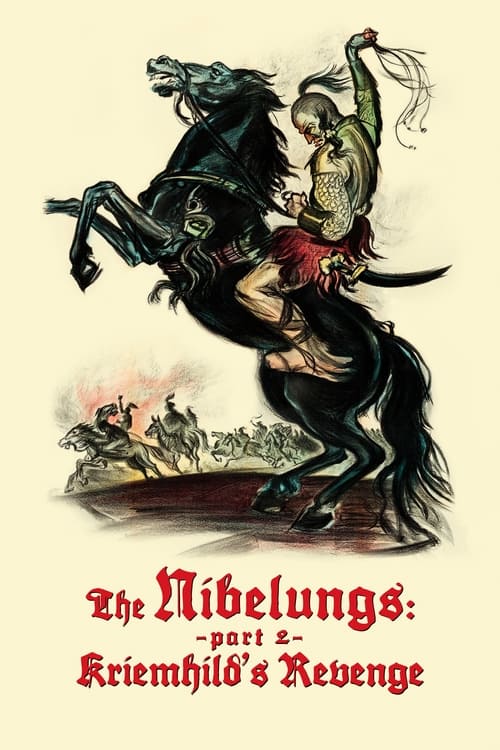
Die Nibelungen: Kriemhild's Revenge
1924 · Fritz Lang
When you're in the mood for something grand, dark, and elemental — a revenge story stripped to myth. A challenge watch for a focused night, ideally with good music and no distractions; it earns the word epic.
What it's about
A widow turns her grief into a weapon. After her husband Siegfried is murdered by a trusted man of the Burgundian court, Kriemhild marries Etzel, king of the Huns — not for love, but for an army. Then she invites her brother King Gunther and his men to visit, and the trap begins to close. It's the second half of Fritz Lang's silent two-part epic drawn from the medieval Nibelungenlied, and it plays as one long, inexorable march toward reckoning.
The experience
Cold, monumental, and genuinely frightening in its single-mindedness — where most silent epics dazzle, this one grinds forward like a machine. The final stretch is overwhelming: spectacle on a massive scale in the service of pure, pitiless obsession.
Performances
Margarete Schön plays Kriemhild as a figure carved from stone — nearly motionless, eyes fixed, her stillness more terrifying than any rage. It's one of silent cinema's great studies in implacable will.
The craft
Lang builds the Hun kingdom and Burgundian court as vast, geometric stage-worlds, and orchestrates crowd scenes and siege spectacle that remain jaw-dropping a century on. The compositions are so severe and symmetrical they feel like fate itself; on a big screen with a proper score it's monumental.
Why it matters
A towering achievement of the German silent era whose scale and imagery echoed through decades of screen epics and fantasy filmmaking — and whose vision of destruction reads as an eerie premonition of the century that followed.
Snapshot
Kriemhilds Rache is the second and darker half of Fritz Lang's two-part silent epic Die Nibelungen, adapted with Thea von Harbou from the medieval Middle High German Nibelungenlied rather than from Wagner's operatic reworking of the same legend. Where the first film, Siegfried, is a luminous fairy-tale of dragon-slaying and betrayal set in a stylized, forested Burgundian world, Kriemhild's Revenge is its cold, remorseless mirror: a chronicle of grief metastasizing into total annihilation. Widowed by the murder of Siegfried at the hands of Hagen von Tronje, Kriemhild marries Etzel, king of the Huns, not for love but for the military power to destroy the men who wronged her. She lures her brother King Gunther and his court eastward to Etzel's realm, and the film builds toward one of silent cinema's most sustained set pieces — the siege and immolation of the great hall in which the Burgundians are trapped. Produced by UFA at the height of its ambition as a monument of national cinema, the film is a study in escalating catastrophe, and one of the founding works of the cinematic historical epic.
Industry & production
Die Nibelungen was a flagship prestige production of Universum Film AG (UFA), Germany's dominant studio, and was shot at its Babelsberg facilities near Berlin. It belonged to the wave of Monumentalfilme — large-scale historical and costume spectacles — with which the German industry sought both domestic prestige and export competitiveness in the early Weimar years. The two parts were conceived and produced together; Siegfried premiered in February 1924 and Kriemhild's Revenge followed later the same year, both at UFA's flagship Berlin house, the Ufa-Palast am Zoo. Precise budget and box-office figures are not something I can responsibly quote, and accounts of the production's cost, while emphasizing its scale, vary; what is well established is that the undertaking was among the most expensive and logistically demanding German films of its moment, requiring vast purpose-built sets, large crowds of extras for the Hun scenes, and a protracted schedule.
The film opens with the dedication "Dem deutschen Volke zu eigen" ("Dedicated to the German people"), a framing that has shaped a century of interpretation, situating the project explicitly as an act of national mythmaking in a country still reeling from defeat in the First World War and the humiliations of Versailles.
Technology
The film's technology is that of the fully mature silent studio system: orthochromatic black-and-white stock, arc and incandescent lighting, and — crucially — the total artificiality of the studio-built world. Almost nothing in Die Nibelungen is photographed on location; the forests, halls, and Hunnish steppe are all constructed or painted, giving Lang absolute control over line, mass, and light. The production is celebrated for its in-camera special-effects work, most of it associated with the first part (the mechanical dragon, the misty forest), but the technical apparatus carries into the second film's architectural spectacle and its climactic fire. The burning of Etzel's hall required practical pyrotechnics staged against monumental sets, a genuinely hazardous undertaking at this scale. Where later Lang–UFA productions such as Metropolis would be defined by the Schüfftan mirror process, Kriemhild's Revenge is more a triumph of set construction, matte and glass work, and controlled studio lighting than of a single signature trick.
Technique
Cinematography
Photography is credited to Carl Hoffmann and Günther Rittau, with Rittau particularly associated with the film's effects and precision optical work (he would go on to shoot Metropolis). The cinematography of Kriemhild's Revenge is notable for its severe, sculptural clarity: figures and crowds are lit and arranged as elements of a composition rather than as naturalistic bodies in space. The camera is largely static and frontal, favoring balanced, frieze-like tableaux over the mobile framing that Lang and his cameramen would explore later in the decade. Depth is organized architecturally, along axes and staircases, and light is used to carve geometry out of the sets. The result is a deliberately hieratic, monumental image-world.
Editing
Editing in the German silent industry of this period was frequently uncredited or handled under the director's supervision, and the specific cutting of Die Nibelungen is not something the standard record attributes cleanly to a named editor; the film's rhythm is best understood as Lang's own. That rhythm is patient and accumulative. Long-held compositions and processional movement dominate, so that when the film does accelerate — in the chaos of the hall's defense and burning — the shift in tempo lands with real force. The cutting works by contrast: stillness against eruption, ceremony against slaughter.
Mise-en-scène / staging
This is the film's supreme achievement. The Burgundian and, especially, the Hunnish worlds are built as total designed environments by the art-direction team of Otto Hunte, Erich Kettelhut, and Karl Vollbrecht. Lang stages human beings as ornament: crowds are ranked into symmetrical masses, warriors into lines and wedges, so that the human figure becomes a unit of pattern. The famous contrast between the two halves is spatial and moral — the rectilinear, ordered geometry associated with the Burgundians versus the more chaotic, teeming, "barbaric" world of the Huns. That opposition, and its coding of the Huns as an Asiatic horde, has been the subject of extensive and warranted critical scrutiny for its Orientalism. The climactic hall siege is a masterclass in the dramatic use of architecture: a single monumental interior becomes a trap, a fortress, and finally a pyre.
Sound
The film is silent and was released with a specially composed orchestral score by Gottfried Huppertz (see below). There is no synchronized diegetic sound; meaning is carried by image, intertitle, gesture, and music. It is worth noting that the first part, Siegfried, was later reissued in the sound era in an altered form, but Kriemhild's Revenge belongs wholly to the silent aesthetic, and modern restorations present it with Huppertz's music.
Performance
Acting is pitched toward the monumental and the emblematic rather than the psychologically naturalistic. Margarete Schön's Kriemhild is the film's center and its most discussed performance: she progressively hardens from grieving widow into a mask of vengeance, her stillness and frozen features reading as a statue of implacable will. It is a performance built on rigidity and containment, the antithesis of expressionist excess. Around her, Rudolf Klein-Rogge — a Lang regular, later Rotwang in Metropolis and the title figure of the Mabuse films — plays Etzel with a strange, watchful gravity, and Hans Adalbert Schlettow's Hagen embodies grim, unrepentant martial loyalty. The ensemble style is theatrical and formalized, consistent with the film's overall hieratic mode.
Narrative & dramatic mode
The film's dramatic mode is tragic and fatalistic, structured as an inexorable descent. Its engine is not suspense over whether catastrophe will come but the mounting horror of watching it arrive. Kriemhild is a heroine of monomania: every relationship, oath, and courtesy is bent toward her single purpose, and the tragedy radiates outward as she sacrifices even her own child, and finally herself, to it. The narrative honors the doom-laden structure of its medieval source, in which loyalty (Treue) is both the highest virtue and the mechanism of universal destruction — Hagen cannot betray his king, the Burgundians cannot abandon Hagen, and so all must die together. The mode is closer to Greek or Norse tragedy than to melodrama: grand, ritualized, and without redemption.
Genre & cycle
Kriemhild's Revenge is a historical-mythological epic and a founding entry in the fantasy-adventure lineage, though its second half is far more war-tragedy than adventure. It belongs to the Weimar cycle of German Monumentalfilme — large costume spectacles of national and historical subjects that the industry produced in the early 1920s alongside directors such as Ernst Lubitsch. Within that cycle, Die Nibelungen is distinguished by its turn away from realist history toward stylized myth. It also sits within the broader international current of the silent monumental epic, descending from the Italian spectacles of the 1910s such as Cabiria.
Authorship & method
The controlling authorship is Fritz Lang's, working in his defining creative partnership with screenwriter Thea von Harbou, then his wife and collaborator on nearly all his major German films. Harbou adapted the Nibelungenlied directly, and both filmmakers were emphatic that they were drawing on the medieval epic rather than on Wagner. Lang's method here is the architectural and pictorial control of every frame — the film is often described as designed rather than merely directed. His key collaborators form a roster that would define UFA's greatest productions: cinematographers Carl Hoffmann and Günther Rittau; the art-direction trio of Otto Hunte, Erich Kettelhut, and Karl Vollbrecht, whose sets are effectively co-authors of the film's meaning; and composer Gottfried Huppertz, whose symphonic score — leitmotif-driven and closely fitted to the action — anticipates his later work on Metropolis. A distinct editor is not reliably named in the standard credits, and the cutting is best credited to Lang's supervision.
Movement / national cinema
The film is a central document of Weimar cinema, though it sits somewhat aslant to the Expressionist movement with which that era is most identified. Where The Cabinet of Dr. Caligari externalizes psychological derangement through distorted design, Die Nibelungen deploys a related stylization toward the opposite end: order, monumentality, and mythic grandeur. Critics often describe its style as a kind of "monumental" or architectural stylization distinct from Expressionist distortion, even as it shares the Weimar commitment to the wholly designed studio image. As national cinema, it is inseparable from its dedication to "the German people" and from the post-war German appetite for founding myth — a context that later commentators would read as fraught.
Era / period
Made in 1924, the film emerges from the fragile stabilization of the mid-Weimar Republic, the year the hyperinflation crisis was being brought under control. It reflects an industry — UFA — at the peak of its resources and ambitions, still a few years before the financial crises that would bring the studio under increasing conservative-nationalist control and before Lang's own Metropolis nearly bankrupted it. It is a product of the silent era at full technical and artistic maturity, on the cusp of the sound transition that lay only a few years ahead.
Themes
The film's dominant themes are revenge, loyalty, and fate. Kriemhild's vengeance is portrayed as at once righteous and monstrous — a moral response to genuine wrong that consumes the innocent along with the guilty and ends in near-universal death. Treue, the warrior-bond of absolute loyalty, is revealed as a value that binds men to mutual destruction. Underlying these is a bleak vision of an honor culture whose codes admit no mercy and no compromise. And overarching all is the theme of national myth itself: the film consciously offers the Germanic hero-legend as cultural patrimony, a gesture whose implications became inescapably charged in the decade that followed.
Reception, canon & influence
Die Nibelungen was received as a landmark of German cinema and secured Lang's international stature alongside Dr. Mabuse the Gambler; its visual grandeur was widely acknowledged even by critics unmoved by its glacial pacing. Its most consequential critical afterlife, however, came retrospectively. Siegfried Kracauer, in From Caligari to Hitler (1947), read the film's ornamental massing of human figures into rigid geometric patterns as a proto-fascist aesthetic, anticipating the choreographed crowds of the Nazi spectacle; the argument echoes in Susan Sontag's later essay "Fascinating Fascism." That the Nazi regime admired the film — and reissued Siegfried — has kept this reading central, even as scholars caution against collapsing a 1924 work entirely into the ideology of a later decade. Lang himself, who left Germany after 1933, distanced himself from such uses.
Looking backward, the film's influences are the Nibelungenlied itself; the broader traditions of German Romantic medievalism; the monumental staging of theater and the earlier Italian film epics; and the designed image-world of Weimar Expressionist and architectural stylization. Its debt to Wagner's Ring, though the filmmakers disclaimed it, is at minimum a shared cultural atmosphere.
Looking forward, its legacy is immense. Most immediately it fed directly into Metropolis (1927), reuniting Lang, Harbou, Rittau, the design team, and composer Huppertz, and carrying forward the aesthetic of the ornamental crowd. More broadly, Die Nibelungen stands as a foundational text of the fantasy and historical-epic film, its dragon-slaying and monumental design echoing through a century of screen mythmaking; comparisons to later fantasy cinema are commonly drawn, though direct lines of influence should be asserted cautiously. The material was itself remade in German cinema in the 1960s. Preserved and restored — notably through the work of the Friedrich-Wilhelm-Murnau-Stiftung, with Huppertz's score reconstructed — the film survives today as both an acknowledged masterpiece of silent cinema and an object lesson in how aesthetic grandeur and political meaning can become inseparable.
A Deleuzian reading
The one thing in this film that never moves is Kriemhild's face.
The full Deleuzian reading of Die Nibelungen: Kriemhild's Revenge →
Reception
In 1924 it was the darker, less crowd-pleasing half of Lang's two-part national epic, overshadowed by Siegfried's fairy-tale spectacle; today cinephiles routinely flip that verdict, hailing Kriemhild's Revenge as the harder, more radical film — the half that 'goes off,' especially since the 2010 Murnau Foundation restoration.
How Die Nibelungen: Kriemhild's Revenge was received, from release to now →
Influences: the films it descends from and the films it influenced
- Cabiria (1914) — Established the monumental architectural set traversed by the slow, deep tracking shot (the 'Cabiria movement'), giving Lang the designed-epic-space idiom of huge built environments explored in depth.
- Intolerance (1916) — Its colossal Babylon set and choreographed thousands modeled the spectacle of massed human figures organized within monumental architecture that Lang stylizes into rigid ornament.
- Das Cabinet des Dr. Caligari (1920) — Founded the Weimar principle of the total designed environment, where built and painted sets externalize meaning and the frame is an authored image-world rather than a recorded space.
- Der Golem, wie er in die Welt kam (1920) — Hans Poelzig's sculpted, leaning expressionist medieval architecture functions as co-author of mood, the same use of architectural depth-as-character Lang gives Etzel's hall and the Burgundian court.
- Der müde Tod (1921) — Lang and von Harbou's earlier fable fixes the tragic-fatalist tableau — the towering wall, symmetrical framing of death and destiny — that Kriemhild's revenge geometry extends.
- Dr. Mabuse der Spieler (1922) — Consolidated Lang's frame-by-frame pictorial control and 'designed rather than directed' method with cinematographer Rittau, the authorial discipline carried directly into the epic.
- Metropolis (1927) — Direct continuation reuniting Lang, von Harbou, Rittau, Hunte, Kettelhut, Vollbrecht and composer Huppertz, scaling the human-ornament massing of Kriemhild's crowds into the worker columns and the Moloch machine.
- Triumph des Willens (1935) — Realizes Kracauer's proto-fascist reading of the film by massing human figures into rigid geometric ornament within monumental architecture as political spectacle.
- Alexander Nevsky (1938) — Deploys hieratic, emblematic figures in frieze-like battle tableaux cut to a leitmotif score (Prokofiev) fitted shot-to-music, the same score-to-action method as Huppertz's symphonic cues.
- Ivan the Terrible (1944) — Stages performers as hieratic emblems whose gestures, shadows and vaulted architecture compose each frame as a designed image, extending monumental national-myth stylization.
- Die Nibelungen (1966) — Direct West German remake of the same von Harbou-adapted Nibelungenlied material, re-staging the dragon-slaying and court pageantry Lang designed.
- Ran (1985) — Marshals color-coded armies as human ornament in static, planar frieze-tableau compositions dramatizing a clan's tragic fatalism, the massed-figure geometry Lang pioneered.
- Excalibur (1981) — Stages Wagnerian medieval myth through hieratic performance and gleaming armored bodies arranged as a designed pageant, the emblematic ritual staging of Nibelungen's court.
- 300 (2006) — Composes flattened planar frieze tableaux with massed warriors as ornamental pattern under total studio-artifice control, the monumental-stylization idiom descended through the graphic epic.
- The Lord of the Rings: The Fellowship of the Ring (2001) — Extends the century-long echo the dossier flags — monumental designed fantasy environments and dragon/battle mythmaking built as total worlds — though the line is atmospheric rather than a documented borrowing.
- Faust (1926) — Built entire worlds inside the UFA studio through matte, forced perspective and modeled architecture, the peak-Weimar craft of total studio artifice that Nibelungen shares.
- Die Nibelungen: Siegfried (1924) — The cycle's second part extends the massed ritual ranks into rigid geometric formations at the Hun court — human ornament pushed to its purest crystalline arrangement.
Similar films
- Faust (1926) — influence & lineage
- Metropolis (1927) — influence & lineage
- Triumph of the Will (1935) — influence & lineage
- Dr. Mabuse, the Gambler (1922) — influence & lineage
- The Cabinet of Dr. Caligari (1920) — influence & lineage
- Die Nibelungen: Siegfried (1924) — shared sensibility
- Hitler: A Film from Germany (1978) — shared sensibility
- Greed (1924) — shared sensibility
All the films related to Die Nibelungen: Kriemhild's Revenge →