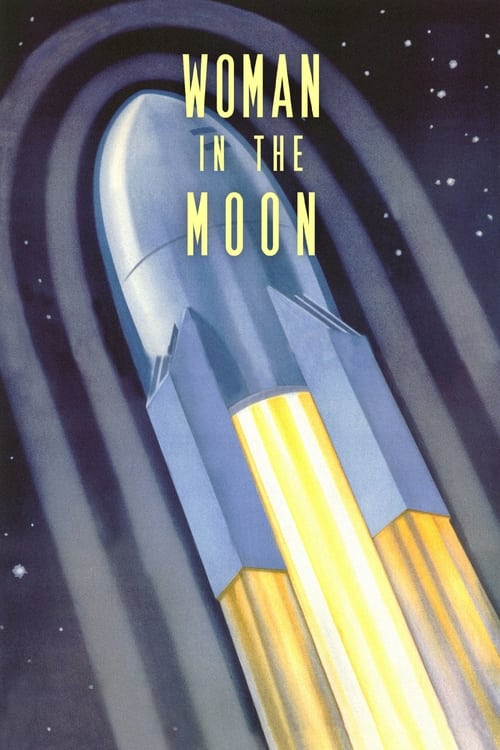
Woman in the Moon
1929 · Fritz Lang
For a curious, patient evening when you want to time-travel — the pleasure of watching cinema invent the future from scratch. It asks some commitment (it's long and silent) and repays it with wonder.
What it's about
A rocket entrepreneur bankrolls the first crewed flight to the Moon after an aging professor insists there's gold waiting in its mountains. A cartel of financiers forces its ruthless agent onto the crew, and a love triangle between the entrepreneur, his engineer colleague, and the engineer's fiancée rides along with them. Greed and rivalry prove as dangerous as the void outside the hull.
The experience
Stately and grand in the silent-epic manner — it takes its time on Earth, then turns genuinely thrilling once the launch sequence begins, with a countdown that still generates real suspense. Watching it feels like seeing the space age dreamed up decades early.
The craft
Fritz Lang built his rocketry with real scientific consultants, and the launch — multi-stage rocket, crowds, the invention of the countdown itself — is staged with astonishing procedural conviction for 1929. The production design imagines spaceflight with a rigor no film would match for decades, and the restored long cut rewards a big screen.
Why it matters
The countdown to zero, now universal from mission control to movie trailers, was invented here as a suspense device; the film stands as the last great monument of German silent cinema and a founding document of realistic science fiction.
Snapshot
Fritz Lang's Frau im Mond — released internationally as Woman in the Moon and in some markets as By Rocket to the Moon — stands at one of the most charged junctures in film history: the last major production from German silent cinema's classical era, completed in the very months when synchronized sound was dismantling the aesthetic world it so ambitiously inhabits. Running to approximately 169 minutes in its most complete surviving form, the film follows rocket entrepreneur Wolf Helius, who bankrolls an expedition to the Moon after elderly Professor Manfeldt insists a vast gold deposit waits there. The mission is infiltrated by a cartel of financiers represented by the cold-eyed Turner, and complicated by a love triangle among Helius, his colleague Hans Windegger, and Windegger's fiancée Friede. What distinguishes Woman in the Moon from the long tradition of fantastical lunar voyages is its studied commitment to plausible science: Lang hired real rocket researchers as consultants, staging the launch with enough technical verisimilitude that the film would, within a decade, be treated as a classified document by the German military. That coincidence of artistic ambition and prophetic accuracy is the film's permanent claim on history.
Industry & production
By 1929 UFA (Universum Film AG) had survived near-bankruptcy in 1927 — rescued by the Paramount-MGM Parufamet agreement that injected American capital in exchange for distribution concessions — and was operating under Alfred Hugenberg's nationalist ownership. The studio had already shouldered the ruinous cost of Metropolis (1927); Lang was not handed a blank check for Woman in the Moon, though the production was still a prestige undertaking. Lang and his wife and screenwriting collaborator Thea von Harbou developed the project from her 1928 novel of the same name, which she wrote partly to generate source material for the film rather than as an independent literary venture. The production budget was substantial but reportedly kept under tighter control than Metropolis, where cost overruns had been severe. For the premiere on 15 October 1929 at the UFA-Palast am Zoo in Berlin, the studio mounted promotional engineering: Hermann Oberth, one of the film's scientific consultants, was contracted to construct a working demonstration rocket that would be launched at the event. The rocket was never completed — technical difficulties defeated the timeline — but the spectacle of genuine rocket scientists publicly associated with a commercial film production was itself unprecedented, blurring the boundaries between popular entertainment and emerging aerospace science.
Technology
Woman in the Moon achieved a level of rocketry realism that no previous fiction film had approached, and the explanation lies in its consultant roster. Lang and von Harbou engaged Hermann Oberth, the Romanian-born German physicist whose 1923 treatise Die Rakete zu den Planetenräumen had helped legitimize liquid-fueled rocketry as a serious engineering proposition. Science writer and rocketry popularizer Willy Ley also participated, as did other figures associated with the Verein für Raumschiffahrt (VfR, Society for Space Travel). The film depicts a multi-stage rocket — not yet standard in popular imagination — capable of achieving lunar trajectory, along with details including a water-immersion launch cradle to cushion the crew against acceleration forces, the presence of a distinct atmospheric layer in the Moon's valleys (scientifically incorrect but a reasonable speculation for 1929), and the suggestion of reduced gravity on the lunar surface. The rocket prop itself was built to a high degree of finish and displayed publicly. The sequence in which a numerical countdown is announced before launch — crew and mission controllers marking off seconds toward zero — is among the most remarked legacies of the film: this dramatized countdown is widely cited as an early, if not the first, cinematic instance of the device, and its influence on actual spaceflight protocol, though anecdotal, has been noted by historians of the American and German rocket programs. After Germany remilitarized and began developing the V-2 ballistic missile under Wernher von Braun and Walter Dornberger at Peenemünde, the rocket-design similarities between Woman in the Moon and actual weapons development prompted the Reichswehr to classify the film and confiscate associated models and promotional materials. The film thus occupies the singular position of a commercial entertainment deemed too technically accurate to circulate freely.
Technique
Cinematography
The primary director of photography was Curt Courant (sometimes credited as Kurt Courant), a Berlin-based cameraman who brought accomplished studio craft to the production. The Earth-bound sequences draw on the full vocabulary of late-Weimar cinematography: deep-focus interiors, dramatic low-angle framings that emphasize the rocket's scale, and compositions that isolate characters against industrial architecture in ways that recall the spatial rhetoric of German Expressionism while remaining more naturalistically lit. The lunar surface sequences present a different register — stark, high-contrast imagery in which the characters move against blank, bright expanses, the visual field reduced to geometry and silhouette. Special effects and optical work were divided among various technicians; the degree of Oskar Fischinger's involvement in specific sequences has not been firmly established in the scholarly record, though he was active in Berlin's experimental film milieu at exactly this moment. The scale model footage of the rocket in flight achieves a solidity unusual for the era through careful attention to lighting consistency between model and location photography.
Editing
The film's construction reflects the tension between Lang's instinct for spectacle and the demands of a narrative that runs nearly three hours. The first half — establishing Helius's world, the conspiracy of the gold cartel, and the relationships that will generate conflict on the Moon — is cut at a deliberate pace that critics at the time found protracted. The launch sequence itself is among the most elaborately assembled passages in Lang's silent work: intercutting among the countdown, the crew's preparations, crowd reaction, the ignition, and the rocket's ascent builds genuine suspense through parallel montage indebted to Griffith and the Soviet school, which Lang had absorbed. Once the action relocates to the lunar surface, the rhythm loosens; the film trusts its strange setting to sustain attention. The editor's contribution to the project is not fully documented in sources I can assess with confidence — care is warranted about specific attributions.
Mise-en-scène / staging
Lang's command of large-scale staging, developed across Die Nibelungen (1924) and Metropolis, is evident in the rocket hangar sequences, where the massive vertical form of the ship dwarfs the human figures in a manner that simultaneously glorifies the technological achievement and diminishes individual agency. On the lunar surface, Lang makes the most of the void: characters are staged at wide intervals, the frame's emptiness functioning as dramatic pressure. The director's characteristic fascination with geometric precision — symmetrical compositions, figures placed on axes of power — persists throughout, but the film's tonal register is warmer than Metropolis, closer to the romantic adventure serial than to that film's social allegory. The love triangle is given space that Lang's more schematic films might compress, and the performances are staged with a degree of psychological interiority that the melodramatic frame supports.
Sound
Woman in the Moon was released as a silent film — with intertitles and live musical accompaniment — at the moment when sound cinema was becoming the commercial standard. A synchronized musical score by Willy Schmidt-Gentner was composed for the production, providing the film with a formal unity that some late-silent features lacked. No synchronized dialogue track was produced. The timing is historically significant: the film premiered one month before the U.S. market had moved almost entirely to sound, and it opened in Germany at a moment when UFA itself was transitioning its sound-stage infrastructure. Lang would make his next German film, M (1931), as a sound production — Woman in the Moon stands as the terminus of his silent practice.
Performance
The performances operate within late-silent convention, with actors calibrating gesture and facial expression to carry emotion that would subsequently be carried by voice. Willy Fritsch as Helius brings a boyish romantic energy appropriate to a character whose idealism the narrative never quite punctures. Gerda Maurus as Friede is the film's emotional center, the "woman in the moon" of the title, whose final decision to remain on the lunar surface with Helius gives the melodrama its poignant resolution. Fritz Rasp, a recurring presence in Lang's Weimar productions, plays the cartel operative Turner with the precise, economical menace he brought to similar roles in Spies (1928). Klaus Pohl as the visionary, somewhat ridiculous Professor Manfeldt is the film's comic-pathos figure, a type Lang would return to — the obsessed scientist vindicated too late. The young Gustl Gstettenbaur as the stowaway boy Gustav provides the film's most overtly sentimental register.
Narrative & dramatic mode
Woman in the Moon braids two narrative traditions that sit uneasily together: the scientifically grounded speculative voyage and the melodrama of romantic rivalry and corporate villainy. The first tradition demands attention to procedure, hardware, and the physical laws governing space travel; the second demands jealousy, betrayal, and sacrifice. Von Harbou's screenplay manages the seam tolerably well in the first half, where the conspiracy plot gives the melodrama momentum, but the lunar sequences increasingly subordinate procedural logic to emotional geometry. The climax — Helius and Friede stranded on the Moon with enough oxygen for one, Helius's sacrifice interrupted by Friede's refusal to leave — resolves the love triangle through mutual abandonment of Earth, a romantic ending that is also, if one attends to the oxygen mathematics, a death sentence. Lang presents this not as tragedy but as transcendence, the moon functioning as a space outside the corruptions of terrestrial capitalism. The narrative mode is thus essentially romantic-idealist draped over a realistic chassis.
Genre & cycle
Woman in the Moon belongs to the tradition of the scientific romance, traceable through Jules Verne's From the Earth to the Moon (1865) and H.G. Wells's lunar fiction, but it represents a significant departure from the fantasy register in which most earlier screen SF operated. Georges Méliès's A Trip to the Moon (1902) is the obvious ancestor, but where Méliès treats lunar travel as enchanted pantomime, Lang treats it as an engineering problem with human stakes. The film arrives at the end of a cycle of German fantastic cinema that includes The Cabinet of Dr. Caligari (1920), Nosferatu (1922), The Golem (1920), and Lang's own Metropolis — a cycle shaped by Expressionist aesthetics and social anxiety. Woman in the Moon is the most technologically optimistic of these films, less interested in the horror of the modern than in its possibility. Within the narrower cycle of space-travel films, it is a founding text for what would later be called hard science fiction cinema: the strand that prizes plausibility and scientific grounding over wonder divorced from mechanism.
Authorship & method
Fritz Lang's authorial signature is present throughout: the obsessives and schemers, the elaborately designed mechanical environments, the geometry of power expressed through composition, the melodrama conducted at operatic scale. His collaboration with Thea von Harbou, which produced the screenplays for Destiny (1921), Dr. Mabuse the Gambler (1922), Die Nibelungen, Metropolis, and Spies, reached its final major creative statement here. Von Harbou's contribution to their partnership is substantial and still underweighted in auteurist accounts: she was the primary narrative architect, bringing to the SF material both a popular novelist's instinct for character legibility and an interest in romantic sacrifice that softens Lang's colder formal instincts. The two divorced in 1933 after von Harbou joined the Nazi Party; Lang fled Germany. Their divergence retrospectively frames the Weimar collaborations as a temporary alignment of complementary temperaments. Curt Courant's cinematographic contribution extended a working relationship with UFA's prestige productions that made him one of the most sought-after cameramen in German cinema before his subsequent career in Britain and France. Hermann Oberth's scientific consultancy was not merely technical window-dressing: his engagement shaped the film's core claim to seriousness and had consequences, through the publicity it generated, for the real history of rocketry.
Movement / national cinema
Woman in the Moon belongs to the mature phase of Weimar cinema, the period after Expressionism's formal experiments had been absorbed into a more commercially oriented studio system while retaining some of their visual ambition. The film shares with other late-Weimar productions — Pandora's Box (1929), The Last Command (1928), Asphalt (1929) — a technical polish and a willingness to engage with modernity as subject matter, but it is less interested than its contemporaries in the social instabilities that would shortly destroy the Republic. Lang's political sensibility in this period was complicated: the film's gold-cartel villains carry a faint whiff of anti-capitalist critique, but the narrative ultimately resolves in favor of individual romantic heroism rather than collective transformation. As a production, Woman in the Moon represents UFA at its most ambitious outside the Murnau and Lang masterworks — a large-scale genre film made with resources and seriousness that Hollywood's own emergent SF productions would not match for decades.
Era / period
The film was made during the transitional moment of 1928–29, when Germany's political and economic stabilization of the mid-decade was beginning to erode — the Great Depression would arrive in Germany with particular devastation — and when the cinema's technological basis was being transformed by synchronized sound. Lang completed a silent epic at the moment of silence's extinction, a formal anachronism that the film's futurist subject matter renders ironic. The late 1920s also mark the moment when rocketry moved from theoretical speculation toward experimental engineering: Robert Goddard had launched the world's first liquid-fueled rocket in 1926; the VfR was conducting experiments; Oberth was a public intellectual of the first order. Lang made his film at the exact historical instant when space travel was transforming from literary fantasy to engineering ambition, and this timing gives Woman in the Moon its peculiar documentary charge.
Themes
The film's central preoccupation is the relationship between visionary ambition and the corrupting forces — commercial greed, sexual jealousy, institutional timidity — that encircle it. Professor Manfeldt is the purest figure of unrewarded vision: he has known for decades that gold exists on the Moon and has been dismissed as a crank. The Moon functions thematically as a zone beyond the reach of the terrestrial order that persecutes dreamers, which is why Lang's conclusion — the lovers stranded there — reads as liberation rather than catastrophe. Capitalism is represented by the gold cartel and by Turner's infiltration of the mission; the film is critical of corporate power without being systematically radical. A secondary theme concerns the costs of masculine rivalry: Helius and Windegger compete for Friede in a way that endangers the entire mission, locating private passion as a hazard within collective scientific endeavor. The Moon itself, in the film's visual and narrative logic, is a place where earthly categories — money, property, romantic convention — lose their grip, which is both the film's utopian promise and its romantic resolution.
Reception, canon & influence
Contemporary critical response was mixed. German reviewers praised the technical ambition and the launch sequences while finding the melodramatic scaffolding overextended; the film was not the popular sensation that Metropolis had been, and its timing — opening two years into the sound era's transformation of audience expectations — placed it at a disadvantage. International reception was modest; some markets shortened the print substantially.
The film draws backward from a long tradition: Verne and Wells are the literary ancestors; Méliès's lunar fantasies are the cinematic ones; the real scientific discourse of Oberth and Tsiolkovsky forms a parallel lineage that Woman in the Moon was uniquely positioned to absorb and dramatize. Lang's own Metropolis established the template for the technologically spectacular UFA production that Woman in the Moon develops in a different tonal direction.
Its legacy operates on several distinct registers. Within the history of science fiction cinema, the film established a precedent for treating space travel as an engineering rather than a magical event, a precedent that would shape the genre's serious wing through George Pal's productions of the early 1950s and beyond. The specific image of a massive rocket launched vertically, crewed by scientists and explorers, counting down to ignition — so embedded in both actual spaceflight and its popular representation as to seem self-evident — passes through Woman in the Moon at a formative moment. Whether the countdown device was Lang's original invention or derived from some prior source in rocketry discourse has not been definitively settled in the historical literature; it should be described as an early and influential instance rather than an absolute origin.
The Nazis' decision to classify the film after Peenemünde began serious V-2 development is the most extraordinary chapter in its reception history — a commercial entertainment treated as weapons intelligence. This anecdote, well-documented in the histories of the German rocket program, retrospectively validates the film's technical ambition and connects it to the actual trajectory of twentieth-century aerospace development. Wernher von Braun and others associated with the postwar American space program have been cited in various contexts as acknowledging the inspirational role of early German SF, including this film, though specific quotations should be treated with caution given the frequency with which such attributions circulate without firm sourcing.
The film has been reassessed upward in canonical terms since its initial reception. Within Lang's filmography it has historically been overshadowed by Metropolis on one side and M on the other, but scholars of science fiction cinema, of Weimar culture, and of the history of technology have restored it to a position of genuine significance. Restored prints have screened at major archives, and the film is now routinely cited in histories of the genre alongside Metropolis as a foundational text. Its peculiar fate — a work of popular entertainment that became, however briefly, a classified document — ensures it a permanent footnote in the history of the century it so presciently imagined.
A Deleuzian reading
Six.
The full Deleuzian reading of Woman in the Moon →
Reception
Released in 1929 just as talkies were sweeping in, it was received as an overlong curiosity and quickly overshadowed by Lang's own Metropolis; today it's celebrated as the founding text of 'realistic' space-travel cinema, decades ahead of its time.
How Woman in the Moon was received, from release to now →
Influences: the films it descends from and the films it influenced
- Le Voyage dans la Lune (1902) — Lang inherits the complete cinematic lunar-voyage template — Earth departure, rocket in flight, Moon surface exploration, return — then systematically replaces every staging and effects convention: Méliès's painted-flat theatrical sets yield to built three-dimensional interiors, and stage-magic illusion yields to scale-model photography calculated to suggest physical plausibility rather than theatrical wonder.
- Dr. Mabuse der Spieler (1922) — Establishes Lang's parallel montage grammar for interweaving simultaneous conspiratorial threads — investigator, criminal, and unwitting intermediaries cross-cut to generate suspense across separated parties — which Woman in the Moon inherits wholesale for the Turner espionage subplot running concurrently with the lunar mission preparation.
- Die Nibelungen: Siegfried (1924) — Lang's method of choreographing actors as geometric elements within symmetrical, architecturally composed framings — frozen tableau blocking that renders characters symbolic rather than naturalistic, subordinating individual movement to compositional pattern — is carried directly into Woman in the Moon's staging of the rocket assembly and launch-control sequences.
- Sunrise: A Song of Two Humans (1927) — Codifies the late-Weimar late-silent pantomime performance mode — wide-eyed physical expressiveness and gestural acting calibrated to communicate emotional states through body rather than synchronized voice — establishing the performance register that Helius and Friede inhabit throughout Woman in the Moon's romantic passages.
- Metropolis (1927) — The same UFA production team, Lang-Von Harbou screenplay structure, and scale model effects methodology are directly continued; the formula of embedding a romantic triangle within a hard-technology spectacle — with figures staged as small elements against enormous industrial architecture — is transposed wholesale from the underground city to the rocket gantry and lunar surface.
- Spione (1928) — The immediately preceding Lang-Von Harbou film establishes the espionage-within-adventure narrative structure — an infiltrator embedded in the protagonist's enterprise, cross-cutting between competing parties pursuing parallel objectives — that Woman in the Moon adopts almost structurally for the Turner subplot and the competing financial interests surrounding the expedition.
- Things to Come (1936) — H.G. Wells's direct participation as technical authority and co-screenwriter inherits Woman in the Moon's precedent of engaging scientists as production consultants; the film's staging of human figures against the vast geometric architecture of the future city — massive scale models photographed to dwarf actors — extends Woman in the Moon's compositional principle of the protagonist rendered insignificant against the built environment into British scientific romance.
- Destination Moon (1950) — Robert Heinlein's engagement as technical consultant and co-screenwriter replicates Woman in the Moon's strategy of hiring working scientists to guarantee rocketry verisimilitude; producer George Pal's scale model methodology for the rocket-in-flight sequences directly inherits the miniature-effects approach Lang established as the production standard for hard-SF space cinema.
- When Worlds Collide (1951) — Deploys the countdown sequence — the ticking numerical descent to zero before rocket launch — as the film's central formal climax, dramatizing what Woman in the Moon introduced as a cinematic device and cementing it as the defining structural rhythm of postwar American scientific-romance cinema.
- 2001: A Space Odyssey (1968) — Douglas Trumbull's scale model effects — built around controlled studio lighting and precise camera-to-model ratios to achieve photographic solidity — directly extend the miniature-photography methodology Woman in the Moon pioneered; Kubrick's geometric staging of astronauts as tiny figures within the Discovery's vast white corridors inherits and formalizes Lang's compositional principle of human bodies dwarfed by their technological architecture.
- Solaris (1972) — Tarkovsky stages Kelvin as a small figure moving through the Solaris Station's geometrically rigid corridors — wide-angle lenses emphasizing architectural structure over the human body — extending Woman in the Moon's compositional principle of the protagonist rendered physically insignificant against the technology that houses them, while embedding intimate romantic transcendence (the returning dead beloved) within the hard-SF framework.
- The Right Stuff (1983) — Kaufman's Mercury launch sequences build their formal and emotional rhythm around the countdown to zero — the device Woman in the Moon introduced to cinema and which was subsequently adopted by actual German rocket engineers at Peenemünde as operational launch protocol — making the film both a historical reconstruction and a direct inheritor of the dramatic grammar Lang invented.
- Contact (1997) — The Machine's construction sequence — Ellie rendered tiny against the concentric rings of the enormous technological apparatus — directly inherits Woman in the Moon's staging of the protagonist dwarfed by the vehicle that will carry her beyond verifiable reality; the scientific-romance architecture of an empirical rationalist whose journey culminates in personal transcendence replicates the narrative structure Lang and Von Harbou established.
- Moon (2009) — Jones stages Sam Bell as a lone figure moving through SARANG Base's spare white geometric interiors and across the high-contrast blankness of the lunar surface — human body as small element against a light-flooded, geometrically reduced field — directly inheriting the visual grammar Woman in the Moon established for lunar-environment staging: maximum tonal contrast between figure and blank, bright, architecturally minimal ground.
- M (1931) — Lang's first sound film directly converts Woman in the Moon's parallel montage across competing investigative parties into synchronized-sound filmmaking, now deploying contrapuntal audio bridges across visual cuts — retaining the same organizational editing principle of simultaneous search conducted by multiple opposed factions while introducing sound as a structural element the silent film could not exploit.
Similar films
- Metropolis (1927) — influence & lineage
- 2001: A Space Odyssey (1968) — influence & lineage
- Spies (1928) — influence & lineage
- Moon (2009) — influence & lineage
- Die Nibelungen: Siegfried (1924) — influence & lineage
- Sunrise: A Song of Two Humans (1927) — influence & lineage
- M (1931) — influence & lineage
- Faust (1926) — shared sensibility
All the films related to Woman in the Moon →