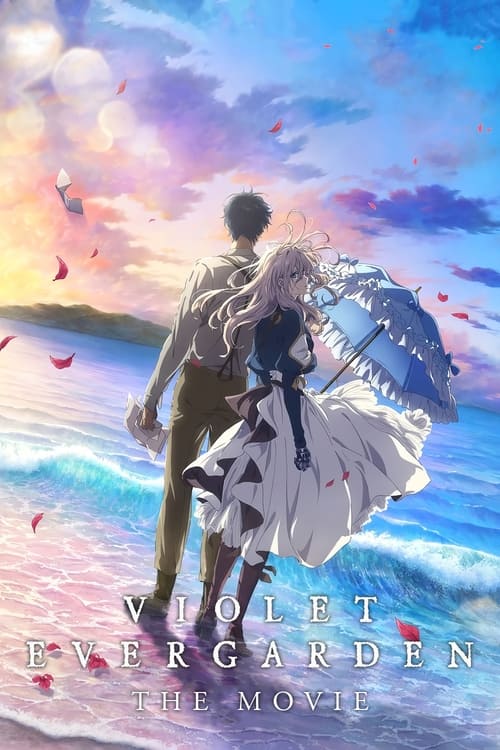
Violet Evergarden: The Movie
2020 · Taichi Ishidate
When you need a good cry and want it to feel like catharsis, not manipulation — a film for a quiet solo night when you're ready to sit with loss and letters left unwritten.
What it's about
In a world recovering from a great war, Violet — a former child soldier who became an Auto Memory Doll, ghostwriting letters for people who can't find their own words — watches telephones and steamships slowly make her profession obsolete. Through it all she still waits for word of the lost commanding officer who gave her the only words that ever mattered to her, while a new commission from a sick boy tests everything she's learned about saying goodbye.
The experience
Slow, hushed, and devastating in the gentlest way — grief measured in a hand hesitating over paper, light through glass, long patient silences. Bring tissues; it earns every tear it asks for.
The craft
Kyoto Animation's house style at its most refined: light refracted through water and glass, emotion animated at the scale of fingertips and breath, and a patience with silence almost unheard of in commercial animation. It's gorgeous on a big screen with good sound — the hush is part of the design.
Why it matters
Completed in the shadow of the 2019 arson attack that killed thirty-six of the studio's artists, its release became an act of collective mourning and defiance — the capstone of KyoAni's most prestigious project and a milestone for emotional realism in anime.
The capstone of Kyoto Animation's most prestigious project follows Violet — a former child soldier who became an Auto Memory Doll, ghostwriting letters for those who cannot find their own words — into a postwar world of telephones and steamships that is slowly rendering her profession obsolete, while she still waits for word of the commanding officer who gave her the only words that mattered. Taichi Ishidate directs in the full KyoAni house style: light refracted through glass and water, grief measured in the animation of a hand hesitating over paper, a patience with silence rare in commercial animation at this scale. The film was completed in the shadow of the July 2019 arson attack that killed thirty-six of the studio's artists; its release in 2020 became, unavoidably, an act of collective mourning and defiance by the studio itself. A story about letters that arrive years late, finished by people determined that their own work would still arrive — the resonance needs no underlining.
Reception
Released in Japan in September 2020 after two delays — first the devastating 2019 arson attack on Kyoto Animation, then COVID — it landed as a symbol of the studio's survival and became a long-running theatrical hit at home; abroad it has since settled in as the 'guaranteed cry' anime film, sitting among the highest fan-rated animated features on Letterboxd and MyAnimeList.
How Violet Evergarden: The Movie was received, from release to now →
Influences: the films it descends from and the films it influenced
- Grave of the Fireflies (1988) — Establishes the postwar-orphan register Violet inherits — trauma conveyed through unsentimental observation of mundane objects and routines rather than dialogue, letting a former combatant's grief accrete in silence.
- Only Yesterday (1991) — Takahata's naturalistic 'acting' animation — held pauses, weight shifts, hesitant hands — and memory intercut with the present are the restraint grammar KyoAni refines for Violet's flashback structure.
- Whisper of the Heart (1995) — The archetype of the hesitating writer: composition treated as physical craft, the hand poised and stalling over the page — exactly Violet's 'hand hesitating over paper' facet.
- The Wind Rises (2013) — Romanticizes interwar technology on the cusp of obsolescence — steamships, aircraft, telephone-era machinery rendered lovingly — the same 'postwar obsolescence' tech-nostalgia Violet builds its world on.
- Millennium Actress (2001) — A whole life organized around waiting for an absent person, told through match-cut editing that folds decades together — the waiting-and-longing engine and time-collapsing montage Violet's letter arcs echo.
- Voices of a Distant Star (2002) — Builds its entire emotional payload on the 'message arriving late' device — communication delayed until it aches — the exact narrative technology of Violet's letters-arriving-late facet.
- 5 Centimeters per Second (2007) — Codifies longing-across-distance imagery — letters, trains, lens-flare lyricism and skies — the lyrical distance-cinematography vocabulary Violet quotes directly.
- Kanon (2006) — KyoAni's Key 'nakige' adaptation grammar — withheld backstory metered out to detonate a delayed final-act catharsis — is the melodramatic structural DNA Violet Evergarden runs on.
- Hyouka (2012) — The Ishidate-era KyoAni house style: backlit glassware, dust in sunbeams, and micro-gesture 'acting' where a glance or finger-twitch carries a scene — the studio technique Violet inherits wholesale.
- Clannad: After Story (2008) — KyoAni's long-form proof that accumulated small domestic moments can earn an overwhelming grief-and-reunion climax — the emotional pacing Violet compresses into feature form.
- Violet Evergarden: Eternity and the Auto Memory Doll (2019) — Ishidate carries this side story's chamber-drama intimacy and epistolary structure forward into the flagship feature, extending the same photographic finish and orchestral-restraint grammar to close the letter-writing arc.
- The Garden of Words (2013) — Hyperreal rendering of light refracting through rain, water and glass — the literal 'light-through-glass-and-water' cinematographic technique Violet shares as a contemporary of Shinkai's studio craft.
- A Silent Voice (2016) — Yamada's KyoAni method of silence-as-editing and low framing on hands and feet to stage unspoken remorse — the same patience-with-silence cutting Violet uses for grief.
- Liz and the Blue Bird (2018) — Pushes KyoAni restraint to negative space and breath — tiny bodily gestures and pauses substituted for dialogue — the extreme of the silence-and-gesture craft Violet practices.
- Maquia: When the Promised Flower Blooms (2018) — A non-aging outsider who must learn love and mortal loss, with a woven-cloth craft as the emotional metaphor — a parallel treatment of the caretaker learning human feeling that Violet dramatizes through letter-writing.
- In This Corner of the World (2016) — Absorbs wartime loss into quiet domestic routine with soft hand-drawn tactility rather than spectacle — the same 'grief metabolized through daily craft' approach in a postwar setting.
- Weathering with You (2019) — Contemporary showcase of water-and-glass light cinematography — rain, reflection and volumetric sun — the same photographic register Violet's compositions pursue in the same era.
Similar films
- Liz and the Blue Bird (2018) — influence & lineage · same viewing thread
- In This Corner of the World (2016) — influence & lineage · same viewing thread
- Maquia: When the Promised Flower Blooms (2018) — influence & lineage
- Grave of the Fireflies (1988) — influence & lineage
- Weathering with You (2019) — influence & lineage
- Only Yesterday (1991) — influence & lineage
- Whisper of the Heart (1995) — influence & lineage · same viewing thread
- A Silent Voice: The Movie (2016) — same viewing thread
All the films related to Violet Evergarden: The Movie →
Watch it with: curated runs of related films
- Anime's Dreaming Adolescents — Watch these together for the ache of being young — first crushes, imaginary worlds, and the small transformations that feel enormous when you're inside them.