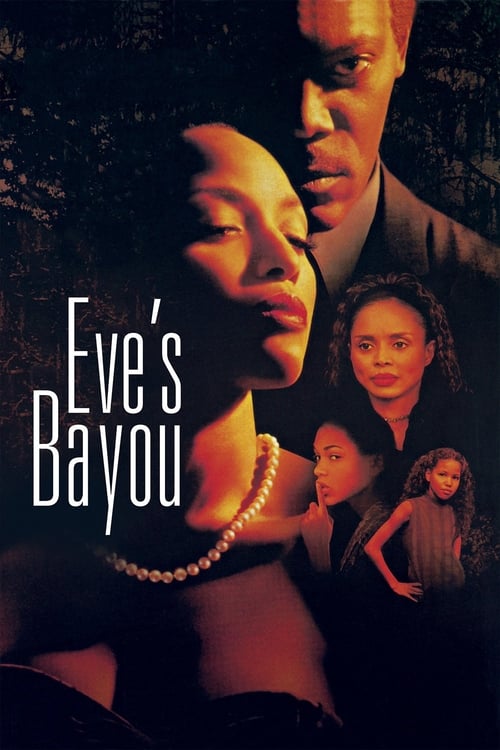
Eve's Bayou
1997 · Kasi Lemmons
For when you want a film to chew on for days — a grown-up family drama with the texture of a ghost story. Reach for it on a slow evening when you're up for ambiguity rather than answers.
What it's about
Louisiana, 1962: the prosperous Creole Batiste family spends a hot summer beside Eve's Bayou, where ten-year-old Eve idolizes her charming doctor father — until one night she sees something she can't unsee. What follows is a Southern Gothic of family secrets, half-understood adult betrayals, and an aunt with the gift of second sight, all filtered through a child's attempt to make sense of what the grown-ups won't say out loud.
The experience
Humid, sensuous, and slow-burning, with an undertow of dread — it feels like a memory you're not sure you can trust, which is exactly the point. It leaves you unsettled and turning the story over, re-deciding what you believe happened.
Performances
Samuel L. Jackson gives one of his most complicated performances as the magnetic, wayward patriarch, and Jurnee Smollett (as young Eve) and Debbi Morgan (as her clairvoyant aunt) are both extraordinary.
The craft
Kasi Lemmons and cinematographer Amy Vincent render memory as silvery, water-logged monochrome visions that change each time they're revisited — a formally daring way of insisting that what happened and what's remembered are never the same. The bayou setting is thick enough to feel on your skin, and the whole film rewards patience and a dark room.
Why it matters
The highest-grossing American independent film of 1997 and famously championed by Roger Ebert as the year's best, it stands as a landmark of Black American filmmaking and one of the great directorial debuts by a woman in the 1990s.
Kasi Lemmons' first feature arrived seemingly fully formed: a Southern Gothic set among the prosperous Creole Batiste family of Louisiana in 1962, narrated from the vantage of a ten-year-old girl who sees something one summer night that she — and the film — will spend the rest of the story trying to understand. Memory is the true subject. Lemmons and cinematographer Amy Vincent render recollection as silvery, water-logged monochrome visions that shift each time they're revisited, insisting that what happened and what is remembered are never quite the same thing. Samuel L. Jackson, who also produced, gives one of his most complicated performances as the charming, wayward family patriarch, and Jurnee Smollett and Debbi Morgan are extraordinary. The highest-grossing American independent film of 1997, it was famously named the year's best by Roger Ebert — over Titanic — and its blend of folk magic, female clairvoyance, and moral ambiguity opened a door for a generation of Black women filmmakers. In 2018 the Library of Congress added it to the National Film Registry.
A Deleuzian reading
A ten-year-old is awake somewhere she shouldn't be, late, on a hot Louisiana night in 1962, and she opens her eyes on her father.
The full Deleuzian reading of Eve's Bayou →
Reception
Warmly reviewed in 1997 — Roger Ebert called it the year's best film — yet it got zero Oscar nominations and slowly faded from mainstream memory. Decades later it's been fully canonized: a National Film Registry induction (2018) and a Criterion release sealed its status as a landmark of Black American cinema.
How Eve's Bayou was received, from release to now →
Influences: the films it descends from and the films it influenced
- Rashomon (1950) — Codifies the contradictory-flashback structure Eve's Bayou runs on — the same event replayed from competing subjective memories so that truth becomes a matter of who is remembering, dramatized by Eve's opening line that 'memory is a selection of images.'
- The Night of the Hunter (1955) — The template for child's-eye Southern gothic: an expressionist, storybook monochrome river-country rendered as a frightened child's perception, a visual grammar Lemmons and DP Amy Vincent echo in the bayou's stylized dread.
- To Kill a Mockingbird (1962) — Establishes the adult-voiceover-framing-a-Southern-childhood device — a grown narrator recalling the year the family's moral certainties collapsed — which Eve's Bayou adopts as its retrospective narration frame.
- Don't Look Now (1973) — Pioneers rendering premonition/clairvoyance as fragmentary flash-cut editing — brief associative inserts of foreseen images cut against the present — the exact montage strategy behind Eve's and Mozelle's silvery visions.
- The Innocents (1961) — Holds the supernatural in permanent ambiguity — is the clairvoyant seeing spirits or projecting her own psyche? — the interpretive uncertainty Eve's Bayou sustains around whether Eve's visions cause or merely witness events.
- Meshes of the Afternoon (1943) — The trance-film grammar of repeated, premonitory dream images and looping subjective vision that underwrites the film's clairvoyant inserts as a woman's inner sight rather than plot exposition.
- Daughters of the Dust (1991) — The immediate progenitor — a Black-woman-authored, painterly, non-linear memory poem of Gullah/Creole folk spirituality and ancestral inheritance that made Eve's Bayou's lush interior Black Southern world commercially thinkable.
- The Color Purple (1985) — A Southern Black memory-melodrama built on a child's threshold viewpoint and warm golden compositions, it inherits Color Purple's female-POV interiority and epistolary remembrance.
- Crooklyn (1994) — Extends Crooklyn's device of filtering a Black family's fractures through a young girl's subjective, unreliable memory, with the child as the film's perceptual center.
- To Sleep with Anger (1990) — Extends the Southern Black-gothic domestic drama where hoodoo, second sight, and folk superstition are woven matter-of-factly into a bourgeois family's daily life, the ambiguous conjure-figure functioning exactly like Harry as a catalyst that surfaces buried family rot.
- Jo Jo Dancer, Your Life Is Calling (1986) — Extends Jo Jo's unreliable-witness structure: a retrospective first-person narration that re-enters scenes it may be getting wrong, with the flashbacks graded warm against a cooler framing present, so the film's form doubts its own narrator.
- Pariah (2011) — Inherits the tradition of centering a young Black girl's interior perception through expressive, mood-driven color cinematography (Bradford Young), treating a coming-of-age gaze as a subject worthy of formal beauty.
- Beasts of the Southern Wild (2012) — Directly extends the child-narrator Louisiana-bayou magical realism — a little girl's voiceover braiding folk myth, flood-country landscape, and a parent's mortality into subjective cosmology.
- Middle of Nowhere (2012) — Advances the quiet-interiority craft Lemmons pioneered for Black women's stories — patient close observation of a woman's inner emotional weather over incident — within the indie space Eve's Bayou helped legitimize.
- Mudbound (2017) — Builds on Eve's Bayou's multi-voice Southern memory structure — overlapping first-person voiceovers each recalling the same land and events — and its Black-woman-shot painterly Southern imagery (DP Rachel Morrison).
- Hustle & Flow (2005) — Amy Vincent forged her humid, honeyed Southern-interior light here; Hustle & Flow's intimate sweat-and-amber visual register is a direct continuation of the same DP's hand.
- Love & Basketball (2000) — Direct crew inheritance — Terilyn A. Shropshire's memory-inflected elliptical cutting and Terence Blanchard's chamber-jazz score — the pairing that lets a domestic drama carry operatic weight without a conventional swelling-strings cue.
- Beloved (1998) — Shares the device of making African-American folk memory and trauma literally supernatural — the past returning as a haunting presence — worked in the same year through the same conjuncture of Black women's storytelling and the gothic.
- Down in the Delta (1998) — A parallel 1998 Black-woman-directed Southern family drama built on inherited objects and generational memory, extending the same authorial lineage of Black women filmmakers Lemmons was opening.
- The Virgin Suicides (1999) — Deploys the same unreliable retrospective narration — a collective memory of a lost year filtered through gauzy, idealizing nostalgia — where the telling admits it is reconstructing rather than reporting.
- The Skeleton Key (2005) — Extends Eve's Bayou's Louisiana Creole folk-magic gothic — hoodoo, conjure, and the fear that belief itself is efficacious — into genre-thriller form, drawing on the same regional supernatural vocabulary.
- Black Snake Moan (2006) — Shot by the same cinematographer, Amy Vincent, who carries forward the humid, blues-saturated Southern palette — sweat, low warm light, sensual close skin tones — she developed rendering the bayou.
- Compensation (1999) — Black memory-melodrama that renders the Southern/period past as photographic reverie framed by women's storytelling — a contemporaneous kindred to Davis's grief-and-grace register.
- The Joy Luck Club (1993) — Descendant extending voice-over-narrated, memory-braided family melodrama centered on women's generational inheritance, using match-transitions between present recollection and dramatized past.
Similar films
- Mudbound (2017) — influence & lineage · same viewing thread
- Daughters of the Dust (1991) — influence & lineage
- Beasts of the Southern Wild (2012) — influence & lineage
- To Kill a Mockingbird (1962) — influence & lineage · same viewing thread
- The Help (2011) — same viewing thread
- Suddenly, Last Summer (1959) — same viewing thread
- Selma (2014) — same viewing thread
- Sweetie (1989) — shared sensibility
All the films related to Eve's Bayou →
Watch it with: curated runs of related films
- Heat and Reckoning in the American South — A run of Southern dramas where family, race, and old money simmer under the same unbearable heat — watch them together to trace the region from the plantation myth through the civil-rights march.