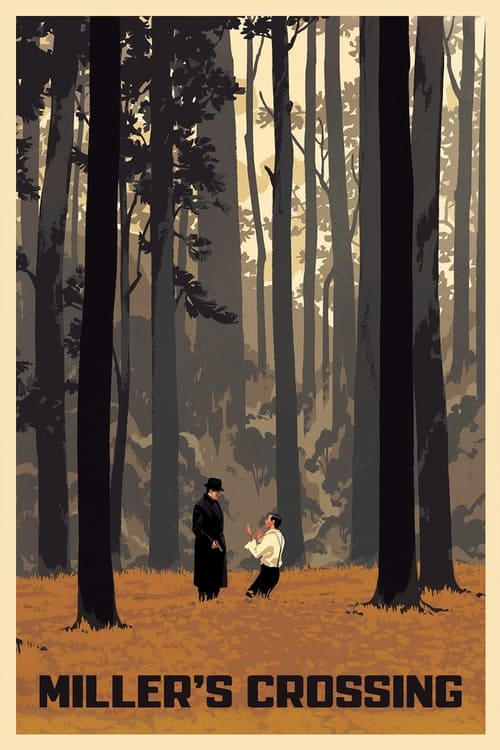
Miller's Crossing
1990 · Joel Coen
For when you want to watch smart people scheme — a whisky-in-hand, lean-in film that rewards close attention and gets better on a second pass. More chess match than shoot-em-up, though the shootouts deliver.
What it's about
In an unnamed American city in 1929, Irish political boss Leo runs the rackets, and Tom Reagan — his sardonic, hard-drinking right hand — does his thinking for him. When both men fall for the same woman and a rival demands the head of her small-time grifter brother, the whole arrangement cracks, and Tom starts playing every side of a brewing mob war at once. It's a story about loyalty, debts, and a man who may be too smart for his own survival.
The experience
Cool, controlled, and quotable — the dialogue crackles in dense period slang while the violence lands sudden and hard. It keeps you slightly off balance about who's playing whom, and it's funnier than a gangster tragedy has any right to be.
Performances
Gabriel Byrne holds the whole film together with a poker face that lets you read three motives into every line; Albert Finney gives the aging boss real warmth and sudden ferocity; and John Turturro, as the grifter pleading for his life, delivers some of the most desperate, squirming acting of the era.
The craft
The Coens build a complete invented world — every hat, streetlamp, and turn of phrase tuned to a hard-boiled 1929 that never quite existed — and shoot it with elegant, gliding formality. Carter Burwell's Irish-ballad-inflected score gives the brutality a mournful grandeur, and the forest of the title becomes one of the most haunting recurring images in American crime film. Handsome enough to reward the biggest screen you have.
Why it matters
It cemented the Coen brothers as major American filmmakers who could inhabit a genre and transcend it, and its reputation has only climbed — it's now regularly ranked among the finest gangster films ever made.
Snapshot
Miller's Crossing is a Prohibition-era gangster picture that wears its literary debts openly while transmuting them into something formally singular. Set in an unnamed American city in 1929 — photographed in New Orleans — it follows Tom Reagan (Gabriel Byrne), the sardonic, self-destructive advisor to Irish political boss Leo O'Bannon (Albert Finney), as he navigates a mob war that he may be secretly engineering from both sides. The film is at once an homage to the hard-boiled prose of Dashiell Hammett, a meditation on loyalty and bad faith, and a showcase for the Coen brothers' capacity to sustain pitch-perfect period pastiche without surrendering emotional or ethical seriousness. It arrived in a period when American independent cinema was sharpening its relationship to genre, and it remains one of the decade's most accomplished examples of literary adaptation by indirection.
Industry & production
Miller's Crossing was the Coens' third feature, following Blood Simple (1984) and Raising Arizona (1987), and the circumstances of its writing have become something of a minor legend in the lore of American independent film. According to the filmmakers' own accounts, they began the screenplay for Barton Fink and encountered a block; rather than force it, they set that script aside and wrote Miller's Crossing, completing it relatively quickly before returning to finish Barton Fink — the two films were shot in close succession, Barton Fink immediately following Miller's Crossing into production. The story illustrates the Coens' unusual practice of writing scripts speculatively and in tandem, maintaining a portfolio of material rather than developing projects in linear studio fashion.
The film was distributed by 20th Century Fox through its specialty arm, which gave it a wider platform than the Coens' earlier work but also exposed its commercial limitations more starkly. It was not a significant box-office success on initial release. Circle Films co-produced the picture. The shoot took place predominantly in New Orleans, which offered period-appropriate architecture — particularly the ornate interiors and leafy residential streets of the Garden District and Uptown neighborhoods — without requiring the production to construct expensive period sets wholesale. The forest location referenced in the title was shot in Louisiana as well.
The cast assembled is noteworthy for the concentration of character talent. Albert Finney, then in his early fifties, brought Old World theatrical weight to Leo O'Bannon. Jon Polito, reliably volcanic, plays the Italian rival Johnny Caspar. John Turturro, in the pivotal role of Bernie Bernbaum — a figure the film circles back to again and again — delivered a performance that helped establish him as one of the Coens' essential collaborators. Marcia Gay Harden, in her feature debut, plays Verna. Steve Buscemi appears in a small but characteristic role. Gabriel Byrne, then primarily known to American audiences for European productions, was cast against a certain leading-man expectation; his blankness reads as inscrutability rather than vacancy, which the film requires.
Technology
The production worked within the conventions of early-1990s 35mm filmmaking, exploiting anamorphic widescreen composition and deep-focus cinematography to achieve its particular visual register. Nothing in the film's technical infrastructure was especially innovative by the standards of its moment; the distinctiveness lies entirely in how existing tools were deployed. Practical lighting — chandelier fixtures, streetlamps, firelight — is used to maintain period credibility while Barry Sonnenfeld's lighting design ensures the deep shadows characteristic of noir without sacrificing legibility. Post-production was handled conventionally; the film predates digital intermediate workflows, and its color palette is the direct product of photochemical choices in exposure and printing.
Technique
Cinematography
Barry Sonnenfeld — who would depart for directing duties after this film — shoots Miller's Crossing with a precision that is simultaneously classical and slightly inhuman. The framing is formal: compositions tend toward symmetry, toward figures positioned in doorways and corridors that emphasize power relations and surveillance. The camera frequently tracks or dollies to follow characters through rooms, giving the interiors a sense of depth and threat. The film's most celebrated sequence — Leo dispatching a squad of assassins while "Danny Boy" plays on the accordion — demonstrates Sonnenfeld and Joel Coen's willingness to stretch a bravura set piece past the point where most directors would cut away. The sequence shifts registers from domestic comedy to explosion to methodical violence without losing tonal coherence, sustained by a single piece of diegetic music.
The opening dream image — Tom's hat caught by wind and rolling through a forest floor of fallen leaves — establishes the film's central symbolic register before a word of dialogue is spoken. It is one of the more poetic images in the Coens' catalog, and Sonnenfeld photographs it with an attention to texture and light — the dappled forest light, the hat's rolling brim — that is almost tactile.
Editing
The Coens edited the film themselves, as was their practice, under the pseudonym Roderick Jaynes. The editing rhythm is characteristically deliberate: scenes play longer than contemporary genre expectations would dictate, allowing performances and dialogue to accumulate weight. The film is not propulsively cut; tension is generated through staging and performance rather than pace. The intercutting during the assassination sequence is measured, confident. What the editing withholds is as significant as what it shows: the film makes a pointed decision to keep certain acts of violence off-screen or at the edges of the frame, forcing the audience into the same position of interpretive uncertainty as Tom.
Mise-en-scène / staging
The period design — overseen by production designer Dennis Gassner — maintains a consistent and detailed mid-period gangster milieu: wide-lapel suits, fedoras, wood-panelled offices, Prohibition-era roadhouses. The costume and art direction are meticulous without being ostentatious; the film earns its period authenticity and then stops calling attention to it. Staging favors triangulated confrontations in enclosed spaces — offices, parlors, corridors — that make the social and political geometry of the story visible. The forest of the title functions as the film's shadow space: outside the city, outside the social codes that govern the gangster world, it is where the film's most morally charged confrontations take place and where the rules governing behavior become genuinely unclear.
Sound
Carter Burwell's score is built around Irish folk material — the use of "Danny Boy" (the melody also known as "Londonderry Air") as a leitmotif for Leo O'Bannon ties the soundscape to ethnic identity and sentiment in ways that complicate the film's harder generic surfaces. Burwell's orchestration is spare, often letting the melody carry scenes that a more conventional score would smother in orchestral commentary. The sound design is attentive to period-specific textures: the clatter of typewriters, the creak of floorboards, the rain. The Tommy gun sequences are rendered with enough mechanical brutality to make the violence visceral without aestheticizing it into abstraction.
Performance
The performances are calibrated to the film's stylized register without tipping into camp. Byrne's Tom is a study in opacity: he acts throughout — deceiving nearly every other character in the film — and the performance asks the audience to maintain uncertainty about whether there is a genuine self beneath the manipulation. Finney brings physicality and warmth to Leo, making his eventual vulnerability credible. Turturro's Bernie Bernbaum is the film's most volatile element: his famous pleading ("Look into your heart") modulates from contemptible to pitiable within individual scenes. Polito's Caspar, all bluster and wounded pride, is operatic in the most controlled sense.
Narrative & dramatic mode
The plot is a labyrinth of shifting alliances, double-crosses, and withheld information. Tom maneuvers between Leo and Caspar, appearing to betray the first in order to infiltrate the second; whether this is loyalty, strategy, or something more perverse remains genuinely open. The film derives much of this structural complexity from Hammett's The Glass Key (1931) — in which a political fixer similarly navigates between competing bosses — and draws on the atmosphere and milieu of Red Harvest (1929), Hammett's foundational hardboiled novel of urban corruption. The Coens have acknowledged both debts explicitly. What the film adds to Hammett is a pervasive atmosphere of ethical nullity: the characters speak constantly of "ethics" and "what's right" (particularly Caspar's early monologue, which is essentially a thesis statement on the film's central preoccupations), but action consistently undermines principle. The film's refusal of a morally redemptive ending is characteristic of the Coens' tragic-ironic mode.
Genre & cycle
Miller's Crossing belongs to a late-1980s and early-1990s cycle of literary gangster films that revisited the classical period of American crime cinema — roughly concurrent with The Untouchables (1987), GoodFellas (1990), Bugsy (1991), and Carlito's Way (1993). These films shared an interest in period reconstruction and in the gangster genre as a vehicle for larger social and ethical inquiry, though they differ substantially in temperament. The Coens' film is distinguished within this cycle by its literary self-consciousness, its refusal of glorification, and its absorption of European art cinema's approach to narrative ellipsis. It is also notable for its engagement with ethnic community politics — the Irish, Italian, and Jewish milieus of the Prohibition underworld — in ways that complicate simple genre archetypes.
Authorship & method
Joel and Ethan Coen wrote the screenplay together (as on all their films) and share production credit, with Joel credited as director. The distinction in their working practice has always been somewhat artificial; accounts from cast and crew consistently describe a collaborative presence on set. The Coens' method at this stage of their career was characterized by exhaustive pre-visualization: the script and the storyboards were developed to a high degree before production, giving the shoot a precision that allowed them to maintain small crews and relatively tight budgets while achieving substantial formal control. Barry Sonnenfeld had been the DP on all three of their first features, and the rapport between filmmakers and cinematographer allowed for an efficiency and shared vocabulary that is visible in the film's confidence. Carter Burwell, also a Coen regular from Blood Simple onward, understood their approach to underscoring — deploying music as emotional commentary while resisting the tendency to over-explain or over-sentimentalize.
Movement / national cinema
The film sits within American independent cinema as it consolidated itself in the late 1980s — energized by Sundance, by the critical success of Blood Simple and Raising Arizona, and by a growing sense that genre material could sustain serious formal ambition outside the studio mainstream. The Coens were, by 1990, among the most formally sophisticated filmmakers working in American genre film. Their influences, however, were transnational: the rigorous visual formalism of the European art tradition (Kubrick is often cited in discussions of their work, with some justification), and specifically the French gangster cinema of Jean-Pierre Melville — whose films similarly combine classical genre conventions with austere, philosophical detachment — inflect the film's mood and pacing. Miller's Crossing does not belong to any national cinema in a narrow sense; it is a product of American film culture shaped by a remarkably broad cinephile formation.
Era / period
The film is set in 1929, the terminal year of the Prohibition boom, and is situated at a moment of gangster historiography — the ethnic immigrant underworld giving way to more organized, bureaucratized structures — that Hammett had already thematized in his fiction. As a film of 1990, it emerged at a moment when the classical studio genres were being systematically revisited and re-examined: the gangster film, the Western, the noir thriller were all subjects of critical nostalgia and formal reinvention. The Coens' engagement with this period is less nostalgic than archaeological — they reconstruct the conventions rigorously in order to probe what those conventions had systematically excluded or suppressed.
Themes
Loyalty and betrayal are the film's announced subjects, but the film is equally interested in the structure of self-deception. Tom operates by a code — his actions, ultimately, appear designed to protect Leo, even at the cost of his relationship with him — but the film withholds any sentimental confirmation of this reading. The Coens are characteristically suspicious of characters who believe themselves to be acting on principle. The repeated invocation of "ethics" in the film's dialogue is laced with irony; characters appeal to moral frameworks that their behavior immediately contradicts. The film is also interested in performance and concealment: virtually every major character is acting, and the distinction between authentic feeling and strategic display becomes progressively less stable. Bernie Bernbaum's appeals for mercy — "Look into your heart" — are explicitly performative, and the film forces the audience to decide whether performed feeling is feeling at all.
Reception, canon & influence
Miller's Crossing performed modestly at the North American box office on its initial release — a disappointment relative to the expectations generated by Raising Arizona's commercial success — but its critical reception was generally strong, with particular attention to its visual sophistication and literary ambition. The film has grown substantially in critical estimation in the decades since, and is now routinely included among the finest American crime films of the 1990s and among the strongest entries in the Coen filmography. It appears with regularity on critical polls of the decade's best films.
The film's primary debt is to Hammett — to The Glass Key most directly in its plotting of a fixer's divided loyalties, and to Red Harvest in its vision of institutional corruption and ethnic urban conflict. The classical Hollywood gangster film (Hawks' Scarface, Wellman's The Public Enemy, and their successors) provides the generic scaffolding. Melville's Le Samouraï and Le Cercle Rouge are felt in the film's cool detachment and its interest in the ethics of criminal professionalism, though direct influence is difficult to document beyond the filmmakers' widely-known affinity for Melville. Preston Sturges is occasionally invoked in discussions of the Coens' dialogue — its density, its period argot, its rhythm — though Miller's Crossing is considerably darker than Sturges's own crime comedies.
The film's legacy within American cinema is best understood as part of a broader Coen influence rather than a discrete phenomenon. Along with Blood Simple, Fargo, and No Country for Old Men, it established the template for a certain mode of genre filmmaking that prizes formal control, literary source material, tonal instability, and moral ambiguity. Subsequent crime films that have engaged seriously with literary hardboiled tradition — from L.A. Confidential (1997) onward — inhabit a landscape that Miller's Crossing helped map. The performance style it elicited — laconic, internally legible only through small physical gestures, resistant to explanatory dialogue — influenced the character acting of American independent and prestige film for a generation. Turturro's Bernie Bernbaum in particular, a character who demands and denies sympathy in the same breath, opened space for a mode of antagonist performance that depends on the audience's simultaneous identification and revulsion.
A Deleuzian reading
A hat rolls through fallen leaves.
The full Deleuzian reading of Miller's Crossing →
Reception
A box-office flop in 1990 — buried in the same season as Goodfellas — it's since climbed to the top tier of Coen brothers rankings and regularly turns up on best-gangster-film lists.
How Miller's Crossing was received, from release to now →
Influences: the films it descends from and the films it influenced
- Le Samouraï (1967) — Gabriel Byrne's performance of strategic inscrutability — the protagonist as self-concealing operator whose interiority is never disclosed — directly models Alain Delon's blank affect, the Melville technique of converting opacity into narrative suspense rather than character exposition.
- The Glass Key (1942) — Miller's Crossing adapts the plot geometry of Hammett's novel of the same name — political boss, double-loyal advisor, favor-trader caught between factions — and Heisler's film of the same source establishes the staging template: the structure rendered as two-on-one confrontational dialogue scenes rather than action sequences.
- The Big Sleep (1946) — Hawks established the hard-boiled adaptation precedent of deliberately sacrificing plot legibility so that dialogue rhythm and character interaction carry weight; Miller's Crossing adopts this anti-expository strategy, trusting the audience to follow tone and relationship rather than demanding narrative accountability.
- Sweet Smell of Success (1957) — James Wong Howe's deep-shadow anamorphic widescreen, lit exclusively by street lamps and practical interior sources in a power-broker milieu, is the direct photographic antecedent for Sonnenfeld's lighting design; both films also stage their central conflict as a triangulated confrontation between a boss, his subordinate, and an outsider threatening the arrangement.
- The Godfather (1972) — Gordon Willis's use of chandelier, desk lamp, and window light as the sole illumination in period interiors — with figures positioned in doorways and corridors to diagram hierarchy — is the photographic template Sonnenfeld and the Coens replicate directly for Miller's Crossing's period gangster compositions.
- Once Upon a Time in America (1984) — Leone's technique of sustaining a violent set piece over a single unbroken musical cue — letting the sequence breathe far past conventional cutting rhythm — is the direct formal antecedent for the 'Danny Boy' assassination sequence, in which the accordion piece plays uninterrupted while the scene shifts registers from domestic comedy to explosion to methodical violence.
- Blood Simple (1984) — The Coens' debut established their systematic practice of staging violence at the frame edge or in ellipsis — the audience inferring acts rather than witnessing them — which Miller's Crossing inherits and refines into a deliberate elision strategy that forces complicity rather than spectacle.
- The Godfather Part II (1974) — The film's visual language is built on Willis's shadow-heavy low-key grammar: extreme darkness as moral weight, figures isolated in pools of motivated light, shadow treated as a physical presence rather than decoration — the forest sequence is the most concentrated echo of Willis's style anywhere in subsequent American cinema.
- L.A. Confidential (1997) — Both films adapt hard-boiled literary material by constructing a triangulated double-cross plot that is deliberately difficult to parse; Dante Spinotti's anamorphic period cinematography with practical light sources parallels Sonnenfeld's approach, and both films stage their key confrontations as multi-party negotiations where loyalty is weaponized rather than honored.
- The Man Who Wasn't There (2001) — Roderick Jaynes editing carries Miller's Crossing's deliberate rhythm forward into black-and-white hard-boiled pastiche where the protagonist's voice-over narrates without ever disclosing motivation — strategic opacity as formal device becomes more total and self-conscious, Byrne's inscrutability taken to its logical extreme.
- No Country for Old Men (2007) — Roderick Jaynes editing deploys Miller's Crossing's elision technique at scale — violence systematically kept off-screen or discovered in aftermath — while Roger Deakins's anamorphic widescreen and the ethical nullity of the ending are direct refinements of the formal and moral strategies Miller's Crossing established.
- A Prophet (2009) — Malik's trajectory — a subordinate who plays captors on both sides simultaneously, disclosing nothing while engineering the outcome — replicates the double-cross-labyrinth geometry of Tom Reagan's situation, and Tahar Rahim's performance of strategic opacity, the face as withheld information, is the clearest European descendant of Byrne's approach to inscrutability as gangster protagonist.
- In Bruges (2008) — The literary gangster film organized around a single ethical question—the right to kill a man who deserves death—with Carter Burwell's inaugural Coen partnership establishing sparse, emotionally ambivalent orchestral scoring played against violence rather than underlining it, the template In Bruges adopts in both moral architecture and musical method.
- The Outfit (2022) — The Coens withhold the protagonist's true allegiance through the entire film, making moral intelligence expressed through deflection and indirection the primary viewing experience; Moore adopts this strategy of concealed loyalty as his central narrative and character device.
- Twilight (2008) — Exemplifies Carter Burwell's signature method of a single aching solo-instrument melodic leitmotif carrying a film's emotion — the same compositional approach that yields 'Bella's Lullaby.'
- Barton Fink (1991) — Written during the same creative session — the Coens drafted Miller's Crossing to break a block on Barton Fink — both films share the Roderick Jaynes pseudonym and an identical editing rhythm in which scenes play past genre expectation to let performance and dialogue accumulate weight before resolving.
- Fargo (1996) — Roger Deakins replaces Sonnenfeld but the formal vocabulary carries forward intact — anamorphic widescreen, Roderick Jaynes deliberate-pacing editing, genre pastiche as a vehicle for ethical inquiry — extending Miller's Crossing's practice of withholding conventional catharsis and substituting formal rigor in its place.
- Road to Perdition (2002) — Conrad Hall's anamorphic cinematography uses practical sources — rain, lamplight, muzzle flash — as the sole illumination in Prohibition-era interiors, creating a near-identical photographic texture to Sonnenfeld's work; the triangulated power geometry (protagonist, employer, employer's treacherous son) mirrors Miller's Crossing's structural arrangement.
- The Assassination of Jesse James by the Coward Robert Ford (2007) — Nick Cave's folk ballads — particularly the recurring 'Jesse James' leitmotif — are integrated as structural and emotional keys to a morally ambiguous protagonist, mirroring exactly how 'Danny Boy' functions in Miller's Crossing: a folk song's melodic identity becomes the register through which the film measures its characters' bad faith.
- The Untouchables (1987) — The Coens' citational gangster film works the same prestige period crime territory — overhead compositions, theatrically staged violence, binary moral structure undermined by ambiguity — while substituting Dashiell Hammett's literary architecture for De Palma's Eisenstein-derived set-piece formalism.
- The Big Lebowski (1998) — The Coens apply the Roderick Jaynes editing pseudonym and genre-deconstruction method to Dashiell Hammett where Lebowski applies it to Raymond Chandler — both films use a hard-boiled literary source as a framework to be systematically emptied of its genre's expected competence and resolution.
- Reservoir Dogs (1992) — Working from the same Melville-and-Hammett source material two years before Reservoir Dogs, the Coens build their film around the same dramatic question — which man in the crew is the informant — using stylized gang-world codes and the gap between professional loyalty and private betrayal as their central formal and moral engine.
Similar films
- Fargo (1996) — influence & lineage · same viewing thread
- No Country for Old Men (2007) — influence & lineage
- Barton Fink (1991) — influence & lineage
- Road to Perdition (2002) — influence & lineage
- The Man Who Wasn't There (2001) — influence & lineage
- Once Upon a Time in America (1984) — influence & lineage
- The Irishman (2019) — same viewing thread
- GoodFellas (1990) — same viewing thread
All the films related to Miller's Crossing →
Watch it with: curated runs of related films
- The Great American Crime Film — A run through the seductions and wreckage of American crime — mob epics that span a whole life beside capers that unravel over a weekend, all told with the same eye for how ordinary greed curdles into violence.