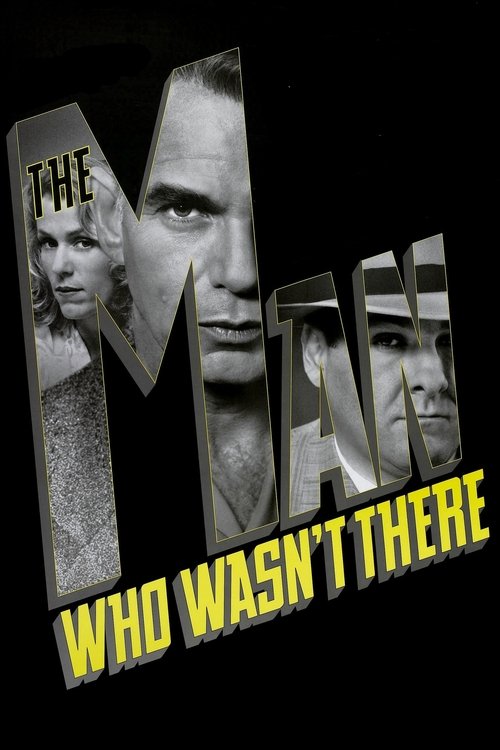
The Man Who Wasn't There
2001 · Joel Coen
For a late night when you want something moody and strange to sink into — cigarette-smoke noir with a philosophical ache. A film to chew on, not a comfort watch.
What it's about
Ed Crane cuts hair in a small California town in 1949 and barely says a word — a man watching his own life from across the room. When a traveling businessman pitches him on the coming miracle of dry cleaning, Ed sees his one exit, and decides to raise the stake by anonymously blackmailing the department-store man he suspects is sleeping with his wife. In classic noir fashion, the quiet little scheme does not stay quiet.
The experience
Slow, hypnotic, and dryly funny in the deadest of deadpans — a fatalistic drift through one man's undoing, narrated in a flat voice that makes doom sound almost peaceful. It's deliberate by design; the mood is the point, and it lingers.
Performances
Billy Bob Thornton does astonishing work with almost nothing: a still face, a cigarette, a murmured voiceover — he makes passivity riveting. Frances McDormand gives his wife brittle, boozy life, and James Gandolfini blusters memorably as the big man with something to hide.
The craft
Roger Deakins's black-and-white photography is the star attraction — barbershop light, venetian-blind shadows, and smoke rendered so beautifully the film works as a gallery of images, set to melancholy Beethoven piano. The Coens' script honors the old insurance-scheme noirs while quietly turning one into something stranger and sadder.
Why it matters
It confirmed the Coens as the great modern custodians of classic American crime cinema and stands among the most acclaimed black-and-white films of its era, with Deakins's work here routinely cited as a career peak.
Snapshot
The Man Who Wasn't There is the Coen brothers' most rigorous exercise in classical film noir: a black-and-white period piece set in Santa Rosa, California, in the summer of 1949, narrated in flat, fatalistic voiceover by a barber who barely speaks aloud. Billy Bob Thornton plays Ed Crane, a chain-smoking "second" barber in his brother-in-law's shop, a man so recessive he seems to watch his own life from across the room. When a passing huckster (Jon Polito) pitches him on the new business of dry cleaning, Ed tries to finance his stake by anonymously blackmailing his wife Doris's employer and probable lover, the department-store manager Big Dave (James Gandolfini). The scheme detonates in the familiar Cain-and-Camus manner — a killing, a wrongful arrest, a wife's suicide, a trial for the wrong crime — and Ed narrates all of it with the becalmed detachment of a man already half-convinced he was never quite present for any of it. Credited to Joel Coen as director and produced by Ethan, but written and shaped by both, the film premiered at the 2001 Cannes Film Festival, where Joel Coen shared the Best Director prize with David Lynch (for Mulholland Drive). It is at once a loving genre reconstruction and a metaphysical fable about uncertainty, identity, and the indifference of the cosmos.
Industry & production
The film arrived in the Coens' most prolific and commercially elevated period, between O Brother, Where Art Thou? (2000) and Intolerable Cruelty (2003), under their long-running partnership with Working Title Films and producer-collaborators including Tim Bevan and Eric Fellner. It was a modestly budgeted, deliberately uncommercial proposition — a black-and-white art film about a passive antihero — financed within the security of that established relationship rather than as a studio tentpole. In the United States it was released in the autumn of 2001 through USA Films, the specialty distributor then handling the Coens' work.
The decision to make the film in black and white was the defining production negotiation. Black-and-white releases were, by 2001, a hard sell to exhibitors and home-video markets, and the practical compromise — discussed at length by the Coens and cinematographer Roger Deakins in subsequent interviews — was to shoot on color negative stock and strike black-and-white prints, preserving the option of a color version for markets that demanded one. This is the rare case where a stylistic decision was also an industrial hedge, and it sits at the seam of the film's technology and its aesthetics. I won't assign box-office figures here; the picture was understood from the outset as a prestige, festival-oriented release rather than a wide commercial play, and its standing rests on critical and craft recognition rather than grosses.
Technology
The film's signature technical fact is its image origin: it was photographed on color film negative and printed in black and white, rather than shot on true monochrome stock. Deakins has explained that color negative gave finer control over tonal rendition — the ability to manipulate how specific colors translated into grayscale values — and addressed practical concerns about the cost and availability of black-and-white stock and processing. The result is a monochrome that is unusually rich in the midtones, with skin, smoke, and fabric separating cleanly across a long gray scale rather than collapsing into the high-contrast graphic look of much vintage noir. Beyond this, the film is a conventional 35mm production for its era; I have not seen reliable documentation that it employed a full digital intermediate, and I won't assert one. The relevant technological story is the analog one: a color-to-monochrome workflow used as an expressive and economic instrument simultaneously.
Technique
Cinematography
Roger Deakins's photography is the film's most celebrated element, earning him an Academy Award nomination for Best Cinematography. Rather than imitate the chiaroscuro extremity of 1940s noir, Deakins builds a cooler, more diffuse monochrome — soft sourcing, deep but legible shadow, faces lit to register thought rather than menace. The framing is patient and frontal, often holding Ed in static or slow compositions that emphasize his stillness and the surrounding world's motion. Smoke is a recurring graphic motif, used both as atmosphere and as a literal visualization of Ed's intangibility — the man who is mostly a column of cigarette haze. Deakins reserves his most lyrical effects for the film's metaphysical registers: the gleam of automobile chrome, the otherworldly light of a UFO sighting, the over-lit calm of the courtroom and the death house. The look is period-evocative without being pastiche, a reconstruction filtered through a modern sensibility about restraint.
Editing
The film is cut by "Roderick Jaynes" — the Coens' long-standing editing pseudonym — alongside Tricia Cooke. The rhythm is deliberately slow and contemplative, governed by Ed's voiceover and his temperament: long takes, unhurried dissolves, and a willingness to let scenes breathe past the point of conventional efficiency. The cutting reinforces detachment, frequently lingering after a line has landed or holding on Ed's impassive face as events unfold around him. The trial and its aftermath are structured with a fatalistic inevitability, and the film's tonal swerves — into UFO lore, into Ed's fantasy of patronizing the young pianist Birdy — are absorbed without acceleration, so that the supernatural and the mundane share the same becalmed tempo.
Mise-en-scène / staging
The production design renders postwar small-town California with meticulous, slightly airless precision: the barbershop, the modest Crane home, the department store, the diner, the dry-cleaning pitch in a hotel room. Staging repeatedly isolates Ed within the frame — behind his barber's chair, at the edge of a conversation, observing rather than participating. The Coens stage social life as a series of performances Ed declines to give, his silence a kind of vacancy that others rush to fill (the garrulous Frank, the bombastic attorney Riedenschneider, the booming Big Dave). The period detail is exact but never nostalgic; it functions as a vivarium for an existential case study.
Sound
The sound design foregrounds Ed's narration — a low, affectless, continuous voiceover that is the film's spine and its central irony, a torrent of inner words from a man who utters almost nothing. Ambient sound is clean and slightly heightened: the snip of scissors, the hiss of steam, the buzz of fluorescent light. Against this, the score (discussed below) introduces a register of romantic feeling the dialogue withholds. The contrast between Ed's near-silence in the world and his unbroken interior monologue is fundamentally a sound-design conceit as much as a writerly one.
Performance
Billy Bob Thornton gives a study in subtraction. Ed Crane is built from stillness, minimal gesture, and a fixed, watchful expression; the performance lives in the voiceover and in what Thornton withholds from the visible surface. Around this vacancy the Coens array louder, fuller presences: Frances McDormand's brittle, drinking, unhappy Doris; James Gandolfini's blustering, frightened Big Dave; Tony Shalhoub's verbose, amoral defense attorney Freddy Riedenschneider; Michael Badalucco's chattering brother-in-law Frank; Jon Polito's oily Creighton Tolliver; and Scarlett Johansson, in an early role, as Birdy, the teenage pianist onto whom Ed projects a redemptive fantasy. The ensemble's volubility is the necessary counterweight to Thornton's emptiness; the film's tension is between a man who isn't there and a world that won't stop talking.
Narrative & dramatic mode
The film is structured as confessional noir: a doomed first-person narration delivered in retrospect, in the tradition of Double Indemnity, by a protagonist recounting how a single transgression unraveled his life. But the Coens drain the mode of its propulsive heat. The crime plot proceeds with grim mechanical irony — Ed's blackmail leads to a killing, but he is punished for a death he did not cause while escaping accountability for the one he did — and the narration is less a confession of guilt than a metaphysical shrug. The dramatic mode is fatalistic and ironic rather than suspenseful; we are invited to contemplate Ed's situation philosophically, not to root for his escape. Digressions into flying saucers and the "uncertainty principle" elevate the genre machinery into a meditation on knowledge and contingency.
Genre & cycle
This is the Coens' purest film noir, and it belongs to a recognizable strand in their authorship: the genre-reconstruction film made with scholarly fidelity and ironic distance. It follows Blood Simple (1984), Miller's Crossing (1990), Barton Fink (1991), and Fargo (1996) in the brothers' recurring engagement with crime and noir forms, and it is the most overtly retro of these — a period neo-noir that reaches back past their earlier modern-dress crime films to the 1940s source material itself. Within the broader neo-noir cycle of the 1990s and early 2000s, it stands apart for refusing the cycle's usual eroticism and violence in favor of philosophical chill.
Authorship & method
The film is a definitive Coen brothers work despite the divided credits (Joel as director, Ethan as producer, both as writers), reflecting their well-documented practice of full creative partnership regardless of how billing is apportioned. Their method here is one of disciplined genre homage shot through with their characteristic ironic fatalism and fascination with hapless schemers undone by their own plans. The key collaborators form the Coens' core repertory company: Roger Deakins, their cinematographer across the era's films, whose monochrome work defines the picture; Carter Burwell, their long-standing composer; the editors working under the Roderick Jaynes pseudonym with Tricia Cooke; and the recurring ensemble of McDormand, Badalucco, Polito, and others. Burwell's contribution is notable for its restraint: the score leans heavily on Beethoven's piano sonatas — the slow movements in particular — used as an emotional and elegiac counterpoint to Ed's affectlessness, with Burwell's original cues woven around them. The choice of canonical classical repertoire over a pastiche jazz-noir score is itself an authorial statement about the film's reach beyond genre.
Movement / national cinema
As American independent-minded filmmaking operating inside the studio-specialty system, the film belongs to no formal movement, but it is consciously in dialogue with two traditions: classical Hollywood film noir of the 1940s, and the European existentialist literature — above all Camus — that the noir sensibility runs parallel to. The Coens function here as American cinephile-authors translating a mid-century transatlantic mood (the absurd, the indifferent universe, the outsider who cannot connect) into a meticulously reconstructed national-cinema idiom. It is American genre filmmaking inflected by a European philosophical inheritance.
Era / period
The film is set with great specificity in the summer of 1949 — postwar, atomic-age California, a moment of suburban prosperity shadowed by new anxieties. That period setting is thematically load-bearing: the era's flying-saucer panic, its faith in modern conveniences (dry cleaning as a frontier of opportunity), and the looming sense of cosmic and scientific uncertainty (the "uncertainty principle" that the attorney brandishes as a defense) all locate Ed's private alienation within a broader postwar unease. The choice of 1949 places the story at the hinge between wartime certainties and the existential, atomic-shadowed modernity to come.
Themes
The governing theme is existential vacancy — Ed as a "modern man," an empty center around whom events occur but who never quite occupies his own life. The title gestures simultaneously at his social invisibility and at a deeper ontological absence. Layered onto this is uncertainty as both physics and philosophy: Riedenschneider's courtroom invocation of the principle that the more closely you look, the less you can know becomes the film's epistemological motto, applied to guilt, identity, and reality itself. The recurring UFO imagery externalizes the sense of an inscrutable, possibly meaningless cosmos. Other threads — fate and irony (punishment misallocated), failed self-reinvention (the dry-cleaning dream), thwarted redemption (Ed's fantasy of Birdy), and the gulf between inner life and outward expression — all orbit the central void. It is a film about a man trying, and failing, to mean something in a universe that offers no confirmation that he does.
Reception, canon & influence
The film was received as a major, if austere and divisive, Coen brothers work. Its most concrete laurels were craft and authorship recognitions: Joel Coen's shared Best Director award at the 2001 Cannes Film Festival (alongside David Lynch) and Roger Deakins's Academy Award nomination for Best Cinematography. Critically, it was widely admired for its formal control and Deakins's images, while some reviewers found its deliberate coldness and slowness alienating — the very detachment that is its subject became, for some, an obstacle to engagement. That split has largely held: it is now regarded as one of the Coens' most accomplished and underappreciated films, a touchstone for those who prize the brothers' formal rigor over their comic anarchy.
Influences on the film (backward): The picture draws openly on the hard-boiled crime fiction of James M. Cain (The Postman Always Rings Twice, Double Indemnity) — the doomed everyman, the adulterous triangle, the scheme that destroys its author — filtered through the classical film-noir adaptations those novels produced. Its philosophical spine reaches to *Albert Camus's The Stranger***, whose detached, affectless narrator awaiting judgment is Ed Crane's clear literary ancestor. Visually it absorbs 1940s noir cinematography while consciously departing from its high-contrast extremes.
Legacy (forward): The film's most direct influence has been as a craft exemplar — a reference point in cinematography circles for sophisticated modern black-and-white achieved through color-negative origination, and part of the body of work that cemented Deakins's stature. As a model of restrained, literate, philosophically ambitious neo-noir, it stands within the Coens' own oeuvre as a bridge to later fatalistic crime meditations such as No Country for Old Men (2007) and A Serious Man (2009), the latter sharing its preoccupation with uncertainty, cosmic indifference, and an ordinary man unable to read the meaning of what befalls him. Its broader influence is more atmospheric than imitative: it remains a demonstration that genre reconstruction can carry serious metaphysical weight, and a frequently cited example when filmmakers and critics discuss the modern revival of black-and-white as a deliberate, expressive choice rather than a nostalgic affectation.
A Deleuzian reading
Start with the smoke.
The full Deleuzian reading of The Man Who Wasn't There →
Reception
Landed quietly in 2001 — respectful reviews, a Cannes Best Director win for Joel Coen (shared with David Lynch), but soft box office and a shrug next to Fargo and Lebowski; it's since become the perennial 'most underrated Coen' pick, steadily climbing in fan rankings.
How The Man Who Wasn't There was received, from release to now →
Influences: the films it descends from and the films it influenced
- Double Indemnity (1944) — Establishes the retrospective confessional voiceover of a doomed schemer narrating his own destruction — the Cain-adaptation template (insurance, adultery, a plan that consumes its author) that Ed Crane's flat narration directly inherits and inverts.
- The Postman Always Rings Twice (1946) — The other canonical Cain adaptation supplying the adulterous triangle and the murder scheme that destroys its conspirators, the structural source the Coens hollow out into passivity.
- Detour (1945) — Pioneers the affectless, fatalistic first-person narration of a passive man swept toward doom — the resigned, non-agentic noir voice that prefigures Crane's emotional vacancy far more than the hard-charging classic noirs.
- Out of the Past (1947) — Nicholas Musuraca's deep-shadow chiaroscuro and figures isolated in pooled light form the 1940s monochrome grammar Deakins consciously absorbs while departing from its high-contrast extremes toward a softer gray scale.
- Sweet Smell of Success (1957) — James Wong Howe's high-contrast urban black-and-white, with cigarette smoke sculpted by light, is a standing reference point for Deakins's expressive smoke-and-shadow imagery here.
- The Asphalt Jungle (1950) — Codifies the meticulously planned scheme that unravels through human weakness and bad luck — the Coens' recurring 'hapless schemer undone by his own plan' structure in its noir source form.
- Lo Straniero (1967) — The direct screen adaptation of Camus's The Stranger, dramatizing the detached narrator who commits a killing and awaits judgment with indifference — the philosophical-formal precedent for Crane's affectless witness to his own trial.
- Miller's Crossing (1990) — Roderick Jaynes editing carries Miller's Crossing's deliberate rhythm forward into black-and-white hard-boiled pastiche where the protagonist's voice-over narrates without ever disclosing motivation — strategic opacity as formal device becomes more total and self-conscious, Byrne's inscrutability taken to its logical extreme.
- The Hudsucker Proxy (1994) — Deakins's monochrome period-Americana lighting matured directly out of the Hudsucker collaboration, applied to the same 1940s/50s closed-world design and deadpan archetype performance.
- No Country for Old Men (2007) — Extends the same Deakins-shot fatalistic crime meditation — restrained framing, near-scoreless contemplative pacing, cosmic indifference to an ordinary man's fate — into widescreen color.
- A Serious Man (2009) — Carries forward the 'uncertainty principle' theme explicitly: an ordinary man unable to read the meaning of what befalls him under a blank, indifferent cosmos, the metaphysical sequel to Crane's bafflement.
- Good Night, and Good Luck (2005) — Robert Elswit shoots a 1950s period piece originated on color negative and rendered as expressive black-and-white — the exact technical lineage (color-stock-to-monochrome) this film helped legitimize.
- The White Ribbon (2009) — Christian Berger's color-originated, digitally graded monochrome treats black-and-white as a rigorous expressive choice rather than nostalgia, part of the revival this film exemplified.
- Roma (2018) — Large-format digital black-and-white deployed as a deliberate formal statement with contemplative long takes — the modern continuation of monochrome-as-authorial-choice that Deakins's work here anticipated.
- The Lighthouse (2019) — Jarin Blaschke's austere, high-craft black-and-white revives noir-era monochrome for a chamber psychodrama, extending the proof that genre/period reconstruction in B&W can carry serious formal weight.
- House of Sand and Fog (2003) — Deakins' near-monochrome desaturation wedded to a fatalistic, machinery-of-doom narrative inevitability is the same Deakins idiom the seed deploys for tragedy.
- Badlands (1973) — Deploys flat, affectless voiceover as ironic counterpoint to violence and consequence, decoupling narration from emotion — the same disjunction between calm voice and lethal events that governs Crane's commentary.
- Blood Simple (1984) — The Coens' debut establishes their Cain-derived neo-noir of a small scheme metastasizing through misread intentions and dumb luck, the authorial DNA this film refines into austerity.
- Fargo (1996) — Deakins's wide, isolating compositions of ordinary people in flat landscapes, plus the McDormand-led ensemble and the 'mild man's criminal plan goes catastrophically wrong' engine, immediately precede this film in the Coen-Deakins partnership.
- O Brother, Where Art Thou? (2000) — Made immediately after with Deakins, it extends the same digital-intermediate experimentation — shot in color and graded to a controlled monochrome, the direct technical heir to O Brother's pioneering DI sepia wash.
Similar films
- No Country for Old Men (2007) — influence & lineage
- Fargo (1996) — influence & lineage
- The White Ribbon (2009) — influence & lineage
- Out of the Past (1947) — influence & lineage
- The Asphalt Jungle (1950) — influence & lineage
- Barton Fink (1991) — shared sensibility
- Blood Simple (1985) — shared sensibility
- O Brother, Where Art Thou? (2000) — shared sensibility