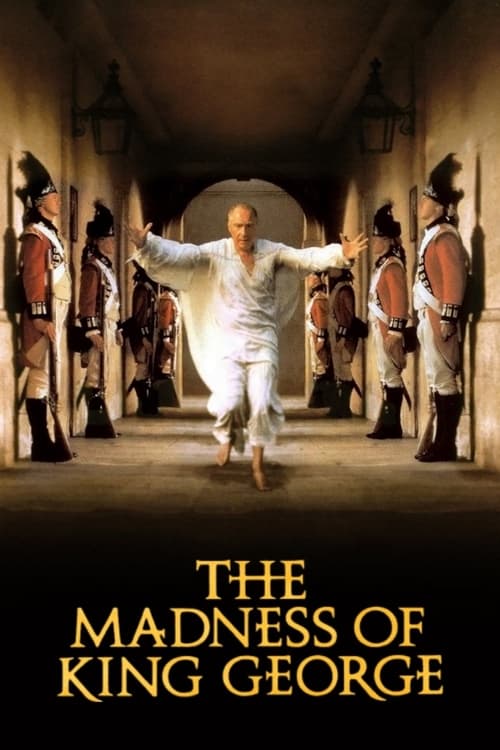
The Madness of King George
1994 · Nicholas Hytner
For when you want smart entertainment that sneaks up on your heart — a literate, briskly funny period piece that's comfort viewing with teeth.
What it's about
In 1788, King George III begins to unravel — babbling through the night, erupting at courtiers, losing the thread of his own mind — and nobody, least of all his doctors with their purges and blisterings, understands why. As Queen Charlotte and Prime Minister Pitt scramble to hide the crisis, the king's scheming son the Prince of Wales sees his chance to seize power, and a blunt, unorthodox doctor arrives with methods that treat the King of England like any other patient.
The experience
Sharp, funny, and unexpectedly moving — a costume drama that crackles with wit while never losing sight of the frightened human being inside the crown. It swings from farce to real anguish and earns both.
Performances
Nigel Hawthorne, in the role he originated on stage, gives one of the great screen performances of the decade: a king who is by turns hilarious, terrifying, and heartbreaking, often in the same scene. Helen Mirren brings fierce devotion to Queen Charlotte, and Ian Holm is flint-hard as the doctor who refuses to be awed by majesty.
The craft
Alan Bennett adapted his own acclaimed play, keeping its verbal snap while Nicholas Hytner, in his film debut, opens it out into palaces, Parliament, and countryside with theatrical confidence. The clash between glittering royal ceremony and the crude medicine of the age gives the film its distinctive texture — gilt and grime side by side.
Why it matters
A defining film of the 1990s British costume-drama revival, it turned Bennett's stage hit into an international success and fixed Hawthorne's George III as the portrait of the mad king in popular memory.
Snapshot
The Madness of King George is the screen adaptation of Alan Bennett's stage play The Madness of George III, which had premiered at London's National Theatre in 1991 under Nicholas Hytner's direction. The film transfers Bennett's chronicle of the 1788–89 Regency Crisis — when George III's descent into apparent insanity threatened to topple Prime Minister William Pitt the Younger and hand power to the dissolute Prince of Wales — to the screen with most of the play's key talent intact, above all Nigel Hawthorne in the title role he had originated on stage. It marked the feature directing debut of Hytner, a theater director of rising stature, and stands as one of the defining works of the mid-1990s British costume-drama revival. The film is at once a clinical study of an illness imperfectly understood in its own time, a political thriller about the fragility of constitutional power, and a meditation, by way of King Lear, on the gulf between the man and the office he embodies. It won the Academy Award for Best Art Direction for Ken Adam and Carolyn Scott, and brought Hawthorne and Helen Mirren to international attention.
Industry & production
The project descended directly from the stage success. Bennett adapted his own play; Hytner, who had staged it, directed; and the production retained Hawthorne, whose performance had been the engine of the theatrical version. The film was produced by Stephen Evans and David Parfitt and released by the Samuel Goldwyn Company, with backing characteristic of the British public-private financing model of the period in which broadcaster and independent money combined to fund mid-budget literary properties. (The precise corporate financing structure I will not detail beyond this, as the published record is not consistent enough to assert specifics with confidence.)
The most often-repeated fact about the production is its retitling. The play's George III became, for the film, King George, and the standard explanation — that distributors feared American audiences would assume they had missed The Madness of King George I and II — has been retold for three decades. Bennett himself addressed the story with characteristic dryness, treating the "sequel" anxiety as something between marketing rationale and joke; it should be cited as the received account rather than as documented studio minutes. Whatever the truth, the change quietly signals the film's commercial ambition: a National Theatre property repackaged for the transatlantic art-house and awards market.
The film performed strongly within its class, anchoring the cluster of acclaimed British period pictures that crowded 1994–95. It collected the Best Art Direction Oscar and nominations for Hawthorne (Best Actor) and Mirren (Best Supporting Actress), with Mirren also taking the Best Actress prize at the 1995 Cannes Film Festival, and Hawthorne winning the BAFTA for Best Actor. I will not quote box-office figures, as I cannot verify them.
Technology
The film was shot photochemically on 35mm, the standard for prestige drama of the era, and finished for conventional theatrical projection; I will not assert a specific aspect ratio or lens package, as I cannot confirm those details. What is worth noting technologically is the absence of spectacle technology: this is a production whose "effects" are entirely pro-filmic — built sets, real historic interiors, candle and window light, period costume and makeup. The visible deterioration of Hawthorne's king is achieved through performance, makeup, and lighting rather than any optical process. In this sense the film belongs to a tradition that treats the camera as a recording instrument for theatrically conceived material, and its technical sophistication lies in production design and photography rather than in postproduction manipulation.
Technique
Cinematography
Andrew Dunn photographed the film. The visual scheme contrasts the cool, ordered grandeur of state interiors — symmetrical, frontal, lit to flatter Ken Adam's architecture — with the increasing visual disorder that accompanies the king's collapse. As George's condition worsens, the camera grows more mobile and the compositions more cramped and unbalanced, mirroring the loss of royal composure. Dunn exploits the natural light of the historic locations and the warm pools of candlelight in the restraint and treatment scenes, where the king is reduced from sovereign to patient. The photography is restrained rather than showy, in keeping with a film that wants the human face — Hawthorne's above all — to carry the meaning.
Editing
Tariq Anwar edited the film. The cutting serves Bennett's brisk, epigrammatic dialogue and the play's parallel structure, intercutting the sickroom with the political maneuvering at Westminster so that the king's bodily crisis and the constitutional crisis advance in tandem. The film's pace is notably quicker than the heritage-drama norm; Anwar's editing keeps the wit moving and prevents the material from settling into tableau, an important achievement in opening out a text written for the stage.
Mise-en-scène / staging
This is the film's signal strength, and the reason for its sole Academy Award. Ken Adam — celebrated for the modernist fantasias of the James Bond films and the War Room of Dr. Strangelove — brought to the eighteenth-century interiors a sense of scale and geometry that makes the palaces feel both magnificent and oppressive. Filming took place in a series of authentic English historic houses and institutions (among them Arundel Castle, Broughton Castle, Wilton House, Eton College and Thame Park are commonly cited), and Adam's design integrates real architecture with built sets so that the seams are invisible. The staging repeatedly frames the king within the apparatus of monarchy — thrones, processions, the rituals of dressing and dining — and then strips that apparatus away as he is bound into a restraining chair, the throne's grotesque double. Hytner, schooled in the theater, blocks scenes for clarity and irony, but consistently uses the camera to do what the stage could not: to isolate the king's face, and to show the watching, calculating eyes of those around him.
Sound
George Fenton composed and arranged the score, drawing heavily and pointedly on the music of George Frideric Handel — the court composer of the Hanoverian monarchy. The use of Handel is dramaturgically exact: it is the music of George III's own dynasty and milieu, and its baroque grandeur both ennobles the king and ironises his degradation, the stately measures playing against the indignities on screen. The sound design otherwise favours the intimate and the clinical — the scrape of instruments, the murmur of physicians, the king's own torrential, disordered speech — against the formal hush of the state rooms.
Performance
The film is built on Nigel Hawthorne's central performance, a portrait of intelligence, authority and tenderness disintegrating and then, agonisingly, reassembling. Hawthorne — who had played the role on stage and was then best known to British audiences as the mandarin Sir Humphrey in Yes Minister — gives the king a restless, voluble wit even in collapse, so that the tragedy is of a sharp mind watching itself fail. Helen Mirren's Queen Charlotte supplies the film's emotional ballast, her loyalty and grief grounding the political machinations. Ian Holm plays Dr. Willis, the clergyman-physician whose regime of discipline and "fixing" the king with his eye is the film's most disturbing thread, and Rupert Everett gives the Prince of Wales a petulant, wounded vanity. Julian Wadham's Pitt and a deep bench of British character actors fill out a world in which everyone is performing a role for an audience of rivals.
Narrative & dramatic mode
Bennett's screenplay operates in two registers simultaneously: a medical narrative of illness, misdiagnosis and brutal treatment, and a political narrative of succession and constitutional jeopardy. The dramatic engine is the question of the Regency Bill — whether the Prince of Wales will be installed as regent, which would mean Pitt's fall and the elevation of the opposition Whigs under Fox. The king's recovery is therefore not merely a personal deliverance but a political reversal, and Bennett refuses to let the two threads separate: the most private bodily humiliations of the monarch are matters of state. The mode is fundamentally ironic — Bennett's voice is too skeptical for hagiography — but it modulates into genuine pathos, particularly in the late scenes where the recovering king reads King Lear with his attendants and recognizes himself in Shakespeare's broken sovereign.
Genre & cycle
The film sits at the intersection of historical biography, political drama and the British "heritage film." It arrived amid a remarkable concentration of mid-1990s English costume pictures — Sense and Sensibility, Persuasion, Restoration, Carrington and others followed within roughly a year — but it is sharper and more astringent than the genre's romantic norm. Where the typical heritage film offers nostalgic immersion in the textures of the past, The Madness of King George uses period spectacle ironically, exposing the cruelty and absurdity beneath the pageantry. It belongs equally to the lineage of the literate British political drama, and to the tradition of theatrical adaptations brought to the screen with their stage casts intact.
Authorship & method
The film is best understood as a triple authorship: Bennett, Hytner, and Hawthorne, with Ken Adam as a decisive fourth voice. Alan Bennett, one of Britain's most distinctive dramatists, supplies the sensibility — the mixture of erudition, comic deflation and underlying compassion, and the recurring preoccupation with Englishness, institutions and the private self trapped inside a public role. Nicholas Hytner, in his first film, brings a theater director's command of actors and text and a clear-eyed visual intelligence; he would go on to direct The Crucible (1996) and reunite with Bennett for The History Boys (2006) and The Lady in the Van (2015), before and during his long tenure running the National Theatre. Andrew Dunn's photography, Tariq Anwar's editing, George Fenton's Handelian score and above all Ken Adam's design are not decorative supports but co-authors of the film's argument about monarchy as spectacle. The method throughout is one of fidelity to a strong stage text, "opened out" with restraint rather than inflated — the film trusts the writing and the performances.
Movement / national cinema
This is emphatically a work of British national cinema in its 1990s configuration: a National Theatre property, publicly inflected financing, a cast drawn from the British stage, and a subject — the monarchy and its discontents — at the center of English self-understanding. It exemplifies the period's productive traffic between the London stage and British film, and the export of "quality" Englishness to the international market. At the same time, its skepticism toward royal mystique gives it an edge that complicates any simple reading as cultural-tourist heritage.
Era / period
The film depicts the late 1780s, the height of the Georgian era, with the American Revolution recently lost and the French Revolution about to erupt — a context the film registers in its anxieties about the legitimacy and stability of monarchy. The treatment of the king's illness is rooted in the medicine of its day: bleeding, blistering, purging, and the moral-disciplinary regime of Dr. Willis. The film's implicit framing of the malady draws on the twentieth-century theory — popularized by the historians Ida Macalpine and Richard Hunter — that George III suffered from porphyria, signaled in the film by the discoloured urine. It should be noted that this diagnosis has since been seriously contested by later scholarship favouring a psychiatric explanation; the film, made in 1994, reflects the porphyria consensus of its moment rather than the current state of debate.
Themes
The film's governing theme is the doubleness of the king — the natural body that sickens and the political body that must not be seen to fail. Bennett dramatizes monarchy as a relentless performance, in which the man is permitted no privacy and no breakdown, and madness becomes the moment the performance collapses. From this flow the film's other concerns: the cruelty and arrogance of medicine confronted with a condition it cannot name; the predatory nature of politics and family, as son schemes against father; and the relationship between sanity and power — to be mad is, for a king, to cease to be king. The recurring invocation of King Lear makes the theme explicit, mirroring George's plight against Shakespeare's archetype of the sovereign undone, while the recovery scene's reading of the play offers a fragile, literary form of healing.
Reception, canon & influence
The film was widely and warmly received as one of the outstanding British films of its year, praised above all for Hawthorne's performance and for the intelligence of Bennett's writing. Its awards profile — the Best Art Direction Oscar, acting nominations for Hawthorne and Mirren, Mirren's Cannes Best Actress award, and Hawthorne's BAFTA — confirmed its standing. Its influences run backward to Bennett's own body of stage work and to the deep well of Shakespearean tragedy it openly draws upon, and to the British tradition of the historical chronicle. Looking forward, it helped consolidate the mid-1990s vogue for British period drama and demonstrated a commercially viable model for transferring National Theatre productions to film with cast and creative team intact. It launched the screen directing career of Nicholas Hytner and cemented an ongoing Bennett–Hytner partnership that would culminate in further screen adaptations. Within the canon it endures as a benchmark for the intelligent historical film — a period piece whose pleasures of design and performance are inseparable from a genuine argument about power, illness and the loneliness of the represented self. Beyond these well-documented lines of reception and legacy, claims of specific influence on later filmmakers are not strongly established in the record, and I will not manufacture them.
A Deleuzian reading
They strap him into a chair.
The full Deleuzian reading of The Madness of King George →
Reception
A warm critical hit in 1994 — four Oscar nominations, a Cannes prize for Helen Mirren — that has since settled into 'beloved-but-underdiscussed' territory: less canonized than its awards haul suggests, but reliably rediscovered whenever royal-madness stories (The Favourite, The Crown, Queen Charlotte) send viewers back to the template.
How The Madness of King George was received, from release to now →
Influences: the films it descends from and the films it influenced
- Barry Lyndon (1975) — Ken Adam's own Oscar-winning Georgian production design and John Alcott's candlelit, natural-light interiors are the direct template for this film's pro-filmic, no-spectacle period look.
- Dr. Strangelove (1964) — Establishes Ken Adam's architecture-of-power design grammar — rooms that dramatize authority — which he carries into staging monarchy as spectacle here.
- Amadeus (1984) — A Peter Shaffer stage play 'opened out' to film, anchoring court drama to a period composer's score (Mozart, as Fenton uses Handel) and fusing genius/madness with royal patronage.
- A Man for All Seasons (1966) — Robert Bolt's prestige stage-to-screen method — fidelity to a strong text, restrained opening-out — that defines the intelligent English historical chronicle this film inherits.
- The Lion in Winter (1968) — James Goldman's stage play of royal-family power struggle driven by theatrical verbal sparring, anatomizing the king's body politic through performance rather than spectacle.
- Becket (1964) — Anouilh stage adaptation that splits the English king between public office and private agony — the two-bodies tension Bennett sharpens via porphyria.
- King Lear (1971) — The explicit Lear template the film draws on: a sovereign's collapsing mind staged so that madness mirrors the disorder of the realm.
- The Madness of George Dundee / Chimes at Midnight (1965) — Welles's Shakespearean treatment of kingship and the lonely body of the monarch, the dramaturgical well of the represented self that Bennett's script taps.
- The History Boys (2006) — The Bennett–Hytner reunion that perfects this film's pioneering model: transferring a National Theatre production to screen with cast and creative team intact.
- The Lady in the Van (2015) — Continues the Bennett–Hytner screen partnership and Bennett's signature mix of erudition, comic deflation and the private self trapped in a public role.
- The Crucible (1996) — Hytner's second feature extends his theater-director's command of a strong dramatic text opened out with visual restraint rather than inflation.
- The Queen (2006) — Anatomizes the represented self's private loneliness inside public monarchy, with Helen Mirren (Queen Charlotte here) carrying a study of the crown's dual body.
- The King's Speech (2010) — A monarch defined by bodily affliction, structured on the same dual medical-political narrative — an incapacitated king and the intimacy of clinical treatment as power play.
- The Gathering Storm (2002) — A stage-derived portrait of a powerful man unraveling privately (Hawthorne's Nigel Hawthorne turn), pointing a high-caliber British craft team entirely at one central performance — the same prestige-theatre-to-screen model.
- Mrs Brown (1997) — A heritage-film study of the monarch's private self against public role (Victoria), built on intimate performance and the loneliness of the crown.
- Elizabeth (1998) — Stages monarchy-as-spectacle through aggressive production design, making the two-bodies-of-the-king idea a primarily visual argument.
- Restoration (1995) — A contemporaneous, design-forward Stuart-court heritage film treating monarchy as lavish spectacle, part of the mid-1990s British period vogue this film consolidated.
- Howards End (1992) — The early-1990s British heritage aesthetic — literate adaptation plus meticulous period design and natural light — that King George extended into the historical-chronicle mode.
- The Favourite (2018) — Shares the bodily-grotesque, court-intrigue chamber drama centered on a physically failing monarch manipulated by attendants and rivals, the same triangular palace-power mechanics.
Similar films
- The King's Speech (2010) — influence & lineage
- The Queen (2006) — influence & lineage
- The Lion in Winter (1968) — influence & lineage
- Barry Lyndon (1975) — influence & lineage
- Hamlet (1996) — shared sensibility
- The Man Who Would Be King (1975) — shared sensibility
- Marnie (1964) — shared sensibility
- One Flew Over the Cuckoo's Nest (1975) — shared sensibility