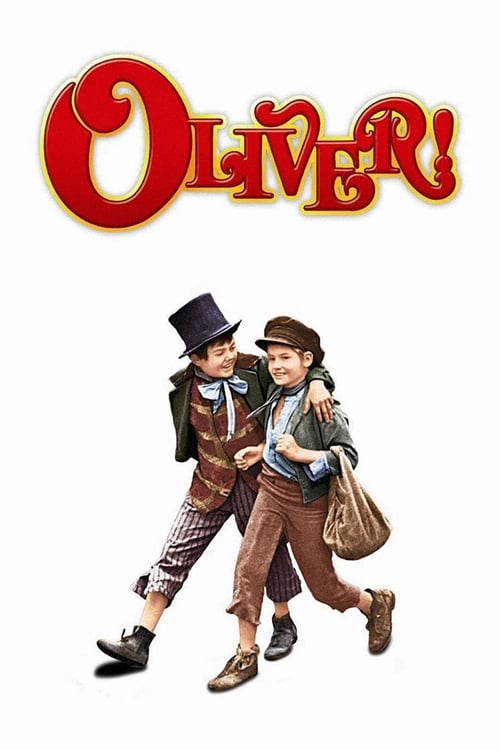
Oliver!
1968 · Carol Reed
For a grand family movie night or a rainy Sunday when you want an old-fashioned spectacle with songs you'll be humming for a week — comfort viewing with more bite than you remember.
What it's about
In Victorian London, an orphan boy who dares to ask the workhouse for more food is cast out into the streets, where the quick-fingered Artful Dodger sweeps him into a den of child pickpockets run by the wily old thief Fagin. Charles Dickens' tale of innocence adrift in a cruel city, retold as a full-scale musical — with the menacing housebreaker Bill Sikes casting a long shadow over the songs.
The experience
Rousing and big-hearted, but with real darkness at its edges — one minute you're swept up in a street-filling song-and-dance number, the next the Victorian cruelty underneath comes through cold. That push and pull between joy and menace is exactly what makes it linger.
Performances
Ron Moody's Fagin is the treasure: funny, sly, and unexpectedly poignant, a rogue you can't help loving. Jack Wild is pure charm as the Artful Dodger, and Oliver Reed's wordless, glowering Bill Sikes brings genuine threat into a musical without singing a note.
The craft
Carol Reed — a master of shadows and moral ambiguity — stages Lionel Bart's songs on enormous, teeming recreations of Victorian London, in a Technicolor palette of amber and soot. The choreography turns whole street markets into dance floors; it's the roadshow musical at its most lavish, made for a big screen.
Why it matters
It swept six Academy Awards including Best Picture — the last musical to do so for over three decades — and stands as the grand finale of the 1960s big-studio musical era.
Snapshot
Carol Reed's adaptation of Lionel Bart's stage musical—itself derived from Charles Dickens' Oliver Twist—is the grandest and most paradoxical of the late-1960s roadshow musicals: a film that wraps institutional cruelty, child exploitation, and domestic murder inside rousing set-pieces and a Technicolor palette of amber and soot. Winner of six Academy Awards including Best Picture and Best Director, it was the last musical to claim the top Oscar until Chicago in 2003. Its achievement is not merely spectacle but tonal negotiation—the sustained tension between Bart's buoyant populism and the Dickensian darkness the material refuses to fully relinquish. Reed, whose signature was moral ambiguity photographed in shadow, found in this ostensibly cheerful assignment a subject he understood from the inside out.
Industry & production
The road from Bart's London stage premiere (June 1960, New Theatre) to Reed's film was long and contentious. The stage musical ran for 2,618 performances in the West End and opened on Broadway in January 1963, winning Tony Awards and establishing itself as a canonical postwar British musical. Film rights were complicated by the existence of David Lean's distinguished 1948 film adaptation of the Dickens novel, which Columbia Pictures controlled. Once the rights landscape was resolved and Columbia committed to a prestige production, Donald Albery and John Woolf produced through Romulus Films with a budget substantial enough to build an entire district of Victorian London on the backlot at Shepperton Studios in Surrey.
Reed came to the project relatively late in its development, but his hiring made sense in retrospect: he was a prestige name whose career had somewhat faltered since the early 1950s peaks, and he had a proven record with intimate, psychologically complex British narratives. The assignment was both a reclamation and, for some critics, a surprise deployment of a dark-realist director on family musical material. The production was staged as a roadshow release—reserved-seat engagements, overture, intermission, exit music—a format that by 1968 was beginning to lose commercial favor following expensive failures elsewhere in the cycle.
Ron Moody, who had created the role of Fagin on the London stage, fought to repeat the performance on film; the role had at various points been considered for other actors. His retention was artistically crucial. Mark Lester was cast as Oliver after an extensive search for a child of the right type and voice (Lester's singing was partially dubbed by Kathe Green). Jack Wild, who played the Artful Dodger, came out of the same wave of British child performers, while Oliver Reed—no relation to the director—was cast as Bill Sikes, bringing an authentic menace to a role that in lesser hands could become pantomime villainy. Shani Wallis, a veteran of British stage and television, played Nancy.
Technology
The production was shot in Panavision anamorphic and released in Technicolor through a dye-transfer print process that gave the image a particular depth and warmth. Cinematographer Oswald Morris—collaborating with Reed for the first time after distinguished work on Moulin Rouge (1952), Moby Dick (1956), and The Spy Who Came in from the Cold (1965)—made a distinctive decision to mute and age the color palette, working with diffusion and filtration to produce what he described as a tallow-candle quality: amber tones, atmospheric haze, a sense of grime and gaslight embedded in the very photochemistry of the image. This was deliberate counter-programming against the saturated primary colors typical of contemporary musicals and contributed significantly to the film's coherent visual world.
John Box's production design was the film's other major technological accomplishment. Box, who had designed Lawrence of Arabia (1962) and Doctor Zhivago (1965) for David Lean, constructed massive exterior sets at Shepperton that represented not a documentary Victorian London but an expressionistic one—heightened, exaggerated in proportion, spatially organized for choreographic use. The set for "Consider Yourself" alone, a labyrinthine market street descending into a broad square, was designed with the movement of hundreds of performers explicitly in mind, building choreographic infrastructure into the architecture of the set.
Technique
Cinematography
Morris's work on Oliver! represents a sustained argument that a musical can sustain visual gravity. His use of deep-focus compositions within the widescreen anamorphic frame keeps the children grounded against monumental architectural backdrops without reducing them to spectacle; the camera frequently finds Oliver at the bottom of a frame filled with threatening or indifferent adult height. For the intimate scenes—Fagin's den, Nancy's confrontation with Bill—Morris shifts toward tighter, lower-key work, the warmth of the color grading giving way to a more oppressive atmosphere. The film does not maintain a single visual register, which is part of its tonal sophistication: the market-day exteriors look and feel different from the thieves' kitchen interiors, which look and feel different again from the final rooftop sequence.
Editing
Editor Ralph Kemplen, who had cut several of Reed's earlier pictures including The Third Man (1949) and Outcast of the Islands (1951), maintained a rhythmic discipline across a film that runs approximately 153 minutes including intermission. The musical numbers required precise synchronization between Onna White's choreography and the pre-recorded tracks, while the dramatic sequences demanded a different, more psychological tempo. Kemplen's handling of the climax—Bill Sikes's flight across rooftops and the crowd gathering below—achieves genuine suspense within a film that has, until that point, been resolutely in the key of entertainment.
Mise-en-scène / staging
Reed's staging instinct, honed across decades of work in tight British interiors, adapted to the musical format with notable success. He understood the difference between a number staged for theatrical visibility and one staged for the camera's eye. "Who Will Buy?" is particularly instructive: set in Bloomsbury at dawn, it uses the widescreen frame to isolate Oliver in a vast, still environment, turning a catalog song into a meditation on the orphan's solitude. Reed's handling of Fagin's den consistently returns to thresholds and enclosures—Oliver watched from above, partially concealed, framed in archways—visual habits that trace to his noir period.
The choreography by Onna White operates in dialogue with, rather than in submission to, Reed's directorial instincts. White's large-scale street numbers have a Brechtian directness—the performers acknowledge the festive nature of the spectacle—while her more intimate staging integrates naturally with Reed's scene-building. The honorary Academy Award White received acknowledged choreographic work that was genuinely sculptural in its use of the three-dimensional space Box had designed.
Sound
Musical director John Green oversaw the orchestration and recording, working from Bart's original score and songs. The orchestrations for the film—richer and more deeply textured than what the West End stage had deployed—maintain the folk-music and Cockney-music-hall idioms Bart had drawn from while adding cinematic sweep. The sound mix, which won the Academy Award for Best Sound, navigated the challenge common to all roadshow musicals of balancing the pre-recorded playback against the actuality of large-scale exterior scenes. The film's sonic palette reinforces its visual one: warm and slightly worn, as though the music itself had been discovered rather than composed.
Performance
The film's tonal range is anchored by Moody's Fagin—a creation that is simultaneously comic, theatrical, and genuinely unsettling, never allowing the audience to fully forget that this man runs children as criminal labor. Moody brings a musicality of gesture that is inseparable from Bart's songs: "You've Got to Pick a Pocket or Two" and "Reviewing the Situation" are performances in which the song and the character's self-understanding are shown to be mutually constitutive. Oliver Reed's Bill Sikes operates in a completely different register—flat, dangerous, sullen—and the film is wise to keep him largely outside the musical grammar; he does not sing, and his presence consistently short-circuits the festive energy that otherwise dominates.
Mark Lester's passivity as Oliver—a blank at the center of swirling performance—is arguably purposeful rather than a limitation: the orphan as an open receptacle for the audience's identification. Jack Wild brings an irrepressible physicality to the Dodger that earned him a Best Supporting Actor nomination.
Narrative & dramatic mode
Oliver! employs the classic road-narrative structure of the bildungsroman from which it derives, but disrupts it through musical convention: each number freezes forward momentum to assert an emotional or social condition. The narrative grammar of the Dickens original—coincidence as providential mechanism, identity revealed through inheritance—is retained in compressed form. What the musical adaptation adds is a persistent present-tense communal voice: the numbers do not advance plot so much as articulate the ethos of each social world Oliver moves through. The workhouse collectively sings its hunger; the London underworld collectively sings its pragmatic solidarity; these are choruses that define community through shared want.
The film handles the darker material—Nancy's murder, the violence implicit in Sikes throughout—with more directness than might be expected in a G-rated family production, a fact that generated some contemporary comment. The murder happens off-screen but is not prettified; its aftermath and the crowd's response are staged as genuine horror.
Genre & cycle
Oliver! belongs to the cycle of prestige roadshow musicals that dominated Hollywood and British production between roughly 1964 and 1969: My Fair Lady (1964), The Sound of Music (1965), Doctor Dolittle (1967), Funny Girl (1968), Hello, Dolly! (1969). The cycle was premised on the assumption that the theatrical musical—already somewhat nostalgic in the age of rock—could translate into massive film events. The Sound of Music's extraordinary commercial success licensed a series of expensive productions, several of which failed significantly. Oliver! was among the last commercially and critically successful entries in the cycle; the roadshow model effectively collapsed with the failures of Hello, Dolly! and Paint Your Wagon (both 1969).
As a British entry in a predominantly American generic mode, Oliver! occupied a particular position: it drew on British theatrical and musical traditions while meeting the production values expected of Hollywood spectacle. Its Dickensian source material gave it a literary prestige that sat unusually well with the populist energy of Bart's songs.
Authorship & method
Carol Reed (1906–1976) built his reputation on intimate British moral dramas photographed with expressionist shadow and geometric precision: Odd Man Out (1947), The Fallen Idol (1948), The Third Man (1949). His instinct for framing moral precarity—characters caught between institutions and impulse—translated into Oliver! as an ability to hold the film's tonal dissonances in productive suspension. His experience directing children (particularly Secker in The Fallen Idol) informed his handling of Lester and Wild.
Oswald Morris (1915–2014), one of the most technically innovative British cinematographers of his generation, brought to Oliver! the same willingness to experiment with photographic process he had deployed on John Huston's Moulin Rouge, where he had similarly aged and distressed the color image. His collaboration with Box was close and productive.
John Box (1920–2005) was the film's visual architect, and his production design—massive, functional as choreographic infrastructure, historically inflected rather than historically pedantic—is as important to the film's achievement as any directorial decision.
Lionel Bart (1930–1999) wrote the original musical's book, music, and lyrics, drawing on Dickens with a particular sensitivity to the communal dimensions of poverty. Bart famously sold his rights to the musical to finance other projects, a decision that cost him considerably as Oliver! became one of the most commercially durable British musicals of the century.
Vernon Harris (1905–1999) wrote the screenplay, adapting Bart's stage adaptation with judicious compression. His script finds ways to cinemafy material designed for theatrical space without losing the episodic character essential to both the Dickens novel and Bart's conception.
Movement / national cinema
Oliver! sits at an intersection of British cinema traditions that rarely coincide: the prestige literary adaptation, the kitchen-sink-adjacent engagement with urban poverty, and the musical spectacular. It belongs to a tradition of Dickens adaptation in British cinema that runs from the silent era through Lean's Oliver Twist (1948)—a film Reed's work is in oblique but constant dialogue with—and forward. The choice to build Victorian London on British soil, with a largely British cast and crew, using British studio infrastructure, gave the production a national-cinema character that distinguished it from the American-produced British-set spectacles of the period.
It was made during the same years as British cinema's New Wave consolidation and the decline of the studio system, but Oliver! was neither of those things: it was an expensive, technically conservative prestige production in a mode that had already peaked. That it succeeded where many contemporaneous productions failed is a tribute to the specificity of its craft.
Era / period
The film was produced and released at a precise historical pivot: 1968, the year of student revolts, political assassinations, and counterculture consolidation. Oliver! is aggressively retro-facing, a lavish engagement with Victorian poverty and Dickensian moral sentiment at the moment when cinema was moving toward Easy Rider and Midnight Cowboy. The Academy's preference for Oliver! over 2001: A Space Odyssey, Rosemary's Baby, and Bullitt in the 1968 field has been read as the Academy's own backward glance, a preference for established forms at a moment of generic disruption. Whether that reading is entirely fair, the film's period aesthetic—its amber diffusion, its Shepperton backlot London—participates in a kind of deliberate temporal displacement that was the roadshow musical's essential promise to its audience.
Themes
The film inherits from Dickens and amplifies through Bart's musical idiom a cluster of themes that remain legible across all three iterations: the orphan's quest for belonging, the institutional indifference of respectable society toward the poor, the ambiguous solidarity of the criminal underworld (warmer in some respects than the workhouse or the bourgeois household), and the possibility of redemption through inheritance of identity and name.
The tension between communal festivity and individual suffering runs throughout. The workhouse sequences present institutionalized want; the Fagin sequences present improvised community at the cost of moral education; the Brownlow sequences present respectable comfort at the cost of connection. Oliver's passage through these worlds is also a passage through different models of social organization, none of which is idealized without complication.
The film also quietly engages—through the Sikes/Nancy relationship and its violent conclusion—with domestic violence as a social fact. The musical form's lightness makes this violence, when it comes, more rather than less disturbing.
Reception, canon & influence
Critical reception at the time was largely favorable for the spectacle and the performances, with some reservations about the generic category itself—critics in 1968 who had absorbed the New Cinema were not always certain how to value what Reed had done. The Academy, the Golden Globes, and the BAFTA all recognized the film substantially. Ron Moody's Fagin has retained canonical status as a screen performance, while the film as a whole occupies an unambiguous place in the history of the British musical.
Influences on the film are layered. The most direct ancestor is Lean's 1948 Oliver Twist, which established a visual and tonal grammar for Dickens on screen that Reed simultaneously echoes and softens. Behind Lean lie the silent adaptations (Baggot, 1909; a series of British shorts) and the long tradition of stage melodrama from which the Dickens serialization itself drew. Bart's musical explicitly invoked the Victorian music-hall tradition—the communal sing-along, the melodramatic narrative ballad—and Reed worked within those invocations. The Hollywood musical's choreographic traditions, particularly the integration of architecture and movement developed from Busby Berkeley through Stanley Donen and Gene Kelly, are absorbed and Anglicized.
Legacy and forward influence are significant, though somewhat diffuse. Oliver! effectively closed the first era of British megamusical filmmaking; no comparable British prestige production in this mode would appear for years. The film's approach to Fagin—softening the novel's antisemitic caricature without fully erasing its traces—initiated a critical discourse about Dickens adaptation and representation that continues in stage revivals and academic accounts. Moody's performance became a benchmark against which subsequent Fagins (including in decades of West End revivals) were measured, a status that constrained as much as it honored.
The cinematographic approach—diffused, warm, period-inflected color rather than the saturated primaries of contemporaneous American musicals—prefigured techniques that would become common in British period productions over the following decades. The principle that a historical setting calls for photographic aging, not photographic correction, has been influential in costume drama cinematography.
The film is regularly revived as a family entertainment and appears in national curricula as a gateway to Dickens, a function Bart always intended the musical to serve. Its place in the canon is secure if not always interrogated; it is more often experienced than studied, which is perhaps the condition of all popular art that has fully metabolized into the culture it once surprised.
A Deleuzian reading
Watch where Carol Reed keeps putting the boy.
The full Deleuzian reading of Oliver! →
Reception
A genuine smash in 1968 — six Oscars including Best Picture — it's since become the go-to exhibit in 'the Academy got it wrong' arguments, winning Best Picture the same year 2001: A Space Odyssey wasn't even nominated. The film itself, though, has aged into a warmly regarded classic of the roadshow-musical era.
How Oliver! was received, from release to now →
Influences: the films it descends from and the films it influenced
- Oliver Twist (1948) — Reed inherited Lean's established lighting grammar for Victorian London interiors—threshold-framing of figures silhouetted in doorway and arch spans, low-key shadow pools as moral geography—then deliberately softened their contrast density to accommodate the musical's tonal register without abandoning the spatial logic.
- The Third Man (1949) — Reed carried his own compositional habit of threshold framing—figures caught between diegetic zones in doorways and archways—from his noir work directly into Oliver!'s choreographic blocking, using the device to hold comedy and menace in simultaneous spatial suspension rather than separating them by cut.
- Moulin Rouge (1952) — Cinematographer Oswald Morris first devised his technique of stretching nylon stocking material over the lens to distress and warm the color image at Huston's request, evoking Toulouse-Lautrec's palette; he reprised this exact gauze-diffusion method for Oliver!'s muted-amber period palette, aging the Technicolor image toward painterly authenticity.
- Oklahoma! (1955) — The first anamorphic wide-screen musical to grapple systematically with the staging problem of isolating a protagonist in one register of the wide frame while the chorus occupies the other—a compositional logic Oliver! inherited and John Box's street-set architecture solved as a design principle rather than a blocking problem.
- Gigi (1958) — As the first CinemaScope prestige literary adaptation to choose period-inflected, desaturated color over the saturated primaries of 1950s Technicolor musicals, Gigi established the aesthetic logic—historical setting calls for photographic aging, not photographic correction—that Morris systematized for Oliver!'s palette.
- West Side Story (1961) — Robbins formalized the principle of designing choreography around specific architectural features as movement infrastructure—fire escapes, gymnasium floors, fences that dictate spatial patterns—a method John Box absorbed when designing Oliver!'s sets as functional choreographic machines rather than period decoration.
- My Fair Lady (1964) — Rex Harrison's spoken-pitch delivery for Higgins—a non-singer integrated into a sung score through rhythmic gesture and inflected speech rather than sustained melody—directly prefigures Oliver!'s handling of Ron Moody's Fagin and Oliver Reed's Sikes within a sung ensemble, normalizing the non-singing principal as a legitimate dramatic device.
- The Sound of Music (1965) — Wise's editing convention of cutting on musical phrase boundaries in anamorphic widescreen—synchronizing image transitions to pre-recorded orchestral markers rather than to dramatic action—established the choreography-synchronization grammar Oliver!'s editors inherited as industrial roadshow protocol.
- Scrooge (1970) — The first film to adopt Oliver!'s complete production grammar for British literary musical filmmaking wholesale—muted-amber period-distressed color, Victorian London sets built as choreographic infrastructure, pre-recorded playback, communal-chorus structure anchoring a Dickens bildungsroman—treating each device as inherited rather than invented.
- Cabaret (1972) — Fosse extended Oliver!'s tonal-dissonance device—violence and threat held within entertainment spectacle through spatial simultaneity—by architecturalizing it: his threshold framing between the Kit Kat Klub stage and the Nazi street is the same formal technique Reed used to keep Sikes's brutality and Fagin's comedy in one suspended frame, pushed from productive ambiguity to ironic critique.
- Barry Lyndon (1975) — Kubrick and John Alcott extended the Morris principle—historical period requires photographic aging rather than photographic correction—to its technical limit, using candlelight and wide-aperture NASA lenses to produce the muted amber low-contrast tones that Morris had achieved through lens-gauze and color-timing, tracing the same aesthetic logic to a different technical endpoint.
- Annie (1982) — Annie's structural design maps onto Oliver!'s point by point: institutional ensemble opening ('Hard Knock Life' mirroring 'Food, Glorious Food'), theatrical scene-stealing adult antagonist as Fagin's functional successor, orphan protagonist isolated in widescreen against communal chorus, bildungsroman resolved through patron adoption—inherited as a structural template rather than conscious homage.
- Les Misérables (2012) — Hooper's decision to record vocal performances live on set—inverting the pre-recorded playback protocol Oliver! had inherited from My Fair Lady—was an explicit correction to the gestural artificiality pre-recorded playback enforced; the prestige literary adaptation, communal-chorus structure, and bildungsroman spine are direct inheritances even as the recording method is reversed.
- Wonka (2023) — Dickensian British-studio musical whose massed street-choreography and orphan-underdog plotting are the lineage for Wonka's laundry-house captives and the Noodle subplot.
- The Great Muppet Caper (1981) — Shares Caper's core craft unit: Oswald Morris lensed it and Ralph Kemplen won the editing Oscar cutting its large-scale musical numbers, the same lensing-plus-cutting sensibility Henson recruited.
- Half a Sixpence (1967) — Produced in the same British prestige literary-musical cycle one year prior, Half a Sixpence worked through identical formal problems—pre-recorded playback, anamorphic widescreen, a bildungsroman protagonist anchored within chorus spectacle, sets designed as dance infrastructure for a Victorian H.G. Wells adaptation—making it a direct generic contemporary, not an influence.
- Funny Girl (1968) — Released the same year in the same roadshow format, Wyler and Herbert Ross independently solved the identical problem of isolating a solo performer's gestural expression in anamorphic widescreen against a chorus via pre-recorded playback, producing parallel formal solutions to the same staging challenge without direct influence in either direction.
Similar films
- Oliver Twist (1948) — influence & lineage
- The Third Man (1949) — influence & lineage
- Mary Poppins (1964) — shared sensibility
- The Kid (1921) — shared sensibility
- Sweeney Todd: The Demon Barber of Fleet Street (2007) — shared sensibility
- Scrooge (1951) — shared sensibility
- The Muppet Christmas Carol (1992) — shared sensibility
- The Wizard of Oz (1939) — shared sensibility
All the films related to Oliver! →