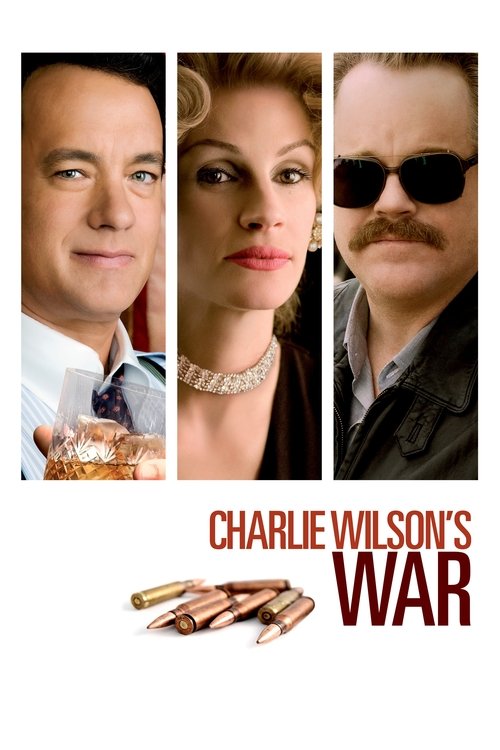
Charlie Wilson's War
2007 · Mike Nichols
For when you want to feel smart without working hard — a witty, grown-up entertainment that goes down like a cocktail. Ideal when you're in the mood for banter over battle scenes.
What it's about
In the 1980s, a hard-drinking, scandal-prone Texas congressman stumbles into the cause of his life: arming the Afghan rebels fighting the Soviet occupation. With a glamorous Houston socialite pulling strings and a gloriously rude CIA officer working the machinery, he quietly engineers the biggest covert operation in the agency's history — all from committee rooms, hot tubs, and back channels. It's a true story that plays like a caper.
The experience
Fast, funny, and dense with great talk — the pleasure is watching sharp people persuade, needle, and outmaneuver each other. It stays light on its feet for ninety-odd minutes, then lands a quiet sting about what the victory cost.
Performances
Philip Seymour Hoffman steals the film outright as the abrasive CIA man Gust Avrakotos — his first scene with Tom Hanks is a small comic masterpiece — while Hanks makes charm and appetite look like a political skill set, and Julia Roberts glitters as the true believer bankrolling the crusade.
The craft
Aaron Sorkin's screenplay is the engine: rapid-fire, quotable, built on overlapping agendas rather than exposition. Mike Nichols directs with the timing of a man who trusts his actors, keeping a story about geopolitics unusually compact and propulsive.
Why it matters
One of the last films from a legendary director, and a model for making real-world statecraft play as sparkling comedy with a conscience.
Snapshot
Charlie Wilson's War is a brisk, talky political comedy-drama about a real and improbable episode of Cold War statecraft: how a hard-drinking, scandal-prone Democratic congressman from East Texas helped engineer the largest covert operation in CIA history, funneling weapons and money to the Afghan mujahideen fighting the Soviet occupation in the 1980s. Adapted by Aaron Sorkin from George Crile's 2003 nonfiction book and directed by Mike Nichols, the film pairs Tom Hanks (as Charlie Wilson), Julia Roberts (as Houston socialite Joanne Herring), and Philip Seymour Hoffman (as abrasive CIA case officer Gust Avrakotos) in a fast, wry account of backroom persuasion. At roughly an hour and forty minutes it is unusually compact for a prestige drama on a geopolitical subject, and it ends on a deliberately sour note about unintended consequences. It carries additional historical weight as the final theatrical feature directed by Nichols, one of postwar American cinema's most versatile stage-and-screen figures.
Industry & production
The film sits squarely in the tradition of the star-driven, mid-budget adult drama that Hollywood still produced in the 2000s before such films were largely squeezed out by tentpole economics. Its production lineage runs through Tom Hanks's company Playtone (with producing partner Gary Goetzman) and Participant — the social-issue production outfit founded by eBay's Jeff Skoll — distributed by Universal Pictures with financing involvement from Relativity Media. The combination is telling: a major-studio release, a star package strong enough to greenlight a politically pointed subject, and a producing partner explicitly oriented toward films with a civic argument.
The source was George Crile's Charlie Wilson's War: The Extraordinary Story of the Largest Covert Operation in History (2003), reported by a longtime 60 Minutes producer. Hanks's involvement as both star and producer was central to the project's momentum, and the casting reads as an assembly of A-list and prestige talent: Roberts against type as a glamorous Texas anticommunist, and Hoffman — fresh off acclaim that would crest with Capote — as the film's comic and moral engine. Amy Adams plays Wilson's chief of staff Bonnie Bach, with Emily Blunt, Ned Beatty, and Om Puri (as Pakistan's President Zia-ul-Haq) in support. The picture was shot partly on location and on sets standing in for Washington, Texas, Pakistan, and the Afghan frontier; portions were filmed in Morocco for the region's landscapes. Released in December 2007, it was positioned as an awards-season entry and drew Golden Globe attention and an Academy Award nomination for Hoffman in the Best Supporting Actor category — the film's most durable industry recognition.
Technology
Technologically the film is conventional and deliberately so. It was photographed photochemically on 35mm in the classical studio manner, at a moment when digital capture was beginning its ascent but had not yet displaced film for prestige drama. There is no signature visual-effects program, no formal experiment with format or capture; the production's resources went into period dressing (1980s Washington and Capitol Hill interiors, Pakistani and Afghan locations), large dialogue ensembles, and the logistics of staging refugee-camp and combat-adjacent scenes rather than into any technological novelty. In an atlas of influence, the relevant point is the opposite of innovation: Charlie Wilson's War is a craftsman's film that treats its technical apparatus as invisible infrastructure in service of performance and talk.
Technique
Cinematography
Stephen Goldblatt, a British cinematographer (and a repeat Nichols collaborator, having shot Closer and the HBO production of Angels in America for the director), gives the film a clean, warm, classically lit look. The camerawork is functional in the best sense — it keeps pace with Sorkin's dense dialogue without calling attention to itself, favoring fluid coverage that lets actors move through rooms. Washington interiors are lit for comedy and clarity; the Afghan and refugee-camp sequences shift toward a harsher, dustier register that supplies the film's brief jolts of gravity. Goldblatt's restraint is a structural choice: the visuals are subordinate to the screenplay, and the photography's job is legibility and rhythm rather than spectacle.
Editing
The cutting — credited to John Bloom (an Oscar-winning editor and frequent Nichols collaborator) with Antonia Van Drimmelen — is the film's defining technical feature. The picture is fast and exceptionally lean; its short runtime is achieved through brisk scene transitions and tight handling of Sorkin's overlapping exchanges. The editing keeps comic timing crisp in the dialogue set-pieces (the office quarrels, the negotiation scenes) and then modulates to let the few sober beats — the refugee camp, the closing — land. The compression is itself an argument: the film races through a years-long covert campaign as if to mirror the giddy, improvised momentum of the operation it depicts, before braking hard at the end.
Mise-en-scène / staging
Nichols, a master of stage and screen blocking, stages much of the film as choreographed movement through interiors — corridors of power rendered literally, with characters talking as they walk. The production design contrasts environments to make a thematic point: the plush absurdity of Wilson's world (a hot tub in Las Vegas, congressional offices, Herring's Houston mansion) set against the austerity of the refugee camps and the spartan offices of the CIA. The staging keeps multiple figures active in the frame during the talkier scenes, using physical business and spatial relationships to dramatize shifting alliances.
Sound
Sound serves the dialogue first; this is a film where talk is the action, and the mix prioritizes the intelligibility and pace of overlapping speech. James Newton Howard's score is supportive rather than assertive, threading light comic and occasionally martial or folk-inflected textures around the geographic shifts without overwhelming the talk. The few scenes of conflict and refugee suffering use sound to puncture the comic surface and remind the audience of the stakes behind the banter.
Performance
Performance is where the film concentrates its energy. Hanks plays Wilson with a relaxed, roguish charm that lets the congressman's appetites and his genuine conviction coexist. Roberts, working against her usual register, plays Herring as a poised, ideologically fierce socialite. The standout is Hoffman's Gust Avrakotos: blue-collar, profane, contemptuous of Agency bureaucracy, and electric in every scene — the performance that earned the film's Oscar nomination and that supplies both its biggest laughs and its closing note of caution (Gust's parable about the Zen master and the recurring refrain "we'll see"). Amy Adams and the supporting ensemble keep the procedural machinery human. The acting is the film's primary delivery system for its ideas.
Narrative & dramatic mode
The film operates as a fast political comedy with a tragic undertow — a "caper" structure applied to statecraft. It follows the classic shape of an improbable scheme assembled by mismatched allies: Wilson's appropriations leverage, Herring's ideological zeal and social connections, Avrakotos's operational cunning, and a rotating cast of foreign partners (Israel, Egypt, Pakistan, Saudi Arabia) drawn into an off-the-books arms pipeline. Sorkin's screenplay favors his trademark mode: rapid, witty, information-dense dialogue in which exposition is dramatized as verbal sparring. The dominant tone is comic and admiring of competence, but the narrative is built to curdle: its final movement pivots from triumph (the Soviet withdrawal) to the failure to fund Afghan reconstruction, framing the whole exhilarating enterprise as a victory with a poisoned aftermath.
Genre & cycle
Charlie Wilson's War belongs to the American political dramedy — the lineage of insider-Washington pictures that treat the corridors of government as a stage for wit and moral compromise. It is kin to Sorkin's own The American President and The West Wing in its romance of skilled operators making things happen, and to the cycle of films, energized by the post-9/11 and Iraq War era, that reexamined U.S. foreign intervention and the intelligence community (alongside contemporaries such as Syriana, The Good Shepherd, Lions for Lambs, and Rendition). Within that cycle it is distinguished by its comic register: where most of those films are grave, this one disguises its critique as entertainment, using the pleasures of the caper to make the eventual reckoning sting.
Authorship & method
The film is a meeting of two strong authorial voices. Mike Nichols brought a half-century of range — from the satirical improv of Nichols and May through landmark films (Who's Afraid of Virginia Woolf?, The Graduate, Carnal Knowledge, Silkwood, Working Girl, The Birdcage, Primary Colors, Closer) and a parallel Broadway career — to a project well suited to his gifts for staging talk and directing actors. His method here is essentially classical: cast superbly, trust the screenplay, stage cleanly, and let performance carry meaning. The film's place in his biography is poignant — it proved to be his last feature for the cinema.
Aaron Sorkin's screenplay supplies the film's idiom: the walk-and-talk rhythm, the comic monologues, the belief that intelligence and verbal facility are dramatic virtues. The adaptation compresses Crile's detailed reportage into a propulsive three-hander and sharpens its argument about blowback. Stephen Goldblatt (cinematography) and John Bloom (editing) were both trusted Nichols collaborators, and their work reflects a shared aesthetic of disciplined, performance-forward classicism. James Newton Howard's score rounds out a craft team chosen for tact rather than flamboyance. The authorship, in sum, is a collaboration between a director who effaces himself behind his actors and a writer whose voice is unmistakable in every line.
Movement / national cinema
The film is firmly within mainstream American studio cinema — Hollywood's tradition of the well-made, star-anchored adult drama — rather than any avant-garde or national-cinema movement. Its closest "movement" affiliation is institutional: the socially engaged production model of Participant, which sought to attach a real-world argument and civic conversation to commercial entertainment. As a subject, it is an American film looking outward at American power abroad, and it belongs to a national-cinema habit of dramatizing the United States' Cold War conduct — but its formal home is unambiguously the classical Hollywood mode.
Era / period
Two periods matter. As a setting, the film inhabits the 1980s Cold War: the Reagan-era covert program (Operation Cyclone) to bleed the Soviet Union in Afghanistan, the geopolitics of Pakistan under Zia, and the final phase of the superpower conflict. As an artifact, it is a product of the mid-2000s — released in 2007, in the thick of the Iraq War and the broader post-9/11 reckoning with American intervention. That double dating is the source of its charge: a story about the 1980s told to an audience living with the long aftermath of those decisions, so that the film's comedy is continuously shadowed by what the viewer already knows came next.
Themes
The film's governing theme is unintended consequence — the gap between a glorious short-term victory and its catastrophic long tail. The covert campaign succeeds spectacularly in its immediate aim (helping to drive the Soviets out), but the film's final movement insists on the failure that followed: the refusal, once the war was won, to invest in Afghanistan's schools, infrastructure, and stability. The closing epigraph attributed to Wilson — that these things were glorious and changed the world, and then "we fucked up the endgame" — crystallizes the argument. Secondary themes include the improvisational, personality-driven, and often unaccountable nature of covert power; the moral ambiguity of effective action (the film admires competence while questioning its ends); and the seductive ease with which a democracy can wage a war it never openly debates. Gust Avrakotos's recurring "we'll see" parable is the thematic keystone, a built-in warning against premature triumph.
Reception, canon & influence
Critically, the film was received as polished, intelligent, and entertaining, with near-universal praise for Hoffman's supporting turn and broad appreciation for Hanks and Roberts; that consensus translated into Golden Globe nominations and Hoffman's Academy Award nomination for Best Supporting Actor. Some critics found it slick or too willing to let charm soften its politics, and the brevity that many admired struck others as a story compressed past the point of full reckoning — particularly in how lightly it could be read as touching the long-term blowback it names in its final minutes. Commercially it performed respectably as an adult prestige release without becoming a blockbuster; precise figures are best left to the box-office record rather than asserted here.
Looking backward, the film draws on a deep well: George Crile's investigative book as its factual spine; Sorkin's own established Washington idiom (The American President, The West Wing); Nichols's long tradition of actor-driven satire and drama; and the broader heritage of the Hollywood political picture. Looking forward, its influence is more modest and more about confirmation than innovation. It stands as a capstone to Nichols's career and a high-profile entry in Sorkin's filmography on the road to his subsequent screenwriting renown (The Social Network, Moneyball, and beyond). More broadly, it remains a frequently cited cinematic touchstone in popular discussions of Cold War covert action and "blowback" — a film whose tidy comic surface and bitter closing line are often invoked precisely because they dramatize, in accessible form, the argument that today's victories can seed tomorrow's disasters. Its legacy is less a school of imitators than a durable reference point: the entertaining, star-powered version of a sober foreign-policy cautionary tale.
A Deleuzian reading
Watch how people move in this film.
The full Deleuzian reading of Charlie Wilson's War →
Reception
Landed in 2007 as the rare Middle East-themed movie that year to actually make money — solid reviews, Golden Globe nominations, an Oscar nod for Hoffman — but felt slighter than its Nichols-Sorkin-Hanks pedigree promised. It's since been re-read as quietly prescient, especially after the 2021 Afghanistan withdrawal, and gets invoked whenever people mourn the death of the mid-budget adult drama.
How Charlie Wilson's War was received, from release to now →
Influences: the films it descends from and the films it influenced
- Who's Afraid of Virginia Woolf? (1966) — Nichols's debut established his core method—stage verbal combat in tight, theatrically blocked spaces and let elite actors carry meaning through overlapping talk—the same actor-trust classicism he applies to the three-hander here.
- The Graduate (1967) — Nichols's technique of effacing the camera behind performance and using clean, functional framing so satire emerges from behavior rather than directorial flourish is the template for this film's restrained classicism.
- His Girl Friday (1940) — Hawks's rapid-fire, overlapping screwball dialogue—talk as velocity and wit as character—is the deep root of the Sorkin walk-and-talk rhythm that propels the Wilson-Avrakotos-Herring exchanges.
- Dr. Strangelove (1964) — Kubrick's strategy of playing Cold War catastrophe as deadpan farce—comic surface concealing a bitter argument about institutional folly—prefigures this film's tidy comedy detonating into its blowback coda.
- The Best Man (1964) — Gore Vidal's adaptation set the Hollywood political-picture mold of insider Washington dealmaking dramatized through sharp, talky scenes in corridors and back rooms that Sorkin inherits and accelerates.
- A Few Good Men (1992) — Sorkin's earliest screen idiom—the climactic comic-rhetorical monologue and the belief that verbal facility is itself dramatic action—originates here and recurs in Wilson's and Avrakotos's set-piece speeches.
- The American President (1995) — Sorkin's mobile walk-and-talk staging through working government interiors, later codified in The West Wing, is the direct stylistic and idiomatic precursor to his Washington scenes here.
- Wag the Dog (1997) — Mamet's lean satirical script treating covert statecraft as a backstage caper run by fast-talking operators is a sibling-template for compressing real geopolitics into propulsive comic dealmaking.
- Primary Colors (1998) — Nichols's prior pairing of star charisma with political satire—staging campaign-world talk cleanly and letting actors humanize cynical machinery—directly rehearses the tone and method of this film.
- Silkwood (1983) — Nichols's disciplined, performance-forward handling of fact-based 1980s political material—keeping cinematography functional so true-story stakes register through actors—anticipates the docudrama restraint applied to Crile's reportage.
- The Social Network (2010) — Sorkin's signature dense, overlapping walk-and-talk and intelligence-as-virtue dialogue, refined on this film, becomes the defining engine of his next screenplay's deposition-driven structure.
- Moneyball (2011) — Sorkin's method of compressing a dense factual book into a propulsive two-/three-hander of verbal sparring between a charismatic lead and a deadpan strategist extends the adaptation approach used on Crile.
- Argo (2012) — Affleck dramatizes a declassified CIA covert operation as a brisk, star-powered caper with comic relief offsetting geopolitical danger—the same 'entertaining true-spy-op' tonal recipe.
- War Dogs (2016) — Phillips runs the arms-dealing-as-comic-caper structure—fast-talking operators gaming a covert weapons pipeline, played for laughs until the moral reckoning—directly downstream of this film's Afghan-arms procurement comedy.
- Vice (2018) — McKay's comic-dramedy treatment of real Washington power—using brisk wit and irony to render policy machinery accessible before turning to its catastrophic consequences—extends this film's blowback-as-dramedy approach.
- Thank You for Smoking (2005) — Reitman's amoral-charmer political dramedy, built on rapid persuasive monologues and a charismatic spinmeister whose wit outruns his ethics, shares the same comic-rhetorical engine and tonal tightrope.
- Syriana (2005) — Gaghan's CIA-and-foreign-policy procedural dramatizing covert intervention and its blowback is the sober, multi-thread counterpart to this film's entertaining single-thread version of the same cautionary argument.
Similar films
- Vice (2018) — influence & lineage
- Argo (2012) — influence & lineage
- Syriana (2005) — influence & lineage
- A Few Good Men (1992) — influence & lineage
- Silkwood (1983) — influence & lineage
- The Graduate (1967) — influence & lineage
- The Hurt Locker (2008) — shared sensibility
- Synecdoche, New York (2008) — shared sensibility