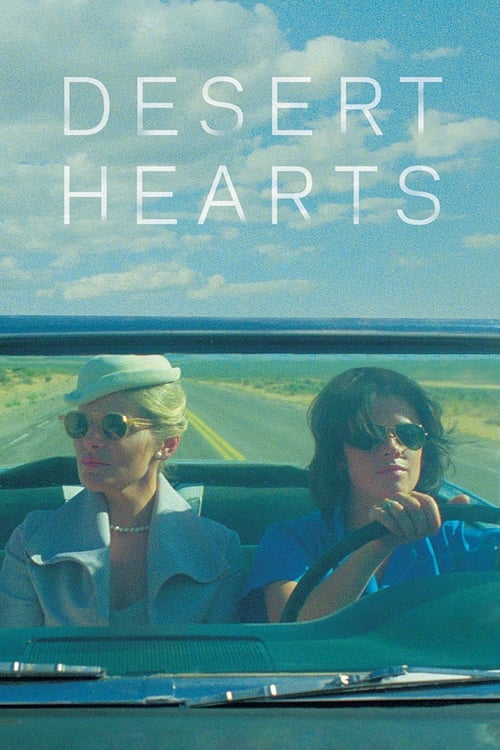
Desert Hearts
1985 · Donna Deitch
For a cozy night in when you want to fall in love — a romance with real longing and real nerve, gentle enough to comfort and honest enough to matter.
What it's about
Reno, Nevada, 1959. Vivian, a buttoned-up East Coast literature professor, arrives at a desert ranch to wait out the six-week residency required for her divorce. There she meets Cay, a younger, carefree local woman who lives openly on her own terms — and an attraction Vivian has no map for begins to unsettle everything she thought she'd decided about her life.
The experience
Sun-bleached, slow-burning, and quietly electric — the tension is all in glances, pauses, and the space between two women in wide desert light. It's tender rather than tragic, and the warmth of it catches you off guard.
Performances
Helen Shaver and Patricia Charbonneau are beautifully matched — Shaver letting Vivian's composure crack by careful degrees, Charbonneau playing Cay with an open, unapologetic ease that makes the attraction feel inevitable.
The craft
Donna Deitch, in a fiercely independent debut she spent years fundraising for, shoots Reno and the Nevada desert with a spare, sun-struck beauty and lets the romance unfold at the pace of trust. The 1950s period detail — casinos, ranch houses, country songs — grounds the love story in a world where it carries real risk.
Why it matters
A landmark of lesbian representation: at a time when queer characters on screen were routinely punished or doomed, it refused tragedy and let its lovers simply have their story. Generations of queer romances trace their permission back to it.
Snapshot
Desert Hearts is a landmark of American independent cinema and of lesbian representation on screen: a spare, sun-bleached romance set in Reno, Nevada, in 1959, in which a buttoned-up East Coast literature professor waiting out a six-week divorce residency falls for a younger, unguarded local woman. Adapted from Jane Rule's 1964 novel Desert of the Heart, and directed by Donna Deitch as her narrative feature debut after a long, self-driven fundraising campaign, the film is historically significant less for formal innovation than for what it refused to do — it declined to punish, pathologize, or kill its lovers. In a lineage of queer cinema still shadowed by tragedy and the "doomed invert," Desert Hearts offered an ending that was open, warm, and unresolved rather than fatal. That choice, more than any single stylistic gesture, is why the film became foundational.
Industry & production
The production story is inseparable from the film's meaning. Deitch, who came out of documentary and photography, optioned Rule's novel and then spent years — by most accounts the better part of the early 1980s — raising financing independently, largely outside the studio system and reportedly through private investors and limited partnerships rather than a conventional production entity. The commonly repeated figure is a budget in the neighborhood of $1.5 million; I flag it as an approximation, since precise, audited figures for a privately assembled independent of this era are not reliably documented, and I will not invent one. What is well established is that Deitch acted as producer as well as director, and that the money came together slowly and precariously, a fact that shaped both the film's modest scale and Deitch's authorial control over the material.
The picture was shot on location in and around Reno and the northern Nevada high desert, using the wide-open landscape and vintage casino and ranch settings as a production asset in lieu of a large budget. After completion it traveled the festival circuit — including Telluride and the Toronto Festival of Festivals in 1985 — before a theatrical release handled by the Samuel Goldwyn Company. It performed respectably for a specialty release and, crucially, found a durable afterlife on home video and repertory screens, where its reputation compounded over decades. The Criterion Collection later restored and reissued it, a canonizing gesture that formalized its standing.
Technology
Desert Hearts is a conventional 35mm photochemical production of its moment, and its technology is best understood as unshowy craft rather than novelty. There is no optical or effects ambition here; the film's "technology" is the classical apparatus of location shooting — anamorphic-adjacent widescreen framing of desert vistas, natural and available light supplemented by careful fill, and location sound married to a soundtrack built substantially from licensed period recordings. The technological story that matters is economic: the film demonstrates how a small crew working on real locations with standard equipment could achieve a polished, expansive look far in excess of its resources. If anything is worth flagging as thin, it is the granular technical record (specific lenses, stock, lab work), which is not comprehensively documented for a production of this budget class.
Technique
Cinematography
The cinematography is by Robert Elswit — later celebrated as Paul Thomas Anderson's regular collaborator and an Academy Award winner for There Will Be Blood — and Desert Hearts stands as one of his important early features. His work here is defined by the contrast between vast, luminous exteriors and close, warm interiors. The Nevada desert and sky are rendered in wide, horizontal compositions that dwarf the characters and externalize Vivian's sense of dislocation, while the casino and ranch interiors are handled in tighter, more intimate framings. Elswit's control of natural light — the hard clarity of desert daylight, the soft dusk tones — gives the romance a specific climatic and geographic texture. The film's most discussed sequence, the extended love scene between the two women, is shot with a patience and tenderness unusual for its period: the camera treats the encounter as emotionally serious and unhurried rather than as spectacle, a decision as much authorial as photographic.
Editing
Editing (credited to Robert Estrin, per the standard record) favors a measured, classical rhythm suited to a chamber romance. The cutting lets scenes breathe, holding on faces and reactions to register the slow thaw of Vivian's reserve and the frank directness of Cay's pursuit. The pacing is deliberate, occasionally to the point that contemporary viewers register it as slow; that unhurried tempo is, however, load-bearing — it makes the emotional turns feel earned rather than engineered, and it gives the central love scene its striking sense of real time.
Mise-en-scène / staging
The film's period design is central to its effect. The 1959 setting is evoked through costuming that codes class and repression — Vivian's tailored suits and gloves against Cay's looser, more physical wardrobe — and through the milieu of Frances Parker's divorce ranch, a distinctly American institution where women waited out Nevada's short residency requirement. The staging repeatedly places Vivian as an out-of-place figure: overdressed, stiff, framed against the informality of the ranch and the desert. Deitch stages the growing intimacy through proximity and touch, using the physical space of cars, rooms, and open land to chart the shrinking distance between the two women.
Sound
The soundtrack is one of the film's signatures. Rather than lean on an original orchestral score, Desert Hearts draws heavily on period country and early rock-and-roll source music, with Patsy Cline's "Crazy" among its most memorable needle-drops. The songs do double duty: they anchor the 1959 setting with documentary precision and function as emotional commentary, the ache of classic country love songs mirroring the film's yearning. (I'll note that the full music-licensing history and any incidental scoring are not something I can enumerate exhaustively without risking error; the salient and well-established point is the film's reliance on period source recordings over a composed score.)
Performance
The performances carry the film. Helen Shaver plays Vivian Bell as a woman whose control is a carapace — her stiffness gradually cracking into vulnerability, played largely through restraint and small physical loosenings. Patricia Charbonneau, in a breakout screen role as Cay Rivvers, brings an easy, self-possessed sexuality and a refusal of shame that reads as radical for the character and the era. The two actresses generate a credible, escalating chemistry that the film depends upon completely. Audra Lindley is a warm, complicating presence as Frances, the ranch owner and Cay's surrogate mother, whose sense of betrayal supplies much of the drama's friction. The supporting ensemble grounds the milieu without stealing focus from the central pair.
Narrative & dramatic mode
The film operates in the register of intimate character drama and slow-burn romance. Its structure is classical and economical: an outsider arrives in a bounded world (the divorce ranch, the six-week clock), is destabilized by an unexpected attraction, resists, yields, and is confronted with a choice about how to live. The dramatic engine is internal — Vivian's psychology, her fear and repression — rather than plot-driven. The six-week residency provides a built-in ticking clock, and the third act turns on whether the relationship can survive Vivian's departure. The celebrated final movement, in which Cay boards the train for a few stops so the two can have a little more time together, resolves nothing in conventional terms; it leaves the future open. That refusal of closure is the film's boldest narrative decision.
Genre & cycle
Desert Hearts sits at the intersection of the woman's picture / romance tradition and the emerging body of explicitly lesbian narrative film. Within the broader 1980s American independent romance, it belongs to the cycle of literary adaptations and character studies that specialty distributors like Samuel Goldwyn and others were bringing to arthouse audiences. But its more consequential generic membership is in the history of queer cinema, where it functions as a corrective to a long cycle of coded, tragic, or punitive representations. It is frequently positioned as a hinge between the pre-Stonewall subtext tradition and the more assertive New Queer Cinema that would crystallize around 1990–1992.
Authorship & method
Donna Deitch is the decisive author of Desert Hearts, not only as director but as the producer who willed the project into existence over years of fundraising and who chose the source material for its rare affirmative ending. Her background in documentary informs the film's attention to milieu and its unforced observational quality. The screenplay adaptation is credited to Natalie Cooper, working from Jane Rule's novel; the adaptation's key structural interventions — including the reworking of the ending toward openness — serve Deitch's evident aim of a romance that treats its lovers with dignity. Among collaborators, cinematographer Robert Elswit is the most historically notable, and his contribution to the film's expansive-yet-intimate look is substantial. Editor Robert Estrin shaped its deliberate rhythm. Because the film pointedly forgoes a marquee original score in favor of source music, there is no single composer-author to foreground here; the sonic authorship lies in the music selection and Deitch's overall design. After Desert Hearts, Deitch moved substantially into television, directing the acclaimed miniseries The Women of Brewster Place (1989) among other work — a career shape common to independent filmmakers of her generation who could not easily replicate independent features.
Movement / national cinema
The film is a product of 1980s American independent cinema — the pre-Sundance-boom ecosystem of self-financed, festival-launched features made outside the studios. It is not tied to a formal aesthetic movement so much as to the infrastructural conditions of independent production and to the parallel emergence of a distribution and exhibition circuit (festivals, specialty distributors, gay and lesbian film festivals, repertory and later home video) that could sustain a film addressed in significant part to lesbian and gay audiences. In the longer arc of American national cinema, it is an early instance of that circuit successfully carrying a film to durable canonical status.
Era / period
Two periods are in play. Diegetically, the film is set in 1959, on the cusp of the 1960s, and its Reno-divorce-ranch world is a precise historical milieu — Nevada's uniquely permissive residency-and-divorce laws created a real class of women "waiting out" their marriages, and the film treats this as both setting and metaphor for transition. Productionally, it is a mid-1980s film, made in a moment when independent cinema was gaining infrastructure and when the politics of gay and lesbian visibility were intensifying, though also darkening under the early years of the AIDS crisis. The film's warmth reads, in part, against that harsher contemporaneous backdrop.
Themes
The governing theme is repression versus authenticity — Vivian's carefully managed, socially sanctioned life set against the possibility of a desire she has never permitted herself. Related to this is the motif of the desert itself: aridity and openness, a landscape stripped bare where pretenses cannot survive, functioning as a stage for emotional exposure. Class and social propriety run throughout, embodied in the contrast between the professor and the casino change girl. The film also foregrounds shame and its refusal: Cay's unashamed self-knowledge is a moral pole against which Vivian must measure herself. And, structurally, it is a film about transition and thresholds — divorce, departure, the six-week clock, the train — the in-between state as the space where transformation becomes possible.
Reception, canon & influence
Critically, Desert Hearts was received as a serious and unusually humane treatment of lesbian romance, and its reputation has grown rather than faded. It became a touchstone precisely because of its ending: in the critical literature on queer cinema it is repeatedly cited as one of the first films to grant a lesbian couple a hopeful, non-tragic conclusion, a break from decades of representations in which same-sex desire was coded, punished, or lethal. The Criterion Collection's later restoration and release confirmed its passage into the canon of American independent film.
Looking backward, the film's influences are literary and observational: Jane Rule's novel above all, and Deitch's documentary sensibility, alongside the broad tradition of the Hollywood woman's picture whose emotional grammar it borrows and redirects. Looking forward, its legacy is substantial. It stands as an important precursor to the New Queer Cinema of the early 1990s and, more diffusely, to the later mainstream of lesbian period romance — films that would similarly stage same-sex desire within constraining historical settings and insist on the seriousness of the love. It is regularly invoked in critical genealogies alongside later titles in that tradition, and its influence on subsequent filmmakers working in lesbian romance is widely acknowledged, even where direct lines are more a matter of shared spirit than documented homage. Its most enduring contribution remains conceptual: it demonstrated, early and durably, that a lesbian love story could end not in death or despair but in an open train window and the possibility of more time.
Reception
A scrappy indie that got a modest, somewhat patronizing reception in the mid-80s mainstream press, it's since been fully canonized — a 2017 restoration and Criterion release sealed its status as a foundational queer classic.
How Desert Hearts was received, from release to now →
How to watch Desert Hearts: what to notice on a first viewing
- Watch how small Vivian looks against the desert sky. Elswit shoots the Nevada desert in wide, horizontal compositions that dwarf the characters, especially Vivian, against the vast open land. The landscape externalizes her dislocation before she says a word about it.
- Notice the difference between Vivian's suits and Cay's looser clothes. Vivian's tailored gloves and jackets code class and repression, while Cay's more physical wardrobe reads as freedom and ease in her own body. Costume alone tells you which woman is still guarding herself and which one already isn't.
- Listen for the country and rock and roll songs on the radio. The film has no original score. Period recordings like Patsy Cline's 'Crazy' carry the emotional weight that music usually supplies. The songs anchor the year and mirror the ache at once, doing double duty a composed score would only do once.
- Watch Vivian's small physical loosenings around Cay. Helen Shaver plays Vivian's control as a shell that cracks gradually, mostly through restraint and tiny shifts in posture rather than speeches. You can track her whole change of heart just by watching what her body allows itself to do.
The whole guide to watching Desert Hearts, with the keys for a rewatch →
Influences: the films it descends from and the films it influenced
- All That Heaven Allows (1955) — Supplies the woman's-picture emotional grammar Desert Hearts borrows and redirects — desire framed as a middle-class woman's transgression against a watching, disapproving community, staged as sincere melodrama rather than camp.
- Picnic (1955) — Models the outsider-arrival structure: a stranger disrupts a closed provincial community and detonates a repressed woman's sexual awakening, rendered in widescreen Americana with the landscape as erotic weather.
- The Misfits (1961) — Establishes the exact Reno divorce-ranch milieu and treats the Nevada desert in monochrome wide compositions as emotional space — the transient, waiting-for-a-decree world Desert Hearts inherits wholesale.
- Now, Voyager (1942) — Precedent for the open, non-possessive ending — love affirmed without permanent union — that Deitch and Natalie Cooper rework into the film's train-window refusal of tragic closure.
- The Bitter Tears of Petra von Kant (1972) — Stages lesbian desire as serious, adult chamber melodrama with full dramatic weight rather than titillation or pathology — the tonal seriousness Desert Hearts extends into a hopeful register.
- Personal Best (1982) — Immediately predates Desert Hearts in depicting a lesbian affair through unsensational, sun-lit naturalism and tactile physical intimacy, normalizing the body without voyeuristic framing.
- Lianna (1983) — American-independent coming-out drama built, like Desert Hearts, on observational realism and a narrative organized entirely around one woman's mid-life erotic awakening and its social cost.
- Go Fish (1994) — New Queer Cinema descendant that inherits Desert Hearts' central proof-of-concept — a low-budget lesbian romance permitted an affirmative, courtship-driven arc instead of punishment or death.
- The Watermelon Woman (1996) — Extends the same New Queer Cinema lineage Desert Hearts seeded, self-consciously building a lesbian film history and insisting on same-sex romance as legitimate cinematic subject.
- The Incredibly True Adventure of Two Girls in Love (1995) — Directly carries forward the hopeful-ending model — two women choosing each other over shame — that Desert Hearts pioneered as a durable alternative to the tragic queer template.
- Carol (2015) — The definitive heir: a 1950s-set lesbian romance built on the woman's-picture grammar and closing on an open, hopeful reunion — Desert Hearts' restraint, period repression, and non-tragic ending mainstreamed with prestige craft.
- Portrait of a Lady on Fire (2019) — Extends the natural-light, painterly period-romance mode and the female gaze, using measured classical rhythm and glances-over-dialogue to dramatize forbidden desire within a constraining historical setting.
- Ammonite (2020) — Continues the period lesbian-romance strain rooted in landscape and repression, staging desire through restrained performance and weather-beaten natural exteriors rather than declaration.
- Disobedience (2017) — Rebuilds the repression-versus-authenticity engine inside a closed, watching community, relying on the same currency of held-back, minutely-calibrated performance Desert Hearts pioneered.
- Bound (1996) — Applies Desert Hearts' insistence on lesbian survival and a happy ending to genre cinema, granting the couple both consummation and escape rather than the era's customary punishment.
- The World to Come (2020) — Shares Desert Hearts' formula of natural-light landscape, historical constraint, and interior restraint, letting period source-diction and terrain carry the suppressed romance.
- There Will Be Blood (2007) — Carries forward cinematographer Robert Elswit's method — expansive widescreen natural-light desert Americana composed to feel both epic and intimate — the visual signature he first stretched across the Nevada of Desert Hearts.
Similar films
- Portrait of a Lady on Fire (2019) — influence & lineage
- Carol (2015) — influence & lineage
- Love Letters (2025) — same viewing thread
- Red Desert (1964) — often watched together
- Wanda (1970) — often watched together
- My First Summer (2020) — shared sensibility
- Girls Like Girls (2026) — shared sensibility
- Paris, Texas (1984) — shared sensibility
All the films related to Desert Hearts →
Watch it with: curated runs of related films
- Families Made and Unmade — A run of intimate domestic portraits — watch these together and feel marriages dissolve, mothers improvise, and love keep redrawing the shape of a family across sixty years.