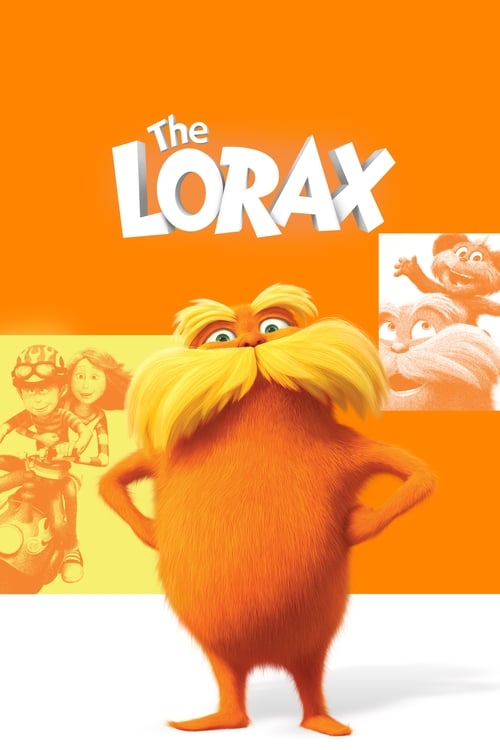
The Lorax
2012 · Chris Renaud
For family movie night when you want something breezy that still gives you and the kids something to talk about afterward. Easy comfort viewing with a message that isn't shy about itself.
What it's about
In Thneedville, a walled town where everything is plastic and even fresh air is sold in bottles, twelve-year-old Ted sneaks outside the city limits to find a real, living tree — the one thing that might impress the girl he likes. What he finds instead is the Once-ler, a hermit with a story to tell: how a young man's booming business, and the grumpy orange creature who spoke for the trees, led to the barren wasteland outside. It's Dr. Seuss's environmental fable expanded into a bright, bouncy musical.
The experience
Fast, candy-colored, and packed with songs and slapstick, with a streak of real melancholy running underneath — the flashback story lands with surprising weight for something this bubbly. Kids get the zip; adults get the sting.
Performances
Danny DeVito is perfectly cast as the Lorax — gruff, funny, and unexpectedly moving — while Ed Helms gives the Once-ler a likable, guilty charm that keeps the villain human.
The craft
Illumination's animators turn Seuss's curling, tufted world into plush, tactile 3D — the truffula valleys are gorgeous, and the contrast with plastic Thneedville is the film's sharpest visual joke. The musical numbers swing big, including a full-throated villain anthem about the joys of unchecked growth.
Why it matters
A major box-office hit that cemented Illumination as a studio powerhouse, it also kicked up a real public argument about a consumerist fable being sold with commercial tie-ins — a debate that became part of the film's story.
Snapshot
The Lorax is a computer-animated musical adaptation of Dr. Seuss's 1971 picture book, produced by Illumination Entertainment and released by Universal Pictures on 2 March 2012 — a date chosen to coincide with the anniversary of Theodor Seuss Geisel's birth. Directed by Chris Renaud with co-director Kyle Balda, it was Illumination's third feature, following Despicable Me (2010) and Hop (2011), and it consolidated the young studio's identity as a lean, brightly colored alternative to Pixar and DreamWorks. The film takes Seuss's spare, cautionary fable about a creature who "speaks for the trees" and expands it into a full-length narrative with a framing story: a boy named Ted, living in the wholly artificial, plastic town of Thneedville, ventures beyond its walls to find a real tree and win the affection of a girl, Audrey. His quest becomes the occasion to hear the Once-ler recount how his own greed razed a forest of Truffula trees and drove away the Lorax. The result is a work that sits at a revealing intersection of children's environmental didacticism, corporate franchise animation, and the commercial contradictions both entail.
Industry & production
The Lorax is best understood as a product of the Illumination model. The studio was founded in 2007 by Chris Meledandri, formerly head of 20th Century Fox Animation, where he had overseen the Ice Age franchise and the CG Seuss adaptation Horton Hears a Who! (2008). Illumination's strategy was to make broadly appealing family animation at budgets significantly below those of its rivals — reportedly in the range of roughly $70 million for The Lorax, well under the $150-million-plus norm for major CG features of the period. Central to this economy was the studio's animation partner, Illumination Mac Guff, the Paris-based facility (built around the French visual-effects house Mac Guff) that executed the studio's early films. Much of the actual animation labor therefore took place in France, while creative direction and voice recording were managed from the American side.
The film reunited a stable creative team: Renaud had co-directed Despicable Me, and the screenplay was written by Cinco Paul and Ken Daurio, the writing partnership behind both Despicable Me and Horton Hears a Who! Their familiarity with adapting Seuss — stretching a slim, image-driven text into a three-act feature — is evident in the strategy of grafting a new frame narrative (Ted, Audrey, and the villain O'Hare) onto Seuss's original Once-ler/Lorax parable.
The picture's release was accompanied by an unusually aggressive tie-in campaign, which became part of its public story. Promotional partnerships attached the Lorax — a character who literally denounces overconsumption — to products including automobiles, pancakes, and disposable goods, drawing pointed commentary about the irony of marketing an anti-consumerist fable through mass merchandising. That tension between message and monetization is arguably the film's most discussed extra-textual feature and a recurring theme in its reception.
Technology
The Lorax was made with standard mid-generation CG animation pipelines and released in both conventional and stereoscopic 3D formats, the latter then near-ubiquitous for studio animation in the wake of Avatar (2009). The Illumination Mac Guff pipeline emphasized a stylized, poster-bright look rather than the texture-heavy photorealism some competitors pursued; surfaces are clean, saturated, and graphic. The Truffula trees — with their candy-colored, cotton-like tufts — are a showcase for the era's grooming and simulation tools, translating Seuss's flat illustrative fronds into volumetric forms that move as soft masses. The film's stereoscopic staging exploits the vertical, tufted verticality of the Truffula forest and the swooping vistas of the valley, while the enclosed geometry of Thneedville offered opportunities for hard-edged, plastic-perfect rendering that deliberately contrasts with the organic world outside the walls.
Technique
Cinematography
As with all fully animated features, "cinematography" here denotes virtual camera design and lighting rather than photography of a physical set. The film's visual grammar draws a stark chromatic and compositional line between two worlds. Thneedville is rendered in flat, artificial primary colors, symmetrical layouts, and a plasticky sheen that reads as intentionally lifeless; the natural landscape, by contrast, is introduced in warm, storybook light and then, in the Once-ler's flashbacks, degraded step by step into the smog-choked, desaturated wasteland of the "Street of the Lifted Lorax." The camera favors buoyant, mobile moves — sweeping through the Truffula valley to convey abundance, then constricting as the forest is felled. This before/after lighting arc is the film's central visual argument, and it is executed through color temperature and saturation as much as through staging. Detailed public documentation of the individual lighting and layout leads is thin, and specific below-the-line camera credits are not well recorded in the general literature.
Editing
The film's cutting follows the conventions of contemporary musical animation: brisk montage during the Once-ler's rise-and-fall song sequences, cross-cutting between the present-day frame (Ted's excursions from Thneedville) and the flashback core (the Once-ler's confession), and rhythmically synchronized editing across the musical numbers. The nested structure — a present-tense quest interrupted by an unfolding, serialized backstory delivered over multiple visits — is the film's principal editorial design, controlling how and when the Once-ler's culpability is revealed. Precise editorial credits are not prominent in the general record, and this dossier will not attribute them speculatively.
Mise-en-scène / staging
Production design carries much of the film's thematic weight. Thneedville is conceived as a sealed, walled municipality where every plant is inflatable and fresh air is sold in bottles by the antagonist, O'Hare — a satirical exaggeration of commodified nature. The forest world, drawn from Seuss's originals, features the tufted Truffula trees, the whimsical Bar-ba-loots, Swomee-Swans, and Humming-Fish, and the Once-ler's ramshackle industrial encampment, whose growth visibly consumes the surrounding greenery. The staging repeatedly contrasts organic curves (the Lorax's world) with manufactured geometry (Thneedville, O'Hare's operation), making the set design itself an ecological argument.
Sound
The Lorax is a full-fledged musical, and its soundtrack is integral rather than incidental. The score is by John Powell, with original songs credited to Powell and screenwriter Cinco Paul. The numbers do significant narrative work: an opening ensemble piece establishes Thneedville's cheerful artificiality; the Once-ler's showstopper charts his corruption as an escalating anthem of self-justification; and a climactic communal number rallies the town toward renewal. Sound design underscores the two-world structure — the plastic hum and jingle of Thneedville against the wind, water, and animal life of the forest, and the mechanical din that accompanies industrial expansion.
Performance
Vocal performance anchors the characterizations. Danny DeVito voices the Lorax, bringing a gruff, exasperated warmth that defines the creature's "grumpy yet charming" register; notably, DeVito also recorded the role for several international dubs, lending his performance to multiple language versions. Ed Helms voices the Once-ler, giving the character an eager, likeable naïveté that curdles into rationalized greed — a performance essential to the film's decision to make the Once-ler a fully seen, sympathetic figure rather than the disembodied voice of Seuss's book. Zac Efron plays the boy Ted and Taylor Swift the object of his affection, Audrey, while Betty White voices Grammy Norma and Rob Riggle the villain O'Hare. The casting leans on recognizable, likeable star voices in keeping with the studio's mainstream, four-quadrant aims.
Narrative & dramatic mode
The film's most significant adaptive choice is structural. Seuss's book is a compact, second-person fable narrated by an unseen Once-ler to a nameless boy; the Lorax appears, warns, and departs, and the moral rests on a single word — "UNLESS." The 2012 feature externalizes and dramatizes all of this. It invents a present-day protagonist with a concrete, relatable motive (romantic longing), a defined antagonist (O'Hare, who profits from the absence of trees), and a redemptive third act in which the town is persuaded to plant the last Truffula seed. The dramatic mode is thus the reassuring, resolution-seeking arc of mainstream family animation, layered over Seuss's more open-ended, ambivalent warning. This shift — from cautionary parable to hero's-journey musical with a victorious ending — is both the film's commercial logic and the crux of critical debate about whether it softens or sells out its source.
Genre & cycle
The Lorax belongs to two overlapping cycles. First, it is part of the CG-animated family musical that flourished in the early 2010s. Second, and more specifically, it is a late entry in the run of feature-length Dr. Seuss adaptations that began with the live-action How the Grinch Stole Christmas (2000) and The Cat in the Hat (2003) and continued with the CG Horton Hears a Who! (2008). Within that cycle, The Lorax — like Horton before it, and by the same screenwriters — represents the animated, rather than live-action, branch, which generally fared better critically by preserving Seuss's graphic sensibility. It also participates in a broader wave of environmentally themed studio animation of the era, the most prominent comparison being Pixar's WALL·E (2008), another film that paired ecological warning with a walled-off, consumerist human enclave.
Authorship & method
Chris Renaud's authorship is best read through the Illumination house style he helped establish: fast, gag-forward, warmly sentimental family comedy with musical set pieces and a gloss of visual polish. Having come up through Despicable Me, Renaud (with co-director Kyle Balda, a veteran animator) brought a sensibility oriented toward broad appeal and buoyant pacing rather than auteurist ambiguity. The screenplay by Cinco Paul and Ken Daurio is the load-bearing creative contribution, since the film's identity depends on its expansion of a very short text; Paul's additional role as co-songwriter further ties the writing and the musical spine together. John Powell, one of the most prolific animation composers of the period (the How to Train Your Dragon films, numerous DreamWorks features), supplied a score and songs designed to carry both comedy and emotional uplift. Individual credits for editing and lighting/photography are not well established in the general public record, and this account declines to attribute them without confidence.
Movement / national cinema
Institutionally, The Lorax is American studio animation — a Universal release from a Los Angeles–based producer. In practice, it is a transatlantic production whose animation was executed largely in France at Illumination Mac Guff. This hybrid arrangement is characteristic of the globalized economics of 2010s CG animation, in which American creative and marketing control is paired with lower-cost overseas production capacity. The film thus belongs less to any national film movement than to the emergent Illumination "brand" — a studio-as-movement whose subsequent success with Minions, Sing, and the Despicable Me series would make it one of the most commercially dominant animation houses of the following decade.
Era / period
The film is firmly of its early-2010s moment: post-Avatar stereoscopic 3D as default; the maturation of mid-budget CG animation as a reliable franchise engine; and a cultural climate in which environmental messaging had become mainstream enough for a major studio to build a tentpole around it — while also being commercially cautious enough to wrap that message in a happy ending and an extensive licensing program. Its release on Seuss's birthday reflects the era's careful stewardship of the Seuss estate as a perennial family-entertainment property.
Themes
The film's overt theme is environmental stewardship: the danger of unchecked resource extraction, the loss of the natural world to industrial greed, and the possibility of renewal through individual action, distilled from Seuss's "UNLESS." Around this sits a critique of consumerism, literalized in Thneedville — a town that has replaced nature with plastic and monetized even the air. A secondary theme is the seductiveness of rationalized greed: by dramatizing the Once-ler's fall as a charismatic musical ascent ("business is business, and business must grow"), the film treats environmental harm not as cartoon villainy but as ordinary ambition sliding into denial. The persistent critical irony — widely noted — is that a film indicting overconsumption was itself sold through an unusually heavy consumer-products campaign, a contradiction that has become inseparable from the work's cultural footprint.
Reception, canon & influence
Critical reception was mixed. Reviewers generally praised the film's color, energy, and vocal performances — DeVito's Lorax in particular — while a substantial share faulted it for diluting Seuss's fable, padding the source with a formulaic quest and villain, and, most pointedly, for the dissonance between its anti-materialist message and its aggressive marketing. It was, however, a strong commercial performer, ranking among the more successful animated releases of its year and helping to establish Illumination as a durable franchise studio; precise grosses are not cited here to avoid overstatement, but its commercial success was clear and widely reported.
Looking backward, the film's influences are layered: Seuss's 1971 book above all; the 1972 television special The Lorax (produced by DePatie–Freleng, with Geisel's involvement), which first dramatized the material; the preceding cycle of Seuss adaptations, especially the closely related Horton Hears a Who! by the same writers; and, thematically, the lineage of ecological family entertainment that includes films such as WALL·E and, further back, animated environmental parables like FernGully: The Last Rainforest (1992). Looking forward, its most consequential legacy is arguably industrial rather than artistic: as an early Illumination hit, it helped validate the studio's low-budget, star-voiced, franchise-friendly formula that would soon reshape the animation marketplace. Within culture at large, the film's afterlife has been shaped less by canonical esteem than by its status as a touchstone for debates about "greenwashing" and by the durable internet-meme life of the Once-ler and the Lorax — an unusual case in which a family film's most lasting influence runs through both boardroom economics and online fan culture rather than through the critical canon.
Reception
Critics shrugged at it in 2012 — an anti-consumerist fable launched with a mountain of corporate tie-ins — but the internet gave it a bizarre second life, and it's now remembered less as a movie than as a formative meme event for a generation of Tumblr users.
How The Lorax was received, from release to now →
How to watch The Lorax: what to notice on a first viewing
- Watch the colors flatten and dull inside Thneedville's walls. Thneedville is rendered in flat, artificial primary colors and a plasticky sheen, while the forest outside opens into warm, storybook color the moment Ted leaves. The color palette alone is telling you which world is actually alive.
- Listen for the hum and jingle of the plastic town. The soundtrack gives Thneedville a mechanical, commercial hum, jingles and clockwork, while the forest brings in wind, water, and animal life instead. Even the ambient noise is arguing over which place actually has anything alive in it.
- Notice the curved, natural shapes of the forest world. Production design contrasts the organic curves of the Lorax's forest with the rigid, manufactured geometry of Thneedville and O'Hare's operation throughout. The shapes of the world are doing the ecological argument before anyone says a word.
- Watch how likeable the Once-ler seems in his early scenes. Ed Helms plays the young Once-ler with an eager, winning naïveté rather than any obvious villainy, a normal guy chasing a normal ambition. The film wants you rooting for him before it shows you what that ambition costs.
- Listen for a song arriving right as the story turns. The film's musical numbers aren't just breaks in the action: an opening ensemble sets up Thneedville, and later numbers chart rising ambition. The songs are carrying real plot information, not just filling time between scenes.
The whole guide to watching The Lorax, with the keys for a rewatch →
Influences: the films it descends from and the films it influenced
- How the Grinch Stole Christmas! (1966) — Establishes the template Renaud inherits — padding a very short Seuss text to a set runtime by inventing business and songs while preserving the storybook rhyme, the exact expansion strategy the Lorax uses on a 1971 picture book.
- The Lorax (1972) — The DePatie–Freleng TV special (made with Geisel) first dramatizes the Once-ler as a hidden narrator dispensing the tale in flashback — the frame-and-flashback confession structure the 2012 film rebuilds around 'the street where the Once-ler still lives.'
- Horton Hears a Who! (2008) — Same screenwriters Cinco Paul and Ken Daurio prove the expanded-adaptation method — grafting a formulaic quest, a manufactured antagonist and gag-forward comedy onto a slim Seuss fable — that the Lorax reuses wholesale.
- Despicable Me (2010) — Renaud's own directorial debut codifies the Illumination house style he carries into the Lorax: fast broad-appeal gags, warm sentimentality, star-voiced leads and glossy low-budget CG built for franchising.
- WALL·E (2008) — The direct model for the two-world color contrast and anti-consumerist ecology — a lush pristine nature set against a slick over-manufactured consumer wasteland — that the dossier itself flags as the Lorax's touchstone comparison.
- FernGully: The Last Rainforest (1992) — The animated environmental parable whose staging of organic living nature against belching industrial machinery (Hexxus/the smog-belching Thneed factory) supplies the Lorax's organic-vs-manufactured visual argument.
- How to Train Your Dragon (2010) — John Powell's soaring, uplift-driven animation scoring method here is the template for the score-and-songs spine he writes for the Lorax to carry both comedy and emotional swell.
- The Polar Express (2004) — Pioneers the untethered mobile virtual camera — swooping impossible CG moves through space — that the Lorax deploys in its Thneedville chase and Truffula-valley reveals, and pairs it with stereoscopic-3D showmanship.
- The Wizard of Oz (1939) — The urtext for palette-as-narrative — drab framed 'real' world versus saturated wonder world — the device the Lorax literalizes in plastic Thneedville's candy colors versus the ashen, denuded outer wasteland.
- Rio (2011) — A sibling bright-CG eco-musical scored the same year by John Powell, sharing the hyper-saturated tropical palette and pop-song set pieces wrapped around an environmental-stewardship plot.
- The Secret Life of Pets (2016) — Renaud extends the same Illumination formula — star-voice casting, gag-forward pacing, buoyant sentiment over auteur ambiguity — refined first on the Lorax into the studio's next original hit.
- Minions (2015) — Co-director Kyle Balda carries the Lorax's brand-machine sensibility forward, proving the meme-ready character and franchise-first design logic the Lorax helped validate for Illumination.
Similar films
- The Lego Movie (2014) — influence & lineage
- How to Train Your Dragon (2010) — influence & lineage
- Toy Story 3 (2010) — shared sensibility
- A Bug's Life (1998) — shared sensibility
- Inside Out 2 (2024) — shared sensibility
- Toy Story 5 (2026) — shared sensibility
- Shrek (2001) — shared sensibility
- My Sweet Orange Tree (2012) — shared sensibility