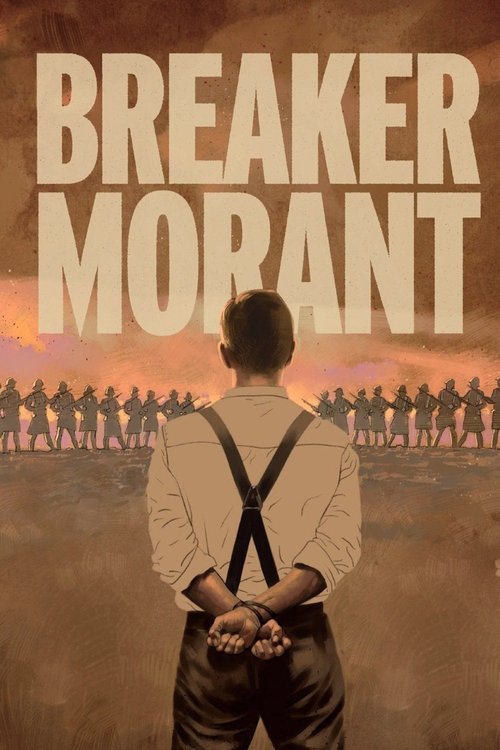
Breaker Morant
1980 · Bruce Beresford
When you want a smart, angry film about justice and power — the kind you finish and immediately want to argue about with someone.
What it's about
South Africa, 1902, near the end of the Boer War: three Australian lieutenants serving in an irregular British unit are court-martialed for shooting Boer prisoners. They insist they acted under orders — orders the British high command now finds convenient to deny. What unfolds is a trial the empire has already decided, except that the defense refuses to play along, and the courtroom becomes a fight over who really authorizes the dirty work of war.
The experience
Taut and quietly furious — a chamber drama where the tension is all in cross-examinations, evasions, and the dawning realization of how the game is rigged. It's gripping like a thriller but leaves you chewing on hard questions about orders, guilt, and scapegoats.
Performances
Edward Woodward is superb as Harry 'Breaker' Morant, a horseman-poet facing the machinery of empire with sardonic calm, and Jack Thompson is electric as the country-lawyer defense counsel who turns out to be far better than anyone expected.
The craft
Beresford structures the film with surgical economy, cross-cutting the courtroom with flashbacks that reconstruct the disputed events from testimony, so you're constantly weighing versions of the truth. Adapted from a stage play, it never feels stagebound — the veldt exteriors give the trial's abstractions real dust and blood.
Why it matters
One of the defining films of the Australian New Wave and an Oscar nominee for its screenplay, it lodged the Morant case permanently in Australian cultural memory and launched Beresford toward Hollywood.
Snapshot
Breaker Morant is a courtroom drama built on a genuine colonial scandal: the 1902 court-martial of three Australians serving with an irregular British unit, the Bushveldt Carbineers, for the killing of Boer prisoners during the South African War. Bruce Beresford's film compresses that history into a taut trial narrative, cross-cut with flashbacks that reconstruct the disputed events, and frames the proceedings as a political sacrifice — three colonial soldiers offered up by the imperial high command to disown a brutal method of warfare it had tacitly sanctioned. It arrived as one of the defining works of the Australian New Wave, won a sweep of domestic honors and a screenwriting nomination at the Academy Awards, and lodged itself permanently in Australian cultural memory through its final, unflinching image of men shot at dawn. Its enduring power lies in its refusal to make its heroes innocent: the film grants that the killings happened, then asks who is truly on trial.
Industry & production
The film was produced through the South Australian Film Corporation, the state body whose backing made South Australia a disproportionately productive center of the 1970s Australian revival. Matt Carroll produced. The project sat squarely within the government-supported model that drove the New Wave — public film bodies and tax-favourable financing underwriting a national cinema that commercial markets alone would not have funded — and it was made on a modest budget characteristic of Australian features of the period, though precise figures should be treated cautiously rather than asserted.
Its immediate source was Kenneth G. Ross's stage play Breaker Morant, first performed in the late 1970s, which had already dramatized the trial for Australian audiences. Behind the play lay a longer documentary trail: George Witton's memoir Scapegoats of the Empire (1907), written by the one condemned man whose sentence was commuted, and later popular treatments including Kit Denton's The Breaker (1973). The screenplay is credited to Jonathan Hardy, David Stevens and Beresford himself, adapting Ross. Shooting took place in rural South Australia, principally in the dry pastoral country around Burra, whose stone buildings and open scrub stood in convincingly for the Transvaal veldt — a practical choice that also tied the film's imagery to a recognizably Australian landscape.
Commercially and reputationally the film performed well beyond its scale. It became a critical success at home and abroad, secured international distribution, and gave several of its principals — and Beresford — the visibility that carried them into larger careers.
Technology
Breaker Morant was made with the conventional 35mm color technology of its era, and its technical ambitions run toward restraint rather than spectacle. There are no elaborate optical effects, no large-scale battle staging of the kind a bigger war production would attempt; the "war" is glimpsed in raids, ambushes and executions rather than set-piece combat. Donald McAlpine's photography favours available and naturalistic light, hard sun on the veldt exteriors and comparatively somber interiors for the courtroom and cells. The exact aspect ratio and stock are matters better left unstated than guessed; what is clear is that the film's look derives from disciplined use of ordinary tools — landscape, faces and daylight — rather than from any technological novelty.
Technique
Cinematography
McAlpine's camerawork is the film's most quietly accomplished element. The exteriors — troopers riding through parched country, the burning of a farm, the scattered violence of a guerrilla war — are shot with a documentary plainness that lends the flashbacks evidentiary weight, as if the camera were reconstructing testimony. Against this, the courtroom is handled in tighter, more controlled framing that isolates faces and holds on reactions, turning argument into drama. The contrast between wide, sun-bleached veldt and enclosed, shadowed interiors organizes the whole picture: the openness of the war where the killings occurred set against the closed room where their meaning is contested. The recurring motif of the firing squad and the dawn execution is composed with a stillness that makes the ending land as image as much as event.
Editing
The editing — credited to William M. Anderson — carries the film's central formal idea: the interleaving of present-tense trial and past-tense action. Rather than telling the story chronologically, the film lets courtroom testimony trigger flashbacks, so that each disputed incident is shown as it is being argued over. This structure does double work. It sustains suspense in what is essentially a static legal proceeding, and it dramatizes the epistemology of the trial itself — we see events, then watch them reframed, qualified or contradicted under examination. The cutting is generally unshowy, serving clarity of argument, with its boldest gesture reserved for the movement between the men's remembered conduct and their present jeopardy.
Mise-en-scène / staging
Much of the film is staged as theater-derived chamber drama, and it wears that inheritance well. The court-martial room — a table of officers, the accused, the lone defending officer — is blocked to emphasize the imbalance of power: the machinery of empire arrayed against three men and an under-prepared advocate. Period detail in uniforms, weapons and the improvised military setting is handled with a plainness that avoids costume-drama gloss. The staging repeatedly frames the accused as small figures within institutional space, and the veldt flashbacks against vast emptiness, visually stating the film's argument about individuals crushed between landscape and law.
Sound
The film is notable for its sonic restraint. Music is used sparingly rather than as constant emotional underscoring; the film leans on dialogue, silence and ambient sound, which sharpens the courtroom exchanges and gives the execution its terrible quiet. Period song is woven in — the Victorian military music-hall register of the imperial era — to place the action culturally and to ironise the gap between martial romance and the squalid reality on trial. (The specifics of the original scoring credit are best stated with caution; the film's reputation rests on how little music it uses, not how much.)
Performance
Performance is where the film is richest. Edward Woodward plays Harry "Breaker" Morant with a mixture of sardonic wit, wounded pride and fatalism, an English-born horseman and versifier who has thrown in his lot with Australia. Bryan Brown, as Peter Handcock, supplies the film's blunt, unrepentant edge — the man who coined the mordant defense that they had operated under "Rule .303," the law of the rifle. Lewis Fitz-Gerald as the young George Witton carries the trial's human vulnerability. Jack Thompson, as Major J. F. Thomas, the country solicitor pressed into service as defense counsel with almost no preparation, anchors the picture: his growing outrage as he grasps the fix he and his clients are in becomes the audience's own. The ensemble, including Charles "Bud" Tingwell among the presiding officers, plays the material without melodrama, trusting the facts to indict.
Narrative & dramatic mode
The dominant mode is forensic: a trial film in which truth is assembled and disassembled through examination, and in which the "action" of a war is admitted only as evidence. The flashback architecture makes memory and testimony the film's real subject — we are never given events raw, only as they are contested. Structurally it is closer to tragedy than to the exoneration narrative it might have been: the outcome is known to history and signaled early, so the drama lies not in whether the men will be convicted but in what their conviction reveals. The film withholds easy catharsis. It neither pretends the prisoners were spared nor lets the audience settle into simple victimhood for the accused, holding instead a deliberately uncomfortable middle ground.
Genre & cycle
Breaker Morant sits at the intersection of the courtroom drama, the war film and the historical picture, and it belongs to a distinct 1970s–80s current of anti-imperial, revisionist war cinema that reinterpreted colonial and world-war history from the vantage of the sacrificed soldier. Within Australian cinema it is a companion piece to Peter Weir's Gallipoli (1981), which followed a year later: both take Australians sent to die in Britain's wars as a founding national grievance, and both convert military history into an argument about colonial identity. As a courtroom drama it stands in the long line of trials-of-conscience films where the law itself is put on trial, its clearest antecedent being Stanley Kubrick's Paths of Glory (1957), with which it shares the premise of soldiers court-martialled to serve the convenience of command.
Authorship & method
Bruce Beresford came to Breaker Morant already established as a leading figure of the revival, with credits ranging from the broad comedy of The Adventures of Barry McKenzie to the sharper Don's Party and the period adaptation The Getting of Wisdom. His method here is one of disciplined adaptation: taking a stage-bound property and opening it just enough — through the flashbacks and the landscape — to make it cinema, while trusting the theatrical strength of the trial. He resists editorialising, letting the structure make the argument. The film became his international calling card and helped carry him to Hollywood, where he directed Tender Mercies and, later, the Best Picture–winning Driving Miss Daisy.
His key collaborators shaped the result decisively. Cinematographer Donald McAlpine, whose naturalism defines the film's texture, went on to a long international career on productions including Moulin Rouge!. Editor William M. Anderson realized the cross-cut structure that is the film's formal signature. The screenwriting team of Hardy, Stevens and Beresford earned the film's Academy Award nomination for Best Adapted Screenplay. On the music, the film's authorship is defined more by economy than by a dominant compositional voice; its restraint is itself a choice.
Movement / national cinema
The film is a landmark of the Australian New Wave, the government-supported renaissance that, through the 1970s, built a distinctively national cinema out of period literary adaptations, landscape, and stories of Australian identity under and against British authority. Breaker Morant crystallizes the movement's central preoccupation: the relationship between Australia and the empire it served. Where earlier New Wave works such as Picnic at Hanging Rock explored a dreamlike colonial estrangement, Beresford's film makes the grievance explicit and political — Australians used and discarded by British command. Together with Gallipoli, it helped fix the "sacrificed digger" as a load-bearing myth of Australian nationhood and gave the New Wave one of its most exportable international successes.
Era / period
Made at the turn of the 1980s, the film reflects a moment when Australian cinema had matured technically and was reaching confidently for international audiences, and when post-Vietnam skepticism about the uses of soldiers by their governments was widely legible. Its diegetic period — 1901–1902, the closing phase of the South African War — is one the film treats with real specificity: the guerrilla war of farm-burning, commandos and blurred combatant status, the anxieties of a modern counter-insurgency conducted without clear rules, and an imperial command eager to appear to have rules when it becomes convenient. The film's implicit dialogue between its 1900s setting and its own late-Cold-War present — the question of who bears responsibility for atrocities committed under orders — is a large part of why it resonated beyond Australia.
Themes
The film's governing theme is scapegoating: the transfer of institutional guilt onto expendable individuals. Around it cluster several others. The defense of superior orders — whether soldiers who kill under instruction can be justly condemned while their commanders go untouched — is argued directly and left morally unresolved. Colonial identity runs throughout: the Australians are simultaneously agents and victims of empire, good enough to fight Britain's war but disposable when it turns embarrassing. The film probes the nature of law under wartime expediency, showing a court whose verdict feels predetermined. And it meditates on the corrosion of ordinary men by irregular, brutal warfare — the way a war without clear lines produces conduct that a peacetime court can only condemn in retrospect. Crucially, the film does not sentimentalize its protagonists into innocents; its refusal to do so is what gives the themes their weight.
Reception, canon & influence
Breaker Morant was received as a major achievement on release. It won a sweep of Australian Film Institute Awards, and at the Cannes Film Festival Jack Thompson was honored for his supporting performance as Major Thomas — recognition that confirmed the film's international standing. It went on to a nomination at the Academy Awards for Best Adapted Screenplay. Critics abroad praised its intelligence, its performances and its moral seriousness, and it became one of the New Wave's most durable exports.
Its influences run backward to a clear lineage: Kubrick's Paths of Glory for the soldiers-as-scapegoats trial; the broader tradition of the conscience-of-the-law courtroom drama; and, in its national dimension, the revisionist reckoning with the ANZAC and colonial-military inheritance that the New Wave had begun to stage. Its immediate source materials — Ross's play, Witton's memoir, and the popular histories of the case — ground it in a documented historical controversy rather than pure invention, though the film, like any dramatization, shapes and selects from that record.
Its influence forward is substantial. Within Australia it stands beside Gallipoli as a foundational text of the national self-image, and it kept the historical Morant case alive as an object of continuing public and legal debate about whether the men received a fair trial. Its cross-cut trial structure and its morally unresolved treatment of wartime atrocity anticipate later war-crimes and military-justice dramas. And it functioned as a launch point for its makers: Beresford, McAlpine, Brown and Thompson all built on it toward international careers. The film's closing words — the condemned man's reported instruction to the firing squad — have passed into cultural shorthand, the surest sign of a work that has outlived its moment.
Reception
An instant triumph — a Cannes prize, an Oscar nomination for its screenplay, and a huge hit at home that helped launch Bruce Beresford toward Hollywood. It's stayed canonical as a peak of the Australian New Wave, though modern viewers and historians push back harder on its 'scapegoats of Empire' framing.
How Breaker Morant was received, from release to now →
How to watch Breaker Morant: what to notice on a first viewing
- Watch for courtroom testimony triggering a flashback to the events. The film lets testimony pull the story back into the veldt, showing each disputed incident right as it's being argued over in the room. You see events reframed and contradicted almost as soon as you've seen them.
- Notice the shift from wide open country to a tight, enclosed room. McAlpine shoots the war exteriors with documentary plainness and open space, then tightens into controlled framing once the film is inside the court. The two spaces argue with each other: the openness where it happened against the closed room where it's judged.
- Notice how many officers sit across from just three accused men. The court-martial room is blocked to show the machinery of empire arrayed against three men and one under-prepared advocate. The imbalance of power is visible in the room's geometry before a single argument is made.
- Listen for how rarely music plays under the courtroom scenes. The film leans on dialogue, silence, and ambient sound instead of a score, sharpening the exchanges between witnesses and counsel. The silence keeps your attention on the argument itself, not on how you're being told to feel about it.
- Watch the defense lawyer's face as he realizes what he's up against. Jack Thompson plays Major Thomas's outrage building scene by scene as he grasps the trap his clients and he are in. His growing anger becomes the audience's own way into the film's argument.
The whole guide to watching Breaker Morant, with the keys for a rewatch →
Influences: the films it descends from and the films it influenced
- Paths of Glory (1957) — Establishes the template Beresford inherits directly: a military court-martial staged as a foregone conclusion where a soldier-advocate's eloquence is powerless against a command structure that has already decided the verdict for political convenience.
- King and Country (1964) — Near-direct precursor — the futile court-martial of a broken common soldier defended by an initially reluctant officer, its claustrophobic chamber staging and inevitable firing-squad ending prefiguring Morant's structure of doomed advocacy against institutional need.
- Billy Budd (1962) — Supplies the naval-tribunal version of the 'superior orders' dilemma — good men bound to condemn a good man because the law and the exigencies of war leave no discretion, argued in tight interior chamber scenes.
- A Man for All Seasons (1966) — Model for Beresford's method of adaptation — a stage-bound conscience-of-the-law property opened just enough with landscape and air to become cinema while trusting the theatrical strength of its trial rhetoric.
- Judgment at Nuremberg (1961) — Forensically dissects the 'we followed orders / acted within the customs of war' defense as a courtroom argument, the exact legal-moral machinery Major Thomas deploys for Morant and Handcock.
- 12 Angry Men (1957) — Chamber-drama precedent for reconstructing an off-screen event entirely through testimony and cross-examination within a single confined room, driving an ensemble without recourse to melodramatic flourish.
- Anatomy of a Murder (1959) — Pioneers the documentary-plain, procedurally scrupulous courtroom that refuses to editorialise about guilt, letting the mechanics of examination rather than musical or directorial underlining carry the moral weight.
- Witness for the Prosecution (1957) — Establishes the interleaving of courtroom present with dramatized flashback drawn from a theatrical property, the cross-cut trial-and-reenactment structure that becomes editor William Anderson's formal signature in Morant.
- The Ox-Bow Incident (1943) — Ancestor of the morally-unresolved execution as indictment — a sham judicial process ending in the killing of men the audience is made to doubt were fairly condemned, with restraint standing in for outrage.
- The Caine Mutiny (1954) — Court-martial drama built on a defense counsel's own ambivalence toward the men and the act he must defend, complicating easy sympathy exactly as Major Thomas's advocacy does.
- The Hill (1965) — Anti-military court-martial chamber drama in which the army sacrifices its own men to protect the institution, carrying forward the moral-confrontation structure and withheld catharsis.
- Breaker Morant restaged sibling — A Few Good Men (1992) — Extends the 'lawful order' military tribunal into a taut adversarial two-hander where a reluctant defense officer forces the institution to admit the chain of command scapegoated the men who carried out its unspoken policy.
- The Trial of the Chicago 7 (2020) — Inherits the cross-cut structure of interleaving courtroom present with flashback reconstruction of the charged events, framing a politically predetermined verdict against a defense that knows the trial is theater.
- Rules of Engagement (2000) — Later war-crimes court-martial drama turning on ambiguous orders and a wartime atrocity, dramatizing the same question of whether soldiers can be justly tried for acts their command tacitly sanctioned.
- Casualties of War (1989) — Carries forward the post-Vietnam skepticism about military justice and atrocity, structuring its reckoning around one soldier's attempt to hold others accountable within a system disinclined to convict its own.
- Gallipoli (1981) — Companion New Wave text on the same wound — the British Empire spending colonial Australian soldiers as expendable, extending Morant's revisionist reckoning with the ANZAC/colonial-military inheritance.
- Sunday Too Far Away (1975) — Australian New Wave prototype for the laconic, unsentimental male ensemble whose camaraderie is conveyed through understatement and physical labor rather than emotional declaration, the performance register Morant adopts.
- The Chant of Jimmie Blacksmith (1978) — Parallel New Wave interrogation of colonial violence and the machinery of settler justice, using the same naturalistic period texture to indict rather than romanticize the imperial frontier.
Similar films
- Gallipoli (1981) — influence & lineage
- The Ox-Bow Incident (1943) — influence & lineage
- Judgment at Nuremberg (1961) — influence & lineage
- Anatomy of a Murder (1959) — influence & lineage
- 12 Angry Men (1957) — influence & lineage
- Casualties of War (1989) — influence & lineage
- The Caine Mutiny (1954) — influence & lineage
- All Quiet on the Western Front (1930) — shared sensibility