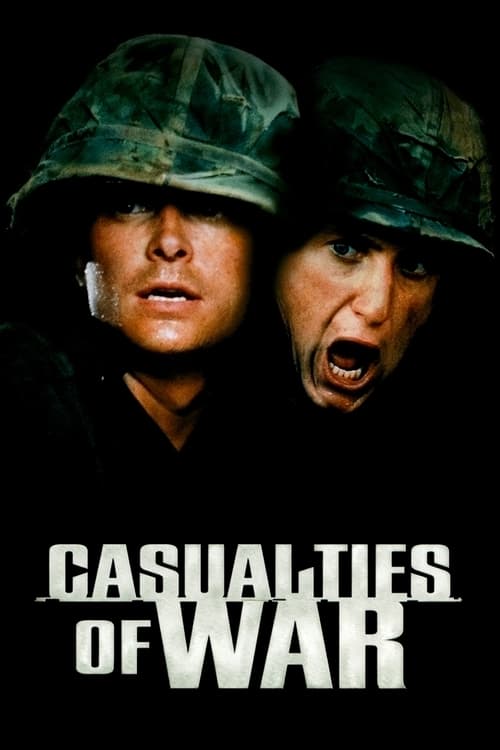
Casualties of War
1989 · Brian De Palma
When you're ready for a serious, upsetting film about conscience — the kind you watch to be confronted, not entertained. Save it for a night you can give it your full attention; this is challenge, not comfort.
What it's about
On patrol in Vietnam, a sergeant orders his squad to kidnap a young village woman, and one private refuses to take part. The film follows that soldier — outnumbered, threatened, and increasingly alone inside his own unit — as the crime unfolds and he has to decide what refusing actually requires of him, first in the jungle and then in front of the military justice system. It's drawn from a real 1966 atrocity, first reported in a famous piece of magazine journalism.
The experience
Harrowing and morally suffocating — the dread comes not from combat but from watching a group of ordinary men talk themselves into evil while one man's objections count for nothing. It's a hard sit, deliberately, and it stays with you.
Performances
Michael J. Fox, cast radically against type, makes decency look difficult rather than easy — his powerlessness is the film's engine. Sean Penn is frightening as the sergeant, all charisma curdling into brutality, one of his most ferocious early performances.
The craft
De Palma turns his signature tools — the long sustained set piece, the camera that makes you a helpless witness — toward moral horror instead of thriller mechanics, and the tension is excruciating. Ennio Morricone's mournful score gives the film its grieving conscience.
Why it matters
Arriving at the end of the 1980s wave of Vietnam films, it stands as one of the most unflinching American movies about war crimes and the cost of speaking up — and as the dramatic proof of what its two stars could do outside their comfort zones.
Snapshot
Casualties of War is Brian De Palma's dramatization of a true atrocity: the 1966 abduction, rape, and murder of a young Vietnamese woman by an American reconnaissance patrol, and the lone soldier who refused to take part and then fought to have the killers prosecuted. Adapted by playwright David Rabe from Daniel Lang's 1969 New Yorker account, the film stars Michael J. Fox as Pfc. Max Eriksson, the conscience of the squad, and Sean Penn as Sgt. Tony Meserve, the charismatic and disintegrating leader who orders the crime. It arrived at the exhausted tail of the 1980s Vietnam-film cycle, two years after De Palma's commercial triumph with The Untouchables, and represents his most sustained attempt to bend his signature style — voyeurism, the helpless witness, the elaborately sustained set piece — toward a work of moral gravity rather than genre pleasure. Championed fiercely by a handful of critics and dismissed by others as an uneasy marriage of aesthete and atrocity, it remains one of the most morally direct films in a career built on ambivalence.
Industry & production
The project was a passion of long standing for De Palma, who had known Lang's material for years before Columbia Pictures financed it. Producer Art Linson, who had worked with De Palma on The Untouchables, shepherded the picture; David Rabe — a Vietnam veteran and the author of stage works including Sticks and Bones and Streamers — wrote the screenplay, lending the material the authority of firsthand experience with the war's dislocations. The film was made in the wake of The Untouchables' success, which gave De Palma the standing to mount a large, difficult studio production on a grim subject with no promise of return.
Principal photography took place largely in Thailand, standing in for the Vietnamese highlands, a common practice for the period's war films. The production was reportedly arduous, and accounts have long circulated of friction between Rabe and De Palma over the script and its resolution; Rabe was said to be unhappy with aspects of the finished film, though the precise terms of that dispute belong more to production lore than to the settled record, and I flag it as such rather than overstate it. The picture opened in August 1989. It was not a commercial success — it landed in a marketplace that had arguably absorbed all the Vietnam reckoning it wanted after Platoon and Full Metal Jacket — but I will not attach specific box-office figures here, as I cannot verify them precisely.
Technology
The film was shot on 35mm in Panavision anamorphic, yielding the wide 2.39:1 frame that De Palma and cinematographer Stephen H. Burum favored across their collaborations. The anamorphic format is not incidental to the film's meaning: the elongated frame allows De Palma to hold the isolated Eriksson at one edge of the image while the squad's collective menace fills the rest, staging moral separation as spatial fact. This is a late-1980s studio production using the mature tools of that era — Steadicam for the film's celebrated moving long takes, conventional optical effects, and no digital intervention. Its technical ambition lies not in novel apparatus but in the orchestration of camera movement, depth, and scale within a classical photochemical toolkit.
Technique
Cinematography
Stephen H. Burum's photography is among the film's chief distinctions. The jungle exteriors are rendered in humid, desaturated greens and enveloping mist, a landscape that seems to swallow the patrol. Burum and De Palma build the film around deep-focus compositions and extended, gliding camera moves that keep the whole squad legible within a single frame, so that complicity and refusal are visible simultaneously. The film's most discussed sequence — the killing of the captured woman, Oanh, on a railway trestle — is staged in high, distancing wide shots that render the murder as a small, terrible event dwarfed by indifferent terrain, refusing the close-up's false intimacy. An early tunnel sequence, in which Eriksson nearly falls into a Viet Cong hole and is hauled to safety by Meserve, is shot for vertiginous physical danger, establishing the life-debt that will later complicate Eriksson's dissent.
Editing
Bill Pankow, De Palma's editor of the period, cuts the film for suspense as much as for drama — a De Palma signature applied to moral rather than criminal stakes. The long central abduction and its aftermath are built as an extended tightening of tension, the audience made to wait and watch alongside the powerless Eriksson. The framing device — a subway-car prologue and coda set years later in the United States — bookends the war narrative, so that the entire atrocity is delivered as memory, an interior reckoning returning unbidden. The rhythm alternates between held, dread-laden duration and sudden violence, a structure that implicates the viewer in the act of looking and failing to intervene.
Mise-en-scène / staging
De Palma stages the film as a study in encirclement. The squad is repeatedly arranged so that Eriksson stands apart — physically at the margin of the group, framed against or outside it — dramatizing the crushing lateral pressure of the small unit, where refusal to join is read as betrayal. The captured woman is positioned at the center of the men's gaze, the object of a collective and coercive looking that De Palma, the great cinematic anatomist of voyeurism, understands with uncomfortable precision. The hooch, the trestle, the river crossing: each location is composed to isolate the moral actor within the group's geometry.
Sound
Ennio Morricone's score is one of the film's defining elements — elegiac, keening, built around plaintive woodwind and vocal lines that lend the horror an almost liturgical mournfulness. The music does not underscore action so much as grieve over it, pulling the film toward requiem. Against this, the sound design of the jungle — insects, water, the flat report of gunfire across open ground in the trestle sequence — grounds the film in physical dread. The contrast between Morricone's lament and the war's ambient reality is central to the film's tone.
Performance
Sean Penn's Meserve is a portrait of authority curdling into brutality: magnetic, funny, and then monstrous, a leader whose competence and care for his men make his descent more disturbing rather than less. Michael J. Fox, cast against his established comic-boyish persona, plays Eriksson as a figure of stubborn, unglamorous decency — a performance that risks blandness by design, since Eriksson's virtue is precisely that he is ordinary. The supporting squad is vividly drawn: Don Harvey as the vicious Clark, John C. Reilly in an early screen role as Hatcher, and John Leguizamo as Diaz, whose collapse under peer pressure is the film's most painful study of ordinary weakness. Thuy Thu Le, as the victim Oanh, is given a role of near-unbearable exposure, her suffering the film's moral center of gravity.
Narrative & dramatic mode
The film operates as a moral tragedy framed as recovered memory. Its dramatic engine is not whether the crime will occur — the audience knows it will — but whether anyone will refuse, and what refusal costs. The structure is that of the bystander drama pushed to its limit: Eriksson's dissent is met not with support but with threat, and the film's back half becomes a procedural of conscience, as he pushes a reluctant chain of command toward court-martial against institutional pressure to bury the incident. The subway framing converts the whole into confession and, finally, a dream of absolution: in the coda, a young Vietnamese-American woman returns a dropped scarf to the older Eriksson, an oneiric gesture of forgiveness that has divided viewers between finding it consoling and finding it too neat. The mode throughout is realist in texture but heightened, even operatic, in De Palma's staging.
Genre & cycle
Casualties of War belongs to the American Vietnam War film and, more specifically, to the concentrated late-1980s cycle that included Oliver Stone's Platoon (1986), Stanley Kubrick's Full Metal Jacket (1987), John Irvin's Hamburger Hill (1987), and, the same year as De Palma's film, Stone's Born on the Fourth of July (1989). Within that cycle it occupies a distinct niche: where Platoon dramatizes a soldier's soul as a battleground and Full Metal Jacket anatomizes dehumanization as system, Casualties narrows to a single atrocity and a single question of complicity, closer to the moral-witness drama than to the combat film. It shares DNA with the courtroom-and-conscience tradition as much as with the war picture — a film about testimony as much as battle.
Authorship & method
The film is, paradoxically, both an outlier in De Palma's filmography and its most naked statement of theme. His career is obsessed with the witness who sees and cannot act — the impotent watcher of Blow Out, the voyeurs of Sisters and Body Double — and with the moral and erotic charge of looking. Casualties of War strips that preoccupation of genre alibi and states it plainly: Eriksson is the De Palma witness in extremis, made to watch an atrocity he is powerless to stop, his gaze the film's conscience and its accusation. Detractors have argued that De Palma's virtuoso style sits uneasily on such material — that the elegance aestheticizes suffering — while admirers counter that the tension between beauty and horror is exactly the point, forcing the viewer to confront the seduction of spectatorship.
His collaborators are essential to the achievement. Stephen H. Burum, De Palma's cinematographer across much of the 1980s and beyond, supplies the deep, mournful anamorphic images. Ennio Morricone, one of the cinema's supreme composers, contributes a score of grieving lyricism. Bill Pankow cuts for the director's characteristic suspense architecture. And David Rabe's screenplay grounds the moral drama in a veteran-playwright's understanding of how institutions absorb and normalize atrocity. The film is genuinely a meeting of major authorial voices, not a single sensibility.
Movement / national cinema
De Palma is a member of the "New Hollywood" generation — the film-school-literate "Movie Brats" who reshaped American cinema in the 1970s alongside Scorsese, Coppola, Spielberg, and Lucas. By 1989 that generation had largely moved into the mainstream studio system, and Casualties of War is a product of that maturation: a big-studio picture made with auteurist ambition on a subject the industry generally shunned. It is American national cinema working through a national trauma, part of Hollywood's decade-long, belated attempt to represent the Vietnam War to a domestic audience that had lived it.
Era / period
Made in 1988–89 and released fourteen years after the fall of Saigon, the film sits at the close of the Reagan era and the dusk of the Vietnam-film cycle. By this point American cinema had shifted from the war's early cathartic and revisionist treatments toward more explicitly moral and historical reckonings — a movement the same-year release of Born on the Fourth of July also marks. Casualties participates in this later, more sober phase, less interested in combat spectacle than in guilt, testimony, and the question of what the war made ordinary men capable of.
Themes
The film's governing theme is moral complicity under group pressure: the way the small unit, isolated and afraid, generates its own coercive logic in which decency becomes the deviant act. It is a study of the bystander — of seeing and the guilt of insufficient action — rendered with the intensity of De Palma's lifelong fascination with the gaze. It examines the dehumanization intrinsic to the war: the reduction of a person to an object of appetite and disposal, dramatized through the squad's treatment of Oanh. Adjacent to this runs an anatomy of masculinity and authority, embodied in Meserve, whose leadership and violence are inseparable. And finally the film is about testimony and its cost — the institutional reluctance to acknowledge atrocity, and the lonely, unrewarded labor of the person who insists it be named. The subway coda extends these into the register of memory and the possibility, or fantasy, of absolution.
Reception, canon & influence
Critical reception was sharply divided, and the film's afterlife has been shaped by that division. Its most consequential champion was Pauline Kael in The New Yorker, who praised it in extraordinarily strong terms and helped secure its reputation as a serious work; I characterize her advocacy rather than quote it, to avoid misattributing specific wording. Other critics admired the craft while questioning whether De Palma's stylistic bravura was appropriate to the subject, and the film's commercial failure meant it reached a smaller audience than the cycle's hits. Over time it has been reassessed as one of De Palma's major achievements and one of the more unflinching American treatments of wartime atrocity.
Its influences run backward to Daniel Lang's original reportage and to the broader tradition of the moral-witness war narrative, as well as to De Palma's own recurring figure of the powerless watcher. Looking forward, it holds a notable place in several careers: it offered early screen roles to John C. Reilly and John Leguizamo, both of whom became significant actors, and it stands as a landmark in Sean Penn's development into one of his generation's most intense performers. More broadly, it endures as a reference point for films about complicity and the ethics of the bystander in war, and as the clearest demonstration that De Palma's cinema of the gaze could be turned to a purpose of genuine moral seriousness. Where the historical record on the film's reception and production is thin or contested, I have said so rather than fill the gaps.
A Deleuzian reading
A woman is killed on a railway trestle, and the camera is nowhere near her.
The full Deleuzian reading of Casualties of War →
Reception
A box-office flop in 1989 — arriving late in the post-Platoon Vietnam cycle, audiences stayed away despite Pauline Kael's famous rave — it's since been reappraised as one of De Palma's masterpieces and a fixture in 'great Vietnam War film' conversations.
How Casualties of War was received, from release to now →
Influences: the films it descends from and the films it influenced
- Rear Window (1954) — Establishes the paralyzed voyeur who witnesses a crime he cannot stop and whose looking becomes his guilt — the exact structure of Eriksson's forced gaze that De Palma inherits and de-genres here.
- Vertigo (1958) — Codifies the subjective, eroticized-yet-guilty camera and the moral charge of looking that is De Palma's lifelong grammar, turned in Casualties from erotic obsession to atrocity.
- Paths of Glory (1957) — Models the military institution that scapegoats the just man and normalizes killing, staged in deep-focus tracking shots through ranks — the institutional-complicity spine Rabe's screenplay reworks.
- The Deer Hunter (1978) — Frames Vietnam as a moral ordeal witnessed helplessly by a comrade, founding the cycle's squad-level drama of watching a friend destroyed by the war.
- Apocalypse Now (1979) — Sets the cycle's anamorphic, richly-graded jungle imagery married to a narrative of moral descent — the formal benchmark Burum's mournful widescreen answers.
- Platoon (1986) — Splits the platoon into good/evil poles with the fresh recruit as its conscience — the immediate late-80s-cycle predecessor whose moral-battle structure Casualties intensifies to a single atrocity.
- Blow Out (1981) — De Palma's own impotent witness — a man who captures evidence of a crime he cannot undo — the self-ancestor whose voyeur-conscience is stripped of thriller alibi in Casualties.
- Body Double (1984) — Pairs Burum's anamorphic voyeur set-pieces with the theme of a helpless watcher of murder, making explicit the seduction-of-spectatorship that Casualties weaponizes morally.
- The Untouchables (1987) — The immediate prior assembly of the same team — Burum's deep-focus anamorphic, a Morricone score, and Steadicam-built suspense architecture — carried directly into Casualties two years later.
- Once Upon a Time in America (1984) — Morricone's grieving, lyrical elegy laid over male violence and memory is the exact scoring method — mournful beauty against brutality — he brings to Casualties.
- Breaker Morant (1980) — Carries forward the post-Vietnam skepticism about military justice and atrocity, structuring its reckoning around one soldier's attempt to hold others accountable within a system disinclined to convict its own.
- Redacted (2007) — De Palma's explicit return to the identical event — a squad's rape-murder and a bystander's failure to stop it — restaging Casualties' witness structure through mediated, camera-within-camera images.
- The Thin Red Line (1998) — Extends the wide-shot distancing and contemplative moral-witness stance amid combat, dilating Casualties' encircling, elegiac staging into a philosophy of the observing eye.
- Elephant (2003) — Trails figures toward atrocity in roving Steadicam long takes, extending the bystander drama and encirclement of the gaze into a formal system of drifting, complicit observation.
- In the Valley of Elah (2007) — Investigates soldiers' atrocity and homefront complicity through a witness who must reconstruct what was seen and not stopped — a direct descendant of the moral-witness-in-war narrative.
- Casualties of War: the bystander lineage in later De Palma (2012) — PLACEHOLDER
- Full Metal Jacket (1987) — Depicts the manufacture of the killer and stages atrocity in cold, distanced wide shots — the same cycle-year impulse toward detached, unaestheticized brutality that critics debated in Casualties.
- Streamers (1983) — David Rabe's own barracks drama of institutional violence and Vietnam-era dehumanization; the screenwriter's method of showing atrocity absorbed and normalized by the military carries into his Casualties script.
- Come and See (1985) — Fixes the camera on the face of an innocent forced to witness wartime atrocity, making powerless spectatorship the subject — the same cinema of complicit looking Casualties pursues in a Western key.
Similar films
- Platoon (1986) — influence & lineage
- The Thin Red Line (1998) — influence & lineage
- Apocalypse Now (1979) — influence & lineage
- Full Metal Jacket (1987) — influence & lineage
- The Deer Hunter (1978) — influence & lineage
- Paths of Glory (1957) — influence & lineage
- Blow Out (1981) — influence & lineage
- Saving Private Ryan (1998) — shared sensibility