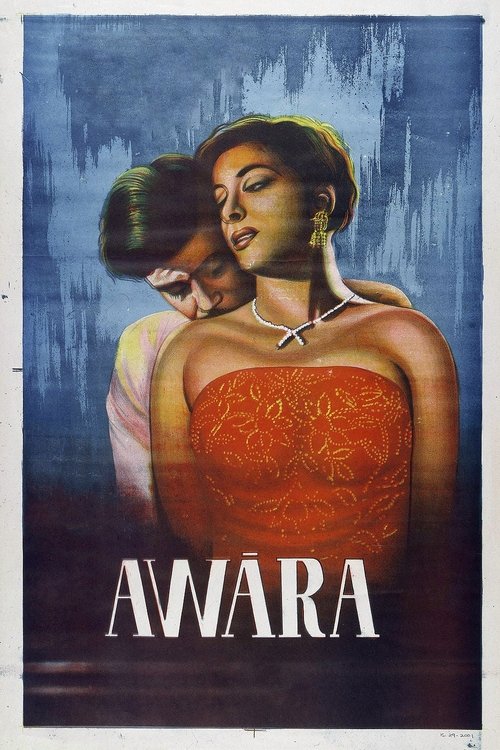
Awaara
1951 · Raj Kapoor
For when you want to surrender to a big, classic melodrama — songs, doomed love, moral reckonings, the works. Perfect for a long evening when you want a film that feels like a whole world.
What it's about
A ragged street thief stands trial for the attempted murder of a distinguished lawyer, and through sweeping flashbacks the film unspools how their lives are secretly entwined — a stern judge who believes criminals are born, not made, an abandoned mother raising a boy in the slums, and a childhood sweetheart who grows up to defend him in court. It's a courtroom melodrama built to demolish one idea: that character runs in the blood.
The experience
Grand, full-hearted, and unashamedly emotional — romance, tragedy, comedy, and show-stopping musical numbers braided into one epic sweep, including a dream sequence of pure spectacle. It aims for the tear ducts and hits them.
Performances
Raj Kapoor, directing and starring at twenty-six, channels a Chaplinesque tramp charm into the vagabond Raj, and his pairing with Nargis produces one of Indian cinema's most iconic romantic partnerships.
The craft
Kapoor stages it with startling ambition for 1951 — expressionist courtroom shadows, a famous extended dream sequence, and Shankar–Jaikishan's song score, whose title number 'Awaara Hoon' became a global earworm. The songs aren't interruptions; they carry the story's emotional argument.
Why it matters
A foundational text of post-Independence Hindi cinema, it made Kapoor an international star with devoted audiences from the Soviet Union to China, and set the template for the socially conscious Bollywood spectacular.
Snapshot
Awaara ("The Vagabond") is the film that made Raj Kapoor an international star and remains one of the foundational texts of post-Independence Hindi cinema. Produced under Kapoor's own R.K. Films banner, directed by and starring the twenty-six-year-old Kapoor, it is a courtroom melodrama built on a single provocative thesis about human nature: whether character is inherited "in the blood" or forged by circumstance. A respected judge, Raghunath, holds that criminals breed criminals; the film sets out to demolish that conviction by revealing that the vagabond thief on trial before an allied court is Raghunath's own abandoned son. Wrapped around this argument are a doomed-and-redeemed romance, a Chaplinesque tramp persona, and a song score by Shankar–Jaikishan whose title number, "Awaara Hoon," traveled farther than almost any Indian film song of its century — into the Soviet Union, China, Turkey and the Middle East. The film is at once an intimate family tragedy, a socialist parable about poverty and class, and a lavish studio spectacle, and its reconciliation of those registers is a large part of why it endures.
Industry & production
Awaara was a family enterprise in the most literal sense. Raj Kapoor produced it through R.K. Films, the studio he had founded in 1948 (his second feature after Aag), directed it, and played the lead. His father Prithviraj Kapoor, the towering stage and screen actor and founder of Prithvi Theatres, played Judge Raghunath — so a real father and son enacted an estranged father and son on screen, a piece of casting whose resonance contemporary audiences read clearly. Kapoor's younger brother Shashi Kapoor appeared as the young Raju, extending the dynastic layering. Opposite Kapoor was Nargis as Rita, in what was already an established and much-discussed off-screen and on-screen partnership; their pairing across the R.K. films of this period became one of the defining star chemistries of the era.
The production came out of the Bombay studio system at a transitional moment, as the old studio-contract model gave way to the star-and-financier arrangements that would dominate the 1950s. R.K. Films operated as a tightly knit repertory of collaborators — writer, composers, lyricists, cinematographer and art director recurring across pictures — which lent the studio's output a consistent authorial signature. Awaara was a large, resource-intensive production for its time, most conspicuously in its extended dream sequence, widely described in film histories as one of the most elaborate and costly set-pieces yet mounted in Indian cinema. Precise budget figures are not reliably documented and I will not invent them, but the scale of that sequence alone signals a production willing to gamble heavily on spectacle.
Technology
Awaara was made in black-and-white, on 35mm, with optical sound, entirely within the conventions of early-1950s Indian studio production. It predates the widespread adoption of color and widescreen in Hindi cinema by several years. Its most consequential "technology" is arguably the mature playback-singing system: songs were pre-recorded by professional singers — here Mukesh voicing Kapoor and Lata Mangeshkar voicing Nargis — and mimed on set, an infrastructure that by 1951 was fully established and central to the film's commercial machinery. The dream sequence depended on studio-bound resources of the period: large constructed sets, extensive artificial lighting, in-camera and optical effects, superimposition and elaborate crane and dolly work. Nothing about the film reaches beyond the era's available tools; its ambition lies in deploying them at unusual scale.
Technique
Cinematography
The cinematography is credited to Radhu Karmakar, a long-standing R.K. collaborator, and it moves fluently between two visual worlds. The realist strand — the slums, the rain, the pavements where the disowned mother and child survive — favours high-contrast, low-key lighting and grimed textures consonant with the socially conscious cinema of the moment. Against this sits the expressionist theatricality of the dream sequence, with its sculpted pools of light, deep shadow and vertical staging. Karmakar's camera is mobile where the drama demands it and composed and frontal in the courtroom, and the film's chiaroscuro — faces half in darkness, figures isolated against black — carries much of its moral argument about the light and dark in a single inherited nature.
Editing
Editing is credited to G.G. Mayekar. The film's architecture is a courtroom frame enclosing extended flashbacks, so the cutting must manage a non-linear structure — moving between the trial's present and the buried past of Raghunath's marriage, his wife's expulsion, and Raju's childhood — while keeping the melodramatic through-line legible. The transitions into and out of the dream are among the most deliberately marked cuts in the picture, sealing the fantasy off as a distinct register.
Mise-en-scène / staging
Art direction by M.R. Achrekar is central to the film's identity. The contrast between the judge's ordered bourgeois home and the chaotic, waterlogged slum is staged as a spatial thesis about class. The dream sequence — organized around a vast spiral staircase, celestial and infernal zones, clouds, smoke and the descent and ascent of figures — is the film's design showpiece and one of the most reproduced images in Indian film history. Kapoor's staging throughout leans on strong theatrical tableaux, inherited in part from the Prithvi Theatres tradition his father embodied, and on the tramp's physical comedy in the streets.
Sound
The sound design is organized, as in most Hindi cinema of the period, around the song sequences. The score punctuates and comments on the drama, and diegetic street sound gives the realist passages their texture. The recording is of its era's optical-track quality. The film's aural signature is inseparable from its music, discussed below.
Performance
Prithviraj Kapoor gives Raghunath a granite, patriarchal authority that makes the character's rigidity tragic rather than merely villainous. Raj Kapoor's performance fuses two traditions: the pathos-and-pratfall of the Chaplin tramp and the wounded intensity of Hindi social melodrama, and his ability to hold comedy and grief in the same body is the engine of the film's sympathy. Nargis plays Rita with a modern poise — she is a lawyer and the judge's ward — that offsets the men's fatalism. K.N. Singh's Jagga, the bandit whose revenge sets the tragedy in motion, and Leela Chitnis as the cast-out mother anchor the supporting drama. The child performance of Shashi Kapoor as young Raju is essential to the film's emotional economy.
Narrative & dramatic mode
The dramatic mode is full-throated social melodrama, structured as a trial-and-flashback. Judge Raghunath, convinced that lineage determines character, sentences the bandit Jagga on the logic that a criminal's son is himself criminal. Jagga's revenge is to abduct and return Raghunath's pregnant wife; Raghunath, poisoned by the same hereditary suspicion, casts her out on the doubt that the unborn child is not his. She bears their son Raju in poverty, and the boy, ground down by circumstance and drawn into Jagga's orbit, becomes the petty thief the film opens on. The irony is exact: the judge's own son becomes the criminal the judge's theory predicts — but for reasons of environment, not blood, which refutes the theory even as it seems to confirm it. Rita, Raju's childhood sweetheart and now the judge's ward, becomes his defender. The courtroom is thus literally the arena in which nature and nurture are argued, and the melodrama's coincidences are not incidental but the vehicle of its ideas.
Genre & cycle
Awaara belongs to the socially conscious melodrama that dominated Hindi cinema's early-1950s "golden age," a cycle preoccupied with poverty, class injustice and the moral drama of Independence-era nation-building. It sits alongside Kapoor's own run of R.K. socials and the broader body of work by figures like Bimal Roy and Mehboob Khan. Within that cycle it is distinguished by its integration of Hollywood-style star comedy (the tramp) and by the sheer scale of its fantasy interlude, which pulls it toward spectacle in a way that purer realist works of the period avoided. It is also a founding entry in the Raj Kapoor "vagabond/innocent" persona cycle that his subsequent films extended.
Authorship & method
Awaara is a strong instance of studio-auteur authorship exercised through a stable creative repertory. Raj Kapoor's method combined a showman's instinct for spectacle and song with a genuine engagement, filtered through his collaborators, in social themes.
The screenplay is the work of Khwaja Ahmad Abbas, the writer, journalist and filmmaker whose progressive, IPTA-adjacent sensibility supplied the social and ideological backbone of several key R.K. films; the nature-versus-nurture argument and the sympathy for the dispossessed bear his imprint. (Additional writing credits are sometimes noted alongside Abbas; I will not assert specific apportionment beyond his central authorship of the story and script.)
The music is by the composing duo Shankar–Jaikishan, with lyrics by Shailendra and Hasrat Jaipuri — the core R.K. song team. Their score is not ornament but structure: "Awaara Hoon," sung by Mukesh, crystallizes the hero's identity; "Ghar Aaya Mera Pardesi" (Lata Mangeshkar) drives the dream; "Dum Bhar Jo Udhar Munh Phere" gives the romance its lyric high point.
Radhu Karmakar (cinematography), M.R. Achrekar (art direction) and G.G. Mayekar (editing) complete the recurring technical nucleus. The consistency of this team across R.K. productions is a large part of what gives Kapoor's cinema its coherent voice.
Movement / national cinema
The film is a keystone of the Hindi cinema of the early Nehruvian period, when the industry was negotiating between commercial entertainment and the social-reformist idealism of a newly independent nation. Through Abbas's involvement it connects to the leftist cultural currents of the Indian People's Theatre Association (IPTA) and Progressive Writers' movement, whose concern with class and poverty runs through the script. At the same time it is unmistakably Bombay commercial cinema, committed to stars, songs and spectacle. Awaara's particular historical importance is that it carried this national cinema abroad: it became, alongside its title song, one of the first Indian films to achieve genuine mass popularity outside South Asia, especially across the Soviet bloc.
Era / period
Released in 1951, four years after Independence and Partition, Awaara speaks directly to its moment. Its preoccupation with the fate of the poor, the justice or injustice of inherited social position, and the possibility of individual redemption maps onto the aspirations and anxieties of a young republic. The Chaplin-derived tramp — the little man against an indifferent order — was a figure with wide resonance in a period of economic hardship, and the film's sympathy for the slum-dwelling outsider aligns with the era's reformist rhetoric. It is very much a document of the immediate post-1947 decade.
Themes
The governing theme is nature versus nurture — whether criminality and virtue are heritable or produced by circumstance — argued explicitly and resolved in favour of environment. Braided into it are class and poverty (the slum against the bourgeois home), the injustice of a legal and social order that condemns the poor while congratulating itself on its rectitude, and paternal authority and its failure: Raghunath's pride destroys his family and manufactures the very criminal he despises. There is a strong current of redemption and the possibility of moral change, embodied in Rita's faith in Raju against his own fatalism. The tramp persona carries a theme of dignity in destitution, the innocent outsider whose goodness survives degradation. The dream sequence dramatizes the internal war between these poles as literal heaven and hell.
Reception, canon & influence
Contemporary reception in India was enormous; Awaara was a major commercial success and consolidated Raj Kapoor and Nargis as the era's defining screen couple. Its most remarkable reception, however, was international. The film and "Awaara Hoon" became a cultural phenomenon in the Soviet Union, where Raj Kapoor achieved a fame with mass audiences that few foreign stars have matched, and the song circulated widely in China, Turkey and across the Middle East, often transliterated and sung locally for decades. The film was presented in competition at the Cannes Film Festival in 1953, an early instance of Indian popular cinema on the international festival stage. It is routinely included in retrospective canons of the greatest Indian films.
Influences on the film (backward): The most visible is Charlie Chaplin, whose Little Tramp shaped Kapoor's screen persona of the innocent vagabond. Hollywood melodrama and courtroom drama inform its structure, and its social realism about slum poverty is often related to the influence of Italian neorealism on Abbas and Kapoor's generation, though Awaara fuses that impulse with studio spectacle rather than adopting neorealist austerity. The nature/nurture debate connects it to a long literary and dramatic tradition; the script's ideological cast reflects the Progressive/IPTA milieu.
Legacy (forward): Awaara established the R.K. Films house style and the Kapoor vagabond archetype that later films in his career elaborated. It helped set the template of the elaborate cinematic dream/fantasy song sequence in Hindi cinema. Its socially engaged melodrama — the wronged, impoverished protagonist set against an unjust order — fed a durable strain in Bombay cinema and anticipated later reworkings of the outsider-hero. Most broadly, it demonstrated that Indian popular cinema could command devoted mass audiences far beyond the subcontinent, making it a landmark not only in Raj Kapoor's authorship but in the global reach of Indian film.
A Deleuzian reading
A courtroom, filmed head-on.
The full Deleuzian reading of Awaara →
Reception
A blockbuster at home in 1951, it then went improbably global — a smash in the Soviet Union, China, Turkey and the Middle East, competing at Cannes in 1953 — and has since settled into the canon as the golden-age Hindi film, the one world-cinema lists reach for first.
How Awaara was received, from release to now →
How to watch Awaara: what to notice on a first viewing
- Watch how often faces slip half into shadow. Radhu Karmakar lights the dramatic scenes in high-contrast chiaroscuro, isolating figures against black so one side of a face often stays lit while the other goes dark. The lighting keeps suggesting two sides pulling at the same person, long before the story explains why.
- Watch the slum's mud and rain against the judge's tidy house. Art director M.R. Achrekar stages a waterlogged, chaotic slum against an ordered bourgeois home, so the two worlds never blur together on screen. The film makes you see class as two physically different worlds before a single line argues about it.
- Watch Raj Kapoor slide from clowning to grief in one scene. Kapoor fuses the Chaplin tramp's pratfalls with the wounded intensity of Hindi melodrama, so comedy and heartbreak share the same body without warning. You're never sure if you should laugh or brace yourself, and that uncertainty is the performance's whole engine.
- Listen for the songs arriving right when dialogue runs out. Shankar-Jaikishan's score doesn't just decorate the story, 'Awaara Hoon' crystallizes who the hero is, and each major number carries feeling the dialogue hasn't stated yet. The songs are doing narrative work, not just providing a break from the plot.
- Notice the story keep jumping back out of the courtroom. The film frames its whole story as a trial, then keeps breaking away into long flashbacks of the past before returning you to the present hearing. You're watching a case be built in pieces, with the past doled out only as the trial needs it.
The whole guide to watching Awaara, with the keys for a rewatch →
Influences: the films it descends from and the films it influenced
- The Kid (1921) — Kapoor built Raju's screen persona — and the RK Films logo posture — directly on Chaplin's Little Tramp, and lifted the foundling-raised-by-a-marginal-guardian premise that drives the nature/nurture case.
- City Lights (1931) — The tramp-in-love mode — comedy folded into pathos so the vagabond can romance a woman above his station — is the template for Raju's courtship of the wealthy Rita.
- The Cabinet of Dr. Caligari (1920) — The 'Ghar Aaya Mera Pardesi' dream sequence borrows German Expressionist practice — M.R. Achrekar's stylized staircases, clouds and looming statuary rendering a psychic interior rather than a real space.
- Bicycle Thieves (1948) — De Sica's neorealist attention to street-level urban destitution is the observational impulse Abbas channeled into Awaara's slum scenes, even as Kapoor wrapped it in studio spectacle.
- Dhoop Chhaon (1935) — Established the playback-singing technique on which Awaara wholly depends — Mukesh voicing Kapoor for 'Awaara Hoon,' Lata for the dream — separating vocal performance from on-camera acting.
- Devdas (1935) — Codified the Indian social-melodrama register — moral suffering, doomed cross-class love, songs as emotional structure — that Awaara inherits and politicizes.
- Aag (1948) — Kapoor's directorial debut assembled the RK repertory — Nargis, Prithviraj, and the studio nucleus — that Awaara consolidated into a house method.
- Barsaat (1949) — Locked in the RK song machinery — Shankar–Jaikishan composing, Shailendra and Hasrat Jaipuri writing, Nargis opposite Kapoor — the exact team whose integrated score structures Awaara.
- Shree 420 (1955) — The immediate elaboration of the Awaara vagabond — the honest innocent corrupted by the city — with 'Mera Joota Hai Japani' extending the Tramp persona and 'Ramaiya Vastavaiya' extending the fantasy song-set.
- Boot Polish (1954) — An RK production scripted from Abbas's progressive sensibility, pushing Awaara's sympathy for the dispossessed into a near-neorealist study of street children.
- Jagte Raho (1956) — Carries the RK innocent-outsider through a single nocturnal city, sustaining the chiaroscuro-lit indictment of a respectable order that fears the poor man.
- Mera Naam Joker (1970) — Kapoor's most explicit self-reckoning with the Chaplinesque clown-vagabond persona Awaara founded, again built on the Shankar–Jaikishan/Shailendra song architecture.
- Deewaar (1975) — Salim–Javed's outlaw-hero, shaped into a criminal by poverty and set against a lawful brother, is the nature/nurture argument of Awaara's Raju-and-Jagga reworked as the Angry Young Man.
- Kabhi Khushi Kabhie Gham (2001) — Establishes the patriarch-as-magistrate blocking K3G reuses — the father seated, elevated and frontal, delivering a verdict on a son whose legitimacy of 'blood' is the case at hand, with the socially unequal beloved as the disqualifying evidence.
- Do Bigha Zamin (1953) — The other pole of the same neorealist moment — Roy takes the class-and-poverty subject Abbas favored toward De Sica's austerity where Kapoor took it toward spectacle.
- Mother India (1957) — Shares Awaara's core engine — the wronged, impoverished protagonist set against an unjust order, resolved through a melodramatic reckoning between parent and outlaw child.
- Pyaasa (1957) — Extends the same craft nexus — the sensitive social outcast, deep-focus chiaroscuro, and songs that voice the hero's identity rather than decorate the plot.
Similar films
- Pyaasa (1957) — influence & lineage
- Pather Panchali (1955) — often watched together
- Sholay (1975) — shared sensibility
- Jab We Met (2007) — shared sensibility
- Dilwale Dulhania Le Jayenge (1995) — shared sensibility
- Lagaan: Once Upon a Time in India (2001) — shared sensibility
- Rang De Basanti (2006) — shared sensibility
- Gangs of Wasseypur - Part 1 (2012) — shared sensibility