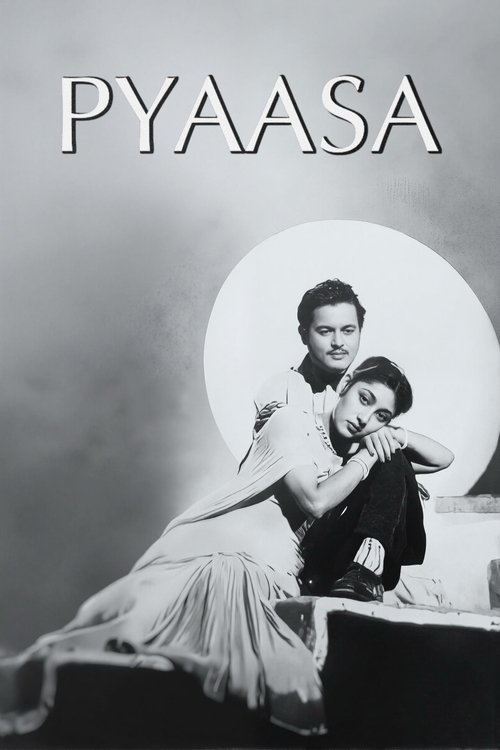
Pyaasa
1957 · Guru Dutt
For when you need to feel something big — heartbreak, righteous anger, tenderness — and want music to do the lifting. A film for a good cry and a long think about what the world does to its dreamers.
What it's about
Vijay is a gifted poet in newly independent India whom nobody wants: publishers reject his verses, his family dismisses him, and the woman he loved has married for money. Destitute on the streets of Calcutta, he finds unexpected kindness from Gulabo, a prostitute who treasures the poems the respectable world throws away — and his fortunes are about to change in a way that will test everything he believes about fame, love, and worth.
The experience
A soaring, sorrowful musical melodrama — the songs carry the emotion the way arias do, and the bitterness at the world's hypocrisy cuts through the romance. It builds to moments of real grandeur; expect to be moved.
Performances
Guru Dutt directs himself as Vijay with wounded, hollow-eyed intensity, and Waheeda Rehman is luminous as Gulabo — her tenderness gives the film its heart. Their scenes together are the reason the film endures.
The craft
V.K. Murthy's high-contrast black-and-white photography sculpts faces and streets out of light and shadow, and S.D. Burman's songs — set to Sahir Ludhianvi's searing Urdu lyrics — aren't interludes but the film's argument. It fuses popular Hindi musical form with genuine social protest, and the imagery deserves the biggest, darkest screen you can find.
Why it matters
One of the towering works of Hindi cinema's golden age, regularly named among the greatest films ever made, and the definitive statement of Guru Dutt's career — its critique of a materialist society has never stopped feeling current.
Snapshot
Pyaasa ("Thirst," or more literally "The Thirsty One") is Guru Dutt's 1957 Hindi-language tragedy of an unrecognized poet, Vijay, adrift in a newly independent India that has no room for him until he is presumed dead. Rejected by publishers, betrayed by a former lover who married for money, and sheltered only by Gulabo, a prostitute who cherishes the verses others discard, Vijay becomes a national sensation once a corpse is mistaken for his. When he returns alive, the world that profits from his martyrdom would rather he stay a legend than a man. Built around the songs of S.D. Burman and the incendiary Urdu verse of Sahir Ludhianvi, and photographed in V.K. Murthy's high-contrast black and white, the film fuses the popular Hindi musical melodrama with a bitter critique of post-independence materialism. It is widely regarded as one of the summits of Indian cinema's 1950s "golden age" and, along with Guru Dutt's own subsequent Kaagaz Ke Phool (1959), the fullest expression of his romantic-tragic authorial voice.
Industry & production
Pyaasa was produced by Guru Dutt Films, the independent production house the director-actor had established after a string of commercial successes (notably the stylish thrillers Baazi, 1951, and Aar Paar, 1954, and the comedy Mr. & Mrs. '55, 1955). Those hits gave Dutt the industrial leverage to mount a far more personal and pessimistic project. By multiple accounts in the biographical literature, the film had a long gestation: Dutt is said to have conceived the story years earlier under a working title along the lines of Kashmakash ("Struggle" / "Conflict"), carrying it as a passion project until his commercial standing allowed it. The specific dating of that early draft should be treated as biographical tradition rather than documented fact.
The film was made within the Bombay studio system of the 1950s, financed and distributed through the standard networks of Hindi commercial cinema and released in 1957. It was a notable success with audiences — an important point, because it demonstrates that a work this melancholic and formally ambitious could still function as mainstream entertainment, largely on the strength of its songs. Precise budget and box-office figures are not reliably documented in the accessible record, and should not be asserted with false precision. What is clear is that Pyaasa's commercial acceptance emboldened Dutt to attempt the even more experimental Kaagaz Ke Phool two years later; that film's failure, and Dutt's death in 1964, retroactively cast Pyaasa as the high-water mark of his career.
Technology
Pyaasa was shot on 35mm black-and-white film in the standard Academy aspect ratio (roughly 1.37:1), using the studio-and-set methods typical of Bombay production at the time. It predates Guru Dutt's own pioneering use of widescreen: Kaagaz Ke Phool (1959) is generally credited as India's first film in CinemaScope, whereas Pyaasa remains resolutely within the classical black-and-white frame. That choice is not merely a limitation of its moment but an aesthetic asset — the film's power depends on the sculptural possibilities of monochrome and controlled studio lighting rather than on spectacle of scale.
The soundtrack was built on the era's playback-singing technology, in which songs were pre-recorded by professional singers and the on-screen performers mimed to them during filming. This industrial division of labor — actor as face, singer as voice — is fundamental to the film's construction, allowing Dutt to choreograph the song sequences as pure visual and emotional set-pieces. Recording was optical, and the musical numbers were designed around the interplay of hard backlight, silhouette, and the mobile camera. Beyond these general observations, granular technical details (specific cameras, stocks, or lighting rigs) are not well documented in the accessible record, and are better left unspecified than invented.
Technique
Cinematography
The cinematography by V.K. Murthy is the film's most celebrated formal element and the foundation of Guru Dutt's mature style. Murthy works in a chiaroscuro idiom often compared to Hollywood film noir and, more distantly, to German Expressionism — pools of hard light carved out of deep shadow, faces half-swallowed by darkness, and dramatic backlighting that turns figures into silhouettes. The approach reaches its apex in the climactic song "Yeh Duniya Agar Mil Bhi Jaaye," where Vijay appears in a doorway, backlit into near-total silhouette with arms slightly outstretched, an unmistakably Christ-like composition. Murthy also exploits the mobile camera expressively: the celebrated crane and tracking movements in the song sequences bind music, lyric, and image into a single sweeping gesture rather than a static illustration of the soundtrack. The collaboration between Dutt and Murthy is one of the signature director-cinematographer partnerships of Indian cinema, and Pyaasa is its defining showcase.
Editing
The film's editing serves its dual register — realist social observation in the dialogue scenes, and heightened lyrical construction in the songs. In the musical sequences, cutting is subordinated to camera movement and lighting, with long, gliding takes preferred over rapid montage, so that the emotional arc of a song unfolds in relatively sustained visual paragraphs. In the dramatic scenes the film follows the classical continuity grammar of 1950s Hindi cinema. The specific editor's credit is not something I can attribute with confidence from the reliable record, so I will not name one; the honest statement is that the montage strategy, whoever executed it, is clearly shaped by Dutt's own priorities as director.
Mise-en-scène / staging
Dutt's staging is the through-line connecting his background in dance to his cinema. Before entering film, he trained at Uday Shankar's dance academy at Almora, and that grounding in movement is legible in how he blocks actors and choreographs the camera around them. Interiors — the publisher's opulent home, the brothel quarter, the cramped spaces of the poor — are dressed and lit to carry the film's thematic opposition between wealth and worth. The recurring motif of thresholds and doorways (Vijay repeatedly framed at the edge of spaces he cannot fully enter) externalizes his social exclusion. The staging of crowds in the final act — the memorial event that curdles into a stampede when the "dead" poet reappears — turns the mise-en-scène into a direct image of a society that prefers its saints safely deceased.
Sound
Sound in Pyaasa is inseparable from its music, but it is worth isolating the way the film uses song as narration rather than interruption. The numbers are not decorative pauses; they carry the protagonist's interior life and the film's argument. Sahir Ludhianvi's lyrics function as the film's moral voice, and the placement of the songs — especially "Jinhe Naaz Hai Hind Par," delivered as Vijay walks through the red-light district — makes the soundtrack an instrument of social critique. Dialogue, credited in the writing to Abrar Alvi, is spare and pointed, and the film often lets silence and ambient tension do work between musical peaks.
Performance
Guru Dutt's own performance as Vijay is defined by restraint and inwardness — a wounded, watchful stillness that lets Sahir's verse and Murthy's light carry the emotional charge. Waheeda Rehman, in an early and star-making role as the prostitute Gulabo, gives the film its tenderness and its conscience; her performance is central to the film's insistence that dignity resides where respectable society refuses to look. Mala Sinha plays Meena, the former beloved who chose security over love, with a complexity that resists simple villainy, and Rehman (the actor) as her publisher husband, Mr. Ghosh, embodies the mercenary world the film indicts. Johnny Walker provides the comic relief typical of the period as the head-massager Abdul Sattar, whose song "Sar Jo Tera Chakraaye" leavens the film's gloom without dissolving it.
Narrative & dramatic mode
Pyaasa operates in the mode of tragic melodrama, but a melodrama sharpened into social indictment. Its dramatic engine is a bitter irony: the poet worth nothing alive becomes worth everything dead. The mistaken-death device — a beggar wearing Vijay's coat is killed and identified as the poet — allows the film to stage a devastating thought experiment, letting Vijay witness his own posthumous canonization and the greed it unleashes among the very people who scorned him. The structure builds toward the great refusal of the finale, in which Vijay rejects not just his exploiters but the entire "world" (duniya) that would claim him, and walks away with Gulabo. The film's dramatic power comes from holding melodramatic feeling and clear-eyed critique in the same frame — sentiment and satire at once.
Genre & cycle
The film belongs to the 1950s Hindi "social" — the socially conscious melodrama that dominated the decade's most ambitious commercial cinema — and it is also, structurally, an integrated musical in which song numbers advance narrative and theme. It sits within a remarkable cycle of films that used the popular musical form to examine post-independence disillusionment and inequality: Raj Kapoor's Awaara (1951) and Shri 420 (1955), and Bimal Roy's Do Bigha Zamin (1953), among others. Within that cycle, Pyaasa is distinguished by its focus on the artist as a figure of social critique and by its unusually despairing tone. It also draws on the older tradition of the doomed, sensitive hero associated with the New Theatres Calcutta melodramas and the Devdas archetype, redirecting that romantic fatalism toward an explicitly political target.
Authorship & method
Pyaasa is the central text of Guru Dutt's authorship, and it is nearly impossible to separate the film from his persona. As director and star he built the work around a semi-autobiographical figure — the artist unrecognized in his lifetime — that would come to seem prophetic. His method was intensely collaborative but unmistakably controlled: he is known for shaping song picturizations shot by shot, treating them as the core of his cinema rather than as ornament. His training in dance under Uday Shankar and his apprenticeship in the Bombay studios (including work as an assistant in the 1940s) fed a style that prized movement, rhythm, and pictorial composition.
The key collaborators are essential to the film's identity. V.K. Murthy (cinematography) supplied the expressionist light that is now synonymous with Dutt's name. S.D. Burman (music direction) composed a score of enduring songs, blending classical and popular idioms. Sahir Ludhianvi (lyrics), a major progressive Urdu poet aligned with the Progressive Writers' Movement, provided verse that functions as the film's political and moral spine — most famously in "Jinhe Naaz Hai Hind Par," which draws on his own poem addressing the exploitation of women in the brothels, turning a love-film's soundtrack into a national reproach. The playback voices — Mohammed Rafi for Vijay, alongside Geeta Dutt and Hemant Kumar — are as much "performances" as anything on screen. Abrar Alvi, Dutt's close writing collaborator, is credited with the dialogue and screenplay work, with the story associated with Dutt himself. The chemistry of this ensemble — director, cinematographer, composer, lyricist, writer — is what makes Pyaasa feel authored rather than assembled.
Movement / national cinema
Pyaasa is a landmark of Indian national cinema and specifically of the Bombay (Hindi) industry's 1950s golden age. It is not a product of a formal avant-garde movement; rather, it exemplifies how India's popular commercial cinema, at its most serious, could absorb the concerns and even some of the visual language of socially engaged filmmaking while remaining a mass entertainment. Its politics connect to the broader progressive cultural current of the period — the Progressive Writers' and allied leftist artistic movements whose sensibility Sahir Ludhianvi carried directly into the lyrics. The film thus stands at the intersection of popular Hindi melodrama and a committed, critical strain of mid-century Indian art, embodying a distinctly national synthesis rather than an imported school.
Era / period
The film is inseparable from its moment: India a decade past independence (1947), in the Nehruvian era of nation-building, when the gap between the republic's ideals and its lived inequalities was becoming impossible to ignore. Pyaasa's anger is the anger of that specific disillusionment — the sense that freedom had not delivered justice, and that a materialist order was smothering both the poor and the artist. The song "Jinhe Naaz Hai Hind Par" ("those who are proud of India") is a direct address to that gap, asking where the nation's pride is when it comes to those it has abandoned. As a period document, the film registers the emotional undertow beneath the optimism of the 1950s.
Themes
The film's governing theme is the incompatibility of art and integrity with a world organized around money. Around it cluster several others: the commodification of everything, including the artist's own death, which becomes more valuable than his life; the hypocrisy of respectable society, contrasted with the moral clarity of the outcast Gulabo; the betrayal of love by ambition, embodied in Meena; and a spiritual, quasi-religious dimension of martyrdom and renunciation, made explicit in the Christ-like framing of the finale and in Vijay's ultimate rejection of the world. Running beneath all of it is a critique of post-independence India's failure toward its most vulnerable — a theme the film delivers not as a lecture but through song, image, and the fate of a single unwanted poet.
Reception, canon & influence
Pyaasa was well received on release and, unusually for so bleak a work, connected with a wide audience — a success owed heavily to its songs, which became and remain classics of Hindi film music. Over subsequent decades its critical standing has only risen, and it is now routinely named among the greatest Indian films ever made. Its international canonization is anchored by its inclusion in TIME magazine's "All-Time 100 Movies" list (2005), which brought it renewed global attention; it has also figured in later international critics' reckonings with world cinema, though the precise details of specific polls should be verified rather than asserted from memory.
Influences on the film (backward): Pyaasa draws on the tragic-romantic hero of the earlier Bengali/New Theatres melodrama tradition and the Devdas archetype of the sensitive man destroyed by an unfeeling world, redirecting that fatalism toward social critique. Its visual language reflects V.K. Murthy's absorption of noir and expressionist lighting, mediated through Hollywood and studio craft. Its politics flow from the Progressive Writers' Movement via Sahir Ludhianvi, and its emotional-musical integration builds on the conventions of the 1950s Hindi social film and Dutt's own earlier work.
Legacy (forward): The film established the template of the "Guru Dutt song picturization" — the emotionally charged, expressively lit, camera-driven musical set-piece — that influenced generations of Hindi filmmakers and remains a reference point for operatic, image-driven melodrama in Indian cinema. Its fusion of popular form with serious critique demonstrated a possibility that later ambitious directors would pursue. Dutt's early death in 1964, and the retrospective reading of Vijay as a self-portrait of the unappreciated artist, deepened the film's mythology and helped canonize it as both a masterwork and a tragic prophecy. Today Pyaasa functions as a keystone of Indian film history — the point at which the Hindi musical melodrama achieved the density and moral weight of major art cinema, without ceasing to sing.
A Deleuzian reading
He stands in a doorway, arms slightly open, backlit until he is nothing but an outline.
The full Deleuzian reading of Pyaasa →
Reception
Unlike the tragic-flop legend that surrounds Guru Dutt, Pyaasa was actually a hit in 1957 — but it climbed from popular success to world-cinema canon decades later, crowned by a place on Time magazine's All-Time 100 Movies list in 2005.
How Pyaasa was received, from release to now →
How to watch Pyaasa: what to notice on a first viewing
- Watch how often Vijay is framed standing at a doorway or threshold. Dutt keeps placing him at the edge of rooms and spaces he cannot fully enter, from publishers' offices to grand interiors. The framing tells you he's shut out before any dialogue explains why.
- Watch faces half-swallowed by shadow throughout the film. Murthy carves pools of hard light out of deep darkness, a chiaroscuro style closer to film noir than to typical Hindi melodrama of its time. The shadow does the work of showing you a world that has no room for Vijay in the light.
- Listen for a song carrying the story instead of pausing it. Sahir Ludhianvi's lyrics voice Vijay's interior life directly, so the musical numbers advance the plot and the argument rather than interrupting them. You can follow the film's whole moral case just by listening to what the songs say.
- Watch Gulabo's face when she reads the poems others threw away. Rehman plays her as the one person who sees value in Vijay's discarded verses before anyone respectable does. Dignity in this film comes from the person society looks down on, not from the ones who claim status.
- Watch Vijay's stillness whenever he's rejected or dismissed. Dutt plays him with a wounded, watchful restraint, letting Murthy's light and Sahir's words carry the feeling instead of his own face doing more. His quiet is doing the emotional work most melodrama would hand to a bigger reaction.
The whole guide to watching Pyaasa, with the keys for a rewatch →
Influences: the films it descends from and the films it influenced
- Devdas (1936) — Supplies the New Theatres tragic-hero template Vijay inherits — the sensitive man passively destroyed by a materialist world — whose fatalist arc Dutt redirects from doomed romance toward social indictment.
- The Cabinet of Dr. Caligari (1920) — Source of the German-expressionist grammar V.K. Murthy absorbed: hard-edged shadow as psychological architecture, which Pyaasa restages in Vijay's descent through darkened staircases and pooled light.
- Sunrise: A Song of Two Humans (1927) — Model for the backlit-silhouette lyric melodrama and the unbroken gliding camera that follows a figure through emotional space — the same fluid tracking Murthy uses to carry Vijay through crowds and thresholds.
- Citizen Kane (1941) — Furnished the low-key chiaroscuro, deep-focus and crane vocabulary — light beamed through smoke, figures dwarfed in cavernous frames — that Murthy channeled into the film's studio noir look.
- Kalpana (1948) — Dutt trained in dance under Shankar; this film's choreographic staging — bodies and camera moving in rhythmic counterpoint — underlies his shot-by-shot 'dance-trained' picturization of songs as blocked movement rather than static performance.
- Awara (1951) — Demonstrated the expressionistically designed, camera-driven song set-piece inside a Hindi social film, proving the integrated musical could carry surreal, high-contrast imagery — the mode Pyaasa refines into 'song-as-narration.'
- Baazi (1951) — Dutt's own noir debut where he and Murthy first built the tracking, moody song picturization and forged the S.D. Burman partnership — the direct workshop for Pyaasa's method.
- Do Bigha Zamin (1953) — Established the Progressive, neorealist-inflected Hindi social film indicting economic exploitation — the political register Sahir Ludhianvi's lyrics push into Pyaasa's 'Jinhe Naaz Hai Hind Par.'
- Kaagaz Ke Phool (1959) — Direct extension of the self-portrait-of-the-unappreciated-artist and Murthy's chiaroscuro, now in CinemaScope — the 'Waqt Ne Kiya' shaft-of-light song is the Pyaasa picturization method perfected.
- Chaudhvin Ka Chand (1960) — Dutt-produced and star-vehicled continuation of the expressively lit song picturization, its title number building the reverent, camera-caressing gaze on the beloved's face codified in Pyaasa.
- Sahib Bibi Aur Ghulam (1962) — Made by Dutt's core team (Alvi writing/directing, Murthy shooting, Dutt starring), it carries the chiaroscuro decay-of-an-order aesthetic and threshold-bound staging straight out of Pyaasa's craft ledger.
- Guide (1965) — Extends song-as-narration and dance-blocked picturization around Waheeda Rehman, letting numbers advance interior transformation rather than pause the plot — the Pyaasa principle made structural.
- Pakeezah (1972) — Inherits the operatic, high-contrast courtesan melodrama and the ghazal picturization as emotional set-piece, staging longing through backlight, veils and doorway thresholds in the Dutt manner.
- Umrao Jaan (1981) — Continues the chiaroscuro courtesan film built on ghazal set-pieces, using expressive lamplight and mirror/doorway framing as the emotional grammar Pyaasa established for the brothel-set song.
- Devdas (2002) — Revives image-driven operatic Hindi melodrama — saturated light, crane-swept song picturizations and the self-destroying artist-lover — proving the density-plus-song ideal Pyaasa first fused remains the reference point.
- Zindagi Na Milegi Dobara (2011) — Weaves recited Urdu verse into narrative as emotional punctuation — the poetry-as-interior-monologue tradition Javed Akhtar's chapter-break poems, spoken in Farhan's voice, descend from.
- Mother India (1957) — Contemporary peak of the integrated Hindi social melodrama, fusing operatic song, moral weight and Nehruvian critique into popular form — the same synthesis Pyaasa achieves in a darker, artist-centered key.
- Shree 420 (1955) — Parallel Nehruvian-disillusionment fable of the honest man corrupted by the city, using song set-pieces as moral commentary — the art-versus-materialism spine Pyaasa shares.
- Pather Panchali (1955) — A contemporaneous Indian counter-model that, like Ray, brought lived-in poverty and social compassion to the screen through expressive available-light cinematography, sharing the post-independence humanist impulse.
- The Cloud-Capped Star (1960) — Integrates the sung number as expressive counterpoint and uses deep-space expressionist lighting for social lament, a Bengali-inflected fusion of song and melodrama running parallel to Ghatak's use of Rabindrasangeet.
- Awaara (1951) — Extends the same craft nexus — the sensitive social outcast, deep-focus chiaroscuro, and songs that voice the hero's identity rather than decorate the plot.
Similar films
- Awaara (1951) — shared sensibility
- Pather Panchali (1955) — shared sensibility
- The World of Apu (1959) — shared sensibility
- The Music Room (1958) — shared sensibility
- The Cloud-Capped Star (1960) — shared sensibility
- Sholay (1975) — shared sensibility
- Aparajito (1956) — shared sensibility
- Charulata (1964) — shared sensibility